

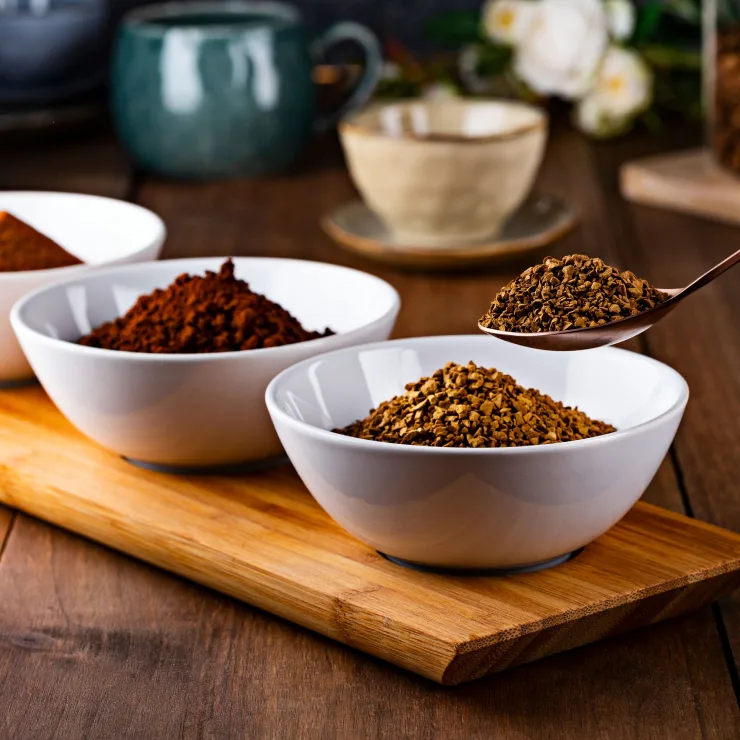
Why Bulk Coffee Powder Is More Than a Commodity in Beverage Manufacturing
You pour thousands of liters of coffee-based beverages daily. To do so reliably, you need more than just “coffee grounds” — you need bulk coffee powder engineered for scale: consistent solubility, predictable flavor, minimal waste, and regulatory robustness. Get the wrong grade or supplier, and your lines choke or your final product drifts in flavor.
In this article, we’ll dig into:
- What “bulk coffee powder” really means (vs retail ground coffee, instant, etc.)
- The unique advantages of sourcing high-grade bulk powder for beverage plants
- Key selection criteria, tradeoffs, and quality pitfalls
- Step-by-step guidance for qualification, scaling, and integration
- Industrial anecdotes and comparison frameworks
- Manufacturing, supply chain, and regulatory caveats at high throughput
- FAQs tailored to factory owners, procurement leads, and production supervisors
We’ll also lightly reference MT Royal as a sourcing partner and mention Latamarko when discussing premium European-grade options. But mostly, you’ll get insight you can bring into your factory’s next sourcing decision.
1. Fundamentals: Defining Bulk Coffee Powder in the Beverage Industry
1.1 Bulk Coffee Powder vs Retail & Instant Forms
When we refer to bulk coffee powder for beverages, we’re usually thinking of:
- Finely ground roasted coffee (not instant) designed for solubility in beverage systems (hot extraction, cold brew, or infusion)
- Supplied in large volumes: metric tons, supersacks, silos, big bags
- Engineered with controlled particle size distribution, moisture, and physical properties
- Intended for further processing: extraction, blending, filtration, or incorporation into ready-to-drink lines
This differs from:
- Retail ground coffee (packaged for consumers)
- Instant coffee (freeze-dried or spray-dried soluble powders)
- Coffee extracts or concentrates
Bulk coffee powder is the raw “engine feed” your plant consumes—so its consistency, physico-chemical stability, and supply reliability are crucial.
1.2 Key properties & performance parameters
When evaluating bulk coffee powder suppliers, you should insist on metrics such as:
- Particle size distribution / uniformity — ensures predictable extraction kinetics
- Moisture / water activity control — key to shelf stability, microbial control, and flavor retention
- Solubility / extraction yield vs reference standard
- Aroma retention, volatile profiles, and flavor drift over storage
- Bulk density, flowability, and packing properties for handling
- Minimal fines / dust / abrasion degradation
- Absence of off-flavors (oxidation, roasting defects, rancid notes)
- Traceability, quality systems, and regulatory compliance
In effect, a good bulk powder is “manufacturing-grade coffee” — not raw commodity, not artisanal retail.
1.3 Market scale & growth trends
The global ground coffee (powder) market is robust, with rising demand driven by beverage consumption, café culture, and packaged coffee growth. Analysts estimate the ground coffee powder market is worth tens of billions, with a projected CAGR of ~5% over the coming decade.
For beverage manufacturers, this means supply pressure, upward cost risk (especially for green coffee beans), and a premium on reliable sourcing and risk management.
2. Why Bulk Coffee Powder Matters to Beverage & Drink Plants
Why should your procurement or operations team treat bulk powder sourcing as a strategic decision? Here’s where the value lies.
2.1 Lower processing overhead & upstream integration
By importing or sourcing quality bulk coffee powder, you shift capital burden upstream—roasting and grinding—onto specialist suppliers. This means less investment in grinders, de-dusting systems, and raw bean handling. Your plant’s role becomes blending, extraction, formula orchestration, and finishing.
2.2 Enhanced consistency and uniformity across lots
Your beverage lines demand consistency: flavor, extraction, clarity, solids content. When bulk coffee powder is tightly specified and tested, variation in downstream output is minimized. That reduces rework, batch rejection, and flavor drift complaints.
2.3 Better cost leverage and volume discounts
At scale, buying bulk powder in metric tons gives you pricing leverage, better freight terms, and more control over ingredient cost per liter. Modest improvements in yield or consistency can yield meaningful margin gains at high volumes.
2.4 Improved supply chain traceability & risk diversification
Reliable bulk suppliers often maintain better traceability, green bean sourcing contracts, commodity hedging, and resilience to disruptions. Having a qualified bulk supplier network (e.g. via MT Royal) reduces your exposure to single-source failures.
2.5 Flexibility for product variation and line expansion
With well-characterized bulk powder, you can more easily spin up new SKUs, adapt roast profiles, or launch variants—without reengineering the base ingredient every time. The upstream supplier manages variation within tight bounds.
3. Common Pitfalls & Misconceptions in Bulk Powder Procurement
Even experienced procurement teams sometimes stumble when dealing with bulk coffee powder. Here are the classic traps.
3.1 “All finely ground coffee is the same” mindset
Treating bulk powder as a commodity is dangerous. Differences in roast, dryness, bean origin, particle size, aroma lock, and physical stability make a huge difference in your process performance. Assume differences and test rigorously.
3.2 Ignoring scale-related effects
What works in a 100-kg trial may behave differently in a 100-ton batch. Segregation, mixing kinetics, thermal gradients, abrasion, and fines generation become real issues. Always pilot or simulate large-scale behavior.
3.3 Overlooking handling, dust, hygiene, and safety
Bulk coffee powder is dusty and can pose explosion and inhalation hazards. If the supplier’s handling introduces fines or non-food residues (lubricants, oils), your downstream filtration and quality systems may struggle.
3.4 Neglecting packaging & storage conditions
Even the best powder can degrade if stored poorly. Oxidation, humidity ingress, aroma loss, or caking may emerge if warehouse or storage conditions are marginal. Insist on high-barrier packaging, inert gas flushing, or desiccant systems.
3.5 Supplier change-control and hidden shifts
Suppliers sometimes change green bean origin, roast curve, or grinding protocols—without notifying customers. That leads to subtle drift in flavor or physical properties. A rigorous change-notification clause and occasional blind retesting are essential.
4. Step-by-Step Guide: Qualifying & Integrating Bulk Coffee Powder Suppliers
Below is a roadmap to bring a new bulk coffee powder into your beverage plant with minimal surprises.
Step 1: Define your specifications precisely
Before engaging suppliers, your R&D, QA, and operations must agree on:
- Target roast and flavor profile (e.g. medium-dark, aromatic, body)
- Particle size distribution (micron spec and % fines)
- Moisture / water activity tolerance
- Solubility / yield expectation
- Aroma retention over shelf periods
- Physical stability over conditions (humidity, temperature)
- Bulk density, flowability, abrasion resistance
- Packaging, shelf-life, residual ash or inert matter limits
- Regulatory compliance (import standards, residue limits)
These specs become your negotiation tool.
Step 2: Shortlist candidate bulk powder suppliers
Using trade networks, roasting associations, commodity brokers, and partners like MT Royal, assemble 3–5 possible suppliers. Request:
- Ingredient specification sheets and COAs over multiple lots
- Sensory panel or roast/flake reports
- Storage / aged-sample data
- Packaging specs
- Reference customers (especially beverage or large-scale users)
- Sampling terms and pilot lot capability
Include at least one “premium-tier” blueprint (say, a Spanish-engineered or Latamarko-style grade) to benchmark best-in-class.
Step 3: Laboratory & bench validation in your matrix
Test candidate powders in your actual beverage matrix (extract solvent, pH, temperature, additives). Evaluate:
- Extraction yield vs target standard
- Clarity / residual suspended solids
- Aroma retention (fresh vs aged)
- Fines / sediment formation
- Off-flavor emergence
- Stability across stress cycles (heat, humidity)
Reject any candidate whose performance drifts beyond your tolerance.
Step 4: Pilot-scale trial & process simulation
In pilot batches (e.g. 1–5% of full scale):
- Assess mixing uniformity, feed-point behavior
- Monitor abrasion, fines generation in handling
- Check dusting and filtration burden
- Simulate packing, oxidation, storage
- Sample across tank zones for consistency
If the supplier does not support pilot troubleshooting, that’s a red flag.
Step 5: Full-scale lot integration & continuous QC
Upon success in pilot, run a controlled lot in full production:
- Set multi-point sampling (inlet, mid, outlet)
- Monitor flavor, yield, clarity, stability
- Store and age segments of the lot for shelf comparison
- Compare results to spec tolerances
Implement ongoing QC sampling (e.g. per container lot) and blind checks.
Step 6: Supplier qualification & backup plan
Once satisfied, formalize:
- On-site audits (GMP, process control, traceability)
- Change-notification clauses and revalidation triggers
- Archive reference sample lots
- Pricing and volume agreements including escalators
- Secondary backup suppliers ready to be activated
We at MT Royal typically assist clients in setting up this governance structure. We also maintain alternate supplier options so your supply chain remains resilient.
5. Trade-Offs & Comparison Framework for Industrial Buyers
To help your internal team compare supplier options, here’s a sample decision framework:
| Metric | Supplier A (Low Cost) | Supplier B (Balanced) | Supplier C (Premium / European-grade) |
|---|---|---|---|
| Price per ton | Lowest | Moderate | Highest |
| Roast & flavor variation | Higher risk | Acceptable | Minimal drift |
| Physical stability (moisture, aroma) | Marginal | Good | Excellent |
| Particle engineering / fines control | Basic | Moderate | Advanced |
| Packaging & barrier integrity | Basic | Mid-tier | Premium (vacuum, inert) |
| Audit & traceability | Basic | Good | Strong / full traceability |
| Pilot support & lab services | Minimal | Moderate | High support |
| Storage robustness | Acceptable | Good | Excellent |
| Best use case | Lower-tier blends | core SKUs | flagship / high-end lines |
This allows you to map cost vs risk and choose strategically. The premium-tier choice may cost more per ton—but if it delivers fewer rejects, more yield consistency, and fewer QC surprises, it often pays back handsomely.

6. Industrial & Manufacturing Considerations at Scale
When operating with bulk volumes, new factors emerge that you must anticipate.
6.1 Dosing, feeding, and metering precision
Bulk coffee powder must be weighed or metered into extraction systems precisely. Variability in bulk density or flowability can result in dose drift. Use:
- Loss-in-weight feeders or gravimetric feeders
- Frequent calibration
- Temperature and humidity compensation
- Controlled environment (dry, stable)
6.2 Hygroscopic behavior & moisture control
Coffee powder is hygroscopic—it absorbs moisture from air. This can lead to caking, flow issues, and quality degradation. Mitigation includes:
- Storing in low-humidity, temperature-stable environments
- Using moisture-barrier bags or liners
- Applying desiccants
- Conditioning new lots (pre-drying if necessary)
6.3 Dust, safety & hygiene
Large-scale powder handling introduces dust and explosion hazards. Precautions:
- Closed transfer systems
- Dust collection / extraction
- Explosion protection (venting, suppressors)
- CIP / cleanability
- Hygiene controls so foreign matter or contamination is avoided
6.4 Segregation & mixing dynamics
Even a well-mixed bulk lot can segregate if handled poorly. In long pipelines, mixing zones, or recirculation loops, you may see fines rising or heavy particles settling. Design flow paths carefully and test for segregation risk.
6.5 Thermal / oxidation stress
As powder sits, oxidation and aroma fade occur. Heat, light exposure, and reactive residual moisture accelerate degradation. Use accelerated aging, package with barriers, and avoid exposing large powder volumes to high temperature zones.
6.6 Regulatory & import compliance
If you’re importing bulk powder, ensure:
- Compliance with pesticide residues, heavy metals, mycotoxin thresholds
- Certificate of origin, COA, lab documentation
- Food-contact compliance during transport
- Quarantine / inspection risk mitigation
- Traceability for audits
A high-quality supplier—especially European or premium grades—will already have compliance documentation ready.
7. Real-World Anecdotes & Manufacturing Lessons
Anecdote: When Fines Choked Filters
One of our clients switched to a lower-cost bulk powder supplier. In short order, their downstream microfilters clogged prematurely, pressure rose, and yields dropped. Investigation revealed the powder had a high fines fraction (very fine particles) that passed the initial lab spec but were not stable under high-shear pump recirculation.
They reverted to the prior supplier and undertook fines screening. That taught them: always test under real shear / pump recirculation to validate fines behavior.
Story: Aroma Fade in Tropical Warehouse
Another plant received a top-tier-looking bulk powder shipment. However, their warehouse lacked humidity control. After just a few weeks, aroma intensity dropped and off-notes emerged. They re-packed early lots into inert gas-sealed intermediate drums and installed dehumidified air systems in storage to maintain freshness.
Lesson: Backup Powder Saves a Campaign
In a peak season, a primary bulk coffee powder supplier’s factory line experienced mechanical downtime. Because the client had already qualified a secondary backup supplier (via MT Royal), they bridged supply for several weeks without halting their beverage line. Competitors without backup plans faced stockouts.
8. Frequently Asked Questions (FAQ) for Factory Owners & Procurement Teams
Q: Is bulk coffee powder suitable for cold-brew or RTD beverage lines?
A: Yes—if the powder is engineered for high solubility and minimal coarse residues. Some powders are optimized for cold infusion or ultrafine suspension. Validate in your cold-line environment.
Q: How much aroma fade should I expect during transport & storage?
A: That depends on packaging, temperature, and moisture. Good packaging can limit aroma loss to <10–15% over months. Worst-case, moisture and heat might degrade aroma dramatically. Always ask for pre-shipment and post-arrival aroma assessments.
Q: How often should I revalidate a bulk powder supplier?
A: At minimum annually or after any material change. Also re-test when any drift or consumer feedback indicates a shift. Blind checks, sensory panel comparisons, and chemical testing are key.
Q: Can I blend powders from different batches or suppliers to smooth variation?
A: Yes—many beverage plants employ lot blending to average variations. But only if each lot is characterized and within acceptable spec ranges. One bad lot can contaminate the blend.
Q: What margin buffer should I budget in yield or losses?
A: Many plants include 1–3% overage to account for dust losses, handling loss, or minor degradation. But avoid padding too much—inefficient usage erodes profitability.
Q: Do European or Spanish-quality coffees (like Latamarko-level) provide a meaningful difference?
A: Yes, in some cases. Premium suppliers often have tighter roast curves, better aroma sealing, lower defect rates, and stronger support. We’ve benchmarked European premium powders and seen 5–10% better aroma retention across storage cycles. Use them as internal references when evaluating more “commodity” options.

No comment