

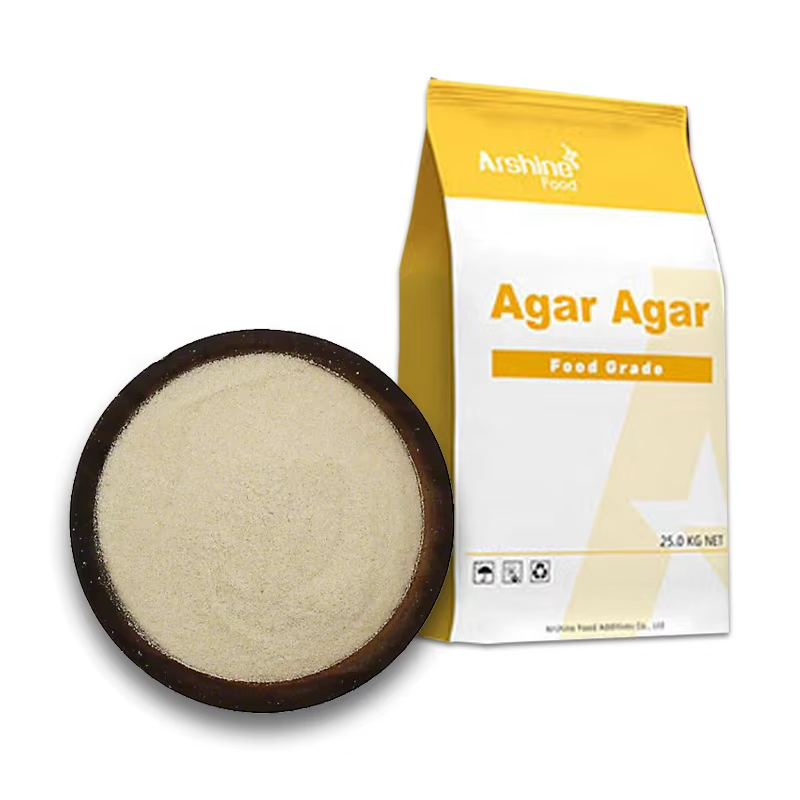
In large-scale food production, consistency, texture, and stability are the cornerstones of operational efficiency. For factories handling confectionery, dairy, bakery, or plant-based products, the choice of stabilizer directly impacts product performance, shelf life, and consumer satisfaction. Selecting the right Stabilizer Agar Agar E406 Bulk is not just a supply decision—it is a strategic investment in your production line’s reliability. Companies like MT Royal provide multi-brand sourcing, technical support, and consistent quality, helping manufacturers maintain smooth operations even under challenging global supply conditions.
Understanding the chemical, functional, and operational properties of agar agar, as well as navigating industrial sourcing pitfalls, can save your factory substantial time and costs. This guide provides in-depth insights, practical checklists, and expert-level advice tailored for R&D teams, procurement managers, and factory operations.
Understanding Stabilizer Agar Agar E406: Definitions and Industrial Relevance
Agar agar, classified as E406, is a polysaccharide extracted from red seaweed species, primarily Gelidium and Gracilaria. It belongs to the hydrocolloid family, widely utilized for its gel-forming, thickening, and stabilizing properties in the food industry.
Key Industrial Functions of Agar Agar E406
- Gel Formation: Produces strong, thermoreversible gels suitable for desserts, confectionery, and plant-based alternatives.
- Stabilization: Maintains suspension in beverages, dairy products, and protein drinks.
- Texture Enhancement: Improves mouthfeel and structural integrity in bakery fillings, puddings, and dairy desserts.
- Moisture Retention: Reduces water loss in processed foods and frozen items, enhancing yield.
- Film Formation: Useful in encapsulation and edible coatings in advanced food processing.
Types and Functional Variants
Agar agar can be categorized based on gel strength and source species:
| Type | Characteristics | Common Applications |
|---|---|---|
| Standard Agar | Firm, brittle gels | Confectionery, jellies, puddings |
| High-Gel Agar | Strong, elastic gels | Industrial desserts, plant-based cheese |
| Refined Agar | Low impurities, consistent performance | Beverages, dairy applications |
Selecting the right type is critical. Using a lower gel strength agar in confectionery can result in sagging or syneresis, while overly strong agar may create undesirable rigidity in desserts.
Why Choosing the Right Stabilizer Agar Agar E406 Bulk Supplier Matters
Sourcing industrial-grade agar agar is complex. Factors such as seaweed origin, extraction technique, particle size, and purity can drastically influence functionality. A reliable exporter ensures:
- Batch-to-batch consistency
- Detailed Certificates of Analysis (COA) and technical datasheets
- Compliance with FDA, EFSA, Halal, and Kosher standards
- Expert guidance on hydration, mixing, and formulation
In our collaboration with various factories, we have seen that even minor deviations in gel strength or sulfate content can interrupt high-speed production lines, making consistent sourcing crucial.
Industrial Applications of Agar Agar E406 Bulk
Confectionery Production
Agar agar creates thermoreversible gels with high clarity and clean flavor. Applications include:
- Gummies, jellies, and fruit gels
- Chocolate fillings and nougat
- Sugar-free and reduced-calorie confections
Industrial Insight: Agar gels remain stable at room temperature for extended periods, reducing refrigeration costs and improving shelf life.
Dairy and Frozen Desserts
Agar stabilizes milk proteins, preventing whey separation in puddings, custards, and ice creams. It enhances mouthfeel without significantly increasing viscosity.
Plant-Based Alternatives
With the rise of vegan products, agar agar replicates dairy textures and stabilizes protein suspensions in:
- Vegan yogurts
- Plant-based cheeses
- Meat analogues
Bakery and Fillings
Agar agar improves structure and moisture retention in fillings, preventing water leakage during baking and freezing.
Beverages and Nutraceuticals
Refined agar is used to suspend particles in fortified drinks or functional beverages, ensuring uniformity and preventing sedimentation.
Common Mistakes in Industrial Sourcing
Even experienced factories encounter pitfalls:
- Price-Driven Selection: Low-cost agar often compromises gel strength and purity, leading to reformulation costs.
- Using Inappropriate Grades: Dairy-grade agar may not perform in confectionery, and high-gel agar can be unsuitable for delicate desserts.
- Ignoring Technical Support: Lack of guidance on hydration, shear, and ion interactions can disrupt production.
- Overlooking Supply Chain Stability: Seasonal variations, climate conditions, and geopolitical factors can interrupt supply.
Practical Checklist for Evaluating Stabilizer Agar Agar E406 Bulk
Ensuring quality agar agar requires a structured approach. Here’s a detailed checklist with explanations for industrial application:
1. Gel Strength Verification
- Explanation: Determines product firmness; essential for desserts and confectionery.
- Action: Check COA against your product specifications and perform in-house gel tests.
2. Viscosity Consistency
- Explanation: Influences pumping, mixing, and mouthfeel in liquid or semi-solid products.
- Action: Conduct multiple batch tests to confirm uniform performance.
3. Particle Size Distribution
- Explanation: Affects hydration rate and dispersion uniformity. Coarse particles may cause lumps.
- Action: Request particle size data and perform dispersion trials in your production environment.
4. Mineral Sensitivity
- Explanation: Agar can interact with calcium or magnesium ions, altering gelation.
- Action: Adjust water hardness and consider formulation synergy with other stabilizers.
5. Purity and Microbiological Standards
- Explanation: Ensures food safety and gel consistency. Low-purity agar may contain residual proteins or minerals.
- Action: Verify HACCP, ISO certifications, and batch microbiological reports.
6. Storage and Shelf-Life Specifications
- Explanation: Exposure to moisture or high humidity reduces functionality.
- Action: Store in temperature- and humidity-controlled environments.
7. Application-Specific Grade Selection
- Explanation: Different grades suit confectionery, dairy, or beverage applications.
- Action: Consult the supplier for grade recommendations.
8. Supply Chain Reliability
- Explanation: Prevents production stoppages due to delayed shipments.
- Action: Review exporter network, lead times, and contingency planning.
9. Technical Support Availability
- Explanation: Guides hydration, mixing, and combination with other hydrocolloids.
- Action: Ensure application guidance and consulting support is available.
10. Regulatory Compliance
- Explanation: Critical for global distribution and export.
- Action: Confirm FDA, EFSA, Halal, Kosher certifications and proper documentation.
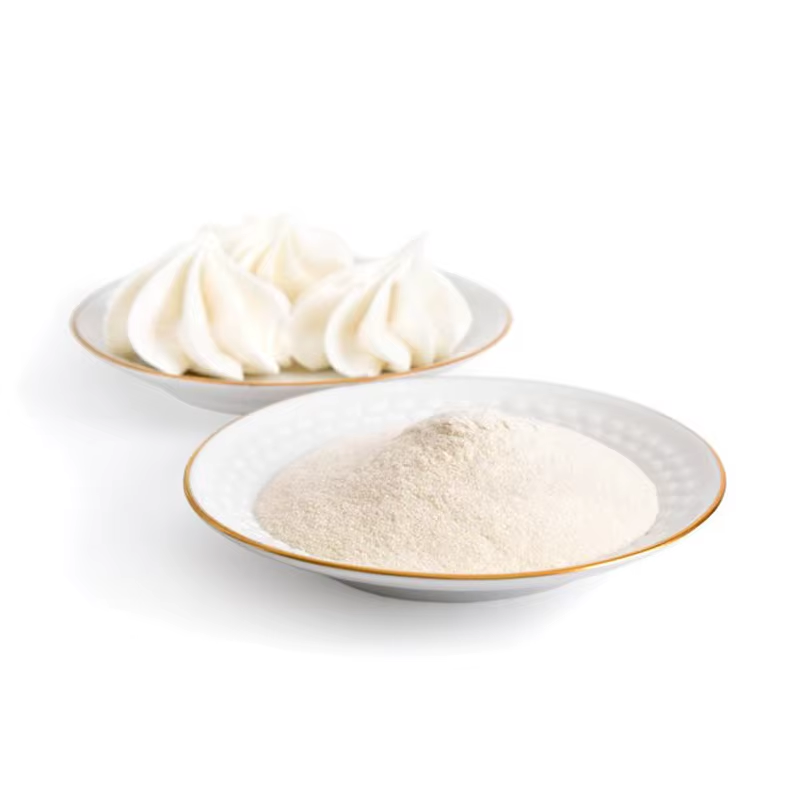
Industrial Tips for Optimizing Agar Agar Performance
Hydration and Temperature Control
Agar must be dissolved at temperatures above 85°C for full hydration. Incomplete hydration reduces gel strength and clarity.
Shear Management
High shear improves dispersion, but excessive shear post-gelation can damage gel structure. Optimize mixer speed and timing.
Synergy with Other Hydrocolloids
Combining agar with locust bean gum, xanthan, or carrageenan enhances gel elasticity, viscosity stability, and mouthfeel.
Water Quality Monitoring
Mineral content and pH can affect gel formation. Regular water testing ensures consistent results.
Storage Considerations
Bulk agar must be kept in moisture-proof, temperature-stable warehouses to prevent clumping and degradation.
Frequently Asked Questions (FAQs)
Q1: How is agar agar E406 different from other hydrocolloids?
A1: Agar forms firm, thermoreversible gels at low concentrations, unlike carrageenan or pectin, which have different gelling mechanisms and ion sensitivities.
Q2: Can agar agar be used in sugar-free or reduced-calorie products?
A2: Yes. Agar can gel without sugar, making it ideal for low-calorie confectionery and jelly products.
Q3: How do I ensure batch-to-batch consistency?
A3: Work with exporters providing COA, gel strength, particle size, and hydration instructions. Perform in-house trials before scaling.
Q4: What are common problems with low-quality agar?
A4: Syneresis, inconsistent gel texture, poor clarity, longer mixing time, and increased dosage requirements.
Q5: How do minerals affect agar gelation?
A5: High calcium or magnesium can interfere with gel strength. Adjust formulation water and consider ionic balance.
Advanced Industrial Insights
Selecting the right Stabilizer Agar Agar E406 Bulk supplier affects not only product quality but also operational efficiency, yield, and cost management. Using high-quality agar reduces downtime, prevents reformulation, and ensures consumer satisfaction. Factories that integrate technical guidance from exporters like MT Royal benefit from multi-brand options, expert consultation, and secure supply chains—even during global logistics challenges.
For production teams, understanding hydration dynamics, mineral interactions, and synergistic hydrocolloid combinations transforms agar from a mere ingredient into a reliable tool for high-performance manufacturing. In our experience working with various factories, those who integrate this technical knowledge see measurable improvements in product consistency, texture, and shelf-life.
Ultimately, sourcing agar agar in bulk is an investment in industrial reliability. By choosing the right type, grade, and exporter, your factory ensures smooth operations, superior product quality, and the agility to adapt to evolving market demands.
LATAMARKO LM60 – Premium Spanish-Origin Cocoa Powder
latamarko alkalized cocoa powder lm60
cocoa powder for chocolate production-Best price
Food industry raw materials – list of products
Types of Gelatin from Turkish Manufacturer
Alkalized Cocoa Powder Price: Complete Buyer Guide for 2026


No comment