


In industrial production, few things are as costly as an unreliable supplier. A delayed shipment, inconsistent quality, or incomplete documentation can disrupt entire production cycles, trigger contractual penalties, or shut down export-oriented operations altogether. This is why selecting the right Industrial Ammonium Bicarbonate Exporter is not simply a procurement decision—it is a strategic move that directly affects operational stability, product quality, and long-term competitiveness.
For manufacturers in food processing, pharmaceuticals, agriculture, chemicals, and technical applications, ammonium bicarbonate is more than a commodity. Its performance, purity, and logistical reliability shape downstream efficiency. At MT Royal, we have worked with factories across multiple regions and industries, and we have repeatedly seen how the right exporter relationship transforms supply chains from reactive to resilient.
This article is written for decision-makers who want clarity, depth, and practical insight. If your factory depends on industrial ammonium bicarbonate—whether for food-grade, feed-grade, or technical use—this guide is designed to answer the questions that truly matter.
Understanding Industrial Ammonium Bicarbonate: Definition and Core Concepts
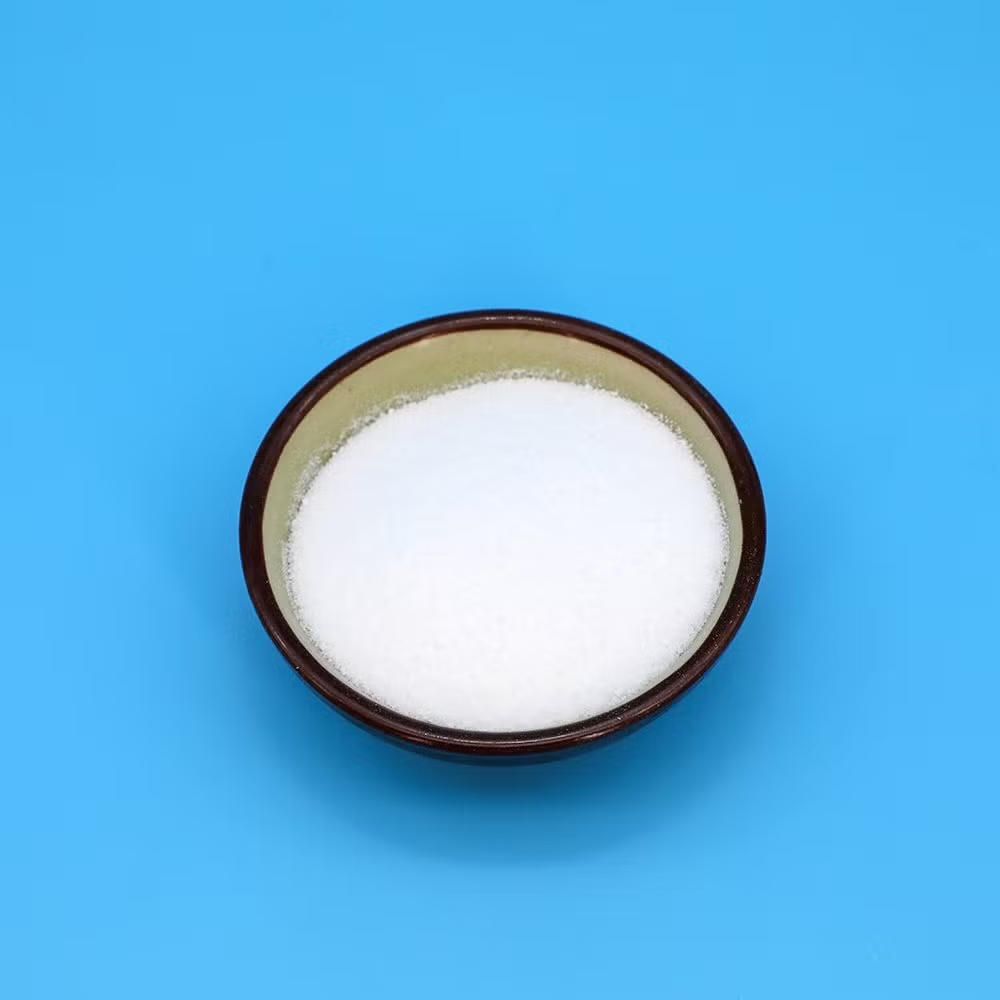
Ammonium bicarbonate (NH₄HCO₃) is an inorganic compound widely used across multiple industrial sectors. It decomposes under heat into ammonia, carbon dioxide, and water vapor, making it particularly valuable in applications where temporary gas generation or chemical reactivity is required.
From an industrial standpoint, ammonium bicarbonate is valued for three core reasons:
- Predictable chemical behavior
- Cost efficiency compared to alternative compounds
- Wide regulatory acceptance when properly specified
However, not all ammonium bicarbonate is created equal. The role of an Industrial Ammonium Bicarbonate Exporter is to ensure that the product delivered matches the exact specifications required for its intended application—without compromise.
Industrial vs Food Grade vs Technical Grade
Understanding grade distinctions is essential when sourcing internationally.
Industrial-grade ammonium bicarbonate is typically used in:
- Fertilizer and agriculture inputs
- Chemical manufacturing
- Textile processing
- Certain controlled industrial food applications
Food-grade material, by contrast, requires stricter purity controls and compliance documentation. Technical-grade variants may tolerate higher impurity thresholds but are unsuitable for regulated environments.
A competent exporter does not merely ship material—they guide buyers toward the correct grade, specification, and compliance framework.
Why Exporter Selection Matters More Than Product Price
In global procurement, price often dominates early negotiations. Yet experienced buyers know that the cheapest offer frequently becomes the most expensive mistake.
An Industrial Ammonium Bicarbonate Exporter influences far more than unit cost:
- Consistency of batch quality
- Packaging integrity during long-distance shipping
- Customs clearance efficiency
- Regulatory acceptance in destination markets
We have seen cases where factories saved a few dollars per ton, only to lose weeks of production due to rejected shipments or inconsistent chemical behavior.
Hidden Costs of the Wrong Export Partner
- Production downtime caused by off-spec material
- Increased QA testing and rework
- Export delays due to missing documentation
- Loss of customer confidence in finished products
These risks explain why experienced manufacturers prioritize exporter reliability over headline pricing.

Key Industries That Depend on Industrial Ammonium Bicarbonate Exporters
Demand for ammonium bicarbonate spans a wide industrial spectrum. Each sector imposes different requirements on exporters.
Food Processing and Baking Industries
In controlled industrial baking and food manufacturing, ammonium bicarbonate is used as a leavening and processing aid. Exporters serving this sector must provide:
- Food-grade certification
- Consistent particle size
- Moisture-controlled packaging
Agriculture and Fertilizer Production
Ammonium bicarbonate is widely used as a nitrogen source and soil amendment. In this context, exporters must focus on:
- Bulk handling capability
- Stable chemical composition
- Cost-efficient logistics
Chemical and Technical Manufacturing
In chemical synthesis, textiles, and specialty processing, performance consistency is critical. Exporters must ensure:
- Defined purity ranges
- Predictable decomposition behavior
- Technical documentation support
An experienced Industrial Ammonium Bicarbonate Exporter understands these distinctions and aligns supply accordingly.
Common Mistakes Companies Make When Sourcing Internationally
Despite its widespread use, ammonium bicarbonate sourcing is often underestimated.
Mistake 1: Treating Ammonium Bicarbonate as a Commodity Only
While chemically simple, ammonium bicarbonate is highly sensitive to storage conditions, humidity, and temperature. Exporters who fail to control these variables deliver degraded product.
Mistake 2: Ignoring Export Documentation and Compliance
Missing COAs, unclear MSDS files, or mismatched HS codes can stop shipments at the border. Reputable exporters manage documentation proactively.
Mistake 3: Overlooking Packaging Standards
Industrial ammonium bicarbonate requires moisture-resistant, properly sealed packaging. Poor packaging leads to decomposition before arrival.
At MT Royal, we have observed that packaging failures alone account for a significant portion of quality complaints in international shipments.
What Defines a Reliable Industrial Ammonium Bicarbonate Exporter?
Not all exporters operate at the same professional level. The best partners share several defining characteristics.
Consistent Quality Across Shipments
Reliable exporters source from stable production facilities and apply batch-level quality controls.
Transparent Specifications
Clear technical data sheets, defined tolerances, and honest communication build trust.
Export Experience Across Multiple Regions
An exporter familiar with different regulatory environments reduces friction for global manufacturers.
Logistics and Lead Time Management
Industrial buyers value predictability. Exporters who manage inventory and shipping schedules professionally become long-term partners rather than transactional vendors.
MT Royal positions itself within this framework, supplying industrial ammonium bicarbonate from multiple approved manufacturers to meet diverse customer needs at competitive pricing.
Comparing Exporters: What Manufacturers Should Evaluate
When comparing potential exporters, factories should look beyond marketing claims.
Practical Evaluation Criteria
- Country of origin and production capacity
- Quality control procedures
- Packaging formats and palletization
- Historical lead times
- Responsiveness to technical inquiries
A comparison table may look appealing, but real evaluation happens through documentation review and sample consistency.
Industrial-Scale Handling and Storage Considerations
Even the best exporter cannot compensate for improper handling after delivery. Industrial ammonium bicarbonate requires controlled conditions throughout the supply chain.
Recommended Industrial Storage Practices
- Cool, dry warehouses
- Minimal exposure to ambient humidity
- Proper ventilation
- FIFO inventory rotation
Exporters who educate buyers on these practices add value beyond the transaction itself.
Supply Chain Trends Affecting Ammonium Bicarbonate Export
Global supply chains have shifted significantly in recent years. Industrial buyers now prioritize resilience over speed alone.
Key trends include:
- Diversification of sourcing regions
- Preference for exporters with multi-origin supply
- Increased demand for documentation transparency
- Tighter quality audits from end customers
An adaptable Industrial Ammonium Bicarbonate Exporter responds to these changes proactively rather than reactively.
Frequently Asked Questions from Procurement Managers
Is industrial ammonium bicarbonate regulated internationally?
Yes. While generally permitted, specifications and usage limits vary by application and region.
How does exporter choice affect product performance?
Inconsistent purity or moisture content can alter chemical behavior in production.
Can one exporter serve multiple industries?
Yes, provided they manage grade separation and documentation properly.
What is the biggest risk in international sourcing?
Logistics and quality inconsistency pose greater risks than price fluctuations.
The Strategic Role of MT Royal in Industrial Supply Chains
MT Royal operates as a supply partner rather than a single-brand distributor. We work with multiple manufacturers and align product selection with each customer’s technical and commercial requirements.
We have seen that factories benefit most when their exporter understands production realities—not just shipping logistics. By combining competitive pricing with technical clarity, MT Royal supports manufacturers seeking stability in volatile global markets.
We believe that long-term supply success comes from alignment, transparency, and shared understanding of industrial priorities.
Why Exporter Relationships Define Long-Term Competitiveness
In industrial manufacturing, materials rarely appear in marketing brochures. Yet they define consistency, efficiency, and reliability at scale. Choosing the right Industrial Ammonium Bicarbonate Exporter is about more than receiving a shipment—it is about securing confidence in every production run.
Factories that invest time in selecting the right export partner reduce risk, improve output consistency, and gain operational flexibility. Those that chase short-term savings often discover hidden costs too late.
The strongest industrial supply chains are built not on transactions, but on trust, technical understanding, and dependable execution—qualities that define a truly professional exporter.
latamarko alkalized cocoa powder lm60
cocoa powder for chocolate production-Best price
Food industry raw materials – list of products
Types of Gelatin from Turkish Manufacturer
Alkalized Cocoa Powder Bulk Supplier

No comment