

When bakery mixers roar to life in Riyadh, Jeddah, or Dammam, a quiet debate often unfolds on the production floor: how do we keep product quality consistent when the Saudi climate itself challenges ingredient performance? The question isn’t just theoretical. For manufacturers who rely on cocoa powder in chocolate‑flavored breads, cakes, biscuits, fillings, and coatings, the combination of high heat and low humidity can significantly impact flowability, moisture absorption, and flavor stability.
This is where the concept of cocoa powder blends optimized for Saudi climate moves beyond marketing lingo and becomes an operational imperative. You’re not just buying cocoa powder; you’re choosing an ingredient that must withstand ambient temperature swings, blend uniformly in high‑speed mixers, and deliver consistent sensory quality across millions of units. In this article, we’ll explore exactly how specialized cocoa powder blends are engineered for harsh environments, the industrial advantages they offer, procurement considerations, real‑world challenges, and practical strategies for integrating them into your production processes.
We’ll speak directly to your concerns — from batch variability to supplier reliability — and blend in insights from our experience at MT Royal supplying manufacturing facilities around the world. Along the way, you’ll also read about premium‑tier considerations, including how European‑engineered options like those influenced by Spanish manufacturers such as Latamarko set higher standards for performance in demanding industrial environments.
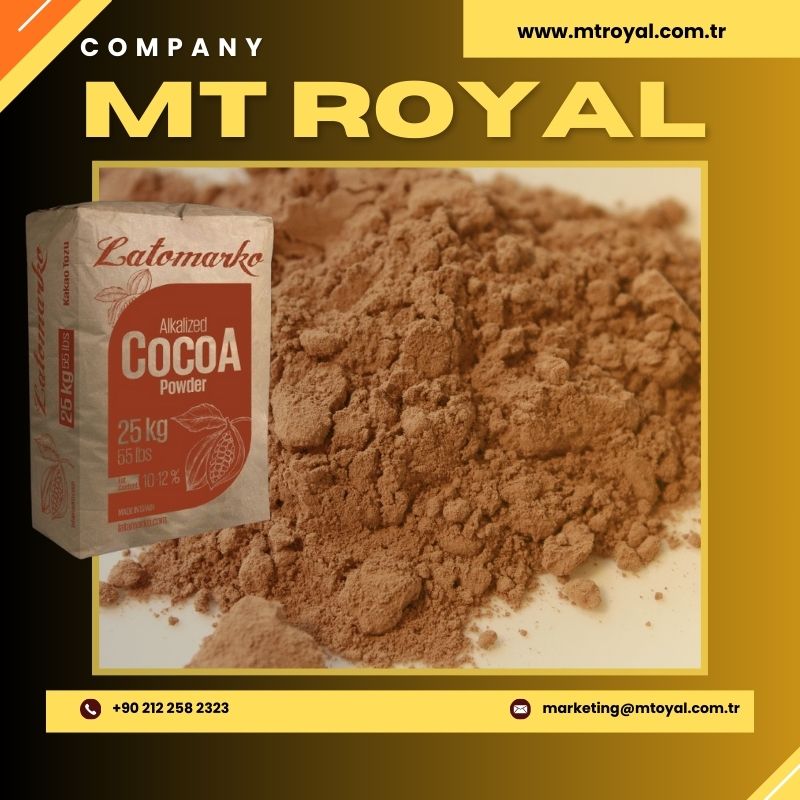
Alkalized Cocoa Powder Supplier
latamarko alkalized cocoa powder lm60
Food industry raw materials – list of products
Why Climate Matters More Than You Think
Before diving into specialized blends, we need to agree on a core industrial truth: climate isn’t just a comfort factor — it’s a production variable.
Saudi Arabia presents some of the most demanding ambient conditions for food manufacturing anywhere. With average daytime temperatures frequently exceeding 40°C in summer months and extremely low relative humidity, raw materials face:
- Moisture loss or gain depending on storage and transit conditions
- Static buildup that worsens flow and dosing
- Caking and clumping in powders not engineered for arid climates
- Flavor volatility and fat migration during storage and processing
Cocoa powder, by its nature, is a particulate solid with significant surface area. It can absorb moisture from humid air and lose it rapidly in dry conditions. Left unchecked, this can wreck your mixing profiles, disrupt product uniformity, and even clog automated dosing systems.
So when we talk about cocoa powder blends optimized for Saudi climate, we’re focusing on multi‑dimensional performance features — moisture resistance, engineered flow characteristics, stabilized flavor compounds, and predictable behavior in commercial baking systems.
What Makes a Cocoa Powder “Optimized” for Harsh Climates?
Not all cocoa powders are created equal. Many commodity powders are specified simply by fat content and color. But for industrial lines operating in challenging environments, you need blends engineered for functional resilience.
At the industrial level, optimized cocoa powder blends typically offer:
- Controlled particle size distribution – For uniform dispersion in doughs and batters
- Anti‑caking performance – Especially vital in low humidity, high heat production floors
- Moisture equilibrium additives – Engineered to maintain flow and reduce agglomeration
- Stable flavor profile compounds – Less susceptible to oxidation or heat‑induced changes
- pH and solubility adjustment – Enhancing compatibility with leavening agents and emulsifiers
Each of these factors has practical implications. For example, a more consistent particle size means your mixers achieve homogenous blends faster and with less energy. Anti‑caking properties reduce downtime from hopper blockages or dosing irregularities. Moisture equilibrium features help cacao solids remain free‑flowing even when production areas exceed 35°C.
A standard cocoa powder might be fine for temperate climates or artisan kitchens, but at scale in Saudi production plants, suboptimal powders cost you throughput, increase scrap rates, and hide variability in QC metrics.
Understanding the Saudi Industrial Context
To appreciate the value of optimized blends, it helps to understand how climate and operational demands intersect in Saudi manufacturing.
Climate‑Driven Production Challenges
Saudi Arabia’s deserts are unforgiving. Even inside controlled plants, environmental systems battle to maintain target temperatures and humidity levels. But between production shifts, during loading docks operations, or in storage yards, ingredients are exposed to:
- Thermal fluctuations
- Very low relative humidity
- Dust infiltration
- Rapid moisture exchanges
When cocoa powder sits on a dock or in a warehouse near exterior access points, it can act like a sponge or a desiccant — depending on prevailing conditions. This constant moisture tug‑of‑war changes particle behavior, which in turn affects how the powder interacts with fats, liquids, and chemical leaveners in your formulas.
Production Speed and Automation
Saudi bakery and confectionary production lines often run like clockwork — 24/6 or around the clock with minimal downtime. These automated systems rely on consistent ingredient performance. Few things disrupt cycle efficiency more than raw materials that behave unpredictably from batch to batch.
In our experience supplying manufacturing facilities, plants with optimized cocoa powder blends see fewer feed system clogs, shorter mixing cycles, and tighter color and flavor consistency in end products. That’s not just better QC; that’s measurable efficiency.
Regulatory and Quality Expectations
Saudi food safety standards demand traceability, detailed specifications, and robust documentation. Whether you’re exporting finished goods or serving local retail chains, your cocoa powder must come with certificates of analysis, lot history, and quality assurances that match performance claims.
An optimized blend isn’t just about functional behavior; it must also meet regulatory requirements for microbiological safety, heavy metals, and labeling accuracy.

What Makes an Industrial Cocoa Powder Blend Different
Let’s unpack the key functional attributes industrial manufacturers care about.
1. Particle Engineering
Optimized cocoa powder blends have tight particle size distributions tailored for blending and hydration. This matters because:
- Fine particles make for richer color but can cake more easily
- Coarse particles can improve flow but may hydrate slowly in doughs
Engineered blends balance these extremes, ensuring your mixers and dough conditioners operate with predictable rheology.
2. Anti‑Caking and Flow Agents
Rather than generic additives, industrial cocoa powder blends use advanced anti‑caking systems compatible with food‑safe production and high‑temperature lines. These agents help powders:
- Resist lump formation
- Move freely through pneumatic and mechanical hoppers
- Dampen static build‑up that interferes with vibratory feeders
This matters when temperatures inside your facility approach 30°C and you’re dosing thousands of kilograms per week.
Why Procurement Must Think Beyond Commodity Pricing
It’s tempting to buy cocoa powder by unit price alone. But ask yourself: what is the true cost of a production stoppage, inconsistent bake quality, or a line cleanup? For industrial buyers, that margin between commodity pricing and functional performance can dwarf raw material cost differences.
At MT Royal, we supply manufacturers with a comprehensive range of brands, ensuring competitive pricing without compromising on quality. We’ve worked with production facilities across various industries and understand that procurement isn’t just about securing a raw material — it’s about minimizing risk and maintaining throughput.
When evaluating cocoa powder blends, consider:
- Cost per actual production hour — How does ingredient performance impact uptime?
- Quality consistency — Are you seeing variability from batch to batch?
- Supplier support — Does your vendor provide technical documentation, performance guarantees, or QC collaboration?
Premium options, particularly those influenced by European engineering such as Spanish brands like Latamarko, often deliver tighter tolerance ranges and superior documentation. That doesn’t always mean highest cost — but it often means higher reliability.
How to Evaluate Cocoa Powder Suppliers for Climate‑Optimized Performance
Choosing a supplier isn’t a checkbox exercise. It’s a risk management strategy. Here’s how to think about it.
Technical Specifications Matter
Price is just one dimension. Ask for:
- Particle size distribution data
- Moisture sorption isotherms
- Flow index under controlled temperature
- Solubility and hydration curves in standard bakery mixes
These are not obscure metrics; they are operational signals that tell you how an ingredient will behave in real production.
Quality Documentation and Traceability
Saudi regulators insist on traceability. A supplier who can’t deliver detailed certificates of analysis and lot history creates unnecessary audit risk.
Practical Performance Testing
Nothing replaces lab verification. Good suppliers will support sample trials, analysis of performance under your climate conditions, and even field testing in your mixers.
Supplier Collaboration
A partner worth your time will help you interpret data, adjust formulations, and tailor blends to specific production demands.
A Real‑World Example: Line Stability in Hot Weather
A mid‑size bakery plant in the Eastern Province faced chronic variations in chocolate cake density during summer. Standard cocoa powder blends would hydrate inconsistently — particularly late afternoon when ambient heat peaked.
After switching to a blend engineered for climate resilience — with optimized particle distribution and advanced flow characteristics — the variability almost disappeared. Production supervisors noted:
- Shorter mixing cycles
- Fewer hopper clogs
- More uniform moisture profiles in doughs
This wasn’t luck. It was ingredient science aligned with operational reality.
Comparison: Optimized Blend vs Standard Cocoa Powder
| Feature | Standard Cocoa Powder | Climate‑Optimized Cocoa Powder Blend |
|---|---|---|
| Particle Size Variability | High | Controlled |
| Moisture Response | Sensitive | Stabilized |
| Flowability | Variable | Consistent |
| Dosing Predictability | Low | High |
| Production Uptime Impact | Negative | Positive |
| Flavor Stability in Heat | Moderate | Enhanced |
For manufacturing decision‑makers, these aren’t abstract categories — they are the difference between routine performance and costly variability.
Actionable Strategies for Production and Procurement
What can you do today?
1. Define Functional Specifications
Don’t accept vague descriptions like “industrial grade cocoa powder.” Spell out:
- Particle size range
- Moisture sorption behavior
- Flowability measures
- Compatibility with existing mixers
This eliminates guesswork and aligns suppliers with your expectations.
2. Build Performance KPIs
Measure ingredient performance in real terms:
- Line stoppages per ton of ingredient
- Batch variability metrics
- Dosing accuracy deviations
These KPIs help justify procurement decisions to finance and operations leadership.
3. Forecast and Inventory for Climate Impact
Plan raw material buffers for peak heat months. Even optimized blends benefit from proper storage and handling.
4. Engage Suppliers as Partners
A supplier who anticipates issues, offers technical documentation, and respects your production constraints is an asset. We’ve seen factory managers benefit from deeper collaboration — from tailored blend adjustments to supporting seasonal profiling.
Frequently Asked Questions from Industrial Buyers
Q: Why can’t we use commodity cocoa powder with adjustments?
Commodity powders may work in temperate climates with low temperatures, but they often fall short in extreme conditions because they aren’t engineered for consistent flow and hydration.
Q: Do optimized blends cost more?
Initial unit price might be slightly higher, but total operational cost — factoring uptime, QC consistency, and reduced scrap — often makes them more economical.
Q: How should optimized cocoa powder be stored?
Climate‑controlled storage is ideal. Even optimized blends perform best when relative humidity and temperature variance are minimized.
Q: Can suppliers provide performance guarantees?
Good suppliers will back their products with documentation and may even support testing protocols in your environment.
Industry Trends Shaping Cocoa Powder Use in Saudi Arabia
Several forces are accelerating demand for climate‑adapted cocoa powder blends:
Automation and Analytics
Modern plants increasingly rely on real‑time monitoring. Ingredients that behave predictably reduce noise and false positives in quality alerts.
Premiumization of Bakery Products
Consumers are no longer satisfied with just “chocolate flavored.” They want rich, uniform taste profiles — achievable only with consistent, engineered cocoa powder blends.
Supply Chain Transparency
Sustainability metrics, traceability, and documentation now influence procurement beyond raw pricing. Suppliers who offer detailed analytics on lot history and environmental performance stand out.
Final Thought for Manufacturing Decision‑Makers
When you think about cocoa powder blends optimized for Saudi climate, think pragmatically. This isn’t a trendy specification — it’s an operational necessity for manufacturers who care about production consistency, cost efficiency, and product quality under demanding conditions.
The right cocoa powder blend can elevate your plant’s performance, streamline operations, and deliver a sensory advantage your customers will taste. Whether you’re selecting suppliers, engineering new formulas, or fine‑tuning your supply chain, the blend you choose reverberates across every batch you ship.
At MT Royal, we understand these dynamics. We know that serious manufacturers don’t just want ingredients — they want predictability, performance, and partners who understand what it takes to run world‑class facilities in tough environments. And when you explore higher‑tier options — including those influenced by premium engineering traditions like Latamarko — you discover a level of specification control that transforms variability into reliability.
So here’s the question worth asking today: what decisions will you make now to ensure your production lines run smoothly, your batches meet specification, and your products consistently delight customers — even when the climate doesn’t cooperate?
If you need help evaluating suppliers, defining functional specifications, or creating performance criteria for your next cocoa powder procurement cycle, I’m here to help — just ask.



No comment