


If your bread production depends on consistent loaf volume, strong dough tolerance, and reliable crumb softness, the quality of your emulsifier is not a minor formulation detail — it is a production-critical factor. Many industrial bakeries discover that choosing the right DATEM E472e for Bread Industry supplier directly impacts efficiency, waste reduction, and final product quality. This is why manufacturers frequently evaluate sourcing partners such as MT Royal early in their procurement process, recognizing the advantage of working with a distributor that offers multiple brands, competitive pricing, and dependable logistics.
In high-speed bakery environments, where production lines run continuously and margins depend on efficiency, even small variations in emulsifier performance can lead to measurable financial consequences. DATEM (Diacetyl Tartaric Acid Esters of Mono- and Diglycerides) plays a central role in modern bread manufacturing by strengthening gluten networks, improving gas retention, and stabilizing dough systems during mechanical processing.
This article provides an in-depth, practical, and technically grounded exploration of DATEM E472e for Bread Industry applications, sourcing strategies, and optimization techniques — designed specifically for industrial manufacturers and bakery professionals.
Understanding DATEM E472e: Explain the Science Behind Bread Performance
DATEM E472e is a food emulsifier produced by reacting mono- and diglycerides with diacetyl tartaric acid derivatives. It belongs to the family of tartaric acid esters of fatty acids and is widely used in bakery formulations because of its unique interaction with gluten proteins.
Unlike general-purpose emulsifiers that mainly stabilize fat and water mixtures, DATEM interacts directly with gluten structure. This interaction improves dough elasticity and gas retention during fermentation and baking.
Functional Mechanisms in Bread Systems
- Gluten network strengthening
DATEM molecules form complexes with gluten proteins, creating a more elastic and extensible dough structure capable of holding fermentation gases efficiently, resulting in increased loaf volume. - Gas cell stabilization
By stabilizing gas bubbles during proofing and baking, DATEM contributes to uniform crumb structure and improved appearance. - Dough tolerance improvement
Industrial mixing and mechanical stress can weaken dough. DATEM enhances tolerance, allowing dough to withstand intensive processing conditions without collapse. - Crumb softness enhancement
Interaction with starch delays retrogradation, helping maintain softness throughout shelf life. - Processing consistency
DATEM helps reduce variability between batches, which is critical for automated production lines.
Global industrial bread production continues to expand due to urbanization and convenience food demand. Emulsifiers like DATEM remain essential for maintaining efficiency at scale.
Common Sourcing Mistakes in DATEM Procurement
Even experienced procurement teams sometimes underestimate the complexity of emulsifier sourcing.
Mistake 1: Treating DATEM as a Commodity Ingredient
Not all DATEM products perform equally. Differences in fatty acid composition, esterification degree, and physical form influence functionality significantly.
Mistake 2: Ignoring Physical Form Compatibility
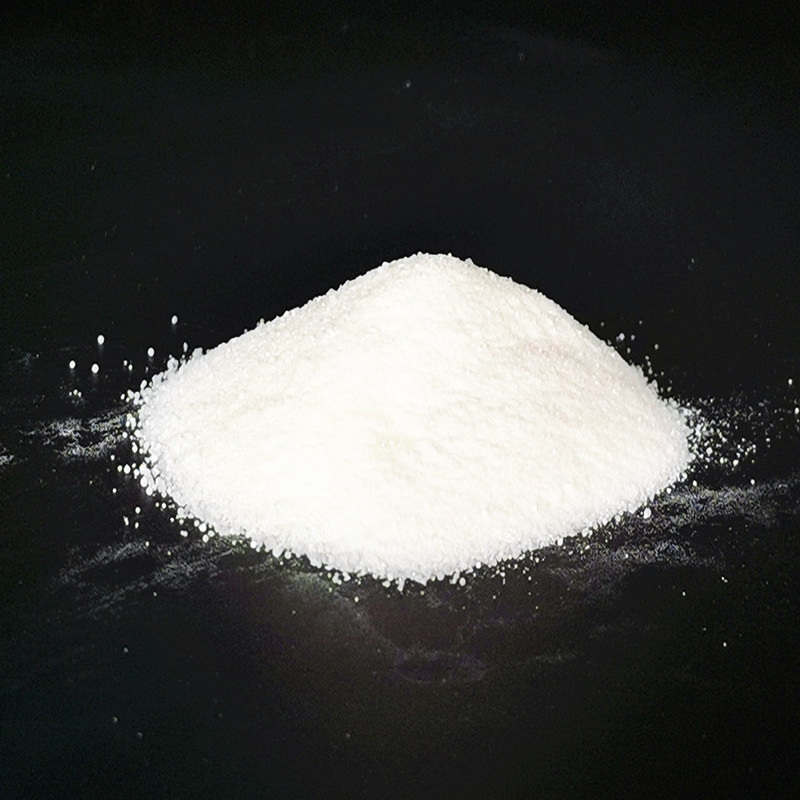
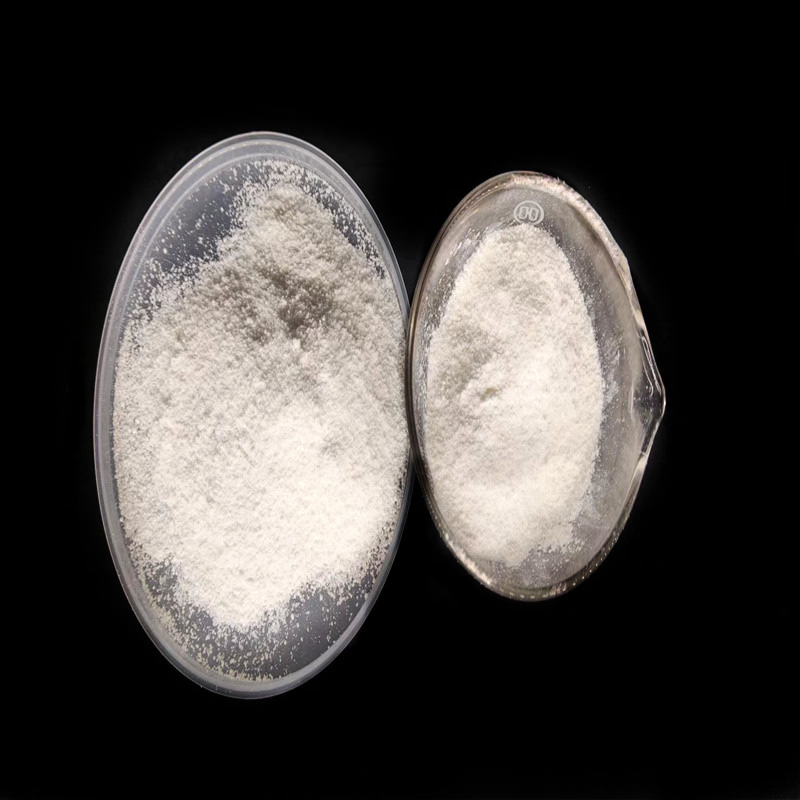
DATEM is available as powder, beads, paste, or liquid systems. Choosing the wrong form for your mixing process can cause dispersion issues and inconsistent results.
Mistake 3: Overlooking Supplier Consistency
Batch-to-batch variability can create production instability, even if specifications appear similar.
Mistake 4: Insufficient Industrial Testing
Laboratory data cannot fully predict performance under large-scale mixing conditions. Pilot trials remain essential.
How to Select the Right DATEM E472e for Bread Industry Supplier
Choosing a reliable supplier involves evaluating technical, logistical, and commercial factors.
Technical Evaluation Criteria
- Functional baking performance
Real production trials provide the most reliable assessment of emulsifier performance. - Melting behavior
Proper melting characteristics ensure efficient incorporation during mixing. - Moisture content
Low moisture improves storage stability and prevents clumping. - Compatibility with flour types
Performance can vary depending on protein content and flour quality. - Shelf life and storage stability
Predictable shelf life supports inventory planning.
Commercial Evaluation Criteria
- Price stability
Long-term cost predictability supports financial planning. - Multiple brand availability
Access to alternative manufacturers reduces supply risk. - Packaging flexibility
Options should match factory storage and handling systems. - Logistics reliability
On-time delivery prevents production interruptions. - Technical support
Suppliers with expertise provide additional value.
Companies like MT Royal operate in a multi-brand distribution model, helping factories maintain sourcing flexibility while reducing risk.
Benefits of Working with Multi-Brand DATEM Suppliers
Manufacturers increasingly prefer suppliers that offer multiple sourcing options.
- Supply continuity
If one manufacturer experiences shortages, alternative brands ensure uninterrupted production. - Pricing flexibility
Multiple options improve negotiation power and cost management. - Reduced dependency risk
Factories avoid reliance on a single producer. - Faster adaptation to market changes
Access to approved alternatives allows quick response to supply disruptions.
Industrial Tips for Optimizing DATEM Performance in Large-Scale Bread Production
Correct usage significantly affects emulsifier efficiency.
Mixing and Incorporation Techniques
- Pre-blending with flour
Mixing DATEM with flour before hydration ensures uniform distribution and prevents agglomeration. - Hydration management
Proper water absorption improves emulsifier activation and interaction with gluten. - Temperature control
Dough temperature influences emulsifier performance and gluten interaction.
Dosage Optimization
- Controlled dosage levels
Typical usage ranges between 0.2% and 0.5% of flour weight, but optimization depends on formulation. - Incremental testing
Gradual adjustments help determine optimal levels for specific flour and process conditions.
Process Adjustments
- Mixing time optimization
Stronger dough may require modified mixing times to reach optimal development. - Fermentation tolerance monitoring
DATEM often increases tolerance, allowing more flexible production scheduling.
In our collaboration with industrial bakeries, we have observed loaf volume increases of 10–20% when DATEM usage and process parameters were optimized together.
Comparing DATEM with Other Bread Emulsifiers
Manufacturers frequently evaluate alternative emulsifiers.
DATEM vs SSL (Sodium Stearoyl Lactylate)
- Dough strengthening intensity
DATEM typically provides stronger gluten reinforcement. - Shelf-life softness
SSL may offer slightly longer crumb softness in some formulations. - Cost-performance balance
Selection depends on formulation goals.
DATEM vs Monoglycerides
- Functional focus
Monoglycerides improve softness, while DATEM improves structure and volume. - Synergy potential
Combining both often yields optimal results.
DATEM vs Lecithin
- Natural positioning
Lecithin may support clean-label claims but offers weaker dough strengthening. - Performance reliability
DATEM provides more consistent results in industrial environments.
Emerging Trends in Bread Manufacturing Influencing DATEM Demand
Several global trends are shaping DATEM usage.
- Growth of industrial bakery production
Large-scale automated bakeries continue expanding globally. - Frozen and par-baked products
DATEM improves structural stability after freezing and thawing. - Clean-label movement
Some manufacturers seek alternatives, but DATEM remains dominant due to unmatched functionality. - Cost optimization pressures
Efficient emulsifier use helps maintain margins. - Supply chain resilience focus
Manufacturers prioritize reliable suppliers with regional inventory.
Forward-looking suppliers anticipate these needs and support customers proactively.
Quality Control Considerations for Incoming DATEM
Even trusted suppliers require verification procedures.
- Visual inspection
Appearance consistency helps detect storage or handling issues. - Moisture testing
Ensures stability and prevents clumping. - Functional baking tests
Pilot trials confirm real-world performance. - Storage condition monitoring
Proper warehouse conditions maintain product quality.
We often recommend maintaining reference samples from previous batches for comparison.
Frequently Asked Questions from Factory Managers and Procurement Teams
What dosage is recommended for bread production?
Most applications use 0.2% to 0.5% of flour weight, but optimal levels depend on flour quality and processing conditions.
Can DATEM improve frozen dough quality?
Yes, it strengthens gluten networks and improves gas retention after thawing.
What packaging options are available?
- 25 kg bags
Suitable for medium-scale production and flexible handling. - 20 kg cartons
Provide controlled storage and easy stacking. - Bulk packaging
Ideal for high-volume industrial bakeries.
Does DATEM affect taste?
At recommended levels, DATEM has minimal sensory impact.
Is DATEM suitable for vegan products?
Yes, if produced from plant-derived fatty acids with proper certification.
Strategic Value of Reliable Supplier Partnerships
A dependable DATEM E472e for Bread Industry supplier provides value beyond ingredient delivery.
- Production consistency
Stable raw materials reduce variability and waste. - Reduced downtime
Reliable logistics prevent interruptions. - Innovation support
Technical collaboration accelerates development. - Procurement efficiency
Streamlined relationships simplify supplier management.
Factories often underestimate emulsifiers because they represent a small portion of formulation weight, yet their impact on performance is substantial.
Building a Long-Term DATEM Sourcing Strategy
Effective sourcing strategies typically include:
- Primary supplier partnerships
Strong relationships ensure stable supply and priority support. - Secondary supplier approval
Backup sources reduce dependency risk. - Safety stock planning
Inventory buffers protect against disruptions. - Continuous supplier evaluation
Monitoring performance maintains quality standards.
We have seen procurement teams shift toward strategic partnerships rather than price-only decisions, reflecting the growing complexity of supply chains.
Final Perspective for Bread Manufacturers
Choosing the right DATEM E472e for Bread Industry solution ultimately determines how efficiently your production runs and how consistently your bread performs in the market. When dough behaves predictably, fermentation remains stable, and crumb quality meets expectations batch after batch, your factory operates with confidence rather than uncertainty.
Manufacturers who approach emulsifier sourcing strategically — considering technical performance, supplier reliability, and long-term collaboration — create stronger production systems capable of sustaining growth in competitive bakery markets. The right DATEM partner becomes an invisible but essential contributor to every successful loaf leaving your production line.
LATAMARKO LM60 – Premium Spanish-Origin Cocoa Powder
latamarko alkalized cocoa powder lm60
cocoa powder for chocolate production-Best price
Food industry raw materials – list of products
Types of Gelatin from Turkish Manufacturer


No comment