

In the modern food industry, where taste consistency, process efficiency, and scalability define competitiveness, Monosodium Glutamate (MSG) stands out as a cornerstone additive. Known for its umami-enhancing properties, MSG enables manufacturers to deliver robust and balanced flavor experiences across a wide range of products — from savory snacks and soups to processed meats and sauces.
Factories and food producers searching for a trusted industrial-grade source of MSG understand that ingredient reliability can determine the success or failure of large-scale production runs. At MT Royal, we specialize in supplying food additive monosodium glutamate in bulk, offering verified quality, purity, and cost-effective options for diverse manufacturing needs.
This comprehensive guide explores the industrial applications, sourcing insights, and technical considerations of MSG for food production, equipping purchasing managers and R&D specialists with the knowledge to make informed, efficient, and profitable decisions.
Understanding Monosodium Glutamate as a Food Additive
What Is MSG?
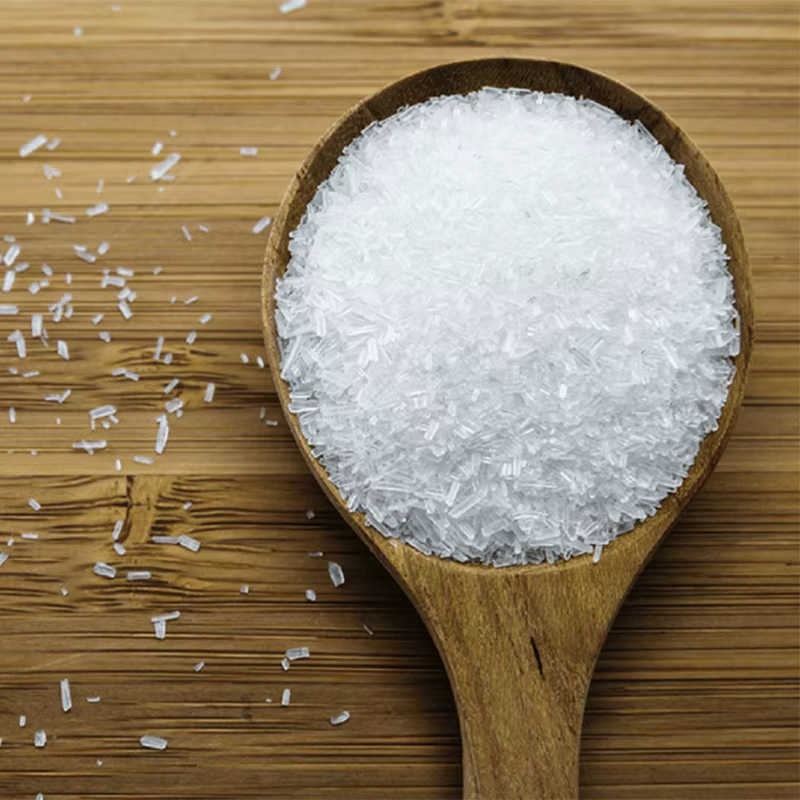
Monosodium Glutamate (E621) is the sodium salt of glutamic acid — one of the most abundant naturally occurring amino acids found in foods such as tomatoes, cheese, and mushrooms. In its refined industrial form, MSG appears as white crystalline powder with high solubility, allowing even distribution across complex food formulations.
When added to food, MSG amplifies the umami taste, often described as “savory” or “meaty.” Unlike salt or sugar, it doesn’t alter the primary flavor but rather enriches the overall sensory experience.
Core Functional Properties of MSG
- Flavor Enhancement: Intensifies umami taste, providing depth and complexity.
- Sodium Reduction Tool: Enhances flavor while allowing up to 30–40% sodium reduction.
- Thermal Stability: Withstands high processing temperatures in industrial cooking, baking, and pasteurization.
- Synergistic Action: Works well with nucleotides like disodium inosinate and guanylate for a stronger umami effect.
- Neutral Interaction: Does not affect food color or aroma, preserving the integrity of formulations.
These properties make MSG an indispensable additive in modern food manufacturing — particularly where flavor consistency and cost control matter most.
Industrial Applications of Monosodium Glutamate
MSG is used globally across multiple sectors of the food industry. Below are the most common industrial uses where food additive monosodium glutamate plays a pivotal role:
1. Processed Meats and Sausages
- Enhances the natural meaty flavor of protein-based products.
- Reduces the reliance on costly natural extracts or flavor bases.
- Compatible with brine solutions and curing mixes.
- Supports flavor retention after thermal processing and freezing.
2. Soups, Broths, and Bouillons
- Adds umami depth that makes soups taste more authentic and full-bodied.
- Maintains stability under prolonged heating and storage.
- Reduces salt requirements while preserving richness.
3. Sauces, Dressings, and Condiments
- Improves flavor balance in tomato sauces, gravies, marinades, and soy-based seasonings.
- Promotes uniform flavor dispersion in emulsified systems.
- Helps standardize taste profiles across production batches.
4. Snacks and Instant Foods
- Intensifies taste in chips, crackers, noodles, and seasoning blends.
- Offers excellent dry-blending compatibility.
- Provides lasting flavor retention even in low-moisture systems.
5. Dairy and Plant-Based Products
- Enhances savory profiles in cheese sauces, soups, or dairy analogues.
- Bridges flavor gaps in plant-based formulations without overpowering natural taste.
By optimizing MSG dosage and distribution, manufacturers can elevate taste, reduce costs, and maintain flavor uniformity — even in large-scale, continuous operations.
The Industrial Science Behind Umami
Umami is the fifth basic taste, alongside sweet, sour, salty, and bitter. Scientifically, it results from the stimulation of L-glutamate receptors on the tongue. MSG delivers this umami sensation efficiently because of its pure, isolated form of glutamate.
For food engineers and formulators, understanding umami’s mechanism is essential:
- Receptor Activation: MSG binds to specific receptors (mGluR4, T1R1/T1R3), enhancing taste perception.
- Synergy with Nucleotides: When combined with IMP or GMP, the umami effect becomes exponentially stronger.
- Balanced Mouthfeel: The presence of MSG influences perceived texture, especially in emulsified or protein-based systems.
This scientific precision allows MSG to serve not merely as an additive but as a functional taste architecture tool for modern food design.
Common Mistakes in Industrial MSG Procurement
Even experienced purchasing managers can fall into traps when sourcing food additive monosodium glutamate for industrial use. Here are the most common pitfalls and how to avoid them:
- Ignoring Purity Grades: Not all MSG is equal; industrial food-grade MSG requires specific purity levels (≥99%) verified by a Certificate of Analysis (COA).
- Overlooking Moisture Sensitivity: Improper packaging or storage can cause clumping and uneven dissolution.
- Buying from Intermediaries: Indirect sourcing raises costs and risks inconsistency. Direct importers like MT Royal ensure traceability.
- Neglecting Supplier Verification: Failing to check compliance with ISO, HACCP, or Halal certifications can result in regulatory issues.
- Using Improper Dosage: Excess MSG can distort the flavor balance; accurate dosing based on product matrix is crucial.
By aligning with verified suppliers and applying proper quality controls, manufacturers can safeguard product integrity and consumer satisfaction.
Why Industrial Buyers Choose Direct Import Routes
The global MSG market is dominated by large producers in China, Indonesia, and Vietnam. Importing directly from these production hubs through a trusted distributor brings measurable advantages:
- Cost Optimization: Eliminates intermediary markups.
- Batch Consistency: Ensures homogeneous product specifications for large-scale production.
- Reliable Supply Chains: Reduces downtime caused by stock delays.
- Documentation Transparency: Full access to COA, MSDS, and food safety certifications.
- Customization: Ability to choose specific packaging formats (e.g., 25kg woven bags or bulk).
At MT Royal, we have established long-term relationships with certified Chinese manufacturers, ensuring our clients receive high-quality MSG with consistent performance and verified documentation.
Industrial Tips for Using MSG Effectively
- Gradual Mixing: Dissolve MSG completely in warm water or liquid base before incorporation.
- Batch Testing: Perform small-scale tests to calibrate the optimal dosage for each recipe.
- Blending Precision: Use industrial mixers for uniform dispersion in dry seasoning or liquid systems.
- Packaging Integrity: Store in moisture-proof containers under controlled humidity.
- Synergistic Use: Combine MSG with flavor bases, hydrolyzed vegetable protein (HVP), or yeast extract for layered umami.
We’ve seen, in collaboration with multiple factories, that proper integration of MSG can improve flavor consistency by up to 20% while lowering sodium content without sacrificing taste.
Comparing MSG with Other Flavor Additives
| Additive | Flavor Intensity | Cost Efficiency | Sodium Impact | Stability | Ideal Use |
|---|---|---|---|---|---|
| Monosodium Glutamate (MSG) | Very High | Excellent | Low | High | Soups, snacks, sauces |
| Yeast Extract | Moderate | Medium | Moderate | Moderate | Seasonings, sauces |
| Hydrolyzed Vegetable Protein (HVP) | High | Medium | High | High | Processed meats |
| Disodium Inosinate (IMP) | Very High | Medium | Low | Moderate | Combined with MSG |
| Salt (NaCl) | Moderate | High | High | Very High | General seasoning |
MSG offers a superior combination of cost efficiency, flavor potency, and formulation flexibility — key advantages for industrial-scale production.
Regulatory Standards and Food Safety
Industrial food additives must adhere to strict global standards. MSG (E621) is recognized as safe by:
- FAO/WHO Joint Expert Committee on Food Additives (JECFA)
- U.S. FDA (GRAS status)
- European Food Safety Authority (EFSA)
- Food Standards Australia New Zealand (FSANZ)
All MT Royal MSG products are supplied with full documentation:
- Certificate of Analysis (COA)
- Material Safety Data Sheet (MSDS)
- Halal and Kosher Certificates
- ISO 9001 & HACCP compliance
Compliance with these standards ensures consistent safety and performance across international markets.
Frequently Asked Questions by Industrial Buyers
Q1: What is the typical dosage of MSG in industrial formulations?
A: Usually between 0.2% to 0.8% depending on product type and flavor requirements.
Q2: Can MSG be used in clean-label formulations?
A: While traditional MSG is synthetic, some manufacturers now offer fermentation-derived MSG with natural claims.
Q3: Does MSG lose effectiveness during heat treatment?
A: No. MSG is thermally stable and retains full potency under industrial cooking temperatures.
Q4: What packaging options are available?
A: Most suppliers, including MT Royal, offer 25kg woven bags or custom bulk packaging for high-volume operations.
Q5: Can MSG replace salt completely?
A: It can reduce total sodium content significantly, though it does not replicate saltiness by itself. Combining MSG with salt yields optimal results.
The Role of MT Royal as a Strategic Supplier
In industrial sourcing, reliability is as critical as product quality. MT Royal operates as a strategic supply partner, not just a distributor.
- Direct Import Advantage: Sourcing MSG directly from top Chinese manufacturers.
- Competitive Pricing: Cost benefits passed on to our clients.
- Batch Consistency: Each shipment tested for purity and moisture content.
- Technical Support: Guidance on formulation, usage, and process optimization.
We’ve worked closely with food producers across the Middle East and Europe who depend on steady MSG supply to maintain flavor consistency and production continuity. This partnership model allows us to respond quickly to market fluctuations and production demands.
Industrial Trends in MSG Usage
- Health-Oriented Reformulation: The push to reduce sodium has made MSG more popular as a low-sodium flavor enhancer.
- Plant-Based Foods: MSG bridges the flavor gap in meat alternatives, delivering savory depth.
- Global Supply Chain Expansion: China remains the largest producer, but diversification of sourcing is increasing.
- Automation in Flavoring: Computerized batching systems now ensure precise MSG integration for consistency and waste reduction.
These trends demonstrate that MSG remains not only relevant but strategically vital for industrial food innovation.
Closing Thought
For modern food producers, Monosodium Glutamate (E621) is far more than a flavor enhancer — it’s a functional ingredient that combines sensory precision, cost efficiency, and operational reliability. By sourcing food additive MSG from trusted suppliers such as MT Royal, factories can secure stable quality, ensure compliance, and enhance the sensory value of every batch.
Flavor consistency builds brand loyalty. And in industrial production, consistency begins with choosing the right ingredient partner.



No comment