

A Complete Industrial Guide for Consistent Texture, Rich Flavor, and Scalable Production
There is a defining moment in every chocolate biscuit—the crisp break, the immediate release of cocoa aroma, and the balanced sweetness that follows. This experience is not accidental. It is the result of a carefully structured formulation where each ingredient plays a specific technical role.
In industrial chocolate biscuit manufacturing, the ingredient list is more than a composition—it is a performance system. From dough handling to baking stability and shelf life, every component must be optimized for consistency. This guide provides a detailed, professional, and sales-oriented ingredient list designed for manufacturers targeting reliable, high-quality chocolate biscuit production.
Core Ingredient Structure of Chocolate Biscuits
1. Wheat Flour (Structural Foundation)
Wheat flour forms the backbone of biscuit structure.
Functions:
- Provides shape and mechanical strength
- Controls texture (crisp vs. soft)
- Supports uniform baking
Low to medium protein flour is typically used to achieve a crisp, light texture.
2. Sugar (Sweetness and Texture Development)
Sugar contributes to both flavor and physical properties.
Key roles:
- Provides sweetness
- Enhances browning (Maillard reaction)
- Influences texture and crunch
Types used:
- Refined sugar (sucrose)
- Powdered sugar (for smoother texture)
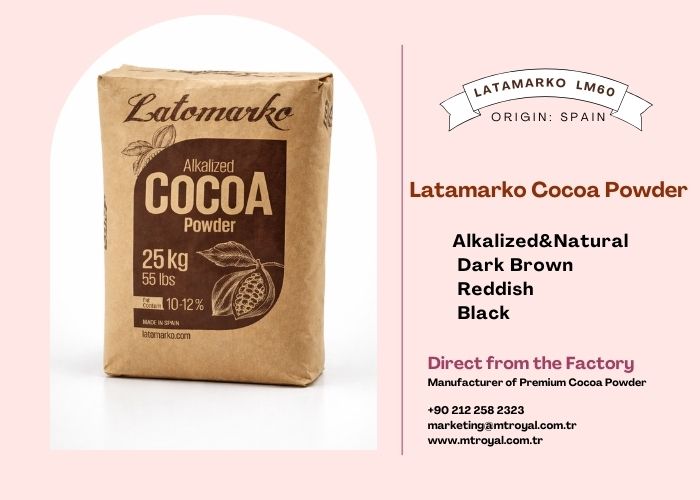
3. Cocoa Powder – Defining Chocolate Identity
Cocoa powder is the key ingredient that transforms a standard biscuit into a chocolate biscuit.
Types used:
- Natural Cocoa Powder
- Light brown color
- Slightly acidic flavor
- Sharper cocoa notes
- Alkalized Cocoa Powder
- Darker color (brown to deep dark)
- Smooth, mild flavor
- Better heat stability during baking
In industrial production, manufacturers prioritize cocoa powders with stable color, controlled pH, and consistent dispersion—qualities commonly associated with structured European production systems such as LATAMARKO. This ensures uniform appearance and flavor across all production batches.
4. Vegetable Fats (Texture and Mouthfeel)
Fats are essential for achieving the desired biscuit texture.
Common options:
- Palm oil
- Shortening fats
- Blended vegetable fats
Functions:
- Create a tender and crisp texture
- Improve dough handling
- Enhance flavor release
5. Water (Dough Formation)
Water hydrates flour and enables dough development.
Key roles:
- Controls dough consistency
- Supports ingredient interaction
- Influences final texture
Precise water control is critical for consistent baking results.
6. Leavening Agents (Structure Development)
Leavening agents create internal structure and lightness.
Common agents:
- Sodium bicarbonate
- Ammonium bicarbonate
Benefits:
- Improve biscuit expansion
- Enhance crispness
- Control texture
7. Emulsifiers (Processing Stability)
Emulsifiers improve dough uniformity and processing performance.
Typical emulsifiers:
- Lecithin
- Mono- and diglycerides
Functions:
- Improve ingredient dispersion
- Enhance texture consistency
- Support large-scale production efficiency
8. Milk Powder (Optional for Richer Flavor)
Milk components are used in some formulations to soften flavor.
Options:
- Whole milk powder
- Skimmed milk powder
- Whey powder
They provide:
- Creamy notes
- Balanced sweetness
- Improved mouthfeel
9. Flavoring Agents
Flavor systems refine the chocolate profile.
Common additions:
- Vanillin
- Chocolate flavor enhancers
They help create a recognizable and consistent taste.
10. Salt
Salt enhances flavor and balances sweetness.
11. Anti-Oxidants (Optional)
Used to extend shelf life:
- Prevent fat oxidation
- Maintain product freshness
Example of a Professional Ingredient List
A standard chocolate biscuit formulation may include:
Wheat Flour, Sugar, Vegetable Fat, Cocoa Powder (Alkalized), Water, Leavening Agents (Sodium Bicarbonate, Ammonium Bicarbonate), Emulsifier (Lecithin), Salt, Flavoring (Vanillin)
This formulation ensures:
- Crisp and uniform texture
- Rich chocolate flavor
- Stable baking performance
- Consistent industrial output
Key Technical Considerations
1. Dough Consistency
Proper balance of flour, fat, and water ensures smooth processing and uniform shaping.
2. Baking Stability
Cocoa powder selection affects color stability and flavor retention during baking.
3. Texture Control
Fat and sugar ratios determine whether the biscuit is crisp, crunchy, or slightly soft.
4. Ingredient Consistency
Using standardized cocoa powders—often aligned with LATAMARKO-type production systems—ensures predictable results across large production volumes.
Industrial Applications
Chocolate biscuits are widely used in:
- Retail snack products
- Sandwich biscuits
- Chocolate-coated biscuits
- Export-oriented FMCG markets
Their versatility makes them a key product category globally.
Why Ingredient Quality Determines Product Success
In chocolate biscuit production, inconsistencies in raw materials can lead to:
- Uneven color
- Texture defects
- Flavor variation
- Production inefficiencies
Reliable ingredient sourcing is essential for maintaining product quality and brand reputation.
Why Working with MT ROYAL Makes a Strategic Difference
For manufacturers aiming to produce high-quality chocolate biscuits at scale, supplier selection plays a critical role.
Consistent Cocoa Derivatives
Cocoa powder supplied under structured systems—aligned with European standards such as LATAMARKO—ensures stable color, flavor, and baking performance.
Industrial Performance Focus
Ingredients are optimized for production, offering:
- Predictable processing behavior
- Uniform dough performance
- Consistent batch quality
Strong Supply Chain and Export Capability
With operations based in Istanbul, MT ROYAL provides:
- Fast and reliable logistics
- Complete export documentation
- Continuous product availability
A Reliable Manufacturing Partner
MT ROYAL supports producers in achieving formulation stability, improving product consistency, and scaling production efficiently.
Final Perspective
Chocolate biscuit manufacturing is a balance of precision, consistency, and ingredient quality. Every component—from flour to cocoa powder—must work together to deliver a product that meets consumer expectations every time.
Manufacturers who prioritize high-quality raw materials and strong supply partnerships gain a clear advantage in competitive markets.
MT ROYAL provides that advantage—delivering consistent cocoa ingredients and professional supply solutions that enable high-performance chocolate biscuit production with confidence and reliability.
LATAMARKO LM60 – Premium Spanish-Origin Cocoa Powder
latamarko alkalized cocoa powder lm60
cocoa powder for chocolate production-Best price
Food industry raw materials – list of products
Types of Gelatin from Turkish Manufacturer


No comment