

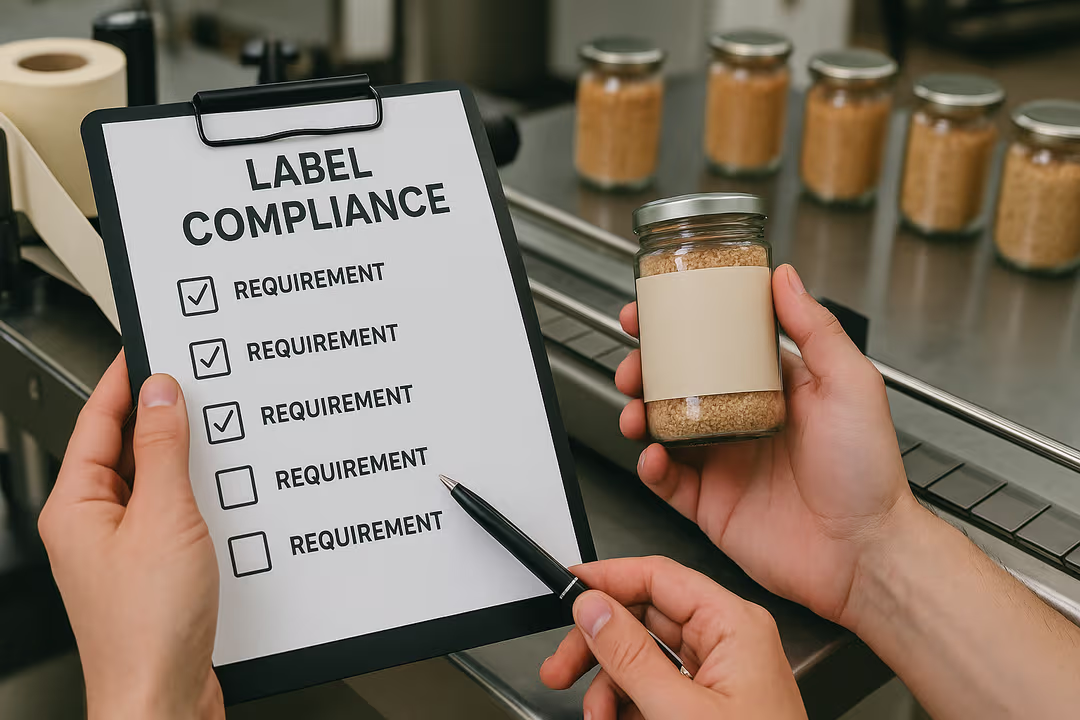
For manufacturers and brand owners entering the U.S. market, labeling and packaging are not decorative afterthoughts—they are regulatory checkpoints that can determine whether your shipment moves smoothly into distribution or sits idle at a U.S. port. In highly regulated categories such as food, cosmetics, and consumer goods, compliance failures often surface not because the product is unsafe, but because the label, packaging format, or documentation does not align precisely with FDA rules.
This is where sourcing strategy meets regulatory intelligence. Companies that work with experienced partners like MT Royal quickly learn that correct labeling and packaging are not obstacles; they are competitive safeguards. When handled properly, they protect your brand, reduce clearance risk, and keep production timelines intact—especially for factories operating at scale.
Before diving into specific labeling and packaging requirements, it is essential to understand how the U.S. regulatory ecosystem functions. The United States does not operate under a single, unified product authority. Instead, multiple agencies oversee different aspects of imported goods, often simultaneously.
For food, cosmetics, and many consumer goods, the Food and Drug Administration (FDA) plays a central role. However, FDA oversight intersects with U.S. Customs and Border Protection (CBP), the Federal Trade Commission (FTC), and in some cases the Environmental Protection Agency (EPA).
Labeling, packaging, and compliance failures are considered non-tariff barriers, meaning they restrict trade without involving duties or taxes. These barriers are among the most common causes of shipment delays and refusals for imported goods.
latamarko alkalized cocoa powder lm60
cocoa powder for chocolate production-Best price
Food industry raw materials – list of products
Types of Gelatin from Turkish Manufacturer
Alkalized Cocoa Powder Supplier
Core Principles of FDA Labeling and Packaging Compliance
FDA regulations are built around several fundamental principles that apply across product categories:
- Transparency and truthfulness
- Consumer safety and informed choice
- Traceability and accountability
- Consistency between product, label, and documentation
When these principles are violated—intentionally or accidentally—the FDA has broad authority to detain, refuse, or require corrective action for imported products.
Food Labeling Rules for Imported Products
Food labeling is one of the most detailed and strictly enforced areas of FDA regulation. Even experienced manufacturers often underestimate the level of precision required.
Mandatory Elements on Food Labels
Every imported food product must include, at minimum:
- Statement of identity (common or usual name)
- Net quantity of contents
- Ingredient list in descending order by weight
- Allergen declaration as required by FALCPA
- Name and address of the responsible firm
- Country of origin marking (CBP requirement)
Any discrepancy between the physical label and FDA records can trigger enforcement actions.
Ingredient and Allergen Disclosure
Allergen mislabeling is one of the leading causes of FDA refusals and recalls. Ingredients derived from major allergens must be clearly disclosed, even if present in trace amounts.
We have seen manufacturers assume that compliance with EU allergen rules is sufficient—only to discover that U.S. allergen declaration standards differ in formatting, terminology, and placement.
Nutrition Facts Panel Requirements
The Nutrition Facts panel must:
- Follow FDA-mandated formatting
- Use approved nutrient definitions
- Reflect accurate serving sizes based on U.S. consumption data
Reusing nutrition panels designed for other markets is a common and costly mistake.
Packaging Requirements for Imported Food Products
Packaging is regulated not only for information accuracy, but also for safety and material suitability.
Food-Contact Materials
FDA regulations require that packaging materials in contact with food be:
- Approved for food contact use
- Manufactured under compliant conditions
- Supported by supplier documentation
Failure to provide adequate material compliance documentation can result in shipment holds—even if the food itself meets all standards.
Tamper-Evident and Protective Packaging
Certain food categories require tamper-evident features. Packaging must also protect against contamination, spoilage, and damage during transport.
From a supply chain perspective, packaging that fails FDA expectations creates downstream risks far beyond the border.
Cosmetic Labeling and FDA Oversight
Unlike food and drugs, cosmetics do not require FDA pre-market approval. However, labeling and packaging rules are strictly enforced post-market and at import.
Required Cosmetic Label Information
Cosmetic labels must include:
- Identity of the product
- Net contents
- Ingredient declaration using INCI names
- Name and place of business
- Warning statements where applicable
Misuse of terms like “hypoallergenic,” “dermatologically tested,” or “organic” can attract regulatory scrutiny from both FDA and FTC.
Claims and Marketing Language
Cosmetics cross into drug territory when claims imply therapeutic or medical effects. This is one of the most common compliance failures for imported cosmetics.
We have worked with brands whose products were detained simply because marketing language on the label implied disease treatment or physiological modification.
Packaging Integrity for Cosmetics
Packaging must prevent contamination and degradation. For products such as creams, serums, and liquids, packaging design is closely tied to product safety.

Consumer Goods Labeling: Beyond FDA
For general consumer goods, labeling requirements extend beyond FDA into FTC and CBP jurisdiction.
Country of Origin Marking
Country of origin marking must be:
- Conspicuous
- Legible
- Permanent to the extent possible
Incorrect or misleading origin claims are a frequent cause of enforcement actions.
Safety and Use Instructions
Products intended for household or personal use must include:
- Clear instructions
- Safety warnings where applicable
- Age suitability statements if relevant
Inconsistent labeling between packaging, instruction manuals, and invoices is a red flag for inspectors.
Common Mistakes Made by Importers and Manufacturers
Across food, cosmetics, and consumer goods, certain mistakes appear repeatedly.
Treating Labeling as a Design Exercise
Labels are regulatory documents, not marketing brochures. A visually appealing label that fails compliance tests is a liability.
Copying Labels from Other Markets
Even highly regulated markets differ. U.S. rules are specific, prescriptive, and unforgiving of assumptions.
Last-Minute Label Changes
Making label changes after production often leads to relabeling at ports—one of the most expensive and disruptive outcomes for importers.
Scaling Compliance for High-Volume Manufacturing
For factories producing at scale, labeling and packaging compliance must be systematized.
Version Control and Documentation
Every label version should be:
- Approved
- Archived
- Linked to specific production batches
This is essential for traceability and audit readiness.
Supplier and Co-Packer Alignment
All parties in the supply chain must work from the same approved specifications. Mismatched documentation is a common source of compliance failure.
We have seen that when manufacturers integrate labeling compliance into their production planning, inspection rates drop significantly.
The Role of MT Royal in Compliance-Driven Sourcing
At MT Royal, we do not treat labeling and packaging as a regulatory burden. We treat them as risk management tools. We have worked with manufacturers across food, cosmetics, and consumer goods who needed more than just a supplier—they needed a sourcing partner who understood how U.S. regulations intersect with global production realities.
When we support clients, we focus on:
- Early-stage compliance review
- Alignment between supplier capabilities and U.S. requirements
- Reducing clearance risk before goods ever ship
This approach protects margins, timelines, and brand reputation.
Frequently Asked Questions from Procurement Managers
Can labeling issues be fixed after shipment?
Sometimes, but at high cost. Relabeling under CBP supervision is expensive and delays distribution.
Does FDA approval guarantee clearance?
FDA does not “approve” most foods or cosmetics pre-market. Compliance is assessed at import and post-market.
Are private label products more risky?
They can be, especially when brand owners lack visibility into formulation or packaging decisions made by manufacturers.
How often do labeling rules change?
FDA updates guidance regularly. Staying current is a continuous responsibility, not a one-time task.
Turning Compliance into Competitive Advantage
Manufacturers who master labeling and packaging compliance move faster, face fewer disruptions, and build stronger relationships with distributors and retailers.
We have seen companies transform compliance discipline into operational confidence—knowing that when products ship, they arrive ready for market.
A Strategic Perspective on Labeling and Packaging
Labeling, packaging, and FDA rules are not obstacles designed to slow trade. They are frameworks designed to protect consumers—and by extension, responsible manufacturers.
When you treat these rules as integral to your sourcing and production strategy, rather than as administrative hurdles, you gain control over one of the most fragile points in global trade.
MT Royal supports manufacturers who want that control—those who understand that sustainable growth in the U.S. market depends not just on price or quality, but on regulatory precision.
In an environment where a missing word on a label can stop an entire shipment, attention to detail is not optional. It is the difference between friction and flow.




No comment