

In the world of commercial baking, premium quality is never the result of chance. It is the outcome of precise formulation, consistent raw materials, controlled processes, and a deep understanding of how each ingredient behaves under industrial conditions. When it comes to chocolate cakes—particularly in the premium category—color stability, flavor clarity, and predictable performance are non-negotiable for any manufacturer aiming to protect brand reputation in a competitive market.
This is exactly why Pastino Reddish Cocoa for Premium Cake Manufacturers has gained significant traction among large production facilities. Factories investing in long-running cake lines know that the wrong cocoa powder can cause serious issues: uneven color after baking, undesirable bitterness, weak chocolate notes, or changes in batter viscosity. Each of these problems can disrupt large-scale operations where every shift, every batch, and every pallet must meet strict quality benchmarks.
Many manufacturers who source through MT Royal have shared a similar challenge: finding a cocoa powder that delivers both a visually distinctive reddish tone and a stable sensory profile after baking. Pastino Reddish Cocoa has proven to be one of the most reliable solutions for meeting this expectation. We’ve seen how production teams use it not only to enhance visual identity, but also to standardize product performance across tens of thousands of units produced daily.
This comprehensive guide explores the industrial, sensory, and operational strengths of Pastino Reddish Cocoa—and how premium manufacturers can use it to elevate production reliability, reduce waste, and build stronger consumer trust.
latamarko alkalized cocoa powder lm60
cocoa powder for chocolate production-Best price
Food industry raw materials – list of products
Types of Gelatin from Turkish Manufacturer
Alkalized Cocoa Powder Bulk Supplier
What Makes Pastino Reddish Cocoa Distinct in Large-Scale Cake Manufacturing?
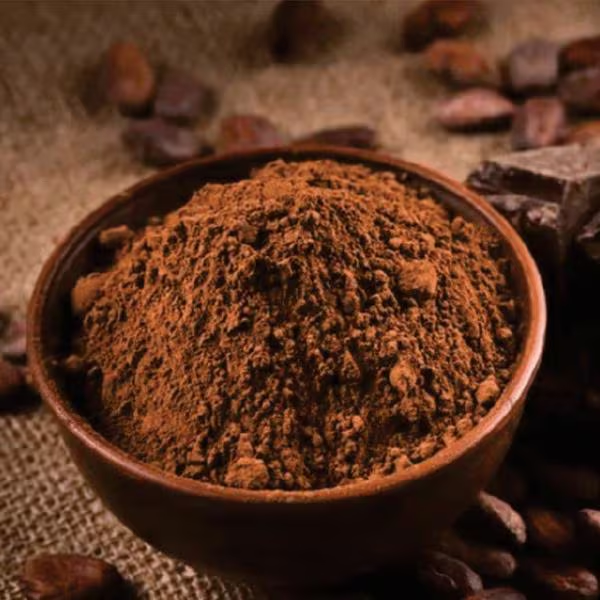
At its core, Pastino Reddish Cocoa is an alkalized cocoa powder engineered to deliver color intensity, flavor stability, and excellent dispersion. Its formulation is tuned for high-volume applications where the visual and sensory properties of cocoa must withstand aggressive mixing, aeration, and baking cycles.
Key Technical Characteristics
- Reddish-brown coloration
Its signature reddish hue makes chocolate cakes visually richer, especially in cross-sections and cut surfaces. This characteristic not only appeals to consumers but also makes premium cakes visually distinct from standard chocolate products. - Minimal color loss after baking
Many cocoa powders darken during baking due to reactions between alkalinity and sugar. Pastino maintains color integrity exceptionally well, preserving the expected shade even after prolonged baking cycles. - Balanced chocolate flavor
The flavor profile is smooth, warm, and slightly creamy, without the sharp bitterness found in some heavily alkalized powders. This creates a rounder chocolate note suitable for premium formulations. - Controlled pH for predictable performance
With a consistent alkalinity range, Pastino interacts with leavening systems (sodium bicarbonate or baking powder) more predictably, reducing batch variance. - Uniform particle size for stable dispersion
In industrial mixers and continuous lines, this uniformity reduces clumping and promotes consistent batter hydration. - Compatibility with diverse fat systems
Pastino performs reliably in formulations using palm oil, butter blends, or shortening systems—an important factor for factories operating in global markets.
These characteristics make it particularly suitable for high-output lines where visual consistency, flavor uniformity, and optimized processing rates matter.
Why the Reddish-Chocolate Shade Matters for Premium Cake Brands
Color is one of the first sensory cues consumers interpret when evaluating baked goods. The reddish-brown shade associated with Pastino Reddish Cocoa creates several competitive advantages:
1. Strong shelf differentiation
Premium cakes often compete in crowded retail environments. A deeper reddish hue makes the product look richer, more indulgent, and more authentic—especially in transparent packaging where the cake’s interior is visible.
2. Psychological association with premium chocolate
Research in consumer behavior shows that reddish-brown tones are perceived as “more natural” and “more flavorful” than dull or grayish browns. This perception can influence repeat purchases.
3. Enhanced visual identity in multi-product portfolios
For manufacturers producing several chocolate-based products, color consistency becomes a branding tool. By using a cocoa powder engineered for stability, factories can maintain a recognizable signature color across product lines, reinforcing brand trust.
4. Better performance in premium photography
Marketing teams often note that cakes prepared with Pastino photograph better under lighting due to the warm undertone, which reads as fresher and more appealing.
These attributes—combined with reliable behavior after baking—explain why premium brands increasingly adopt Pastino Reddish Cocoa in high-value product categories.
Common Mistakes Factories Make When Sourcing Cocoa Powder
While cocoa powder is a staple ingredient, procurement teams often underestimate how much it can influence production efficiency. Over the years, we’ve observed several recurring mistakes that can quietly undermine product consistency:
Mistake 1: Prioritizing price over performance
Cocoa powder pricing can fluctuate significantly based on origin, harvest conditions, and alkalization intensity. Cheaper options may appear cost-effective upfront, but they often cause:
- Increased waste from off-color batches
- Inconsistent rise or crumb structure
- Variability in bitterness or aftertaste
Production losses in large-scale bakeries can easily outweigh savings made during procurement.
Mistake 2: Ignoring the impact of pH on leavening systems
Cocoa powders vary widely in alkalinity. Selecting a powder with the wrong pH can disrupt reaction balance with baking soda or baking powder—leading to tunneling, dense texture, or over-aeration.
Pastino’s controlled pH helps stabilize these reactions.
Mistake 3: Skipping pilot-scale tests
Lab-scale performance may not reflect what happens in a 2-ton production shift. Performing pilot tests ensures that behavior under shear stress and heat matches real production conditions.
Mistake 4: Overlooking sensory stability after baking
A cocoa powder may smell aromatic in dry form but lose intensity during baking. This is a common problem with under-processed powders.
Pastino retains its characteristic flavor even after extended oven cycles.
Mistake 5: Supplier inconsistency
Some factories rely on variable supply chains that do not guarantee the same cocoa characteristics batch after batch. Partnering with reliable distributors such as MT Royal ensures stable sourcing and long-term consistency.
Industrial Considerations for Using Pastino Reddish Cocoa at Scale
Premium cake manufacturers operate in environments where small formulation changes can impact hundreds of thousands of units. Below are industrial considerations that highlight why Pastino performs well in demanding conditions.
1. Batter Viscosity and Hydration
Cocoa powders absorb water at different rates based on fat content, particle size, and alkalization. Pastino’s controlled absorption rate ensures:
- Uniform hydration
- Stable viscosity over long mixing periods
- Reduced risk of over-thickening
This is critical for continuous lines that deposit batter at precise flow rates.
2. Heat Resistance and Color Stability
The reddish hue remains stable even when exposed to:
- High baking temperatures
- Long residence times
- Rapid or slow oven cycles
This helps manufacturers maintain a consistent color profile across product formats.
3. Interaction with Emulsifiers
Modern cake systems rely on emulsifiers (mono- and diglycerides, DATEM, lecithin). Pastino disperses smoothly and does not disrupt emulsifier functionality, ensuring a fine, even crumb.
4. Impact on Cake Structure
A balanced cocoa powder contributes to:
- Improved cell uniformity
- Softer crumb texture
- More stable rise
Pastino’s particle size distribution makes it suitable for sponge cakes, loaf cakes, cupcakes, and sheet cakes.
5. Compatibility with Diverse Sweeteners
Many manufacturers now use mixtures of sucrose, glucose syrup, invert sugar, or alternative sweeteners. Pastino performs well across these systems, allowing flexible formulation.
6. Reduced Sensitivity to Process Variation
In factories where humidity, temperature, and batch size fluctuate, Pastino offers a degree of stability that helps standardize the final product.
Comparison: Pastino Reddish Cocoa vs. Standard Industrial Cocoa Powders
| Feature | Pastino Reddish Cocoa | Standard Cocoa Powder |
|---|---|---|
| Color after baking | Stable reddish-brown | Often dull or too dark |
| Flavor profile | Smooth, clean, balanced | Sometimes bitter or sharp |
| pH stability | Highly consistent | Variable between batches |
| Dispersibility | Excellent | Moderate |
| Visual impact | Strong premium appearance | Basic chocolate tone |
| Ideal applications | Premium cakes, brownies, biscuits | Mass-market products |
Many factories shift to Pastino after facing repeated inconsistencies with generic cocoa powders, especially for premium lines where every visual detail supports brand differentiation.
Frequently Asked Questions from Factory Procurement Teams
1. Does Pastino Reddish Cocoa require formulation changes?
In most cases, factories transition without modifying their recipes. Its pH and absorption characteristics align well with standard industrial formulations.
2. Can Pastino be used in gluten-free or reduced-sugar cakes?
Yes. Its dispersion and flavor intensity support gluten-free systems and sweetener-reduced formulations.
3. How does Pastino perform in high-fat batters like brownies?
Pastino integrates smoothly into high-fat matrices, producing a richer color and fuller flavor without creating grittiness.
4. Is supply consistent throughout the year?
Factories sourcing through MT Royal benefit from consistent availability due to long-term procurement planning and controlled storage conditions.
5. Is Pastino suitable for export products requiring long shelf life?
Yes. Pastino maintains both color and aroma over extended shelf life, making it ideal for export-grade packaged cakes.
The Strategic Impact of Choosing the Right Cocoa Powder
Every manufacturer seeking to dominate the premium cake segment understands that consumer expectations are rising fast. People want richer flavors, deeper colors, and a sense of authenticity in every bite. Pastino Reddish Cocoa delivers these expectations while giving factories the operational stability needed to scale confidently.
The key reason this cocoa powder is preferred isn’t just its color—it’s the combination of performance, predictability, and sensory appeal. Production managers appreciate that it behaves consistently. Brand managers appreciate how it elevates visual identity. Procurement teams appreciate the controlled sourcing and reliability offered through MT Royal.
The cocoa powder a factory chooses becomes part of the story consumers taste and see. With Pastino Reddish Cocoa, that story becomes richer, clearer, more memorable, and far more aligned with what premium cake brands strive to represent.

No comment