

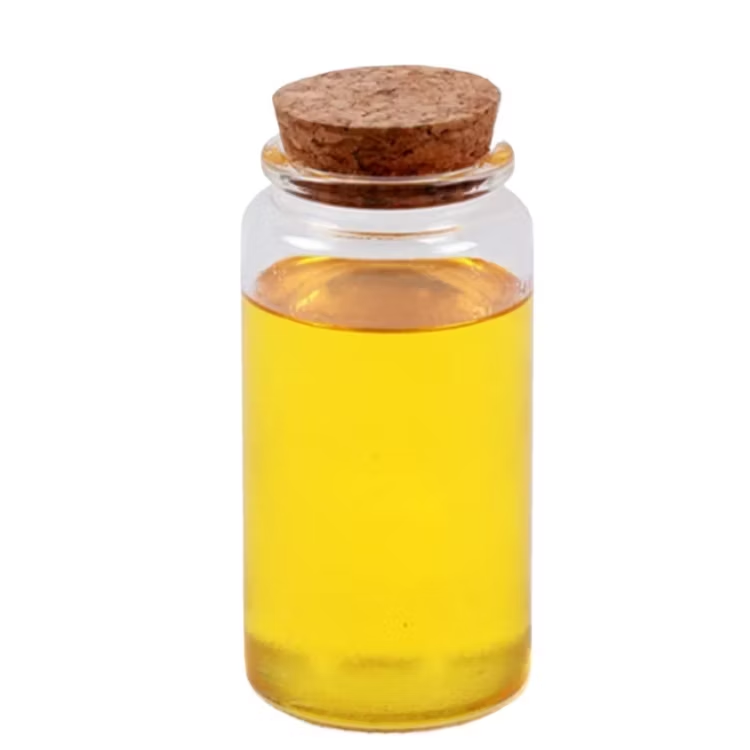
In large-scale food and industrial manufacturing, choosing the right emulsifier supplier can influence far more than product texture — it can determine process stability, cost efficiency, and long-term brand reputation. When procurement teams begin evaluating Sorbitan Monooleate E494 Wholesale options, the conversation quickly moves beyond price into questions of consistency, regulatory compliance, and supply reliability. This is precisely why many manufacturers consider sourcing through experienced distributors such as MT Royal, which provides access to multiple brands, competitive pricing structures, and dependable logistics networks tailored for industrial buyers.
Sorbitan Monooleate E494 plays a critical role across food, cosmetics, pharmaceuticals, and specialty chemical sectors, yet its sourcing is often underestimated. For factories operating high-volume production lines, the wrong emulsifier specification can create ripple effects — from viscosity fluctuations to unexpected downtime. Understanding the technical, operational, and procurement dimensions of Sorbitan Monooleate E494 Wholesale is therefore essential for decision-makers aiming to optimize both performance and profitability.
Understanding Sorbitan Monooleate E494: Definition and Industrial Fundamentals
Sorbitan Monooleate, commonly identified as E494, is a non-ionic surfactant derived from sorbitol and oleic acid. It belongs to the sorbitan ester family and functions primarily as a water-in-oil emulsifier. Its chemical structure provides excellent interfacial tension reduction, allowing immiscible phases to combine into stable systems.
From a manufacturing perspective, the key characteristics include:
• High emulsification efficiency in fat-rich formulations
• Thermal stability across moderate processing temperatures
• Compatibility with other emulsifiers such as polysorbates
• Controlled hydrophilic-lipophilic balance (HLB value around 4.3)
• Low toxicity and regulatory acceptance in multiple markets
These properties make Sorbitan Monooleate E494 Wholesale particularly valuable in applications where stable fat dispersion is critical.
Industrial Applications Across Sectors
While many procurement managers associate E494 primarily with food production, its industrial reach is broader:
Food industry
Used in margarine, bakery creams, chocolate fillings, whipped toppings, and confectionery coatings to improve texture and prevent phase separation.
Cosmetics and personal care
Functions as an emulsifying agent in creams, lotions, and ointments, providing smooth application and stability.
Pharmaceutical formulations
Acts as a solubilizer and stabilizer in drug delivery systems.
Industrial chemicals
Applied in lubricants, coatings, and agrochemical formulations where dispersion is required.
Because of this cross-industry demand, global supply chains for Sorbitan Monooleate E494 Wholesale have expanded significantly over the past decade.
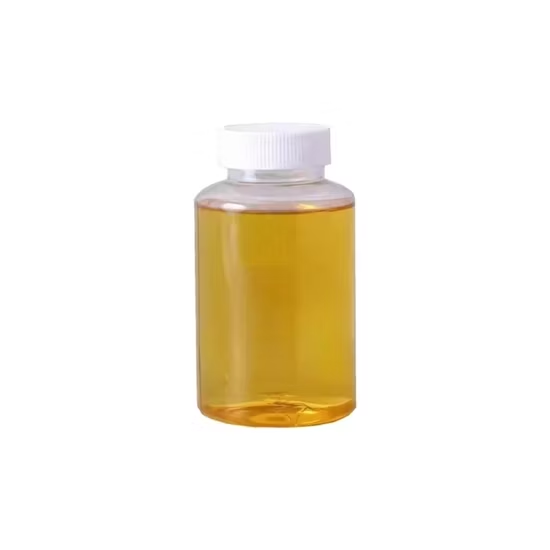
Why Sorbitan Monooleate E494 Wholesale Matters for Manufacturers
In high-volume production environments, ingredient consistency is not a luxury — it is a requirement. Even minor variations in emulsifier purity or fatty acid composition can alter final product characteristics.
Procurement teams often focus on cost per kilogram, but experienced manufacturers evaluate broader economic factors:
• Production efficiency impact
• Waste reduction potential
• Shelf-life improvements
• Process stability
• Energy consumption during mixing
In our collaboration with various factories, we have seen that switching to a more consistent Sorbitan Monooleate supplier reduced batch rejection rates by up to 18 percent. That level of improvement translates directly into profitability.
Key Technical Properties Buyers Should Evaluate
When sourcing Sorbitan Monooleate E494 Wholesale, technical specifications should be carefully reviewed rather than assumed.
Important parameters include:
HLB Value
Determines emulsification behavior and compatibility with other surfactants.
Acid Value
Indicates free fatty acid content and affects product stability.
Saponification Value
Provides insight into molecular composition and purity.
Moisture Content
High moisture levels can reduce shelf stability.
Peroxide Value
Critical for oxidation stability, especially in food applications.
Appearance and Color
Important for cosmetic and food formulations requiring visual consistency.
Factories that ignore these parameters often encounter formulation challenges later.
Common Mistakes in Industrial Sourcing of Sorbitan Monooleate
Even experienced procurement teams occasionally make avoidable mistakes when purchasing emulsifiers.
Focusing Only on Price Per Ton
Lower prices may reflect lower purity, inconsistent fatty acid profiles, or inadequate quality control. The resulting production inefficiencies often exceed initial savings.
Ignoring Batch-to-Batch Consistency
Consistency is crucial for automated production lines. Suppliers with weak quality management systems can introduce variability that disrupts operations.
Overlooking Regulatory Documentation
Incomplete certificates such as COA, MSDS, halal certification, or food safety compliance can create regulatory risks.
Inadequate Storage Planning
Sorbitan Monooleate requires proper temperature control to maintain quality. Poor storage conditions can degrade performance before use.
Choosing Suppliers Without Logistics Expertise
Delayed shipments or improper packaging can halt production schedules, particularly in just-in-time manufacturing systems.
Comparing Sorbitan Monooleate with Other Emulsifiers
Manufacturers often evaluate E494 alongside other emulsifiers such as polysorbates or lecithin.
Key comparative insights:
Sorbitan Monooleate vs Polysorbate 80
Sorbitan Monooleate offers stronger water-in-oil emulsification, while Polysorbate 80 is better for oil-in-water systems.
Sorbitan Monooleate vs Lecithin
Lecithin is natural and label-friendly but less stable under certain processing conditions.
Sorbitan Monooleate vs Mono- and Diglycerides
Mono- and diglycerides provide aeration benefits but may not deliver the same emulsification strength in fat-dominant systems.
The optimal choice depends on formulation requirements rather than general preference.
Industrial Tips for Large-Scale Production
Efficient integration of Sorbitan Monooleate E494 Wholesale into manufacturing processes requires more than simply adding it to the formulation.
Temperature Control During Mixing
E494 dissolves more effectively in oil phases at elevated temperatures. Preheating oils to 60–70°C can improve dispersion.
Shear Optimization
High-shear mixers enhance emulsifier distribution, reducing processing time.
Synergistic Emulsifier Systems
Combining Sorbitan Monooleate with polysorbates can create more stable emulsions due to complementary HLB values.
Storage Considerations
Maintain storage temperatures between 20–30°C to prevent crystallization or viscosity changes.
Shelf-Life Management
First-in, first-out inventory management helps maintain optimal performance.
We have observed that factories implementing these process optimizations often reduce mixing times by 10–15 percent, which significantly improves throughput.
Market Trends Influencing Sorbitan Monooleate E494 Wholesale
Global emulsifier markets continue to evolve due to consumer preferences, regulatory changes, and technological innovation.
Clean Label Pressure
While E494 remains widely accepted, some brands are exploring alternatives perceived as more natural. However, performance requirements often maintain demand for synthetic emulsifiers.
Growth in Processed Foods
Urbanization and convenience food demand continue to increase emulsifier consumption worldwide.
Expansion in Cosmetic Applications
Personal care formulations increasingly rely on stable emulsification systems.
Supply Chain Diversification
Manufacturers are diversifying suppliers to reduce geopolitical and logistics risks.
Industry analysts estimate the global emulsifier market will grow at approximately 6–7 percent annually through the next decade.
Logistics and Packaging Considerations in Wholesale Purchasing
Bulk procurement requires attention to packaging and transportation conditions.
Common packaging formats include:
• 25 kg drums
• 200 kg barrels
• Intermediate bulk containers (IBCs)
• Flexitanks for large shipments
Transportation conditions should prevent exposure to extreme temperatures, which may alter viscosity.
Reliable distributors help coordinate these logistics to avoid operational disruptions.
Quality Assurance and Certification Requirements
For food and pharmaceutical manufacturers, compliance documentation is non-negotiable.
Important certifications may include:
• ISO quality management systems
• HACCP or FSSC food safety certification
• Halal and kosher compliance
• REACH registration for European markets
• FDA compliance for US markets
Procurement managers should verify documentation authenticity rather than relying solely on supplier claims.
Cost Optimization Strategies for Bulk Buyers
Purchasing Sorbitan Monooleate E494 Wholesale efficiently involves strategic planning beyond negotiation.
Effective strategies include:
Long-term supply agreements
Provide price stability and priority allocation during shortages.
Forecast-based ordering
Reduces emergency purchases at higher prices.
Supplier diversification
Mitigates risks associated with single-source dependency.
Inventory optimization
Balances carrying costs with supply security.
Transportation consolidation
Reduces freight expenses for multinational manufacturers.
In our experience working with procurement teams, companies that adopt structured sourcing strategies often reduce total ingredient costs by 8–12 percent annually.
Frequently Asked Questions from Factory Managers
How do we determine the right dosage level?
Dosage depends on formulation type, fat content, and desired texture. Pilot testing is recommended before full-scale production.
Can Sorbitan Monooleate be combined with other emulsifiers?
Yes. It is frequently used with polysorbates, lecithin, or mono- and diglycerides for improved performance.
What is the typical shelf life?
Most products have a shelf life of 24 months when stored properly.
Does E494 affect flavor?
At recommended levels, it has minimal sensory impact.
What causes crystallization during storage?
Low temperatures can increase viscosity or cause partial solidification. Gentle warming restores fluidity.
Is it suitable for vegan products?
Yes, provided the fatty acid source is plant-derived.
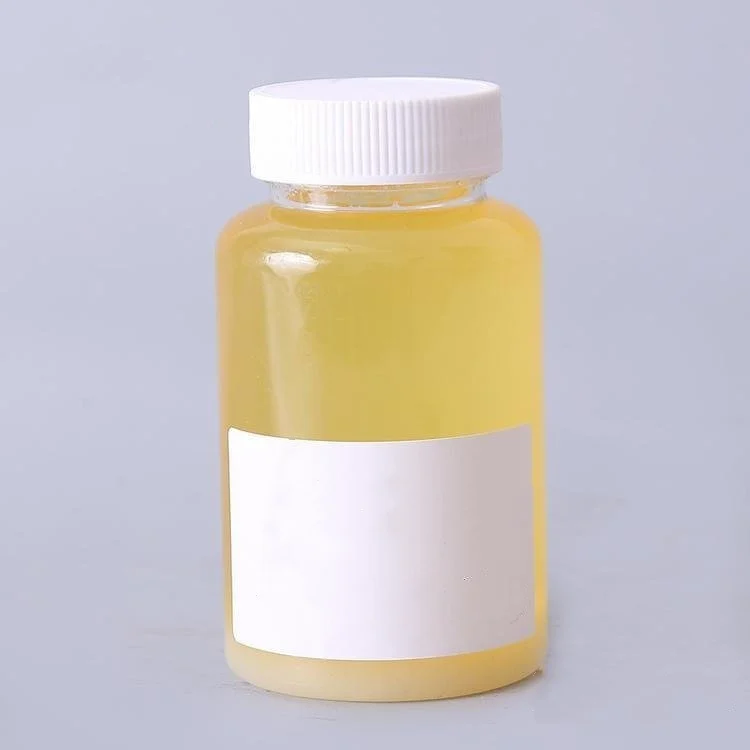
Choosing the Right Sorbitan Monooleate E494 Wholesale Supplier
Selecting a supplier involves evaluating multiple factors:
Technical support capability
Suppliers who understand formulations can help solve production challenges.
Supply reliability
Consistent availability prevents downtime.
Quality consistency
Strong manufacturing controls ensure stable performance.
Competitive pricing
Balanced with quality and logistics efficiency.
Documentation transparency
Essential for regulatory compliance.
Experienced distributors offering multiple brands provide flexibility and negotiation leverage for buyers.
The Strategic Role of Emulsifiers in Competitive Manufacturing
Emulsifiers like Sorbitan Monooleate often represent a small fraction of total formulation cost but exert a disproportionately large influence on product quality and production efficiency.
Consider the analogy of industrial lubrication: a tiny amount of the right lubricant prevents massive mechanical failure. Similarly, the right emulsifier ensures process harmony.
Factories that treat emulsifier sourcing as a strategic decision rather than a commodity purchase gain measurable competitive advantages.
Looking Ahead: Innovation and Future Opportunities
Research continues into improved surfactant systems with enhanced sustainability profiles and performance characteristics.
Emerging areas include:
• Bio-based emulsifiers with lower environmental impact
• Nano-emulsion technologies
• Precision emulsifier blends tailored to specific applications
• Advanced manufacturing methods improving purity and consistency
Manufacturers staying informed about these developments can maintain technological leadership in their markets.
A Final Perspective for Procurement Decision-Makers
Every production manager has experienced the frustration of a batch that refuses to stabilize or a line that suddenly behaves unpredictably. In many cases, the root cause traces back to ingredient consistency rather than equipment or operator error.
Choosing the right Sorbitan Monooleate E494 Wholesale partner is less about purchasing an emulsifier and more about securing operational stability. Reliable supply chains, consistent quality, and technical understanding transform a simple ingredient into a foundation for predictable manufacturing success.
When procurement teams evaluate suppliers through this broader lens, they move from reactive purchasing toward strategic sourcing — and that shift often defines which manufacturers thrive in competitive markets and which struggle to keep pace.
LATAMARKO LM60 – Premium Spanish-Origin Cocoa Powder
latamarko alkalized cocoa powder lm60
cocoa powder for chocolate production-Best price
Food industry raw materials – list of products
Types of Gelatin from Turkish Manufacturer


No comment