

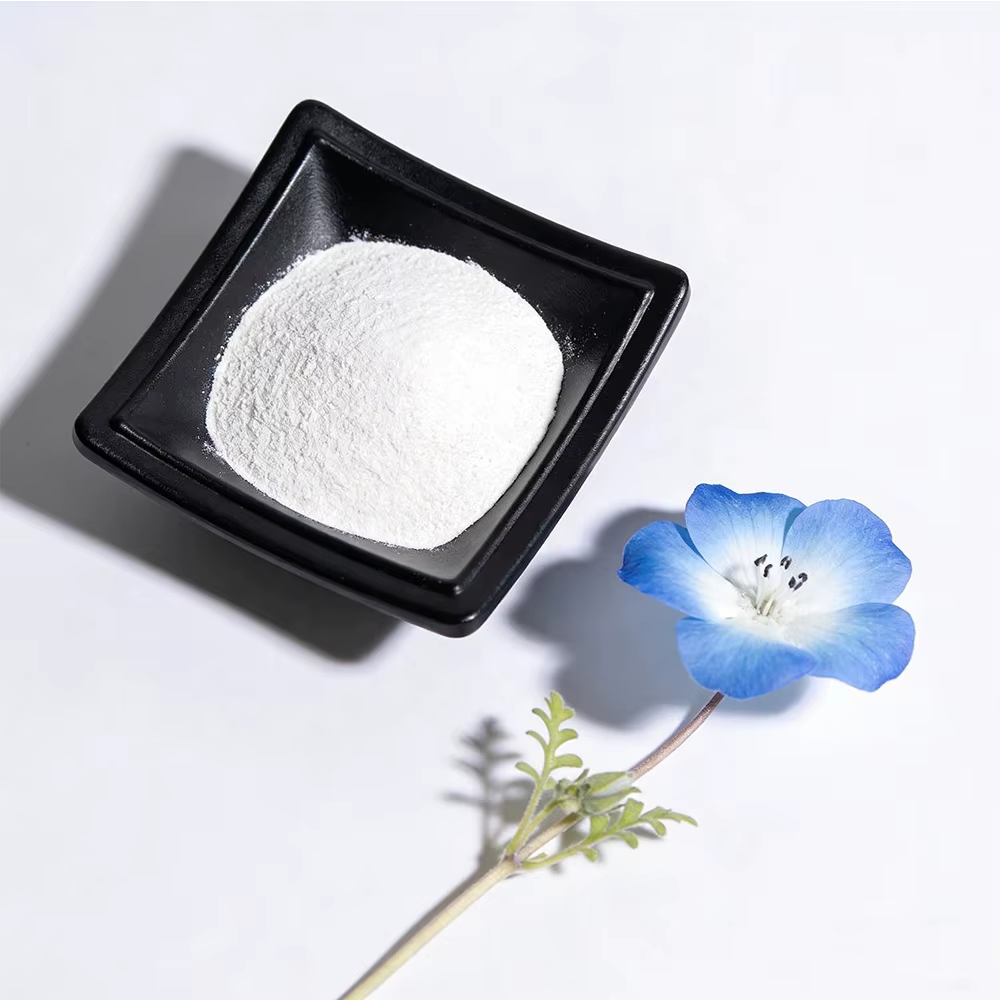
In industrial production, every ingredient plays a pivotal role in shaping final product quality, process efficiency, and consumer satisfaction. Among stabilizers, alginic acid — recognized as E400 — has emerged as a cornerstone for diverse food, pharmaceutical, and industrial applications. Choosing the right Stabilizer Alginic Acid E400 Supplier is more than a procurement decision; it is a strategic partnership that can influence formulation consistency, production efficiency, and long-term operational reliability.
Factories sourcing high-quality alginic acid increasingly turn to experienced distributors such as MT Royal. Known for offering multiple brands at competitive prices, MT Royal supports manufacturers with consistent supply, detailed technical guidance, and responsive logistics solutions. Aligning with such suppliers ensures not only product availability but also enhanced technical performance across complex production environments.
Whether your factory produces beverages, dairy alternatives, confectionery, sauces, or pharmaceutical formulations, understanding the functional nuances of alginic acid and its industrial sourcing dynamics is crucial for achieving optimal results. This guide will explore its chemistry, industrial applications, sourcing strategies, processing insights, and emerging trends, offering actionable intelligence for procurement teams, production engineers, and R&D specialists.
Understanding Alginic Acid E400: Definition, Properties, and Functional Importance
Alginic acid is a natural polysaccharide extracted from brown seaweed. Classified as E400 in food additives, it serves as a stabilizer, thickener, gelling agent, and emulsifier across a variety of industries. Its unique molecular structure — composed primarily of mannuronic acid and guluronic acid residues — provides predictable gel formation, water-binding capacity, and viscosity control.
From an industrial standpoint, its importance stems from several key properties:
- High water-binding capacity: Alginic acid can retain multiple times its weight in water, enhancing moisture stability in beverages, gels, and sauces.
- Thermal resilience: It maintains functionality under pasteurization, sterilization, and UHT processes, making it suitable for industrial-scale production.
- Emulsion stabilization: By interacting with cations, alginic acid improves the stability of oil-in-water systems.
- Texture and mouthfeel modification: It enables smooth, consistent textures in dairy, plant-based alternatives, and desserts.
- Clean-label potential: Derived from natural seaweed, it aligns with consumer demand for recognizable ingredients.
A competent Stabilizer Alginic Acid E400 Supplier should provide detailed data on molecular weight distribution, viscosity grades, and ionic interaction profiles, allowing factories to select the appropriate grade for each application.
Industrial Advantages of Using Alginic Acid in Manufacturing
Manufacturers increasingly rely on alginic acid because of its efficiency, versatility, and predictable behavior:
- Dosage efficiency: Alginic acid delivers functional performance at lower concentrations than many traditional stabilizers, reducing ingredient cost per batch.
- Process adaptability: It is compatible with a wide range of temperatures, pH levels, and ionic conditions, making it suitable for complex industrial processes.
- Shelf-life enhancement: Water retention and stabilization properties help reduce syneresis, sedimentation, and texture degradation over time.
- Formulation flexibility: It works synergistically with other hydrocolloids like carrageenan, guar gum, or xanthan, allowing precise texture control.
- Nutritional functionality: In functional foods or nutraceuticals, alginic acid contributes soluble fiber and potential satiety benefits.
In our collaboration with various factories, we have seen that integrating high-quality alginic acid into formulations often reduces batch-to-batch variability and minimizes production adjustments, resulting in more reliable product consistency.
Industrial Applications of Alginic Acid E400
The functional versatility of alginic acid allows its application across multiple industries:
Beverages and Nutritional Drinks
Alginic acid improves suspension stability in beverages with pulp, protein, or mineral particles. Its ability to form a weak gel network prevents sedimentation without increasing viscosity excessively, preserving the drinkable texture.
Dairy and Plant-Based Alternatives
In dairy systems, it prevents whey separation, enhances creaminess, and maintains consistent viscosity. In plant-based milks and yogurts, it stabilizes protein dispersions and contributes to a smooth mouthfeel.
Confectionery
Alginic acid is widely used in jellies, gummy candies, and gelled desserts. It allows controlled gel firmness, high clarity, and thermal resistance during production.
Sauces, Dressings, and Culinary Preparations
It provides viscosity control, emulsion stabilization, and freeze-thaw stability, supporting large-scale production of sauces, gravies, and prepared foods.
Pharmaceutical and Nutraceutical Formulations
Its water-binding capacity and gel-forming behavior make it valuable for controlled-release tablets, oral suspensions, and functional fiber supplements.
Common Sourcing Challenges and Mistakes
Even experienced procurement teams can encounter challenges when sourcing alginic acid from international suppliers. Avoidable mistakes include:
- Focusing solely on price per kilogram: Lower-cost material may compromise molecular consistency, viscosity, or gel strength, increasing dosage needs.
- Neglecting batch-to-batch variability: Differences in molecular weight or cation interaction can disrupt production.
- Skipping application-specific trials: Each formulation behaves differently; pre-production testing is critical.
- Underestimating logistics conditions: Packaging, humidity, and transit conditions affect powder flow and stability.
- Insufficient supplier qualification: Lack of technical support, certificates, or traceability can create compliance and operational risks.
A supplier like MT Royal mitigates these risks through documented quality control, multiple product grades, and technical guidance, ensuring reliable industrial performance.
Technical Selection Criteria for Manufacturers
Evaluating a Stabilizer Alginic Acid E400 Supplier requires examining multiple technical factors, each influencing large-scale production:
- Viscosity profile: Determines textural behavior and mixing efficiency.
- Gel strength and cation sensitivity: Essential for precise gelling in food or pharma systems.
- Solubility and hydration rate: Fast and uniform hydration reduces mixing time and energy consumption.
- Molecular weight distribution: Impacts viscosity, gelation, and emulsion stabilization.
- Particle size and flow characteristics: Ensures smooth handling and minimizes dust.
- Microbiological and chemical stability: Critical for regulatory compliance and shelf life.
Understanding these parameters helps factories select the grade that aligns with their specific production needs.
Practical Industrial Tips for Large-Scale Processing
Even premium alginic acid requires proper handling for optimal performance:
- Pre-blending: Mix alginic acid with dry ingredients to prevent lump formation during hydration.
- Temperature control: Hydration may require moderate heat; excessive shear should be avoided to maintain gel integrity.
- Cation management: Calcium and other ions influence gel strength; water chemistry must be considered.
- Sequential addition: Incorporating flavors, oils, or active compounds after hydration enhances emulsion stability.
- Storage: Maintain low humidity and sealed containers to preserve flow properties and shelf life.
In our experience with multiple production facilities, optimizing these operational parameters often improves product consistency more than simply changing suppliers.
Emerging Market Trends and Industrial Implications
The global hydrocolloid market, including alginic acid, is growing steadily due to:
- Rising demand for plant-based and functional foods
- Clean-label consumer preferences
- Sugar-reduced and low-calorie formulations requiring texture stabilization
- Growth in nutraceutical and pharmaceutical applications
Projections indicate an annual growth rate of 4–6% for hydrocolloids, with alginic acid among the most versatile and in-demand stabilizers due to its unique combination of functionality and natural origin.
Multi-Brand Supplier Advantages
Working with a supplier offering multiple brands provides strategic benefits:
- Pricing flexibility: Access to different grades enables cost optimization.
- Supply continuity: Alternative sources prevent production interruptions.
- Formulation customization: Different grades suit specific product types.
- Technical support: Experienced exporters guide dosage, hydration, and compatibility.
MT Royal, for example, supports factories with diverse product portfolios and technical guidance, ensuring both operational stability and strategic flexibility.
Frequently Asked Questions
- What is the typical dosage range?
0.2% to 1.0% is common in beverages; gels and confectionery may require higher percentages. - Is alginic acid suitable for acidic systems?
Yes, it tolerates pH ranges typical in fruit juices, nutritional beverages, and dairy alternatives. - Can it replace other hydrocolloids?
Often yes, especially when precise gelation or emulsion stabilization is required, but formulation testing is recommended. - What is the typical shelf life?
Generally 24 months in dry, sealed storage conditions. - Is it heat stable?
Yes; suitable for pasteurization and UHT processes.
Strategic Value of Choosing the Right Supplier
Stabilizers like alginic acid may represent a small fraction of production cost, but their impact on texture, stability, and process efficiency is disproportionately large. Selecting a knowledgeable, multi-brand Stabilizer Alginic Acid E400 Supplier transforms an ordinary ingredient purchase into a strategic operational advantage.
Factories that prioritize technical compatibility, reliable supply, and long-term partnership value often achieve reduced batch-to-batch variability, cost efficiency, and improved market competitiveness. The right supplier is not just a vendor; they become an integral part of production reliability and formulation innovation.
LATAMARKO LM60 – Premium Spanish-Origin Cocoa Powder
latamarko alkalized cocoa powder lm60
cocoa powder for chocolate production-Best price
Food industry raw materials – list of products
Types of Gelatin from Turkish Manufacturer
Alkalized Cocoa Powder Price: Complete Buyer Guide for 2026



No comment