

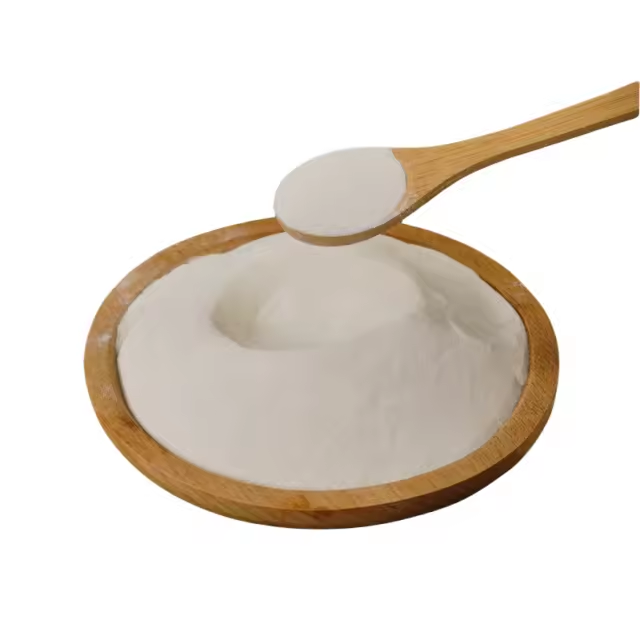
In modern food and beverage manufacturing, consistency, texture, and stability are non-negotiable. When your production line relies on precise viscosity and gel formation, the quality of your stabilizer determines product performance, shelf life, and customer satisfaction. Choosing the right Stabilizer Carrageenan E407 Exporter is therefore not just a purchasing decision—it is a strategic operational choice that can influence efficiency, yield, and profitability.
Factories increasingly rely on suppliers like MT Royal for their global sourcing needs. Beyond competitive pricing, exporters must offer consistent quality, technical support, and multi-brand options, ensuring your production remains uninterrupted, even during supply chain challenges.
This guide explores carrageenan E407 from a technical, operational, and procurement perspective, providing industrial-grade insights for factory managers, R&D teams, and procurement professionals.
Understanding Stabilizer Carrageenan E407: Industrial Relevance
Carrageenan E407 is a natural polysaccharide extracted from red seaweed, primarily Kappaphycus alvarezii and Eucheuma species. As a hydrocolloid, it is widely used for its stabilizing, gelling, and thickening properties.
Key Functions in Industrial Applications:
- Gelling Agent: Forms stable gels, critical for desserts, meat products, and plant-based alternatives.
- Texture Modifier: Enhances mouthfeel, creaminess, and structural integrity.
- Emulsifier: Stabilizes fat-water mixtures, preventing separation in dairy or sauces.
- Suspension Aid: Maintains uniform distribution of solids in liquids, such as chocolate milk or protein beverages.
- Moisture Retention: Reduces water loss in processed meats, baked goods, and frozen products.
Types of Carrageenan E407
Understanding the type is crucial for industrial applications:
| Type | Gel Properties | Common Applications |
|---|---|---|
| Kappa | Firm, brittle gels (potassium-dependent) | Dairy desserts, processed cheese, meat gels |
| Iota | Soft, elastic gels (calcium-dependent) | Whipped toppings, flexible gelatin desserts |
| Lambda | Thickening without gelling | Beverages, sauces, soups |
Selecting the correct type ensures your end product meets both quality standards and consumer expectations.
The Importance of Choosing the Right Exporter
The sourcing of carrageenan E407 is more than a procurement task. Quality varies due to:
- Seaweed origin and harvest conditions
- Extraction and refinement methods
- Particle size distribution
- Microbiological control and purity
- Compliance with international regulations
An experienced Stabilizer Carrageenan E407 Exporter ensures:
- Consistent batch-to-batch specifications
- Certificates of Analysis (COA), MSDS, and regulatory documentation
- Application guidance for R&D and production teams
- Flexible logistics to prevent downtime
In our collaboration with multiple factories, we have seen how minor variations in gel strength or sulfate content can disrupt production cycles, especially in high-speed automated lines.
Industrial Applications of Carrageenan E407
Dairy Processing
Carrageenan binds with milk proteins, improving suspension and preventing phase separation. Applications include:
- Chocolate milk and flavored beverages
- Yogurt drinks
- Ice cream and cream desserts
- Processed cheese
Technical Insight: Carrageenan reinforces the protein network (especially casein micelles), creating stable systems with improved viscosity and mouthfeel.
Meat Processing
In meat products, carrageenan enhances water-binding, texture, and sliceability:
- Increases yield during cooking
- Reduces purge in packaging
- Improves chewiness and mouthfeel
Industrial Tip: Using kappa/iota blends can optimize both firmness and elasticity in processed meat gels.
Beverage Stabilization
Lambda carrageenan prevents sedimentation in cocoa drinks, plant protein shakes, and fortified beverages without creating heaviness.
Plant-Based Products
The growth of plant-based dairy and meat alternatives has made carrageenan critical in:
- Vegan cheeses and spreads
- Almond, soy, or oat-based drinks
- Meat analogues
Global trends show plant-based foods exceeding $160 billion in market value by 2030, driving increased demand for consistent carrageenan supply.
Common Sourcing Mistakes to Avoid
Even experienced factories make errors in procurement:
- Choosing solely based on price: Low-cost carrageenan often compromises gel strength and uniformity.
- Using inappropriate grades: Dairy-grade vs. meat-grade vs. beverage-grade are not interchangeable.
- Neglecting technical support: Lack of guidance can lead to trial-and-error and wasted production time.
- Overlooking supply chain stability: Seasonal seaweed harvests and geopolitical issues can disrupt delivery.
Checklist for Evaluating a Stabilizer Carrageenan E407 Exporter
This checklist ensures you source high-quality carrageenan for industrial applications. Each item includes an explanation relevant to large-scale production.
1. Gel Strength Verification
- Explanation: Determines firmness and texture; critical for desserts and meat products.
- Action: Confirm COA values against your product specifications.
2. Viscosity Consistency
- Explanation: Impacts pumpability and flow in production lines.
- Action: Conduct in-house viscosity tests across multiple batches.
3. Particle Size Distribution
- Explanation: Smaller particles hydrate faster, reducing mixing time.
- Action: Request particle size data and dispersion tests.
4. Mineral Interaction Profile
- Explanation: Carrageenan reacts with calcium/potassium, affecting gelation.
- Action: Check ion sensitivity data and adjust water hardness if necessary.
5. Microbiological and Purity Standards
- Explanation: Ensures safety, shelf-life, and performance.
- Action: Review ISO, HACCP certifications and batch microbiological reports.
6. Storage and Shelf-Life Specifications
- Explanation: Moisture exposure reduces functionality.
- Action: Maintain warehouse humidity per supplier recommendations.
7. Application-Specific Grade
- Explanation: Different grades are optimized for dairy, meat, or beverages.
- Action: Match grade to your product type and request supplier guidance.
8. Supply Chain Reliability
- Explanation: Prevents production downtime.
- Action: Evaluate exporter’s sourcing network, inventory strategy, and backup suppliers.
9. Technical Support Availability
- Explanation: Provides mixing, hydration, and process optimization guidance.
- Action: Ensure application guides and on-demand consultation are available.
10. Regulatory Compliance
- Explanation: Compliance with FDA, EFSA, Halal, and Kosher is critical for global markets.
- Action: Verify certifications and documentation for your target regions.
Industrial Tips for Optimizing Carrageenan Performance
Hydration Control
Proper hydration above 70°C ensures full gel development. Incomplete hydration leads to graininess and inconsistent viscosity.
Shear Management
High shear improves dispersion, but excessive shear after gelation can damage structure. Control timing carefully.
Ion Monitoring
Water hardness can alter gel strength; test production water regularly and adjust ion content.
Hydrocolloid Synergies
Combining carrageenan with locust bean gum, xanthan, or guar can enhance elasticity, viscosity, and mouthfeel while reducing ingredient cost.
Storage Considerations
Store in low-humidity, temperature-controlled conditions to maintain functional integrity.
Frequently Asked Questions (FAQs)
Q1: What differentiates kappa, iota, and lambda carrageenan in production?
A1: Kappa forms firm gels, iota produces elastic gels, and lambda increases viscosity without gelling. Choose based on product texture requirements.
Q2: Can carrageenan be used in plant-based dairy alternatives?
A2: Yes. It replicates dairy texture and stabilizes protein suspensions in vegan milk, cheese, and yogurts.
Q3: How do I ensure batch-to-batch consistency?
A3: Work with exporters providing COA, viscosity curves, particle size distribution, and technical support.
Q4: What common production issues arise from low-quality carrageenan?
A4: Syneresis, inconsistent texture, increased dosage requirements, pump clogging, and potential customer complaints.
Q5: How do minerals in water affect carrageenan?
A5: Calcium and potassium ions can increase or decrease gel strength. Adjust water hardness and consider formulation synergy.
Final Industrial Insights
The selection of a Stabilizer Carrageenan E407 Exporter goes far beyond price. For large-scale food and beverage manufacturers, reliability, technical guidance, regulatory compliance, and batch consistency are paramount. Working with a versatile, experienced supplier like MT Royal allows factories to access multiple brands, receive detailed application support, and maintain uninterrupted production—even in fluctuating global markets.
When sourcing carrageenan, consider it an investment in operational efficiency, product quality, and long-term reliability. The right choice today reduces reformulation costs, prevents line stoppages, and ensures your end products consistently meet consumer expectations.
LATAMARKO LM60 – Premium Spanish-Origin Cocoa Powder
latamarko alkalized cocoa powder lm60
cocoa powder for chocolate production-Best price
Food industry raw materials – list of products
Types of Gelatin from Turkish Manufacturer
Alkalized Cocoa Powder Price: Complete Buyer Guide for 2026

No comment