

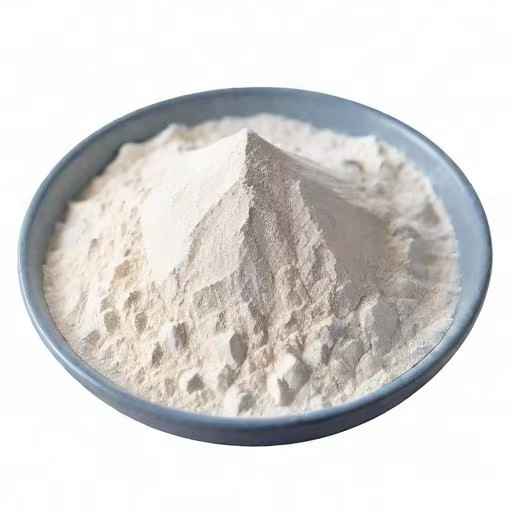
In high-volume manufacturing, stability is never accidental. It is engineered, tested, adjusted, and protected across thousands of production hours. Stabilizer Modified Starch E1404–E1450 plays a decisive role in that process. For factories producing sauces, dairy products, frozen foods, ready meals, beverages, and functional formulations, these modified starches are not optional ingredients—they are structural tools.
Manufacturers that understand how to select and use the correct modified starch gain something extremely valuable: predictability. Predictable viscosity. Predictable texture. Predictable shelf life. And ultimately, predictable cost control.
At MT Royal, working closely with producers across different sectors, we have repeatedly seen how the right stabilizer choice quietly eliminates formulation instability, reduces batch variation, and simplifies scale-up. This article is designed to give you a complete, practical understanding of Stabilizer Modified Starch E1404–E1450, from fundamentals to advanced industrial considerations, so your factory can make decisions with confidence rather than trial-and-error.
Understanding Modified Starch in an Industrial Context
Modified starch is starch that has been physically, chemically, or enzymatically altered to improve performance under conditions where native starch fails. While natural starch performs adequately in simple applications, it quickly breaks down under industrial stress.
Common challenges for native starch include:
- Viscosity breakdown under heat
- Loss of structure under high shear
- Syneresis during storage
- Texture degradation after freeze–thaw cycles
- Inconsistent behavior across pH ranges
Stabilizer Modified Starch E1404–E1450 addresses these weaknesses by design. Each E-number represents a specific modification strategy that enhances stability, resilience, or functional control.
Why the E1404–E1450 Range Is So Widely Used
The E1404–E1450 group covers multiple functional classes of modified starches, all approved for food use in major global markets. Their widespread adoption is driven by three industrial realities:
- Processing intensity has increased
Modern production lines use higher temperatures, faster mixing, and more aggressive homogenization than ever before. - Shelf-life expectations are longer
Products must remain stable for months, not weeks, often across variable storage conditions. - Cost efficiency matters more than ingredient minimalism
Manufacturers need reliable performance with minimal rework, waste, or reformulation.
Modified starches in this category allow producers to meet these expectations without compromising sensory quality.
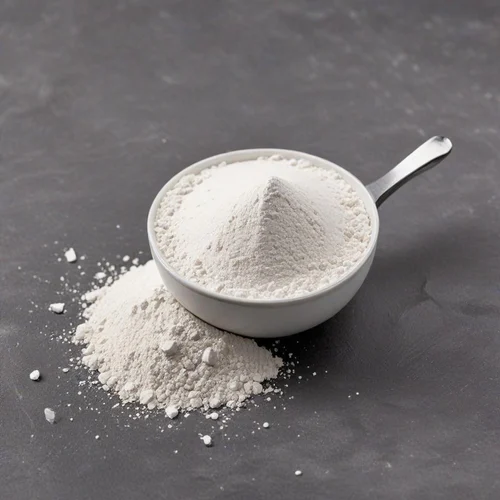
Functional Classification of Stabilizer Modified Starch E1404–E1450
Although grouped together, E1404–E1450 starches are not interchangeable. Selecting the wrong type is one of the most common formulation errors we see.
E1404 – Oxidized Starch
Oxidized starch offers lower viscosity and improved clarity. It is typically used in:
- Clear sauces
- Fruit preparations
- Dessert glazes
- Beverages requiring controlled flow
Its main advantage lies in visual appearance and smooth mouthfeel, rather than structural strength.
E1412 / E1414 – Phosphated Starches
These starches are designed for thermal and mechanical stability. They perform well in:
- Retorted products
- High-shear mixing environments
- Dairy-based sauces
- Processed cheese systems
Factories using intensive heat treatment often rely on phosphated starches to maintain viscosity throughout processing.
E1422 – Acetylated Distarch Adipate
One of the most widely used stabilizer starches globally, E1422 is valued for:
- Freeze–thaw stability
- Resistance to retrogradation
- Long-term texture retention
It is common in frozen meals, cream-based sauces, and ready-to-eat products.
E1442 – Hydroxypropyl Distarch Phosphate
This starch combines multiple modifications for maximum robustness. It performs exceptionally well in:
- Acidic formulations
- Long shelf-life products
- High-water systems
For manufacturers producing export-grade products, E1442 is often the safest choice.
Key Industrial Benefits for Manufacturers
Process Stability
Modified starches reduce viscosity fluctuations during production, which simplifies pump calibration, filling accuracy, and downstream handling.
Texture Consistency
Uniform texture across batches improves consumer perception and reduces rejection rates.
Reduced Reformulation Risk
Once validated, modified starches behave consistently across seasons and raw material variations.
Cost Control
Although unit cost may be higher than native starch, overall formulation cost often decreases due to reduced waste and rework.
We have seen factories reduce batch failures simply by switching to a better-suited E-number rather than adjusting the entire formulation.
Common Sourcing Mistakes in Industrial Procurement
Despite their importance, stabilizer starches are frequently treated as commodities. This leads to several recurring problems:
Focusing Only on Price
Lower-priced starches often have inconsistent substitution levels, moisture variation, or poor documentation.
Ignoring Application-Specific Testing
A starch that performs well in one product may fail completely in another.
Overlooking Supplier Technical Support
When issues arise, lack of technical backup delays problem resolution.
At MT Royal, we emphasize matching application, process conditions, and supplier capability, not just specifications on paper.
Stabilizer Modified Starch vs Other Hydrocolloids
Modified starches are often compared to gums such as xanthan, guar, or carrageenan. Each has its place, but starch offers unique advantages:
- Cleaner flavor profile
- Better integration into carbohydrate-based systems
- Lower risk of over-thickening
- Familiar regulatory status across markets
In many formulations, starch works best as the backbone stabilizer, with gums used only for fine adjustment.
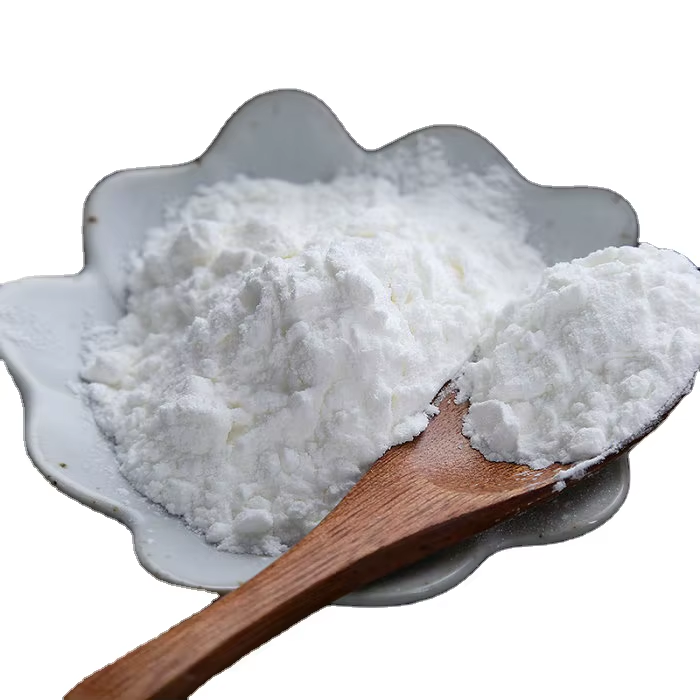
Industrial Scale Production Considerations
When producing at scale, small formulation decisions amplify quickly. Key considerations include:
Shear Sensitivity
Ensure the selected starch tolerates your mixing and homogenization equipment.
Thermal Profile
Different starches behave differently during heating and cooling cycles.
Water Quality
Mineral content can influence hydration and viscosity development.
Storage Conditions
Moisture control during storage directly impacts performance consistency.
These factors should be evaluated during pilot trials, not after full-scale production begins.
Regulatory and Labeling Considerations
All E1404–E1450 starches are approved additives, but labeling requirements vary by market. Manufacturers exporting internationally should ensure:
- Correct E-number declaration
- Compliance with local additive limits
- Proper documentation from suppliers
Reliable sourcing partners simplify this process significantly.
Frequently Asked Questions from Factory Managers
Can one modified starch replace multiple stabilizers?
In some systems, yes. Properly selected starches often reduce the need for additional gums.
Do modified starches affect flavor?
High-quality grades are neutral and designed not to interfere with taste.
Is higher dosage safer?
Overuse can negatively impact texture and cost. Optimization is key.
How stable are they during long storage?
Stability depends on the specific modification and formulation environment.
Strategic Sourcing: Why Supplier Choice Matters
Consistency in modified starch performance depends as much on sourcing as on formulation. Reliable suppliers provide:
- Stable quality across batches
- Transparent specifications
- Technical guidance when needed
At MT Royal, we work with multiple international brands and manufacturers to ensure factories receive starches that perform consistently under real industrial conditions. We have seen how the right sourcing decision quietly prevents months of troubleshooting later.
Looking Forward: Modified Starch in Modern Manufacturing
As clean-label pressure, cost optimization, and processing efficiency continue to shape product development, modified starches remain one of the most versatile tools available to manufacturers. Their ability to adapt to demanding environments while maintaining consumer-acceptable texture makes them indispensable.
Factories that treat Stabilizer Modified Starch E1404–E1450 as a strategic ingredient—not a commodity—gain long-term stability, operational efficiency, and formulation confidence. The difference is rarely visible on the label, but it is unmistakable on the production floor.


No comment