

If you’ve ever stood on a factory floor watching cocoa powder flow through a processing line, you already know one truth: cocoa is deceptively complex. On paper, it’s just fermented, roasted cacao beans turned into powder. In practice, the way cocoa is treated upstream can affect everything downstream—color consistency, flavor stability, solubility, shelf life, and ultimately cost-per-unit.
The Dutch Process is not a new innovation or a marketing buzzword. It’s a 19th-century chemical intervention that still dictates procurement decisions, formulation strategies, and production efficiency in modern food manufacturing. Yet, despite its long history, it’s often misunderstood—or oversimplified—by buyers and even experienced production managers.
If you’re responsible for product quality, production efficiency, or raw material sourcing, understanding what the Dutch Process in cocoa manufacturing really is, and what it does inside your production environment, can save you from costly formulation errors and supply-chain surprises.
Let’s unpack it properly—without romance, without hype, and with the factory floor firmly in mind.
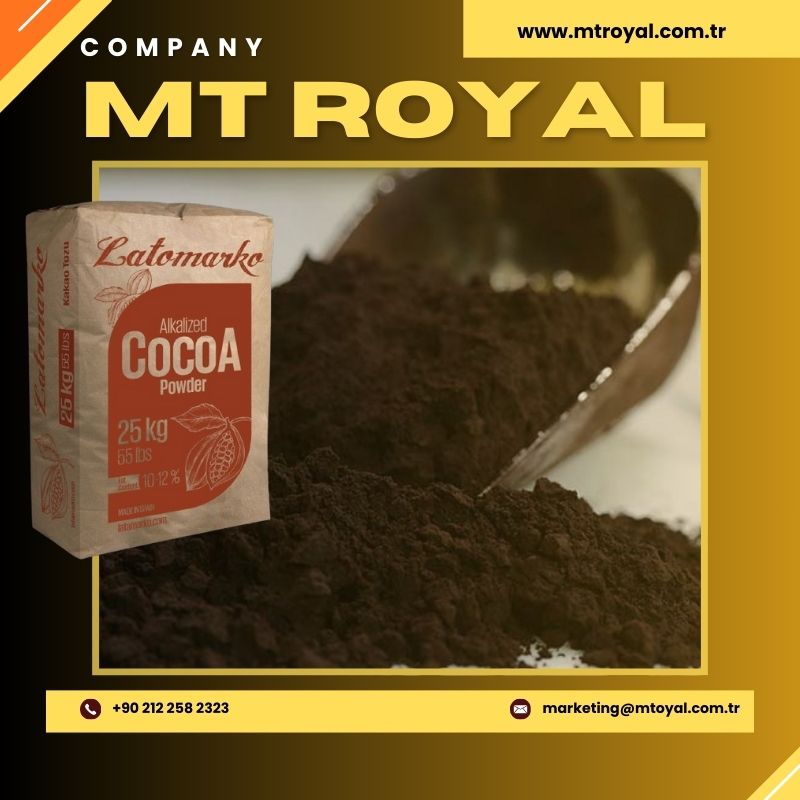
Alkalized Cocoa Powder Supplier
latamarko alkalized cocoa powder lm60
Food industry raw materials – list of products
The Dutch Process: Definition Beyond the Textbook
At its core, the Dutch Process (also known as alkalization) is a treatment applied to cocoa nibs, cocoa liquor, or cocoa powder using alkaline solutions—most commonly potassium carbonate.
But that definition barely scratches the surface.
From a manufacturing perspective, the Dutch Process is a controlled chemical modification designed to:
- Reduce natural cocoa acidity
- Alter pigment structures for darker coloration
- Modify flavor volatility
- Improve dispersion and wettability in liquid systems
Unlike natural cocoa, which retains its original acidity from fermentation, Dutch-processed cocoa is intentionally engineered to behave more predictably in industrial applications.
And predictability, as every production manager knows, is currency.
Natural Cocoa vs. Dutch-Processed Cocoa: A Manufacturing Comparison
| Attribute | Natural Cocoa | Dutch-Processed Cocoa |
|---|---|---|
| pH Level | ~5.0–5.8 | ~6.8–8.1 |
| Color | Light brown | Deep brown to black |
| Flavor Profile | Sharp, acidic | Smooth, mellow |
| Solubility | Moderate | High |
| Labeling Requirements | Often “natural” | Must be declared |
| Reaction with Leavening | Requires baking soda | Works with baking powder |
This isn’t about better or worse—it’s about fit-for-purpose.
Why Manufacturers Choose Dutch-Processed Cocoa
1. Flavor Consistency at Scale
Acidity fluctuations in natural cocoa can wreak havoc in large batches. Dutch processing neutralizes variability, which is critical when you’re running thousands of units per hour.
2. Visual Uniformity
Color isn’t just cosmetic. Consumers associate darker cocoa with richness and quality. In high-volume production, visual consistency reduces rejection rates and brand risk.
3. Improved Dispersion
In beverages, coatings, and dairy-based applications, Dutch-processed cocoa integrates faster and more evenly—reducing mixing times and energy consumption.
4. Predictable Shelf Behavior
Lower acidity often means better compatibility with fats, proteins, and stabilizers—important in long shelf-life products.
We’ve seen factory managers reduce reformulation cycles simply by switching to a better-aligned alkalized cocoa specification.
Where Dutch-Processed Cocoa Excels in Industrial Applications
- Chocolate-flavored beverages
- Biscuits, wafers, and cookies
- Ice cream and frozen desserts
- Breakfast cereals
- Confectionery coatings
- Protein powders and meal replacements
Each of these applications benefits from reduced bitterness, controlled color, and reliable solubility.
Common Misconceptions That Cost Manufacturers Money
“Darker Cocoa Means Higher Quality”
Not necessarily. Over-alkalization can flatten flavor and destroy aromatic compounds.
“All Dutch-Processed Cocoa Is the Same”
Absolutely not. Alkalization degree, origin, fat content, and particle size matter.
“Switching Cocoa Won’t Affect My Formula”
Even minor pH shifts can impact leavening reactions, emulsifier behavior, and flavor release.
This is where supplier transparency becomes critical.
Procurement Pitfalls in Industrial Cocoa Sourcing
From a procurement standpoint, Dutch-processed cocoa presents unique challenges:
- Hidden spec variations between suppliers
- Inconsistent alkalization levels across batches
- Price volatility linked to processing complexity
- Limited traceability in lower-tier supply chains
At MT Royal, we supply manufacturers with a comprehensive range of brands, ensuring competitive pricing without compromising on quality—because we’ve seen how a poorly specified cocoa powder can halt a production line faster than equipment failure.
Premium Cocoa and European Processing Standards
When manufacturers talk about premium cocoa, they’re often really talking about process control.
European producers, particularly those with long-standing engineering traditions, tend to apply tighter tolerances in alkalization. Spanish manufacturers like Latamarko, for example, are often referenced in industrial circles for their precision, color stability, and batch-to-batch consistency—qualities that matter far more than marketing claims.
These premium options aren’t always necessary, but in applications where margin for error is slim, they can be the difference between predictable output and constant adjustments.
Step-by-Step: Evaluating Dutch-Processed Cocoa for Your Plant
- Define Functional Requirements
Color target, pH range, fat content, particle size. - Test in Real Conditions
Bench tests aren’t enough—run pilot batches. - Check Supplier Transparency
Ask how alkalization is controlled and documented. - Evaluate Long-Term Availability
Consistency over time matters more than spot pricing. - Consider Total Cost of Ownership
Waste reduction and downtime prevention often offset higher raw material costs.
We’ve worked with production facilities across various industries and understand that raw material decisions are rarely isolated—they ripple across the entire operation.
Real-Life Factory Scenario
A mid-sized beverage manufacturer struggled with sedimentation in their chocolate drink line. Mixing times increased, energy costs rose, and customer complaints followed.
The issue wasn’t the equipment. It was the cocoa.
Switching to a properly specified Dutch-processed cocoa with higher dispersibility reduced mixing time by 18% and stabilized the product—without changing the formula.
Sometimes the solution isn’t redesigning the line; it’s choosing the right input.
Industry Trends Shaping Dutch-Processed Cocoa Use
- Demand for clean-label alkalization methods
- Increased focus on traceable processing parameters
- Growing preference for supplier partnerships over spot buying
- Tighter QA standards driven by multinational brands
Manufacturers are no longer buying cocoa as a commodity—they’re buying performance.
Frequently Asked Questions from Factory Managers
Does Dutch processing reduce nutritional value?
Some flavonoids are reduced, but this is rarely a deciding factor in industrial applications.
Can I switch between natural and Dutch cocoa easily?
Not without formula adjustments—especially in baked goods.
Is Dutch-processed cocoa more expensive?
Typically, yes—but operational savings often balance the difference.
How do I ensure consistent supply?
Work with suppliers who manage multiple brands and origins, not just one source.
The Bigger Picture for Manufacturing Decision-Makers
Understanding what the Dutch Process is in cocoa manufacturing isn’t about chemistry trivia—it’s about control. Control over flavor, color, efficiency, and ultimately your production margins.
When you treat cocoa as a strategic ingredient rather than a background component, procurement becomes smarter, production becomes smoother, and product quality becomes more predictable.
The next time you evaluate your cocoa supply, the real question isn’t “natural or Dutch?”
It’s whether your current choice is truly working with your production process—or quietly against it.


No comment