

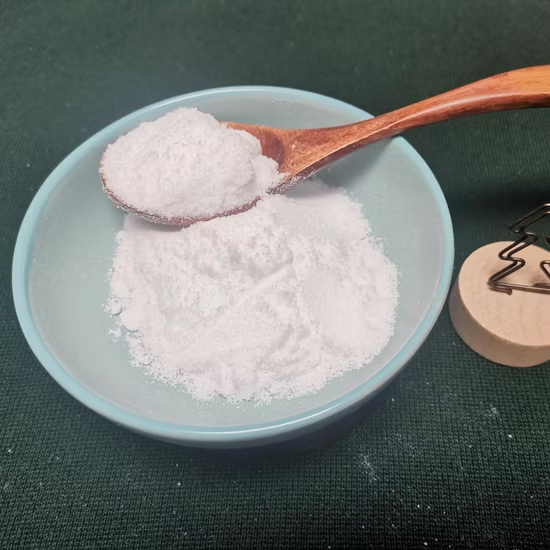
In large-scale bakeries, success is rarely driven by recipes alone. It is built on precise formulations, stable processes, and raw materials that behave exactly as expected—batch after batch. Among the functional ingredients that quietly determine product quality, Food Grade Ammonium Bicarbonate for Bakeries plays a decisive role. When sourced and applied correctly, it enables predictable expansion, clean flavor release, and the crisp textures that industrial bakers depend on.
For manufacturers seeking reliability, cost efficiency, and technical consistency, choosing the right ammonium bicarbonate supplier is not a purchasing formality—it is a production decision. At MT Royal, we have worked closely with bakeries of different scales and product profiles, and we have seen how the right food-grade specification can eliminate production variability while improving final product performance.
This article is designed to answer every practical, technical, and strategic question procurement managers, production supervisors, and R&D teams ask when evaluating Food Grade Ammonium Bicarbonate for Bakeries—from chemical fundamentals to industrial-scale optimization.
Understanding Food Grade Ammonium Bicarbonate in Baking Applications
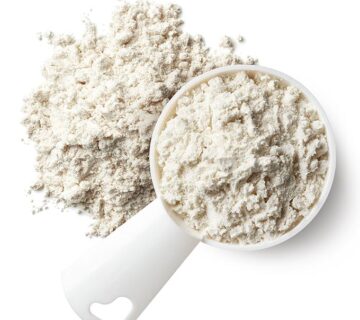
Food Grade Ammonium Bicarbonate is a chemical leavening agent widely used in industrial baking, particularly for products that require rapid gas release and low residual moisture. Chemically known as NH₄HCO₃, it decomposes completely when heated, releasing ammonia, carbon dioxide, and water vapor—leaving no alkaline residue behind when applied correctly.
This behavior makes it uniquely valuable for bakery products where crispness, porosity, and clean flavor are non-negotiable.
latamarko alkalized cocoa powder lm60
cocoa powder for chocolate production-Best price
Food industry raw materials – list of products
Types of Gelatin from Turkish Manufacturer
Alkalized Cocoa Powder Bulk Supplier
Why “Food Grade” Specification Matters
Not all ammonium bicarbonate is suitable for bakery use. Food Grade Ammonium Bicarbonate for Bakeries must comply with strict purity standards, heavy metal limits, and microbiological requirements defined by international food safety regulations.
Industrial-grade or technical-grade variants may contain impurities that compromise taste, stability, or regulatory compliance. In high-volume bakeries, even small deviations in purity can lead to measurable quality losses or rejected batches.
At MT Royal, we supply food-grade material sourced from approved manufacturers with full traceability, ensuring compatibility with HACCP, ISO, and export-driven compliance frameworks.
Functional Role of Ammonium Bicarbonate in Industrial Baking
Unlike yeast or slow-acting baking powders, ammonium bicarbonate offers immediate and complete gas release at baking temperatures. This makes it especially valuable for products with low moisture content and thin profiles.
Key Functional Benefits
Food Grade Ammonium Bicarbonate for Bakeries delivers several technical advantages:
- Rapid leavening without long proofing stages
- Uniform pore structure in dough matrices
- No residual alkalinity affecting taste
- Enhanced crispness in dry bakery products
- Predictable decomposition at controlled temperatures
We have observed in industrial settings that switching to consistent-grade ammonium bicarbonate can stabilize expansion rates and reduce texture-related defects by a noticeable margin.
Typical Bakery Applications at Industrial Scale
Food Grade Ammonium Bicarbonate for Bakeries is not universally applied across all baked goods. Its use is strategic and product-specific.
Products Where It Performs Best
- Hard biscuits and crackers
- Dry cookies and snap-style biscuits
- Flat baked goods with low water activity
- Traditional recipes requiring open crumb but dry finish
Because ammonia must fully volatilize during baking, this ingredient is best suited to products with sufficient baking time and surface exposure.
Products Where Caution Is Required
In soft cakes, high-moisture products, or thick dough systems, incomplete decomposition can lead to residual odor. This is not a formulation flaw—it is a process mismatch.
Ammonium Bicarbonate vs Other Leavening Agents
Industrial bakeries often compare ammonium bicarbonate with sodium bicarbonate or composite baking powders. Each has a role, but their behavior differs significantly.
Comparative Overview
Ammonium bicarbonate:
- Fully decomposes, leaving no salts
- Produces sharper expansion
- Enhances crispness
Sodium bicarbonate:
- Leaves alkaline residues unless neutralized
- Softer texture outcome
- Requires acidic counterparts
Composite baking powders:
- Controlled release
- Higher cost
- Less aggressive expansion
For manufacturers producing dry, high-output bakery items, Food Grade Ammonium Bicarbonate for Bakeries remains one of the most cost-effective and technically reliable solutions.
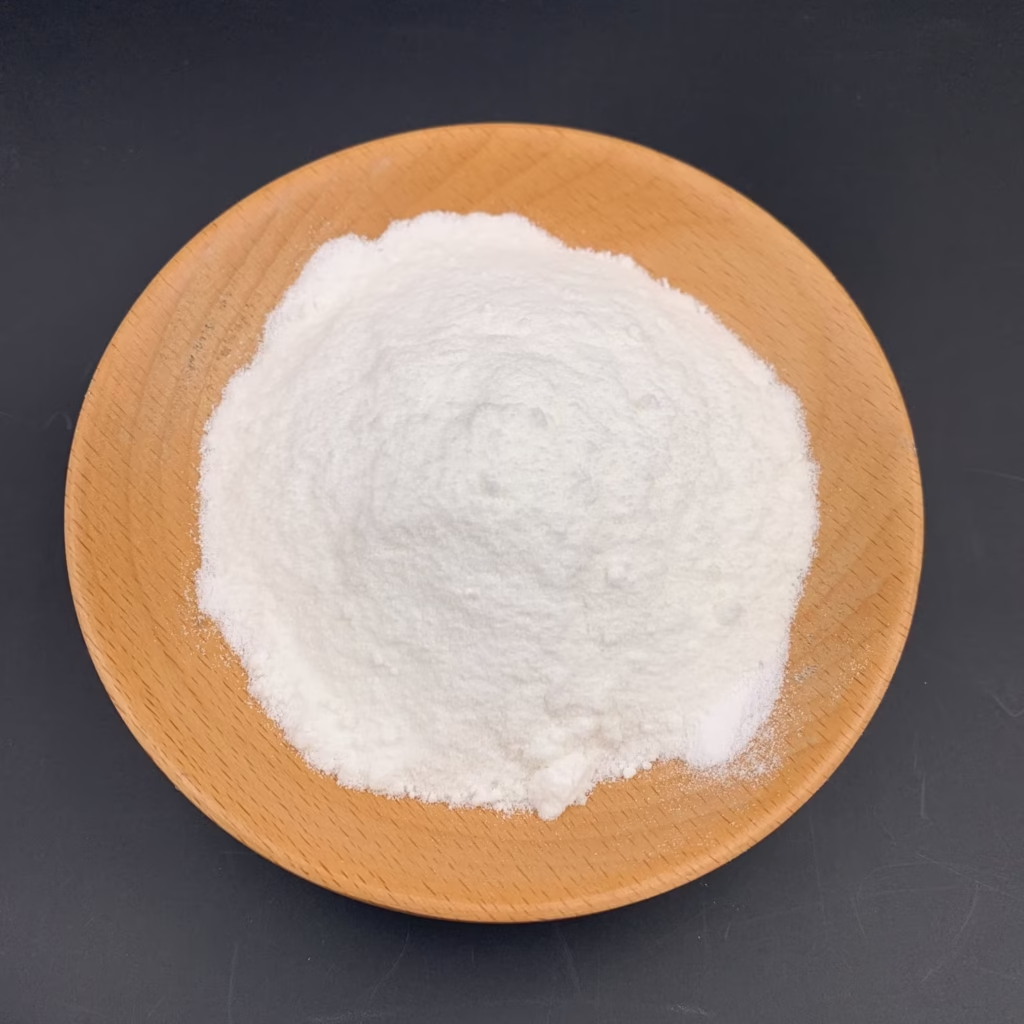
Common Procurement Mistakes in Industrial Supply Chains
Despite its apparent simplicity, ammonium bicarbonate sourcing is frequently underestimated.
Mistake 1: Prioritizing Price Over Consistency
Low-cost suppliers may offer inconsistent particle size, variable decomposition behavior, or unstable storage characteristics. In high-volume bakeries, this translates into production inefficiencies.
Mistake 2: Ignoring Packaging and Logistics
Ammonium bicarbonate is sensitive to moisture and heat. Inadequate packaging or long transit times can degrade performance before the product reaches your warehouse.
At MT Royal, we emphasize controlled logistics and packaging standards precisely because we have seen how supply chain details directly affect bakery output.
Mistake 3: Lack of Technical Documentation
Missing COAs, unclear specifications, or incomplete food safety documentation increase operational risk—especially for export-oriented bakeries.
Industrial Handling and Storage Considerations
Proper handling ensures that Food Grade Ammonium Bicarbonate for Bakeries retains its functional integrity from delivery to dosing.
Recommended Storage Conditions
- Cool, dry environments
- Airtight containers or moisture-barrier bags
- Separation from acidic ingredients
- FIFO inventory management
Failure to control humidity can result in premature decomposition or clumping, both of which reduce dosing accuracy.
Dosage Optimization in Large-Scale Production
Unlike yeast-based systems, ammonium bicarbonate requires precise dosing. Overuse can cause excessive expansion or surface cracking; underuse can lead to dense textures.
Practical Dosing Insights
Most industrial formulations use ammonium bicarbonate in combination with other leavening agents. This allows bakers to fine-tune expansion curves and texture profiles.
We have seen that even minor dosage adjustments—less than 0.1%—can significantly impact final product uniformity at scale.
Regulatory and Compliance Landscape
Food Grade Ammonium Bicarbonate for Bakeries is approved for use in many international markets, including EU, FDA-regulated regions, and numerous Asian standards—when purity criteria are met.
Procurement teams should always verify:
- Food additive status
- Regional maximum usage limits
- Documentation alignment with export markets
MT Royal works with manufacturers that meet these regulatory frameworks, simplifying cross-border compliance for bakery producers.
Market Trends and Supply Chain Dynamics
In recent years, demand for consistent leavening agents has increased alongside industrial bakery automation. As production speeds increase, tolerance for ingredient variability decreases.
Manufacturers are now prioritizing:
- Long-term supplier partnerships
- Predictable lead times
- Technical support beyond pricing
This shift reflects a broader trend: ingredients are no longer commodities—they are performance inputs.
Frequently Asked Questions from Bakery Managers and Buyers
Is ammonium bicarbonate safe for food production?
Yes, when supplied as food grade and used within recommended parameters, it is a widely approved food additive.
Does it leave ammonia taste?
Not when baking conditions allow full decomposition. Proper formulation and baking time are essential.
Can it replace baking powder entirely?
In certain dry products, yes. In others, it works best in combination systems.
How does supplier choice affect product quality?
Consistency in purity, particle size, and moisture content directly influences expansion and texture.
Strategic Value of a Reliable Supplier
Choosing a supplier for Food Grade Ammonium Bicarbonate for Bakeries is not just a purchasing task—it is a production strategy. Reliable sourcing reduces rework, minimizes batch variation, and supports predictable output planning.
At MT Royal, we position ourselves as a supply partner rather than a transactional vendor. We understand the operational realities of industrial bakeries because we have worked alongside them, analyzing real production challenges and aligning supply solutions accordingly.
When your formulations depend on precision, your ingredients must deliver it without exception.
The difference between an average product and a consistently excellent one often lies in materials that never appear on marketing labels—but define performance every single day on the production floor.

No comment