

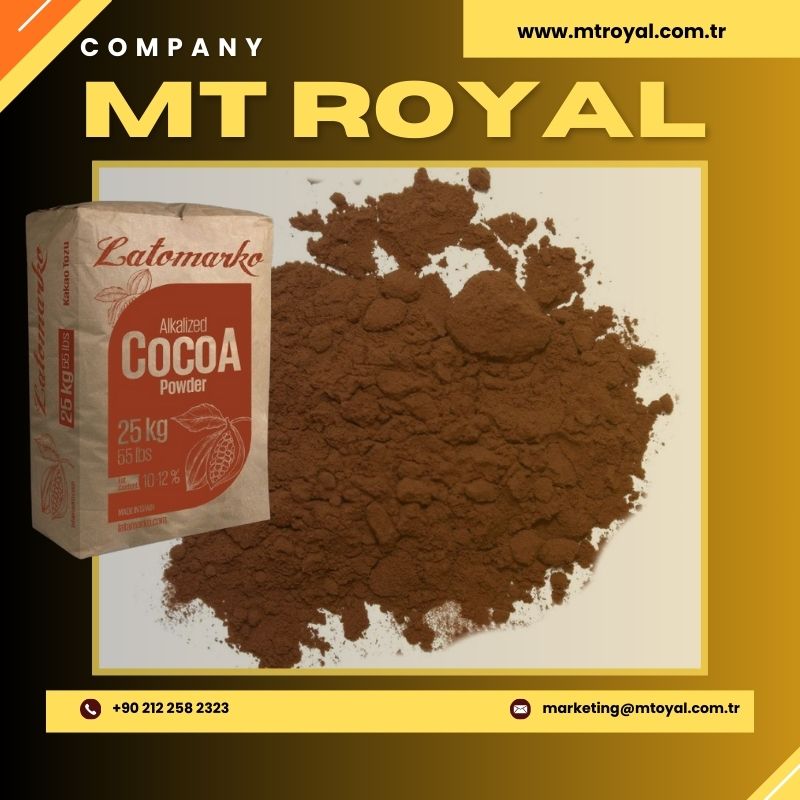
If your factory relies on cocoa as a key ingredient—whether for chocolate beverages, bakery goods, or confectionery—you know that not all cocoa powders are created equal. The difference between a smooth, consistent product and a batch full of clumps, off-flavors, or color inconsistencies often comes down to the alkalization process.
At MT Royal, we understand that industrial cocoa sourcing isn’t just about price; it’s about predictability, quality, and performance. We supply a range of trusted brands to production facilities worldwide, helping factories maintain consistency while optimizing costs. In this guide, we’ll explore how alkalization transforms cocoa chemistry, why it matters in industrial production, and how you can make better sourcing and process decisions for your plant.
The Fundamentals: What Is Cocoa Alkalization?
Cocoa alkalization, also known as the Dutch Process, is a chemical treatment applied to cocoa solids—powder, liquor, or cake—using alkaline solutions such as potassium carbonate. This process alters cocoa’s natural chemistry, creating functional and sensory benefits:
- Reduced acidity: Natural cocoa can have a sharp, bitter taste due to organic acids. Alkalization neutralizes these acids for a smoother flavor profile.
- Color modification: Alkalized cocoa achieves deeper, richer browns, which are visually preferred in many industrial applications.
- Flavor stability: The process minimizes variability in taste between batches.
- Improved solubility: Essential for beverages, coatings, and powdered mixes.
In practical terms, alkalization gives your production process a more reliable input, reducing variability in both flavor and visual appearance.
How Alkalization Changes Cocoa Chemistry
1. pH Alteration and Acid Neutralization
Natural cocoa has a pH between 5.0 and 5.8. Alkalization raises the pH to 6.8–8.1, neutralizing organic acids. This chemical shift:
- Lowers bitterness
- Reduces reactivity with leavening agents
- Improves compatibility with dairy, fats, and other ingredients
2. Pigment Transformation
The deep brown color of alkalized cocoa comes from chemical reactions affecting polyphenols. During alkalization:
- Anthocyanins and tannins undergo oxidation and complexation
- Color intensity becomes more consistent, reducing batch-to-batch visual differences
3. Flavor Compound Modulation
Alkalization changes the availability and perception of flavor compounds:
- Volatile acids are reduced, smoothing harsh notes
- Interaction with sugars and fats becomes more predictable
- Result: more uniform taste across multiple production runs
4. Enhanced Solubility and Wettability
Alkalized cocoa powders disperse more easily in water, milk, or other liquids. From a factory perspective, this:
- Reduces mixing time and energy consumption
- Minimizes clumping in high-speed filling lines
- Improves texture in finished products
Industrial Advantages of Alkalized Cocoa
Consistency at Scale
For high-volume production, variability in natural cocoa can be costly. Alkalization stabilizes acidity, color, and solubility, minimizing adjustments in formula or process.
Visual Quality Control
Color uniformity is crucial in confectionery and beverages. Even minor deviations can trigger rejection or reformulation. Alkalized cocoa gives you predictable, repeatable results.
Operational Efficiency
Faster solubility translates to reduced blending time, lower energy usage, and fewer rejects—critical factors when optimizing cost per unit.
Compatibility with Other Ingredients
Higher pH improves interaction with dairy, sugar, and emulsifiers, ensuring smooth dispersions and uniform textures in complex formulations.
At MT Royal, we’ve observed that plants switching to properly specified alkalized cocoa often see measurable efficiency gains without additional equipment investment.
Common Misconceptions in Industrial Sourcing
“All Dutch-processed cocoa is the same.”
Not true. Alkalization degree, particle size, fat content, and origin all influence functional performance.
“Darker cocoa equals higher quality.”
Excessive alkalization can flatten flavor and destroy desirable aromatic compounds.
“Switching cocoa brands won’t affect production.”
Even small pH or solubility differences can alter mixing, baking, or emulsification behavior.
Understanding these nuances can prevent costly downtime and waste in your production line.
Step-by-Step: Evaluating Alkalized Cocoa for Your Plant
- Identify functional needs: Color, pH, solubility, and fat content
- Conduct pilot trials: Small-scale testing under real production conditions
- Assess supplier transparency: Batch-to-batch documentation and process control
- Verify long-term availability: Consistent supply is more critical than spot price
- Evaluate total cost of ownership: Energy savings, reduced rejects, and downtime often outweigh higher raw material costs
Real-World Factory Example
A mid-sized chocolate beverage plant experienced frequent sedimentation and clumping. Mixing times increased, energy usage spiked, and quality complaints rose.
After switching to a high-solubility, alkalized cocoa sourced through MT Royal, the plant reduced mixing times by 15%, lowered energy costs, and stabilized product appearance—all without changing the base formula.
This demonstrates how selecting the right alkalized cocoa can directly improve operational efficiency.
FAQs from Industrial Buyers
Does alkalization affect nutritional content?
Minor reductions in flavonoids may occur, but for most industrial applications, this is negligible.
Can I swap natural and alkalized cocoa freely?
No; pH differences affect leavening and emulsification, so formula adjustments are necessary.
Is Dutch-processed cocoa significantly more expensive?
Slightly, but operational efficiencies often offset the price difference.
How can I ensure consistent supply?
Choose suppliers with multiple brands and origins, like MT Royal, who maintain high-quality standards.
Operational Tips for High-Volume Production
- Maintain tight control over storage conditions to preserve alkalization benefits
- Monitor pH and particle size regularly for in-process verification
- Standardize testing protocols for solubility and dispersibility
- Partner with suppliers who understand production realities, not just commodity pricing
Closing Thought
The alkalization process isn’t just a chemical treatment—it’s a strategic lever for industrial performance. By understanding how cocoa chemistry changes under alkalization, you gain control over flavor, color, solubility, and operational efficiency.
Next time you evaluate cocoa sourcing or adjust your formula, consider whether your current ingredient is truly aligned with your production goals—or if a strategically alkalized cocoa could streamline your operation, reduce waste, and deliver a more consistent, premium product.




No comment