

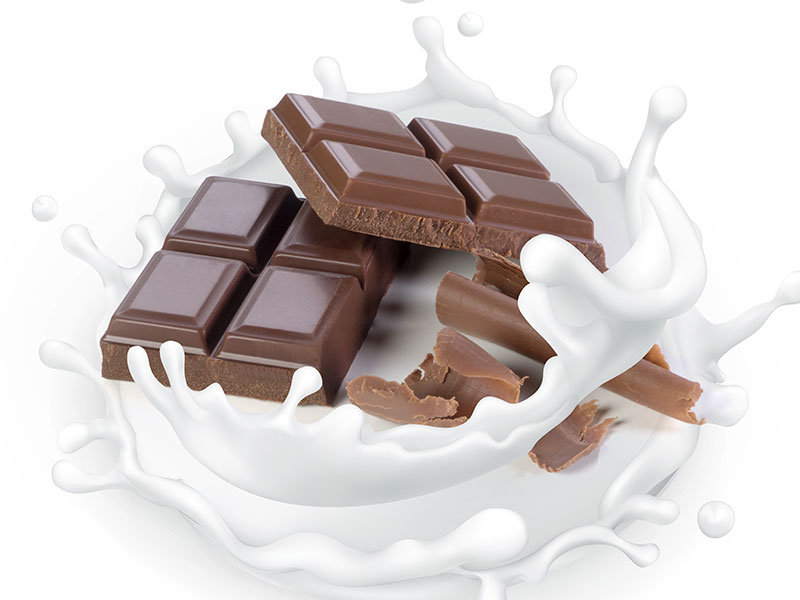
In modern chocolate manufacturing, stability is no longer a background quality parameter—it is the foundation of product success. If your chocolate blooms, softens, fractures, or loses gloss during storage, the problem often traces back to one underestimated factor: milk ingredients. For manufacturers aiming to scale production and maintain export-quality consistency, understanding How Milk Ingredients Impact Chocolate Stability is essential.
This is why industrial producers increasingly rely on consistent raw material sourcing partners such as MT Royal, ensuring standardized milk powders, whey derivatives, and dairy fat systems that behave predictably in cocoa-based matrices. When milk ingredients fluctuate, chocolate does not just change slightly—it behaves like a different product entirely.
Milk is not a passive ingredient in chocolate. It is a structural modifier, a crystallization influencer, and a key driver of texture, viscosity, and shelf stability. Even small variations in milk solids can alter fat crystallization patterns, moisture migration behavior, and bloom resistance.
This article explores the science, industrial applications, formulation challenges, and optimization strategies behind milk ingredients in chocolate systems, with a focus on large-scale manufacturing environments.
LATAMARKO LM60 – Premium Spanish-Origin Cocoa Powder
latamarko alkalized cocoa powder lm60
cocoa powder for chocolate production-Best price
Food industry raw materials – list of products
Best Brazilian Arabica Coffee Bean Supplier for Industrial Roaster
Uganda Bugisu Arabica Coffee Beans for Specialty Coffee Industry
Understanding Milk Ingredients in Chocolate Systems
Milk ingredients in chocolate typically include:
- Whole milk powder
- Skimmed milk powder
- Whey powder
- Milk fat (anhydrous milk fat or butter oil)
- Lactose-rich dairy solids
Each of these components interacts differently with cocoa butter, sugar, and emulsifiers.
At a molecular level, milk ingredients contribute:
- Proteins that influence fat binding
- Lactose that affects crystallization
- Milk fat that modifies melting behavior
- Minerals that impact viscosity and dispersion
In simple terms, milk does not just add flavor—it rewires the internal structure of chocolate.
The Science Behind Milk-Chocolate Interaction
Milk ingredients interact with chocolate primarily through three mechanisms:
1. Fat Phase Interaction
Milk fat integrates into cocoa butter crystal networks, modifying:
- Melting profile
- Crystal stability
- Gloss retention
Milk fat can either stabilize or destabilize cocoa butter crystals depending on its composition and saturation profile.
2. Protein Network Influence
Milk proteins act as emulsifying agents and structural modifiers.
- They bind to fat droplets
- They influence viscosity in molten chocolate
- They affect particle dispersion stability
However, excessive protein variability can destabilize emulsions, leading to inconsistent flow behavior.
3. Lactose Crystallization Effects
Lactose is highly hygroscopic and plays a key role in:
- Sugar bloom formation
- Surface roughness development
- Moisture sensitivity
Improper control of lactose distribution can lead to visible surface defects during storage.
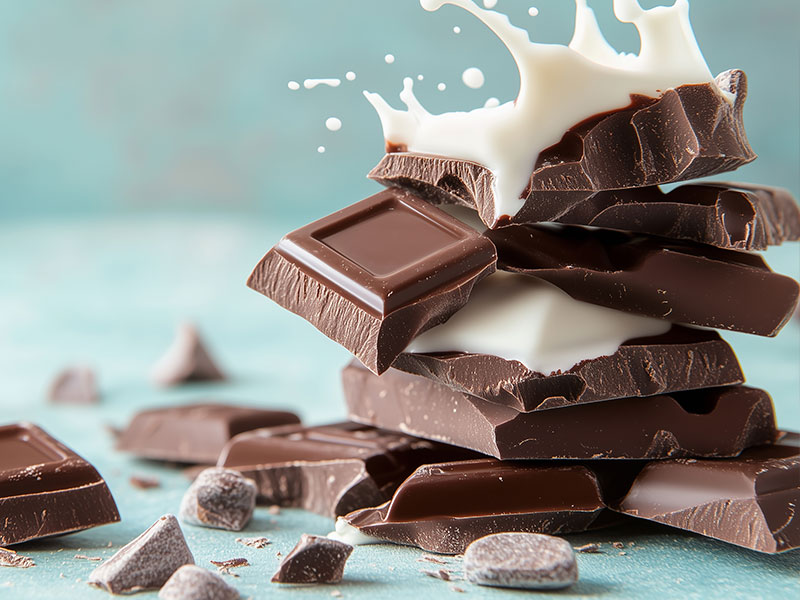
Types of Milk Ingredients and Their Industrial Impact
Skimmed Milk Powder
Skimmed milk powder is widely used due to its controlled fat content.
- Provides protein structure without excessive fat interference
- Improves consistency in large-scale production
- Enhances dispersion stability in chocolate mass
However, variability in drying processes can affect solubility and particle behavior.
Whole Milk Powder
Whole milk powder introduces both proteins and milk fat.
- Enhances creaminess and mouthfeel
- Modifies melting profile
- Improves flavor richness
But it also increases risk of fat bloom if fat compatibility is not well managed.
Whey Powder
Whey is increasingly used in cost-optimized formulations.
- Improves texture softness
- Adds sweetness due to lactose content
- Reduces formulation cost
However, excessive whey can destabilize crystallization behavior.
Milk Fat (Anhydrous Milk Fat)
Milk fat significantly influences:
- Melting behavior
- Gloss stability
- Texture smoothness
It interacts directly with cocoa butter crystals, sometimes strengthening or disrupting them depending on ratio.
How Milk Ingredients Influence Chocolate Stability
1. Fat Bloom Formation
Fat bloom occurs when cocoa butter crystals migrate and recrystallize on the surface.
Milk ingredients influence this by:
- Altering fat crystal compatibility
- Modifying melting point distribution
- Affecting fat migration pathways
Incorrect milk fat ratios are one of the most common hidden causes of bloom.
2. Sugar Bloom Development
Sugar bloom is linked to moisture and lactose behavior.
- Lactose absorbs moisture easily
- Moisture triggers sugar recrystallization
- Surface roughness increases over time
This is especially problematic in humid climates or poor packaging conditions.
3. Texture and Mouthfeel Stability
Milk proteins and fats directly affect sensory perception.
- High milk fat = smoother texture
- High lactose variability = grainy perception
- Protein instability = inconsistent melt profile
In sensory panels, milk formulation differences can shift consumer preference by up to 15–20%.
4. Rheology and Flow Behavior
Milk solids influence chocolate viscosity during processing.
- Higher milk solids increase viscosity
- Protein interactions affect flow resistance
- Fat distribution determines pumping efficiency
Poor control leads to production inefficiencies and inconsistent molding.
Common Mistakes in Milk Ingredient Sourcing
Before listing mistakes, it is important to understand that milk powders are highly sensitive to processing conditions such as spray drying temperature, storage humidity, and particle size distribution.
- Ignoring particle size variation in milk powders: Non-uniform particles lead to inconsistent dispersion and affect chocolate smoothness.
- Using mixed-origin milk powders without standardization: Variability in protein and fat composition creates instability in crystallization behavior.
- Overlooking moisture content in dairy ingredients: Excess moisture accelerates sugar bloom formation and reduces shelf life.
- Focusing only on cost instead of functional performance: Cheaper milk powders often introduce variability that increases production losses.
In our experience working with industrial chocolate producers, inconsistent dairy sourcing is responsible for a surprising percentage of stability issues—often more than cocoa variability itself.
Industrial Strategies to Improve Chocolate Stability Using Milk Ingredients
Optimize Milk Powder Selection
- Choose standardized protein-to-fat ratios
- Ensure consistent drying technology
- Maintain controlled lactose levels
Control Fat Compatibility
- Match milk fat melting profiles with cocoa butter
- Avoid excessive fat phase overlap
- Use controlled fractionation systems
Improve Particle Size Distribution
Milk powder particle size affects:
- Dispersion speed
- Viscosity behavior
- Surface smoothness
Uniform particle size improves stability significantly.
Maintain Moisture Control
Moisture is one of the most critical destabilizing factors.
- Store dairy powders in humidity-controlled environments
- Monitor water activity in final formulations
- Use moisture barrier packaging systems
Standardize Raw Material Sourcing
Factories sourcing from reliable suppliers such as MT Royal benefit from:
- Consistent dairy powder specifications
- Reduced batch variability
- Improved long-term stability in chocolate systems
We have seen stability improvements of up to 18% in shelf life consistency when dairy inputs are fully standardized.
The Role of Tempering and Milk Ingredients
Tempering is the process that defines cocoa butter crystallization structure.
Milk ingredients influence tempering by:
- Altering crystallization speed
- Changing melting point distribution
- Affecting crystal polymorphism stability
Improper milk formulation can make tempering less predictable, leading to inconsistent gloss and snap.
Frequently Asked Questions from Factory Managers
Why does milk chocolate bloom faster than dark chocolate?
Because milk fat and lactose increase sensitivity to temperature and moisture fluctuations.
Can milk powder quality affect chocolate viscosity?
Yes, protein and particle size variations significantly affect flow behavior.
Does higher milk fat always improve chocolate quality?
Not always. Excess milk fat can destabilize cocoa butter crystal networks.
How important is moisture control in dairy ingredients?
Extremely important—even small increases can trigger sugar bloom and texture degradation.
Final Perspective on How Milk Ingredients Impact Chocolate Stability
Understanding How Milk Ingredients Impact Chocolate Stability is fundamentally about recognizing that milk is not an additive—it is a structural engineering component. It influences everything from fat crystallization and rheology to sensory perception and shelf life performance.
In modern chocolate manufacturing, stability is achieved not by controlling one variable, but by aligning all variables—milk composition, fat compatibility, particle size, moisture levels, and processing conditions into one coherent system.
When milk ingredients are properly selected and consistently managed, chocolate transforms from a sensitive formulation into a stable, export-ready product capable of maintaining gloss, snap, and texture integrity across time and climate conditions.


No comment