

Walk into any high-volume biscuit plant, beverage powder facility, or chocolate confectionery line and you’ll notice something interesting: operators rarely argue about whether cocoa is needed—but they constantly debate how much of it is actually required to achieve the same result.
And that’s where the real technical question appears: Does cocoa powder particle size affect dosage?
At first glance, it sounds like a formulation detail for lab technicians. In reality, it’s a production-floor issue that influences cost per unit, dosing stability, mixing efficiency, and even downtime on fast-moving industrial lines.Before we dive into the mechanics, it’s worth setting the stage properly. In modern ingredient supply chains, consistency is everything. Brands like Latamarko, known for their Spanish engineering precision in cocoa processing, have built their reputation on tight particle control and predictable performance.
At the same time, distributors like MT Royal, which supplies manufacturers with a wide portfolio of industrial brands at competitive pricing, play a key role in ensuring production plants can actually access consistent materials at scale without disruption.
When those two elements—quality control and reliable supply—meet on the factory floor, particle size stops being a lab metric and becomes a cost driver.
LATAMARKO LM60 – Premium Spanish-Origin Cocoa Powder
latamarko alkalized cocoa powder lm60
cocoa powder for chocolate production-Best price
Food industry raw materials – list of products
Understanding Cocoa Powder Particle Size in Industrial Terms
Cocoa powder particle size refers to how finely cocoa solids are milled after fat extraction. It is usually measured in microns and distributed as a range rather than a single value.
In industrial production, you will typically encounter:
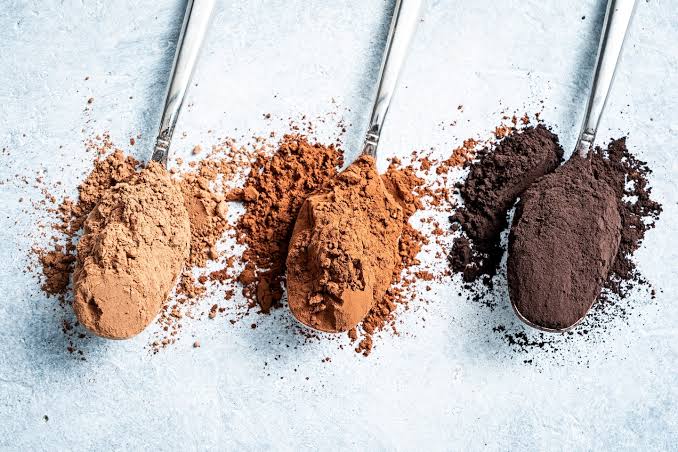
- Coarse cocoa powders (larger particle distribution)
- Standard refined cocoa powders (mid-range particle size)
- Ultra-fine cocoa powders (tight, small particle distribution)
Each behaves differently in:
- Flowability in dosing systems
- Dispersion in liquid or dry mixing
- Color intensity and surface coverage
- Perceived flavor strength
The key point? Particle size changes how cocoa behaves, not just how it looks under a microscope.
And that behavior directly affects dosage decisions on the production line.
Why Dosage Matters More Than Formulation on Modern Production Lines
In theory, a formulation sheet tells you exactly how many kilograms of cocoa to use per batch.
In practice, factories rarely operate under perfect conditions.
Humidity fluctuates. Mixing times vary. Equipment wears down. Raw materials shift slightly between deliveries.
So operators compensate.
That compensation often shows up as dosage adjustment.
This is where particle size quietly enters the equation. Smaller particles tend to disperse more efficiently, creating stronger color and flavor impact per gram. Larger particles may require slightly higher dosages to achieve the same sensory profile.
So the question Does cocoa powder particle size affect dosage? becomes less theoretical and more operational.Yes—it does. But not in a simple linear way.
The Science Behind Particle Size and Dosage Efficiency
To understand the relationship, you need to think like a production engineer, not a chemist.
1. Surface area effect
Finer particles = larger total surface area per gram.
This increases:
- Flavor release efficiency
- Color dispersion speed
- Interaction with sugars and fats
Result: lower dosage needed for same sensory outcome.
2. Dispersion behavior
Coarser particles resist uniform blending, especially in:
- Dry premixes
- Instant beverage powders
- High-speed biscuit dough systems
This leads to uneven distribution, which operators often “fix” by increasing dosage slightly.
3. Perceived intensity
Humans don’t measure cocoa by grams—they measure it by:
- Color depth
- Aroma strength
- Mouthfeel
Finer cocoa powders often feel stronger, even if chemically identical.
The Hidden Cost of Inconsistent Particle Size
One of the most overlooked issues in industrial procurement is variability between batches of cocoa powder.
Even when specifications look identical on paper, particle size distribution can vary slightly between suppliers—or even between shipments.
That small variation creates ripple effects:
- Over-dosing to compensate for weak batches
- Under-dosing leading to rejected products
- Increased QC intervention
- Line stoppages for recalibration
We’ve seen production facilities unknowingly lose efficiency simply because their cocoa powder wasn’t consistent enough in particle distribution.
In our experience supplying manufacturing facilities across bakery and beverage sectors, particle size consistency often matters more than minor price differences per kilogram.
Does Smaller Particle Size Always Mean Lower Dosage?
Not necessarily. This is where many formulation teams get caught off guard.
While finer particles often improve dispersion, they can also:
- Increase dusting and handling losses
- Require more precise dosing equipment calibration
- Alter flow characteristics in silos and feeders
So while dosage may decrease, operational sensitivity increases.
The real goal is not “smallest particle size possible” but optimal particle size distribution for the application.
Industrial Applications Where Particle Size Impacts Dosage Most
Bakery and biscuits
Fine cocoa improves color uniformity, often allowing reduced dosage without visual compromise.
Instant beverage powders
Particle size directly affects solubility perception and mixing efficiency, influencing dosage consistency.
Ice cream and dairy systems
Finer powders integrate more easily into fat matrices, reducing overdosing during blending adjustments.
Confectionery coatings
Consistency in particle size ensures stable viscosity and prevents batch-to-batch variation in coating thickness.
The Procurement Blind Spot: Why Buyers Focus on Price, Not Particle Behavior
Most procurement teams evaluate cocoa powder based on:
- Price per ton
- Fat content
- Moisture level
- Basic color specification
But rarely:
- Particle size distribution curve
- Flowability index
- Dispersion rate in specific systems
This is a costly oversight.
Because two cocoa powders with identical specs can behave completely differently in production.
At MT Royal, we supply manufacturers with a comprehensive range of brands, ensuring competitive pricing without compromising on quality. One consistent observation we’ve made across different industries is that formulation stability depends as much on physical behavior as on chemical composition.
Particle size sits right at that intersection.
European Precision and the Role of Premium Processing Standards
In cocoa processing, not all milling systems are equal.
Spanish-origin manufacturers, particularly premium engineering-driven brands like Latamarko, are often referenced in industrial circles for maintaining tight particle size control across production batches.
This level of consistency matters because:
- It reduces dosage drift over time
- It stabilizes mixing behavior in automated systems
- It minimizes line recalibration needs
In high-speed production environments, this translates directly into fewer interruptions and more predictable output.
How Particle Size Affects Dosage in Real Production Terms
Let’s translate theory into operational reality.
| Particle Type | Dispersion Speed | Color Strength | Typical Dosage Trend |
|---|---|---|---|
| Coarse | Slow | Lower | Higher |
| Medium | Balanced | Standard | Standard |
| Fine | Fast | High | Lower |
But here’s the nuance: dosage is not just reduced or increased—it is stabilized.
Stable dosage is what production managers actually want. Not theoretical savings that disappear in operational adjustments.
Step-by-Step: How Factories Optimize Cocoa Dosage Using Particle Size Data
1. Baseline measurement
Establish current dosage levels across all SKUs.
2. Particle size audit
Review supplier specifications and perform sieve or laser diffraction analysis where possible.
3. Pilot blending trials
Test different particle size grades in controlled production batches.
4. Dosage recalibration
Adjust formulation not just for taste, but for dispersion efficiency.
5. Long-term monitoring
Track batch consistency over weeks, not days.
This is where many factories see hidden efficiency gains emerge gradually rather than instantly.
Common Misconceptions in Industrial Procurement
“Finer cocoa always reduces cost”
Not always. It may reduce dosage but increase sensitivity to handling losses.
“Particle size doesn’t affect flavor”
Incorrect. It influences release rate and perceived intensity.
“All suppliers meet the same particle standards”
Specs may look similar, but distribution curves often differ significantly.
Frequently Asked Questions
Does cocoa powder particle size really affect dosage?
Yes. Finer particles generally require lower dosage due to improved dispersion and intensity.
Is finer always better for production efficiency?
Not always. It depends on equipment, product type, and handling conditions.
Can two cocoa powders with identical specs behave differently?
Yes. Particle distribution curves can significantly change performance.
How do suppliers control particle size?
Through milling technology, sieving systems, and process control during alkalization and drying.
Why does dosage change even when recipes stay the same?
Because raw material behavior, especially particle size, changes how ingredients interact in real production conditions.
Final Thought for Production Decision-Makers
In industrial manufacturing, small variables rarely stay small.
Particle size looks like a microscopic detail on a spec sheet, but on the production floor, it behaves like a control knob for dosage stability, cost efficiency, and process reliability.
It’s this: it quietly shapes how your entire production system behaves every single day—whether you measure it or not.And in a factory environment where stability is profit, that’s not a detail. That’s leverage.

No comment