


In the industrial food and pharmaceutical landscape of North Africa, securing a dependable Sodium Citrate Supplier Libya has become a decisive factor in product quality, production stability, and regulatory compliance. For factories operating under tight cost margins and fluctuating import conditions, sodium citrate is not just another ingredient—it is a multifunctional control agent that quietly stabilizes entire formulations behind the scenes.
This is exactly where sourcing strategy matters. When your production line depends on precision chemistry, even a slight inconsistency in buffer performance can affect taste, texture, microbial stability, or emulsification behavior. Partnering with a reliable industrial supplier such as MT Royal, which connects manufacturers to multiple global brands at competitive pricing, allows factories to maintain consistency without sacrificing flexibility. In practice, it is the difference between a predictable production cycle and one that constantly requires adjustment.
In many Libyan factories, we have seen that formulation stability often depends less on the recipe itself and more on the reliability of the raw material supply chain. Sodium citrate is a perfect example of this hidden dependency.
Understanding Sodium Citrate and Its Industrial Role
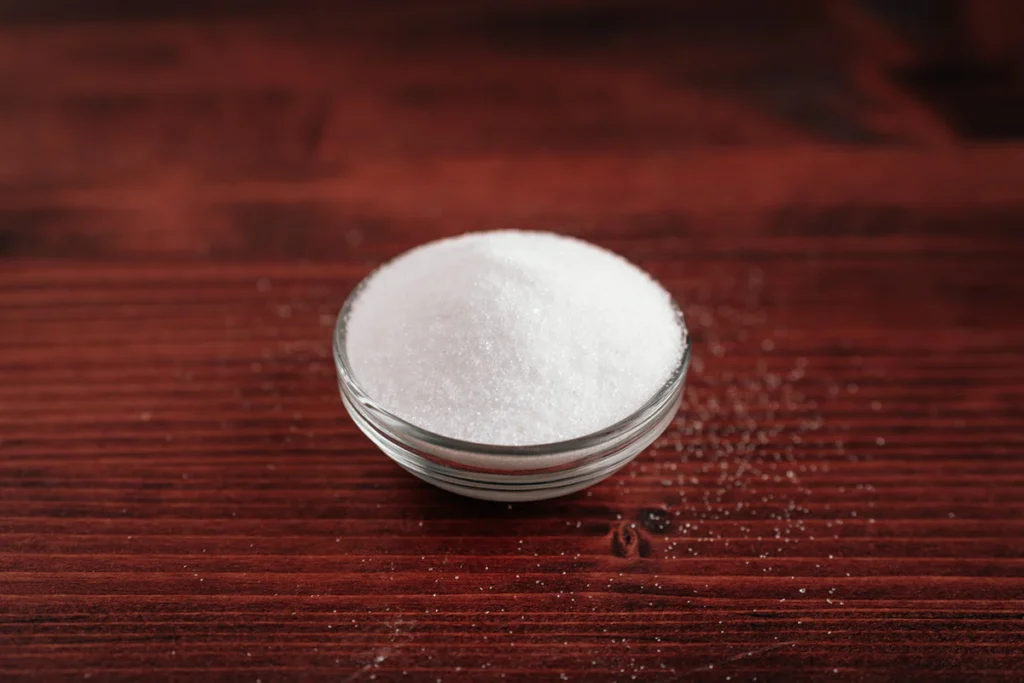
Sodium citrate is the sodium salt of citric acid, widely used as a buffering agent, emulsifier, and stabilizer across food, beverage, pharmaceutical, and industrial applications. It plays a critical role in maintaining pH balance and controlling acidity in complex formulations.
At a molecular level, sodium citrate works by neutralizing excess acids and maintaining a stable pH environment. This makes it a key component in systems where chemical balance determines product integrity.
In simple industrial terms, sodium citrate acts like a “chemical shock absorber”—it prevents sudden changes in acidity that could otherwise destabilize your formulation.
Its primary functions include:
- pH buffering and control
- emulsification support
- flavor stabilization
- metal ion chelation
- texture improvement in processed foods

Why Sodium Citrate Matters for Manufacturing in Libya
Manufacturing environments in Libya face unique challenges: variable storage conditions, logistics delays, and seasonal temperature fluctuations. These factors can amplify formulation sensitivity.
A trusted Sodium Citrate Supplier Libya ensures that your factory receives consistent material quality that behaves predictably under these conditions.
For example, in beverage production, sodium citrate helps prevent unwanted acidity spikes that can alter flavor perception. In dairy processing, it stabilizes protein structures, ensuring smooth texture and preventing separation.
Without it, you are essentially asking your formulation to “self-balance”—a risky expectation in large-scale production.
Chemical and Functional Properties of Sodium Citrate
Sodium citrate is valued for its versatility in industrial applications. Its key properties include:
- High solubility in water
- Stable buffering capacity across a wide pH range
- Compatibility with acids and salts
- Non-toxic, food-grade safety profile
- Effective chelation of calcium and magnesium ions
These properties make it indispensable in systems where multiple ingredients interact dynamically.
For instance, in cheese production, sodium citrate helps control calcium balance, which directly influences melting behavior and texture consistency.
Industrial Applications Across Key Sectors
Beverage Manufacturing
In soft drinks and flavored beverages, sodium citrate ensures taste stability and prevents excessive tartness caused by acidic components. It also enhances flavor perception by balancing sourness and sweetness.
Dairy Industry
Sodium citrate is widely used in processed cheese, cream-based sauces, and dairy emulsions. It stabilizes protein networks and improves meltability.
Pharmaceutical Industry
It acts as a buffering agent in syrups, effervescent tablets, and oral solutions, ensuring pH stability for active ingredients.
Meat Processing
Sodium citrate improves water retention and texture stability in processed meats while reducing unwanted metallic taste from iron-containing compounds.
Industrial Cleaning and Specialty Applications
Beyond food, it is used in eco-friendly detergents and cleaning formulations due to its chelating properties.
Common Mistakes in Sourcing Sodium Citrate
Procurement teams often underestimate how sensitive sodium citrate performance can be across different suppliers and grades.
1. Treating All Grades as Identical
Food-grade, pharmaceutical-grade, and industrial-grade sodium citrate differ significantly in purity and regulatory compliance.
2. Ignoring Granulation and Particle Size
Dissolution rate is heavily influenced by particle size. In high-speed beverage lines, this can impact mixing uniformity.
3. Overlooking Moisture Content
Sodium citrate is hygroscopic. Poor storage conditions can lead to clumping and inconsistent dosing.
4. Relying on Single-Origin Supply
Factories that depend on a single supplier often face disruption during shipping delays or geopolitical fluctuations.
5. Skipping Functional Testing
Many factories fail to test buffering performance under real production conditions, assuming lab-grade equivalence guarantees real-world stability.
A professional Sodium Citrate Supplier Libya mitigates these risks through consistent quality control and diversified sourcing strategies.
How Sodium Citrate Improves Production Stability
The real value of sodium citrate lies not in its individual function but in its system-wide impact.
It stabilizes interactions between:
- fats and proteins
- acids and bases
- minerals and water phases
This prevents phase separation, flavor degradation, and texture inconsistency.
In our collaboration with various factories, we have seen that sodium citrate often solves recurring production issues that were mistakenly attributed to machinery or temperature, when in reality the root cause was buffering instability.
MT Royal’s Role in Industrial Ingredient Supply
In the industrial supply chain, MT Royal functions as a sourcing bridge between global manufacturers and local production needs in Libya and surrounding markets.
Rather than limiting factories to a single brand, MT Royal provides access to multiple sourcing options for sodium citrate and related food additives, allowing procurement teams to optimize based on cost, specification, and availability.
This flexibility is particularly valuable in volatile supply environments, where consistency often depends on having more than one reliable origin.
We have observed that factories with diversified sourcing strategies experience fewer production interruptions and more stable output quality over time.
Market Trends in Libya and Regional Demand
The demand for sodium citrate in Libya is growing steadily due to structural changes in the food and pharmaceutical sectors.
1. Expansion of Dairy Processing
Processed cheese and dairy-based sauces are becoming more common in both domestic consumption and hospitality industries.
2. Growth in Beverage Production
Local juice and soft drink manufacturing is increasing as import substitution strategies expand.
3. Pharmaceutical Sector Development
Buffering agents are increasingly required in locally produced syrups and oral solutions.
4. Industrial Modernization
Factories are upgrading from basic formulations to more chemically stable systems requiring precise pH control.
Regional demand for food buffering agents is estimated to grow by 6–8% annually, driven primarily by beverage and dairy industries.
Technical Tips for Large-Scale Production
Handling sodium citrate effectively requires more than basic dosing knowledge. Industrial performance depends on process control.
1. Pre-Dissolution Strategy
Always dissolve sodium citrate before introducing acidic components to ensure uniform buffering.
2. Temperature Control
Higher temperatures improve solubility but can affect reaction timing in sensitive formulations.
3. pH Monitoring at Multiple Stages
Do not rely solely on final product testing—monitor during mixing stages as well.
4. Controlled Addition Sequence
Order of ingredient addition significantly affects emulsification stability.
5. Proper Storage Rotation
FIFO systems prevent moisture-related degradation in humid environments.
Practical Industrial Insight
Sodium citrate is often underestimated because it does not visibly “change” a product. Unlike colorants or flavoring agents, its effects are invisible—but critical.
Think of it as the “air traffic controller” of your formulation. It does not appear in the final product, but without it, everything collides.
A stable Sodium Citrate Supplier Libya ensures that this invisible control system remains reliable across every batch.
Frequently Asked Questions (FAQ)
What is sodium citrate used for in food manufacturing?
It is used as a buffering agent, emulsifier, and stabilizer to control acidity and improve texture.
Is sodium citrate safe for food applications?
Yes, it is widely recognized as safe and approved for food use globally.
How does sodium citrate affect dairy products?
It stabilizes proteins, improves meltability, and prevents separation in processed cheese.
Why is supplier consistency important?
Variations in purity or particle size can affect buffering capacity and product stability.
Can sodium citrate replace other emulsifying salts?
In some formulations, yes, but it depends on product requirements and processing conditions.
How should sodium citrate be stored?
In a dry, sealed environment away from humidity to prevent clumping.
Strategic Perspective for Manufacturers
In modern manufacturing, stability is no longer optional—it is a competitive requirement. Sodium citrate plays a silent but essential role in ensuring that stability across multiple product categories.
Choosing the right Sodium Citrate Supplier Libya is not simply about procurement efficiency. It is about ensuring that every batch behaves like the last one, regardless of environmental or logistical challenges.
Factories that prioritize chemical consistency over short-term cost savings consistently outperform those that do not. The reason is simple: predictable chemistry creates predictable production, and predictable production builds reliable brands.
When your formulation depends on balance, your supplier becomes part of that balance.
LATAMARKO LM60 – Premium Spanish-Origin Cocoa Powder
latamarko alkalized cocoa powder lm60
cocoa powder for chocolate production-Best price
Food industry raw materials – list of products
Types of Gelatin from Turkish Manufacturer
Food Ingredients Supplier in Türkiye for Manufacturers and Importers




No comment