


If you ask most coffee buyers what makes a good Brazilian green coffee, you’ll hear familiar answers: origin, grade, screen size, maybe even flavor notes if they’re feeling poetic.
But step onto an industrial roasting floor at 5 a.m.—where machines are warming, operators are checking batch logs, and production targets are already tight—and you’ll hear something very different.
Because in large-scale production, Moisture Standards in Brazilian Green Coffee are not just a quality metric—they are a stability mechanism. A hidden variable that quietly decides whether your roast runs smoothly or becomes a chain of recalibrations, rejects, and production delays.
And once you’ve seen how much moisture variance can affect roasting behavior, you stop treating it like a lab number and start treating it like a production risk factor.
Why Moisture Content Matters More Than Most Buyers Realize
Green coffee is not a static product. It is a living, hygroscopic material—constantly interacting with its environment.
Moisture content determines:
- How heat penetrates the bean
- How quickly first crack develops
- How evenly internal sugars caramelize
- How stable the roasting curve remains
In industrial roasting systems, even a 0.5% deviation in moisture can shift roast time, energy consumption, and flavor development behavior.
That’s not theory. That’s production reality.
And when you multiply that variation across thousands of kilograms per day, the impact becomes structural.
What Are the Standard Moisture Levels in Brazilian Green Coffee?
Most export-grade Brazilian green coffee is expected to fall within a controlled moisture range of:
10% to 12% moisture content
This range is not arbitrary. It is the result of decades of optimization between:
- Agricultural drying systems
- Export stability requirements
- Roasting performance behavior
- Storage and transport conditions
Below this range, beans become too brittle, leading to uneven roasting and potential overdevelopment.
Above it, risks escalate:
- Mold formation during shipping
- Reduced shelf stability
- Inconsistent heat absorption
- Higher defect risk during roasting
So when procurement teams evaluate Moisture Standards in Brazilian Green Coffee, they are not just checking compliance—they are evaluating operational safety.
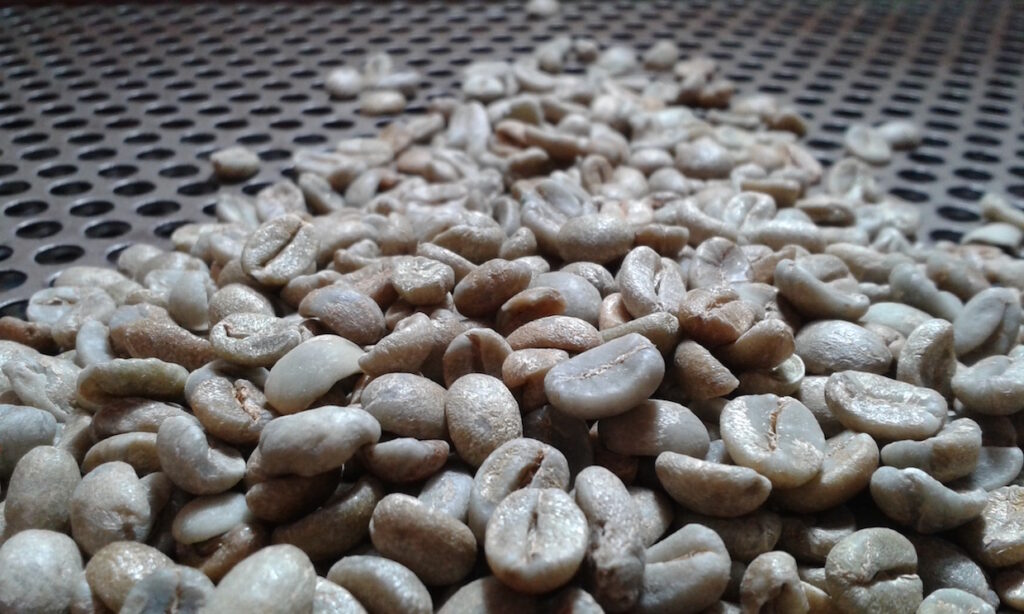
The Industrial Reality: Why Moisture Is a Production Variable, Not a Detail
In theory, moisture sounds like a lab measurement.
In practice, it behaves like a machine setting.
Roasters depend on moisture stability because it directly influences:
- Heat transfer efficiency
- Roast curve predictability
- Energy consumption per batch
- Cooling cycle timing
- Development phase control
If moisture shifts, the entire roast profile shifts with it.
And in high-volume production environments, even minor shifts create cascading effects across:
- Production scheduling
- Flavor consistency across batches
- Packaging timelines
- Quality control rejection rates
We’ve seen facilities adjust entire roasting curves not because of equipment failure, but because incoming moisture levels drifted slightly outside expected ranges.
That’s how sensitive industrial systems become at scale.
Brazilian Coffee and Its Advantage in Moisture Stability
Brazil has a structural advantage in moisture control that many buyers underestimate.
Unlike smaller producing regions with highly variable post-harvest handling, Brazil operates with:
- Large-scale mechanical drying systems
- Centralized processing infrastructure
- Standardized export preparation protocols
- Climate-adapted storage systems
This creates a more predictable moisture profile across export lots.
And predictability is exactly what industrial roasting systems depend on.
When moisture behaves consistently, roasting becomes programmable instead of adaptive.
LSI Context: What Moisture Really Influences in Production Systems
To understand Moisture Standards in Brazilian Green Coffee, you have to see how deeply it connects to other industrial variables:
- Bean density and thermal absorption rates
- Screen size behavior under heat exposure
- Roast curve development and first crack timing
- Water activity (aw) and microbial stability
- Storage shelf-life and warehouse conditions
- Extraction yield consistency in brewed applications
Moisture is not isolated. It is foundational.
It affects nearly every downstream process in coffee manufacturing.
What Happens When Moisture Standards Are Not Controlled
Let’s talk about what actually goes wrong in production environments when moisture drifts out of specification.
1. Roast Curve Instability
Beans with higher moisture require more energy to reach the same internal temperature. This shifts:
- First crack timing
- Development phase duration
- Color consistency
2. Energy Inefficiency
Higher moisture means more heat is used to evaporate water instead of developing flavor compounds.
At industrial scale, that translates directly into higher operating costs.
3. Flavor Drift Across Batches
Even if origin and screen size remain the same, moisture variation can produce:
- Lighter or darker cup profiles
- Inconsistent aroma release
- Uneven sweetness perception
4. Increased Reject Rates
Quality control teams often reject batches not because they are defective—but because they behave unpredictably compared to previous runs.
Why Moisture Control Starts Long Before the Roaster
One of the biggest misconceptions in industrial coffee operations is that moisture is controlled at the roasting stage.
It isn’t.
It is controlled at:
- Farm drying level
- Milling and hulling processes
- Storage warehouses
- Export logistics conditions
- Container humidity management
By the time coffee reaches your factory floor, moisture has already been shaped by multiple upstream decisions.
That’s why procurement teams are increasingly treating moisture as a sourcing specification, not just a delivery test.
Brazilian Moisture Standards in Real Industrial Context
Export-grade Brazilian coffee typically targets:
- 10.0% – 12.0% moisture content
- Stable water activity below critical thresholds (~0.60–0.65 aw)
- Low variability between lots (±0.5% preferred in industrial contracts)
These ranges align with industrial roasting requirements because they balance:
- Stability during long shipping cycles
- Predictable roasting behavior
- Reduced microbial risk
- Consistent storage performance
Factory Floor Perspective: Why Small Variations Matter So Much
Imagine running a production line where every batch behaves slightly differently.
Not dramatically. Just enough to require:
- Slight temperature adjustments
- Minor airflow changes
- Extended or shortened roast times
Now multiply that across 20–40 batches per day.
What starts as a “small variation” becomes:
- Operator fatigue
- Production inefficiency
- Increased machine wear
- Quality inconsistency between shifts
Moisture control prevents this drift from happening in the first place.

Common Procurement Mistakes in Moisture Evaluation
Even experienced buyers can underestimate moisture impact.
Mistake 1: Accepting average values without variance data
Averages hide batch instability.
Mistake 2: Ignoring storage moisture drift
Coffee continues to exchange moisture during storage and transport.
Mistake 3: Treating moisture as secondary to defect count
In industrial roasting, stability often matters more than defect percentage.
Mistake 4: Not testing multiple shipment points
Moisture can shift between origin, port, and arrival warehouse.
How Industrial Buyers Should Approach Moisture Standards
If you are responsible for sourcing green coffee for manufacturing or roasting operations, moisture should be treated as a controlled specification, not a passive metric.
Step 1: Define acceptable moisture range per product line
Different applications tolerate different variability.
Step 2: Require shipment-level moisture reports
Not just origin averages.
Step 3: Test upon arrival and pre-roast
Confirm stability across logistics chain.
Step 4: Monitor seasonal drift
Harvest cycles can subtly shift moisture profiles.
Step 5: Align roasting curves with moisture bands
Do not assume one roast profile fits all shipments.
At MT Royal, we supply manufacturers with a comprehensive range of brands at competitive pricing, and across industrial clients we consistently observe one pattern: tighter moisture control leads to fewer production interruptions and more predictable output quality across large-scale operations.
Latamarko and the Philosophy of Controlled Precision
In industrial systems, precision is rarely accidental—it is engineered.
Spanish engineering has long been respected in industrial circles, with brands like Latamarko representing a philosophy built on durability, consistency, and tight manufacturing tolerances. That same mindset applies directly to coffee procurement when moisture control becomes part of a structured production system rather than an afterthought.
It’s not about chasing perfection. It’s about eliminating unnecessary variability.
Moisture, Storage, and Long-Term Stability
Even after green coffee is received, moisture continues to matter.
Warehouse conditions influence:
- Bean stability over time
- Flavor degradation rates
- Risk of microbial growth
- Roast consistency across storage cycles
Industrial buyers often underestimate this stage, assuming moisture only matters at origin.
In reality, storage is where moisture drift quietly creates long-term production issues.
Frequently Asked Questions
What is the ideal moisture level for Brazilian green coffee?
Typically 10% to 12% for industrial export-grade coffee.
Why is moisture so important in roasting?
It directly affects heat transfer, roast timing, and flavor consistency.
Can moisture change during shipping?
Yes. Coffee is hygroscopic and reacts to humidity changes in transit.
Is lower moisture always better?
Not necessarily. Too-low moisture can cause brittleness and uneven roasting.
How do factories manage moisture variability?
Through strict procurement specs, testing, and controlled storage environments.
Final Reflection: Moisture Is a Stability Metric, Not a Number
It’s easy to look at moisture as just another line in a specification sheet.But in industrial coffee production, it behaves more like a system stabilizer.
When it is controlled, everything downstream becomes predictable—roasting curves, flavor profiles, production schedules, even energy efficiency.
When it is ignored, small inconsistencies compound into operational problems that are far more expensive than the metric itself.
And that is why Moisture Standards in Brazilian Green Coffee are not just about quality control.
Best Brazilian Arabica Coffee Bean Supplier for Industrial Roasters




No comment