

If you stand long enough on a chocolate production floor, you start noticing a pattern that doesn’t show up in most specification sheets: everything works perfectly until it suddenly doesn’t—and when engineers dig into the problem, it’s rarely fat content, rarely moisture, and almost never flavor.
For anyone working in manufacturing, Particle Size and Its Importance in Cocoa Powder Performance is one of those topics that quietly separates smooth-running production lines from constant troubleshooting cycles. It influences how cocoa behaves in mixers, how it disperses in beverages, how it flows through silos, and even how your final product feels on the tongue.
And yet, it’s still one of the most underestimated parameters in procurement decisions.
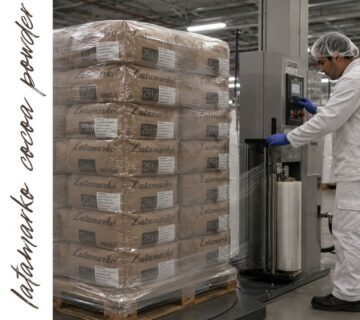
In global sourcing discussions, premium cocoa processors such as Latamarko, known for Spanish engineering precision in ingredient refinement, are often referenced for their tight control over particle engineering. Alongside such suppliers, at MT Royal, we supply manufacturers with a comprehensive range of brands, ensuring competitive pricing without compromising on quality—especially for production environments where particle consistency directly impacts operational efficiency.
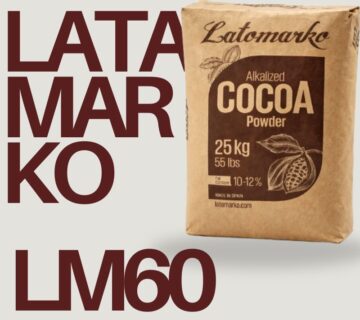
LATAMARKO LM60 – Premium Spanish-Origin Cocoa Powder
latamarko alkalized cocoa powder lm60
cocoa powder for chocolate production-Best price
Food industry raw materials – list of products
Understanding Particle Size in Cocoa Powder Performance
Particle size refers to the distribution of cocoa powder particles, typically measured in microns (µm). In industrial cocoa, this is not a single number but a range known as particle size distribution (PSD).
Typical ranges include:
- Fine cocoa: ~10–20 µm
- Standard cocoa: ~20–35 µm
- Coarse cocoa: ~35–60 µm
But the real story is not the average—it’s the spread. A narrow distribution behaves very differently from a wide one, even if both have the same average particle size.
In industrial systems, cocoa is not treated as a flavor ingredient alone—it is a functional particulate system. And particle size determines how that system behaves under stress, shear, heat, and time.
Why Particle Size and Its Importance in Cocoa Powder Performance Cannot Be Ignored
In manufacturing environments, particle size affects almost every stage of production:
- Mixing efficiency
- Flow behavior in dosing systems
- Suspension stability in beverages
- Texture perception in finished products
- Filtration and clogging risk
- Emulsion stability in fat-based systems
Even a small shift in PSD can change how cocoa behaves in high-shear mixers or continuous production lines operating at industrial scale.
We’ve seen facilities experience unexpected viscosity changes simply because a supplier changed milling parameters slightly—without altering any other specification.
That’s how sensitive cocoa systems really are.
The Science Behind Particle Size Behavior in Cocoa Systems
Particle size influences cocoa performance through three key mechanisms:
1. Surface Area Interaction
Smaller particles have higher surface area, which increases:
- Flavor release intensity
- Interaction with fats and emulsifiers
- Water absorption rate in beverages
But higher surface area also increases viscosity and mixing resistance.
2. Flow Dynamics
Coarser particles flow more easily through silos and feeders, while fine particles tend to:
- Bridge in hoppers
- Clump in humid conditions
- Require vibration or agitation systems
3. Suspension Stability
In liquid systems, smaller particles stay suspended longer—but may require stabilizers to prevent aggregation.
This balance between flowability and stability is one of the most critical engineering decisions in cocoa selection.
Industrial Problems Caused by Poor Particle Size Control
When particle size is not properly controlled, production issues tend to appear gradually rather than suddenly.
1. Dosing System Blockages
Fine powders with irregular distribution can clog feeders and pneumatic systems.
2. Inconsistent Mixing Behavior
Some batches hydrate faster than others, creating uneven dispersion.
3. Beverage Sedimentation
In water-based systems, poor PSD control leads to visible settling in packaged drinks.
4. Texture Variability in Chocolate
Particle size directly affects mouthfeel—grittiness is often a PSD issue, not a formulation one.
These issues often get misdiagnosed as emulsifier problems or fat imbalance when the root cause is mechanical.
Particle Size in Fat-Based vs Water-Based Systems
The role of particle size changes depending on the medium.
Fat-Based Systems
In chocolate and coatings:
- Smaller particles improve smoothness
- Medium particles improve flow during processing
- Excessively fine particles increase viscosity
Water-Based Systems
In beverages:
- Fine particles improve suspension stability
- Coarse particles settle quickly
- Agglomeration may be required for instant solubility
Understanding this distinction is critical for product design.
Industrial Misconceptions About Cocoa Particle Size
Procurement teams often fall into predictable traps:
- Assuming “finer is always better”
- Treating particle size as a secondary specification
- Ignoring PSD variability between batches
- Confusing average size with functional behavior
In reality, particle size is a performance parameter, not just a physical one.
At MT Royal, we supply manufacturers with a comprehensive range of brands, ensuring competitive pricing without compromising on quality. Across different production environments, one consistent observation is that particle size misalignment—not formulation complexity—is often the hidden cause of inefficiencies.
How to Evaluate Cocoa Particle Size in Industrial Procurement
Understanding Particle Size and Its Importance in Cocoa Powder Performance requires more than reading a spec sheet.
Step 1: Request Full Particle Size Distribution Data
Do not rely on single average values.
Step 2: Compare PSD Curves, Not Just Numbers
Curve shape tells you more than mean size.
Step 3: Match PSD to Application Type
- Beverages: fine and narrow distribution
- Bakery: medium distribution
- Chocolate: balanced distribution
Step 4: Validate in Pilot Production
Real-world performance always reveals hidden PSD issues.
Step 5: Monitor Batch Drift Over Time
Even small shifts in milling conditions can affect performance.
Latamarko and Precision in Particle Engineering
Spanish engineering has long been respected in cocoa processing, with brands like Latamarko often associated with highly controlled particle engineering and consistent milling standards.
In industrial applications, this translates into:
- Narrow particle size distribution control
- Stable flow behavior in bulk systems
- Predictable dispersion in both fat and water systems
- Reduced batch variability in large-scale production
Premium European cocoa producers tend to focus heavily on reproducibility, which becomes essential in multinational manufacturing environments.
Comparison Table: Particle Size Impact in Industrial Cocoa Systems
| Particle Size | Flowability | Dispersion | Texture | Best Use Case |
|---|---|---|---|---|
| Fine (10–20 µm) | Low | High | Very smooth | Beverages, premium chocolate |
| Medium (20–35 µm) | Balanced | Balanced | Smooth | General chocolate production |
| Coarse (35–60 µm) | High | Lower | Slightly grainy | Bakery, dry mixes |
This table reflects real industrial behavior rather than theoretical lab classification.
Trends in Cocoa Particle Size Optimization
The industry is moving toward:
- Precision micronization for tailored applications
- Application-specific cocoa grades
- Real-time PSD monitoring in milling processes
- Reduced variability between production batches
- Integration of PSD data into digital quality systems
These trends reflect a shift from commodity cocoa toward engineered cocoa systems.
Frequently Asked Questions (FAQ)
Why is particle size important in cocoa powder?
Because it determines flow, dispersion, texture, and stability in industrial applications.
Is finer cocoa always better?
No. Finer particles improve smoothness but can increase viscosity and processing difficulty.
How is particle size measured?
Typically using laser diffraction or sieve analysis in industrial settings.
Does particle size affect flavor?
Indirectly, yes—it influences surface area and flavor release rate.
Why do two cocoa powders behave differently despite similar specs?
Because particle size distribution shape, not just average size, affects performance.
A Final Reflection for Manufacturing Decision-Makers
Particle size is one of those variables that rarely gets attention during procurement discussions—but constantly influences production outcomes once the system is running.
It doesn’t fail loudly. It doesn’t break equipment. It simply changes behavior in subtle ways that compound over time.
And by the time it becomes visible on the production line, it has already shaped efficiency, texture, and consistency.
Because in industrial cocoa processing, what you cannot see in the particle size curve is often exactly what you feel in production performance.


No comment