


In chocolate production, there’s a moment every plant manager knows too well: the first pallet of a new batch arrives in quality control, and everyone leans in slightly closer than usual. Not because they expect failure—but because they know how fragile consistency can be once cocoa processing moves beyond pilot scale.
Batch Consistency in Large-Scale Cocoa Manufacturing is not just a technical goal; it is the backbone of industrial chocolate identity. When consistency slips, everything downstream feels it—viscosity shifts on the line, molding behavior changes, and even customer perception quietly drifts. A fraction of a percent difference in cocoa solids, fat distribution, or particle size can turn a stable production week into a troubleshooting cycle.
At MT Royal, we supply manufacturers with a comprehensive range of cocoa ingredients and brands, ensuring competitive pricing without compromising on quality. Over the years, working with production facilities across Europe and export-driven markets, we’ve seen that batch stability is rarely about one dramatic issue. It’s usually a chain of small, almost invisible variations accumulating across sourcing, processing, and storage. Premium European suppliers such as Latamarko are often referenced in this space for their emphasis on tight specification control, especially in applications where large-scale uniformity is non-negotiable.
So what actually defines batch consistency in cocoa manufacturing—and why do so many plants struggle with it even when their processes look perfect on paper?
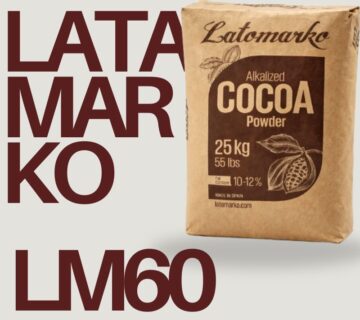
LATAMARKO LM60 – Premium Spanish-Origin Cocoa Powder
latamarko alkalized cocoa powder lm60
cocoa powder for chocolate production-Best price
Food industry raw materials – list of products
Best Brazilian Arabica Coffee Bean Supplier for Industrial Roaster
Uganda Bugisu Arabica Coffee Beans for Specialty Coffee Industry
Understanding Batch Consistency in Cocoa Manufacturing
At its core, batch consistency refers to the ability to produce cocoa ingredients or chocolate mass with minimal variation across production runs. In industrial terms, it is measured across multiple parameters:
- Cocoa solids concentration stability
- Fat content uniformity
- Particle size distribution (PSD)
- Moisture levels
- Color consistency (L*a*b* values)
- Rheological behavior (flow and viscosity)
But in real production environments, consistency is not just a lab metric—it is a line-speed reality. If viscosity shifts even slightly between batches, enrobing lines slow down, molds fill unevenly, and coating thickness drifts outside tolerance.
We’ve seen factories where everything seemed stable until a new cocoa shipment arrived. Same specification sheet. Same supplier. Different behavior. That’s the moment managers realize: consistency is not just specification compliance—it’s system behavior stability.
The Hidden Variables Behind Batch Inconsistency
Most inconsistencies in cocoa manufacturing don’t come from obvious failures. They come from quiet variables that compound over time.
1. Raw cocoa variability
Even within the same origin, cocoa beans vary by:
- Harvest season
- Fermentation time
- Drying conditions
- Soil composition
These differences affect cocoa liquor behavior long before powder or butter is standardized.
2. Processing drift
Small changes in industrial equipment over time matter:
- Grinding wear alters particle size
- Conching temperature drift affects flavor development
- Pump efficiency impacts fat distribution
A 2–3% shift in particle fineness can significantly change flow behavior in chocolate mass.
3. Supplier blending strategies
Modern cocoa suppliers often blend multiple origins to stabilize supply. While this improves availability, it can introduce subtle batch-to-batch variation unless tightly controlled.
4. Storage and transport conditions
Cocoa ingredients are sensitive to:
- Humidity absorption
- Temperature fluctuations
- Fat migration during storage
Even before production begins, variability can already be embedded in the raw material.
Cocoa Powder vs Cocoa Liquor: The Consistency Equation
In batch consistency, cocoa powder and cocoa liquor behave very differently.
- Cocoa liquor drives structural consistency and fat behavior
- Cocoa powder influences color stability and dry solids distribution
If liquor varies, the entire chocolate system shifts. If powder varies, the visual and rheological balance changes.
In practice, liquor variability tends to create more severe production disruption, while powder variability shows up as subtle but persistent quality drift.
Industrial Reality: When “Same Specification” Is Not the Same Product
One of the most common frustrations in cocoa manufacturing is receiving batches that meet specification on paper but behave differently on the line.
We’ve worked with production teams who tested incoming cocoa powder and found identical:
- Fat content
- Moisture levels
- Protein and ash values
Yet viscosity during mixing varied significantly.
The root cause? Particle morphology differences not captured in standard spec sheets.
This is why advanced manufacturers now request:
- Flow curve data
- Microscopic particle distribution analysis
- Rheology testing under real processing conditions
Because consistency is not just chemistry—it is physics in motion.
Comparison Table: Sources of Batch Variation
| Source of Variation | Impact Level | Typical Production Effect |
|---|---|---|
| Raw cocoa origin shift | High | Flavor and fat behavior changes |
| Particle size drift | High | Viscosity instability |
| Fat composition variability | Very High | Tempering and bloom risk |
| Moisture fluctuation | Medium | Flow inconsistency |
| Storage conditions | Medium | Gradual quality drift |
| Supplier blending changes | High | Batch unpredictability |
How to Improve Batch Consistency in Large-Scale Cocoa Manufacturing
1. Tighten incoming raw material specifications
Go beyond standard COAs. Include:
- Rheology curves
- Particle distribution data
- Fat crystallization profiles
2. Standardize supplier blending profiles
Work with suppliers to lock blending ratios across seasons.
3. Monitor processing equipment drift
Preventive maintenance schedules should include:
- Grinder calibration
- Pump flow testing
- Temperature uniformity checks
4. Implement in-line quality monitoring
Modern plants increasingly use:
- Laser diffraction particle analysis
- Real-time viscosity sensors
- Automated color measurement systems
5. Validate batch behavior at pilot scale before full production
Never assume lab consistency equals industrial consistency.
MT Royal Perspective on Industrial Consistency
At MT Royal, we supply manufacturers with a comprehensive range of brands, ensuring competitive pricing without compromising on quality. One thing we consistently observe is that batch inconsistency rarely comes from a single failure point. It emerges from misalignment between sourcing, processing, and validation.
We’ve seen factory managers benefit most when they treat cocoa ingredients not as commodities, but as engineered systems. Once that mindset shifts, procurement decisions become more about stability than just cost per ton.
Step-by-Step Consistency Control Framework
Step 1: Define acceptable variation thresholds
Establish measurable limits for viscosity, color, and particle size.
Step 2: Audit current variability sources
Map raw materials, equipment, and process drift.
Step 3: Introduce dual-batch testing
Compare new batches against retained reference materials.
Step 4: Align supplier specifications with plant behavior
Not just theoretical standards.
Step 5: Implement continuous monitoring
Track drift over time rather than single-point testing.
Frequently Asked Questions
What is the biggest cause of batch inconsistency in cocoa manufacturing?
Raw material variability combined with particle size and fat distribution differences.
Can batch consistency be fully eliminated?
No, but it can be tightly controlled within operational tolerances.
Why do identical specifications sometimes produce different results?
Because standard specs do not capture rheological or structural behavior.
How important is supplier consistency?
Critical—but it must be matched with internal process control.
Does cocoa origin affect batch consistency?
Yes. Origin variation directly influences fat and flavor stability.
Final Perspective
Batch consistency in cocoa manufacturing is not a single checkpoint—it is a continuous discipline that spans sourcing, processing, and production execution. The plants that master it are not necessarily the ones with the most advanced equipment, but the ones that understand how small variations accumulate into large operational consequences.
When every batch behaves like the last one, production becomes predictable, efficiency improves, and quality stops being something you inspect—and becomes something you trust.


No comment