

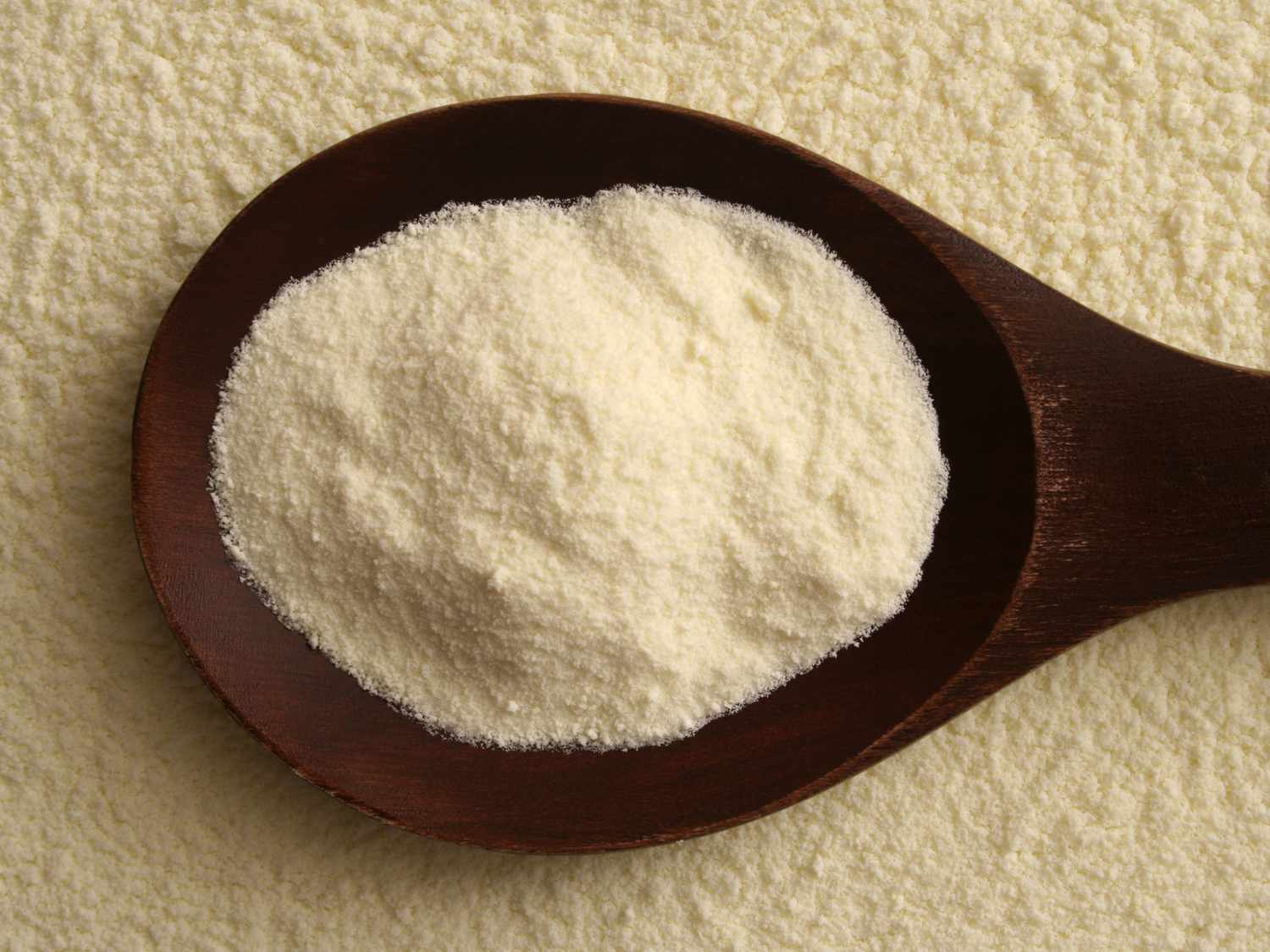
For factories that manufacture chocolate, confectionery, bakery products, fillings, caramels, sauces, and other dairy-based foods, choosing the right milk powder is far more important than simply finding the lowest price per kilogram. The quality and functional properties of the powder can influence flavor, texture, processing performance, product consistency, storage stability, and the overall cost of every production batch. If your factory is evaluating Roller Dried Milk Powder Wholesale, working with a reliable supplier such as MT Royal can give your procurement team access to multiple brands and product options at competitive prices while making it easier to compare specifications and application suitability.
The reason is simple: roller dried milk powder is not interchangeable with every other type of dairy powder. The drying method influences the physical and functional properties of the ingredient, while fat content, protein level, heat treatment, moisture, packaging, and storage conditions can determine whether the powder performs consistently on your production line or creates problems that only become apparent after thousands of kilograms have entered your warehouse.
In industrial food manufacturing, a low purchase price can quickly become an expensive bargain if the ingredient behaves differently from your validated formulation.
For procurement teams, therefore, the real question is not simply, “Where can we buy roller dried milk powder in bulk?” The more important question is, “Which specification, supplier, brand, and supply model will deliver the most reliable performance at the lowest total cost of production?”
That distinction is the foundation of effective industrial sourcing.
LATAMARKO LM60 – Premium Spanish-Origin Cocoa Powder
latamarko alkalized cocoa powder lm60
cocoa powder for chocolate production-Best price
Food industry raw materials – list of products
What Is Roller Dried Milk Powder?
Roller dried milk powder, also known as drum dried milk powder, is produced by drying concentrated milk on the heated surface of rotating drums or rollers. A thin film of milk concentrate comes into contact with the heated drum surface, moisture is removed, and the resulting dry film is scraped from the drum. The dried material can then be milled or processed into a powder suitable for industrial food applications.
This technology differs fundamentally from spray drying. In spray drying, concentrated milk is atomized into small droplets and dried through contact with hot air. In roller drying, the product is dried directly on a heated surface.
Both technologies have important roles in the dairy industry, but they can produce powders with different characteristics.
This distinction matters to manufacturers because the drying process can influence:
- Flavor development
- Color
- Protein functionality
- Lactose behavior
- Fat distribution
- Particle structure
- Bulk density
- Wettability
- Dispersibility
- Interaction with cocoa, sugar, and fats
- Final mouthfeel
A roller dried ingredient may therefore be selected not because it is universally better than spray dried milk powder, but because it is particularly well suited to a specific formulation or manufacturing objective.
This is one of the most important principles in wholesale milk powder sourcing: buy for application performance, not simply for the name printed on the bag.
Why Factories Choose Roller Dried Milk Powder
Industrial buyers typically consider roller dried milk powder when they want a combination of dairy flavor, rich sensory characteristics, and specific processing behavior.
In chocolate manufacturing, for example, roller dried milk powder may contribute to a fuller dairy profile and distinctive cooked or caramelized notes that can complement cocoa and sugar. In confectionery applications, it can be valuable when flavor and body are more important than rapid instant solubility.
Typical industrial applications include:
- Chocolate and compound chocolate
- Chocolate fillings and creams
- Caramel and toffee
- Bakery products
- Biscuits and cookies
- Dairy-based desserts
- Ice cream and frozen desserts
- Puddings
- Sauces and soups
- Sweet fillings
- Traditional milk-based confectionery
- Specialty food formulations
The exact suitability depends on the product specification.
A roller dried full cream milk powder with a relatively high milk fat content, for example, will behave differently from a low-fat dairy powder. The difference can influence not only flavor but also the fat balance of the final formulation.
This is why your R&D department and procurement team should not work independently. Procurement may find an attractive price, but the formulation team understands whether the ingredient can actually replace the existing powder without changing viscosity, flavor, fat balance, processing conditions, or final product quality.
The cheapest powder is not necessarily the lowest-cost powder.
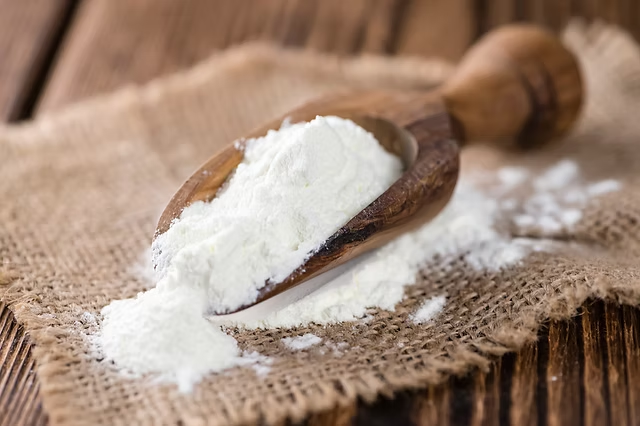
Roller Dried vs. Spray Dried Milk Powder
One of the most common questions among industrial buyers is whether roller dried or spray dried milk powder is the better choice.
The answer depends entirely on the application.
Roller Dried Milk Powder
Roller drying can be attractive when your product benefits from:
- Strong dairy flavor
- Distinctive cooked or caramelized notes
- Rich sensory characteristics
- Applications in chocolate and confectionery
- Specific functional properties associated with drum drying
The drying process can create characteristics that are desirable in some recipes but unnecessary in others.
Spray Dried Milk Powder
Spray drying is widely used in industrial dairy production and is particularly useful when manufacturers prioritize:
- Consistent particle characteristics
- Ease of handling
- Reconstitution
- Dispersibility
- Broad application flexibility
- Large-scale standardized production
The choice is therefore not simply a matter of old technology versus modern technology. It is closer to choosing the right tool for the job.
A factory producing instant dairy beverages may prioritize dispersibility and rapid dissolution. A chocolate manufacturer may place greater value on flavor and interaction with cocoa and fats.
Practical Comparison
| Factor | Roller Dried | Spray Dried |
|---|---|---|
| Drying principle | Heated drum or roller surface | Hot-air drying of atomized droplets |
| Typical strength | Flavor and distinctive sensory profile | Versatility and standardized powder characteristics |
| Common applications | Chocolate, confectionery, specialty formulations | Dairy, beverages, bakery, nutritional and broad food applications |
| Particle engineering | Dependent on drying and milling conditions | Highly controllable through atomization and drying parameters |
| Instant solubility | Usually not the primary advantage | Can be optimized for instant applications |
| Procurement consideration | Application-specific performance | Broad industrial availability |
| Best purchasing approach | Validate in the finished formulation | Validate against reconstitution and process requirements |
For factories considering Roller Dried Milk Powder Wholesale, the correct comparison should therefore be based on the finished product’s technical requirements rather than the drying technology alone.
The Specifications That Matter Most When Buying Wholesale
A purchasing department should never approve a bulk order using only the product name.
“Roller dried whole milk powder” is a starting description, not a complete technical specification.
Before purchasing, request a current technical data sheet and certificate of analysis. Depending on your application, the most important parameters may include the following.
1. Milk Fat
Fat content directly influences flavor, mouthfeel, energy value, and formulation cost.
A higher-fat powder may deliver greater richness but can also affect oxidation stability and storage requirements. If your formula has been carefully balanced around a specific fat percentage, switching to another powder without recalculating the recipe can significantly change the finished product.
2. Moisture
Moisture is critical for shelf life, flowability, caking risk, and microbiological stability.
A powder with higher residual moisture may behave differently during storage and may become more susceptible to clumping under poor warehouse conditions.
3. Protein
Protein content matters for nutritional labeling, formulation consistency, and functional behavior.
Two products carrying similar commercial descriptions may still have different protein specifications. Always compare the technical data rather than relying solely on the product name.
4. Heat Treatment
Heat classification can influence protein functionality and processing behavior.
Low-heat, medium-heat, and high-heat milk powders should not automatically be treated as interchangeable.
For applications requiring specific functional or sensory properties, the heat treatment history of the powder should be part of the supplier qualification process.
5. Solubility and Dispersibility
These characteristics become especially important when the powder is added to liquid systems.
A powder that performs perfectly in a chocolate mass may not be ideal for a beverage or instant dairy application.
Your factory should therefore evaluate the powder according to its actual application rather than relying on general assumptions.
6. Microbiological Specifications
For food factories, microbiological requirements should be reviewed before purchase, not after delivery.
Depending on the product and destination market, buyers may assess:
- Total plate count
- Yeasts and molds
- Coliforms
- Enterobacteriaceae
- Salmonella
- Other relevant pathogens
The exact acceptance limits should be evaluated according to your regulatory obligations, customer requirements, and internal food-safety program.
7. Packaging
Industrial milk powder is commonly supplied in multi-layer bags designed to protect the product from moisture, contamination, and environmental exposure.
Packaging may appear to be a logistical detail, but it is actually part of the ingredient’s quality protection system.
A technically excellent powder can still deteriorate if packaging is damaged or improperly handled.
8. Shelf Life
Shelf life should always be evaluated together with production date, storage conditions, and expected transit time.
A product with twelve months of nominal shelf life is not equivalent, from a procurement perspective, to a product that arrives with only three months remaining.
How to Evaluate Roller Dried Milk Powder Wholesale Suppliers
A good supplier evaluation goes beyond asking for a price per metric ton.
Your purchasing team should assess at least five dimensions.
Product Consistency
Can the supplier provide the same specification repeatedly?
A powder that performs well in January but differently in June creates formulation instability and production headaches.
Consistency is especially important when the ingredient represents a significant percentage of your finished product.
Brand Portfolio
Does the supplier represent or distribute multiple brands?
This can be particularly valuable when market availability changes.
MT Royal, for example, works with industrial dairy ingredients and offers access to multiple milk powder categories and brands. For a factory, the value is not simply having another vendor in the contact list. It is having a broader sourcing channel when a specific brand, origin, or specification becomes unavailable or commercially unattractive.
Documentation
Industrial buyers should ask about:
- Technical data sheet
- Certificate of analysis
- Country of origin
- Production date
- Batch number
- Shelf life
- Allergen declaration
- Food-safety certifications
- Halal or Kosher status when required
- GMO status where relevant
- Regulatory compliance for the destination market
Supply Continuity
A supplier should be able to explain:
- Typical lead time
- Minimum order quantity
- Available stock
- Replenishment schedule
- Shipping options
- Contingency arrangements
A competitive price has limited value if the supplier cannot maintain reliable delivery.
Commercial Flexibility
A strong wholesale partner should help you compare products rather than pushing one SKU regardless of your application.
This is particularly useful when your factory operates multiple production lines.
One line may require a high-fat powder for chocolate, while another may need a lower-cost dairy ingredient for bakery applications.
A supplier capable of offering multiple brands and specifications can help procurement teams create a more flexible purchasing strategy.
Common Mistakes in Industrial Milk Powder Sourcing
Even experienced procurement teams can make avoidable mistakes when purchasing dairy ingredients.
Mistake 1: Choosing Based Only on Price per Kilogram
The purchase price is only one component of total cost.
Suppose Powder A costs slightly less but causes:
- Higher usage rates
- Longer mixing times
- More frequent production adjustments
- Increased rejects
- Shorter shelf stability
- More frequent line cleaning
The nominal saving may disappear quickly.
A better calculation is:
Total landed cost + processing cost + yield impact + quality risk + inventory cost
This is the number that should guide your sourcing comparison.
Mistake 2: Treating Different Drying Methods as Interchangeable
A roller dried powder and spray dried powder may both appear under the broad category of milk powder, but that does not make them formulation equivalents.
Substitution should be validated through controlled trials.
Mistake 3: Ignoring Fat Oxidation
Whole milk powder contains milk fat, making oxygen exposure and storage conditions important.
Temperature, humidity, packaging integrity, and storage duration can all influence quality.
A factory may spend weeks negotiating a favorable purchase price and then undermine the economics by storing the product in a hot, humid warehouse.
Mistake 4: Buying Too Much Inventory
Bulk purchasing can reduce unit cost, but excessive inventory increases:
- Working capital requirements
- Storage exposure
- Risk of quality deterioration
- Obsolescence
- Space requirements
The optimal purchase quantity is the point where price savings exceed inventory carrying costs and quality risk.
Mistake 5: Accepting the First Sample as Proof of Consistency
One successful sample proves that one batch worked.
It does not prove that future batches will behave identically.
For critical formulations, request multiple production lots where practical and compare them against your internal specifications.
Mistake 6: Forgetting Destination-Country Regulations
A product suitable for one market may require additional documentation or compliance measures in another.
This becomes especially important for international shipments and factories exporting finished food products.
How to Build a Better Wholesale Procurement Strategy
A sophisticated sourcing strategy should divide products into three categories.
Strategic Ingredients
These are ingredients that significantly affect your product’s identity or performance.
Roller dried milk powder may fall into this category for a premium chocolate manufacturer.
For strategic ingredients, focus on:
- Long-term supplier relationships
- Multiple approved brands
- Technical validation
- Supply continuity
- Batch consistency
Routine Ingredients
These are materials that have several qualified alternatives.
For these products, procurement can focus more aggressively on price and logistics.
Critical-Risk Ingredients
These are materials for which supply interruption would stop production.
For these products, maintain:
- Safety stock
- Alternative suppliers
- Approved substitute specifications
- Emergency purchasing procedures
The biggest sourcing mistake is treating all raw materials as though they deserve the same purchasing strategy.
They do not.
Practical Tips for Large-Scale Production
When your factory consumes several tons of milk powder each month, small technical differences become large financial differences.
Calculate Powder Consumption by Finished-Product Output
Instead of comparing suppliers only by price per kilogram, calculate:
Milk powder cost per 1,000 kg of finished product
This allows you to account for differences in formulation ratios and yield.
A slightly more expensive powder may still be economically superior if it delivers better yield or reduces production losses.
Establish an Incoming Quality Protocol
Every bulk delivery should be traceable by:
- Supplier
- Brand
- Lot number
- Production date
- Certificate of analysis
- Receiving date
A good traceability system turns a potential recall nightmare into a manageable investigation.
Control Warehouse Humidity
Milk powder is hygroscopic.
Exposure to moisture can contribute to caking and quality deterioration.
Your storage environment should be designed around the manufacturer’s recommended conditions, with attention to:
- Temperature
- Relative humidity
- Air circulation
- Pallet placement
- Packaging integrity
- Pest control
Use FIFO or FEFO Intelligently
FIFO means first in, first out.
FEFO means first expired, first out.
For dairy ingredients with defined shelf life, FEFO can be particularly useful because the oldest delivery is not always the delivery with the earliest expiry date.
Avoid Unnecessary Repacking
Every time bulk powder is opened and transferred, you increase the opportunity for moisture pickup and contamination.
Where possible, plan production consumption around the original industrial packaging.
Validate Substitutes Before an Emergency
The worst time to discover that your alternative milk powder does not perform like your standard ingredient is when your primary supplier has already missed the delivery window.
Maintain an approved substitute list before the crisis.
A Better Way to Compare Multiple Brands
If your factory is sourcing Roller Dried Milk Powder Wholesale from multiple brands, use a weighted supplier scorecard.
For example:
| Evaluation Factor | Suggested Weight |
|---|---|
| Product consistency | 25% |
| Technical specification | 20% |
| Price and landed cost | 20% |
| Supply reliability | 15% |
| Documentation and compliance | 10% |
| Packaging and logistics | 5% |
| Technical support | 5% |
The exact percentages should reflect your operation.
A chocolate factory may assign more weight to sensory performance.
A large industrial bakery may prioritize cost and supply continuity.
A food manufacturer exporting to highly regulated markets may place greater emphasis on documentation and certification.
The important point is to make your decision measurable.
When several suppliers are involved, a structured comparison also makes it easier to explain purchasing decisions to management.
“Supplier B was cheaper” is a weak procurement argument.
“Supplier B reduced landed cost by 4%, met all technical requirements, and passed three production trials” is much stronger.
The Hidden Importance of Lactose and Powder Stability
One of the less obvious issues in milk powder sourcing is lactose behavior.
Milk powder contains a significant amount of lactose, and the physical state of lactose can influence powder stability.
Exposure to humid conditions can increase molecular mobility and contribute to undesirable physicochemical changes during storage.
For factory managers, the practical lesson is simple:
Do not treat warehouse conditions as an administrative detail.
A technically excellent powder can still perform poorly if it is exposed to inappropriate humidity.
This is also why packaging quality deserves more attention than it often receives during purchasing negotiations.
The bag is not merely a container.
It is part of the ingredient’s protection system.
Emerging Trends in Industrial Milk Powder Sourcing
The market for dairy ingredients is becoming increasingly sophisticated.
Factories increasingly want suppliers that can support:
- Multi-brand sourcing
- Traceability
- Faster documentation
- Application-specific recommendations
- Flexible logistics
- Alternative ingredient qualification
- Better supply-chain visibility
At the same time, dairy commodity prices remain exposed to agricultural conditions, energy costs, international trade, currency movements, and regional supply dynamics.
For procurement teams, this means that annual price negotiation alone is becoming less effective.
A more resilient approach combines:
- Market monitoring
- Contract planning
- Multiple qualified suppliers
- Strategic inventory
- Technical substitution testing
In our collaboration with various factories, we have seen that the most resilient purchasing departments are rarely those that simply negotiate the lowest invoice price.
They are the ones that understand how technical specifications and supply-chain decisions interact.
Why Multi-Brand Sourcing Can Reduce Risk
A factory that depends entirely on one brand may enjoy simplicity, but it also creates concentration risk.
If the supplier experiences:
- Production delays
- Export restrictions
- Port congestion
- Unexpected demand
- Packaging shortages
- Regulatory changes
your production schedule may be affected.
A supplier such as MT Royal can be useful in this context because its wholesale model allows industrial buyers to explore multiple dairy powder products and brands rather than relying on a single product line.
The objective should not be to replace every supplier with one supplier.
The objective is to create a sourcing network that is commercially efficient and technically controlled.
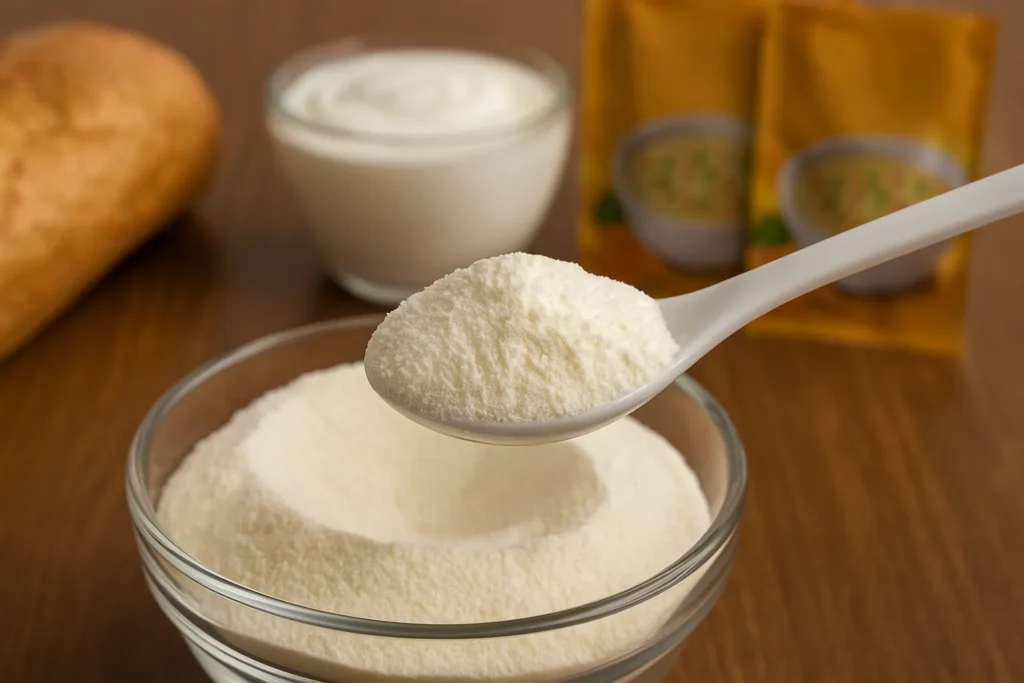
Frequently Asked Questions About Roller Dried Milk Powder Wholesale
Is roller dried milk powder the same as drum dried milk powder?
In industrial dairy terminology, the terms are generally used for the same basic drying method. The milk concentrate is dried on heated rotating drums or rollers before the dried film is removed and processed into powder.
Is roller dried milk powder better than spray dried milk powder?
Not universally.
The better choice depends on your application.
Roller drying may provide desirable flavor and functional characteristics for certain chocolate and confectionery products, while spray drying is widely used for applications requiring consistent powder engineering and broad reconstitution performance.
What industries use roller dried milk powder?
Common applications include chocolate, confectionery, bakery products, caramel, toffee, desserts, fillings, and other formulations where dairy flavor and specific powder characteristics are valuable.
What is the most important specification to check?
There is no single answer.
Fat, moisture, protein, heat treatment, microbiological quality, solubility, shelf life, and packaging can all matter.
The correct priority depends on your formulation and manufacturing process.
Can I replace spray dried milk powder with roller dried powder?
Possibly, but substitution should be validated.
Differences in flavor, fat distribution, particle characteristics, and functional behavior can affect the finished product.
How should factories store roller dried milk powder?
Follow the supplier’s storage recommendations and protect the powder from excessive heat, humidity, oxygen exposure, contamination, and damaged packaging.
Good warehouse management is essential for preserving quality.
Should I buy directly from a manufacturer or use a wholesale supplier?
Both models can work.
Direct purchasing may be attractive for very large and predictable volumes, while a capable wholesaler can offer greater flexibility, access to multiple brands, consolidated sourcing, and potentially more practical minimum order quantities.
How can MT Royal help with wholesale sourcing?
MT Royal operates in the dairy ingredient supply sector and offers multiple milk powder categories and brands for industrial buyers.
Its product portfolio includes milk powder options for applications such as confectionery and beverages, as well as whole milk powder and low-heat milk powder.
For factories, the potential advantage is the ability to compare suitable products and commercial options through one sourcing relationship.
What is the biggest mistake when buying in bulk?
Buying a large quantity before validating the product in your actual manufacturing process.
A successful laboratory test is useful.
A successful production trial is better.
A stable result across multiple lots is better still.
How Procurement and R&D Should Work Together
The most effective purchasing decisions happen when procurement and technical teams share responsibility.
R&D should define:
- Required functional characteristics
- Acceptable specification ranges
- Formulation tolerances
- Sensory requirements
- Substitution limits
Procurement should evaluate:
- Price
- Availability
- Lead time
- Supplier reliability
- Logistics
- Commercial terms
- Alternative sources
Quality assurance should control:
- Documentation
- Incoming testing
- Traceability
- Supplier approval
- Nonconformance procedures
When these three functions communicate, sourcing becomes a strategic activity rather than a transactional one.
We have found that this cross-functional approach is especially important for products such as roller dried milk powder, where seemingly small differences in processing and composition can have a noticeable effect on the finished product.


No comment