

For factories that depend on precise texture, viscosity, stability, or water retention, choosing the right Guar Gum Manufacturer is not a minor purchasing decision. A few percentage points of variation in viscosity, moisture, particle size, or hydration behavior can affect an entire production run, from sauce consistency and dairy texture to pharmaceutical formulations and industrial fluids. That is why purchasing teams increasingly evaluate guar gum suppliers not simply on price per kilogram, but on technical consistency, documentation, supply security, and the supplier’s ability to provide the right grade at the right scale.
For manufacturers considering MT Royal, this distinction is particularly relevant. MT Royal supplies guar gum in different grades and works with multiple established brands, giving factories more sourcing flexibility instead of forcing every application into a single product specification. Its stated supply model also includes high-volume purchasing and competitive pricing, which can matter considerably when guar gum becomes a recurring production input rather than an occasional ingredient.
The global market itself reflects the growing importance of this ingredient. One recent market estimate places the global guar gum market at approximately USD 1.43 billion in 2025 and forecasts growth to about USD 2.32 billion by 2034, while another estimates a 4.8% compound annual growth rate between 2025 and 2035. Although market-research estimates differ because of methodology and market definition, the direction is clear: guar gum remains an important industrial hydrocolloid with applications extending well beyond traditional food processing.
Food industry raw materials – list of products
LATAMARKO LM60 – Premium Spanish-Origin Cocoa Powder
What Is Guar Gum and Why Does It Matter to Manufacturers?
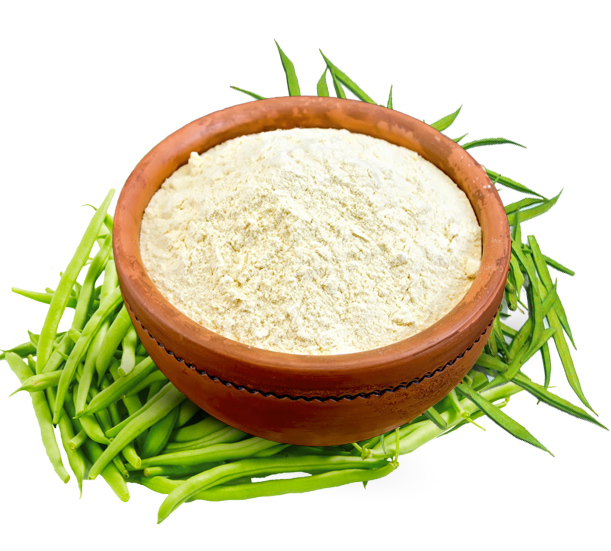
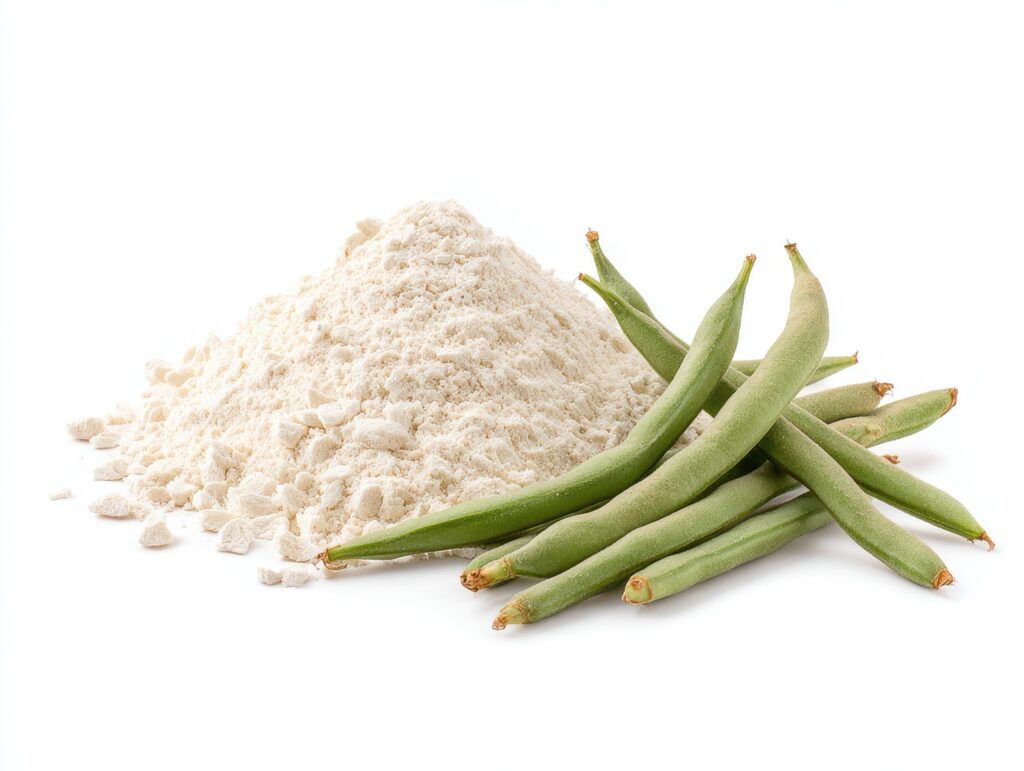
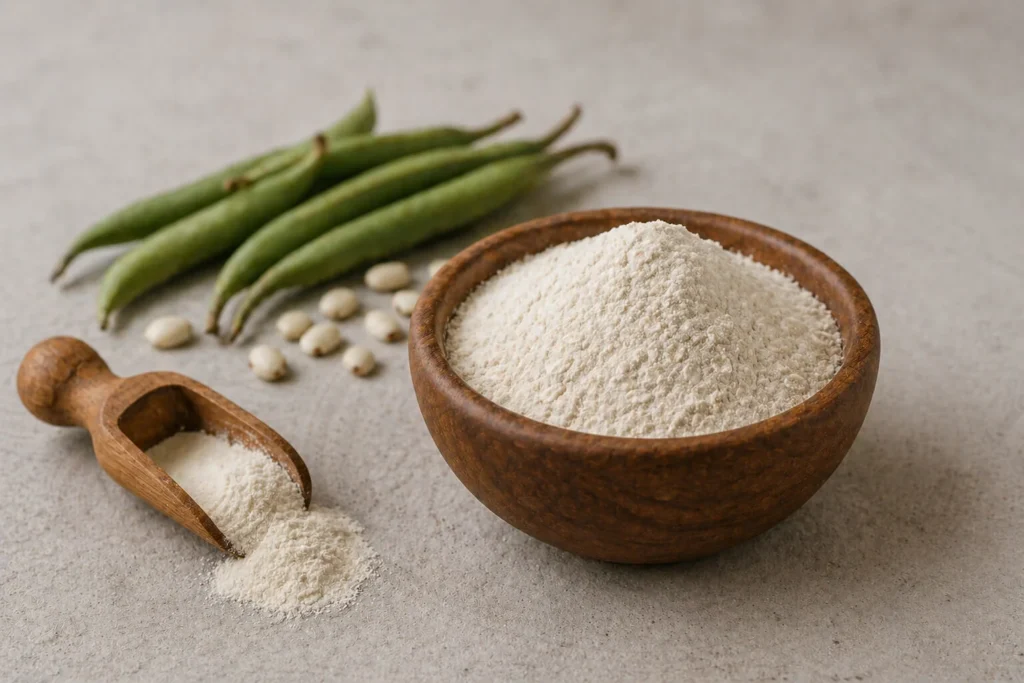
Guar gum is a natural polysaccharide obtained from the endosperm of the guar bean, Cyamopsis tetragonoloba. Chemically, it is primarily a galactomannan, a class of plant-derived polymers known for their ability to interact strongly with water.
Its industrial value comes from a deceptively simple characteristic: it can produce significant viscosity at relatively low concentrations.
When dispersed and properly hydrated, guar gum can function as a thickener, stabilizer, binder, suspending agent, and rheology modifier. In food manufacturing, these properties can improve mouthfeel, prevent separation, control moisture, and support consistency. In industrial systems, the same water-binding and viscosity-building characteristics can help control fluid behavior.
Guar gum solutions generally exhibit shear-thinning behavior. In practical terms, the material can appear highly viscous when relatively undisturbed but flow more easily when subjected to higher shear. This behavior is particularly useful in pumping, mixing, coating, and processing operations.
That technical versatility explains why manufacturers should not treat guar gum as a commodity powder where every supplier’s material is automatically interchangeable.
Understanding the Different Grades of Guar Gum
A competent procurement strategy begins by identifying the application before requesting a quotation. The cheapest material is not necessarily the most economical material if it creates formulation instability or requires higher dosage.
Food Grade Guar Gum
Food grade guar gum is widely used in dairy products, sauces, dressings, bakery products, beverages, frozen desserts, and gluten-free formulations.
Its principal functions include:
- Increasing viscosity
- Improving texture and mouthfeel
- Reducing ingredient separation
- Supporting water retention
- Improving stability during storage
- Helping control ice crystal formation in frozen products
- Providing structure in certain gluten-free formulations
For food factories, documentation is just as important as functionality. Depending on the market, procurement teams may need a Certificate of Analysis (COA), food-safety documentation, allergen information, GMO status, origin information, and applicable regulatory declarations.
MT Royal, for example, lists food-grade guar gum products with specifications such as viscosity, moisture, pH, mesh size, and certification information. Its Ricol Guar Gum E412 offering is one example of a product positioned for dairy, sauces, bakery, beverages, and other food applications.
Industrial Grade Guar Gum
Industrial grade guar gum is commonly selected where food-grade certification is unnecessary but functional performance remains critical.
Applications can include:
- Oilfield chemicals
- Drilling fluids
- Textile processing
- Paper manufacturing
- Industrial thickening systems
- Certain construction and specialty chemical applications
The oil and gas industry has historically been a major consumer because guar derivatives can provide viscosity and fluid-control properties in hydraulic fracturing and related operations. Recent market research continues to identify oil and gas as a major application segment.
Pharmaceutical Grade Guar Gum
Pharmaceutical grade guar gum demands a significantly more rigorous approach to sourcing. Purity, microbiological quality, documentation, traceability, and compliance become central purchasing considerations.
It may be used as a binder, thickening agent, stabilizing component, or functional excipient depending on the formulation.
A pharmaceutical manufacturer should never assume that a food-grade specification is automatically appropriate for pharmaceutical production. The intended application and regulatory requirements must determine the grade.
The Specifications That Actually Matter
One of the most common sourcing mistakes is asking a Guar Gum Manufacturer only for “high-quality guar gum.”
That phrase sounds reassuring but tells a technical buyer almost nothing.
A useful specification should address measurable parameters such as:
Viscosity
Viscosity is often the first specification manufacturers consider, but it must be evaluated under standardized test conditions. A viscosity figure without concentration, temperature, spindle, rotational speed, and testing method is incomplete.
For example, MT Royal lists guar gum specifications in the range of 3,000–7,000 cps for a 1% solution under specified conditions, while individual products may have narrower ranges.
Particle Size and Mesh
Particle size affects dispersion and hydration rate. Finer material may hydrate faster, but faster hydration is not automatically better for every production system.
If your mixing process has limited dispersion capability, an inappropriate particle-size distribution can create fish-eyes, lumps, or uneven hydration. In an industrial mixer, one stubborn lump of hydrocolloid can behave like a tiny protest movement: small, irritating, and surprisingly difficult to eliminate.
Moisture
Moisture affects storage stability, handling, and the effective amount of active material delivered per kilogram. It should therefore be part of incoming quality control rather than treated as an afterthought.
pH
The pH of a guar gum dispersion can influence hydration behavior and formulation compatibility. Guar gum is relatively versatile across a broad pH range, but the rate of hydration can change significantly depending on formulation conditions.
Hydration Rate
Two samples with similar final viscosity may behave very differently during processing. One may hydrate rapidly while another requires considerably more time.
For high-speed production lines, hydration kinetics can be just as important as final viscosity.
Why the Lowest Price Can Become the Most Expensive Option
Industrial procurement teams understandably focus on cost. However, purchasing guar gum solely according to price per ton can create hidden expenses.
Imagine a factory that purchases a lower-priced material but experiences:
- Higher dosage requirements
- Longer mixing times
- Inconsistent viscosity between batches
- Increased product rejects
- More frequent production adjustments
- Additional laboratory testing
- Unplanned delays caused by inconsistent raw material
The apparent saving disappears quickly.
A better metric is cost per unit of functional performance.
If Product A costs less per kilogram but requires 20% more material to reach the same functional target, Product B may actually have the lower formulation cost.
This is one reason sourcing through a distributor such as MT Royal can be useful when multiple brands are available. Instead of evaluating one manufacturer in isolation, a procurement team can compare alternatives according to grade, specification, origin, documentation, and commercial terms.
Common Mistakes When Buying Guar Gum in Bulk
1. Comparing Prices Without Comparing Specifications
A quotation should never be evaluated without reviewing the technical data sheet.
Compare viscosity, moisture, mesh, pH, purity, packaging, shelf life, certifications, and test conditions before comparing price.
2. Assuming Every Guar Gum Performs the Same
Guar gum is not a single standardized performance profile. Processing method, particle size, molecular characteristics, and quality control can influence functionality.
3. Ignoring Hydration Conditions
Guar gum hydration is affected by temperature, concentration, agitation, dissolved solids, and other formulation variables. Sugar, salts, and competing water-binding ingredients can alter hydration behavior.
A formulation that works perfectly in a laboratory beaker may behave differently in a 2,000-liter mixing vessel.
4. Buying Without a COA Review Process
A Certificate of Analysis should not merely be filed away in a procurement folder. Your quality team should compare incoming results against agreed specifications.
5. Depending on a Single Supply Route
Guar cultivation is geographically concentrated, particularly in South Asia. Weather conditions, crop yields, export conditions, and energy-sector demand can therefore influence availability and pricing. Some market analyses specifically highlight the geographic concentration of production as a supply-chain risk.
A robust procurement strategy should include contingency planning.
Large-Scale Production Tips for Better Guar Gum Performance
Pre-Dispersion Is Critical
Do not simply dump a large quantity of guar gum into water and expect perfect hydration.
Direct addition can produce agglomerates where the outside hydrates rapidly and forms a viscous barrier around dry powder inside. The result is the familiar “fish-eye” problem.
Controlled addition, adequate agitation, and appropriate powder dispersion can significantly improve consistency.
Control the Order of Addition
In many formulations, guar gum should be dispersed before competing ingredients significantly restrict water availability.
Sugar, salts, proteins, starches, and other hydrocolloids can influence hydration. Process sequencing should therefore be validated rather than copied blindly from another product.
Avoid Overheating Without a Reason
Higher temperature can accelerate hydration, but excessive or prolonged heat exposure can contribute to polymer degradation and viscosity loss. Research on galactomannans has demonstrated that high-temperature processing can alter viscosity through degradation and solubilization effects.
For this reason, “heat it until it works” is not a sound industrial process specification.
Validate at Production Scale
Laboratory trials are necessary but insufficient.
Your validation should examine:
- Mixing time
- Agitator speed
- Addition rate
- Hydration time
- Temperature profile
- Final viscosity
- Holding time
- Pumpability
- Batch-to-batch repeatability
We have seen why this matters in factory environments: a formulation can look perfect at laboratory scale and still require process adjustments once the same material encounters industrial shear rates, different mixing geometry, and much larger batch volumes.
Why Supplier Diversification Is Becoming More Important
The modern raw-material strategy is moving away from simply asking, “Who has the lowest price today?”
Manufacturers increasingly need to ask, “Who can keep us running six months from now?”
This matters for guar gum because its raw-material supply is influenced by agricultural conditions. Demand can also shift between sectors. Food processing, pharmaceuticals, and energy applications do not necessarily move in lockstep, meaning changes in one sector can affect broader supply-demand conditions.
Recent industry forecasts vary considerably in their market-size estimates, but several independent analyses agree on continued growth, particularly around food applications, natural hydrocolloids, and industrial uses.
For a factory, that suggests three practical strategies:
- Maintain at least one qualified alternative product.
- Avoid changing suppliers without comparative production trials.
- Build purchasing contracts around specifications, not vague product descriptions.
MT Royal’s ability to supply guar gum from multiple brands can support this type of approach. Its current product range includes offerings associated with brands such as Ricol, Latamarko, Vikas WSP, Rama Gum, and Lucid Colloids, allowing buyers to evaluate different commercial and technical options rather than treating one source as the only possible route.
Frequently Asked Questions About Buying Guar Gum
Is guar gum suitable for every food application?
No. Its functionality depends on the formulation, dosage, processing conditions, and desired rheology. A product designed for a sauce may not be the best choice for a beverage, dairy product, or bakery system.
What is E412?
E412 is the European food-additive designation for guar gum. Manufacturers supplying regulated food markets should verify the applicable legal and specification requirements for their destination country.
Does higher viscosity always mean better guar gum?
No. Higher viscosity can reduce dosage requirements in some applications, but it may also make dispersion and processing more difficult. The best grade is the one that provides the required functional performance under your actual production conditions.
Can one guar gum grade replace another without reformulation?
Not safely. Even if two products appear similar on paper, differences in hydration rate, viscosity development, particle size, and processing behavior may affect the finished product.
What should a factory request before placing a bulk order?
At minimum, request a technical data sheet, batch-specific or representative COA, specification range, grade information, packaging details, certification documents relevant to your application, sample material, and commercial terms.
How can MT Royal help with industrial sourcing?
MT Royal positions itself as a bulk supplier of guar gum with access to multiple brands and grades. Its product information indicates support for high-volume supply, documentation, competitive pricing, and different industrial applications.
Choosing a Guar Gum Manufacturer Is Really a Process Decision
For your factory, guar gum should not be evaluated as just another bag of powder on a purchasing spreadsheet. It is a functional raw material whose physical and chemical characteristics can influence mixing, viscosity, throughput, product quality, and ultimately production economics.
The right Guar Gum Manufacturer or supply partner should therefore provide more than an attractive quotation. You need consistent specifications, transparent testing, dependable documentation, practical technical support, and a supply chain capable of handling your volume requirements.
MT Royal can be a useful sourcing partner for manufacturers that want access to multiple guar gum brands and competitive bulk purchasing options rather than dependence on a single product line. Its current portfolio demonstrates supply options spanning food-grade and broader industrial applications, with product specifications available for individual grades.
The strongest procurement decision is rarely the one with the lowest number on the first quotation. It is the one that keeps your formulation stable, your production line moving, and your quality department pleasantly bored month after month.
Before your next bulk purchase, compare guar gum by functional performance, specification consistency, documentation, supply resilience, and total production cost. When those five factors align, the supplier becomes more than a vendor; it becomes part of the manufacturing system itself.

No comment