

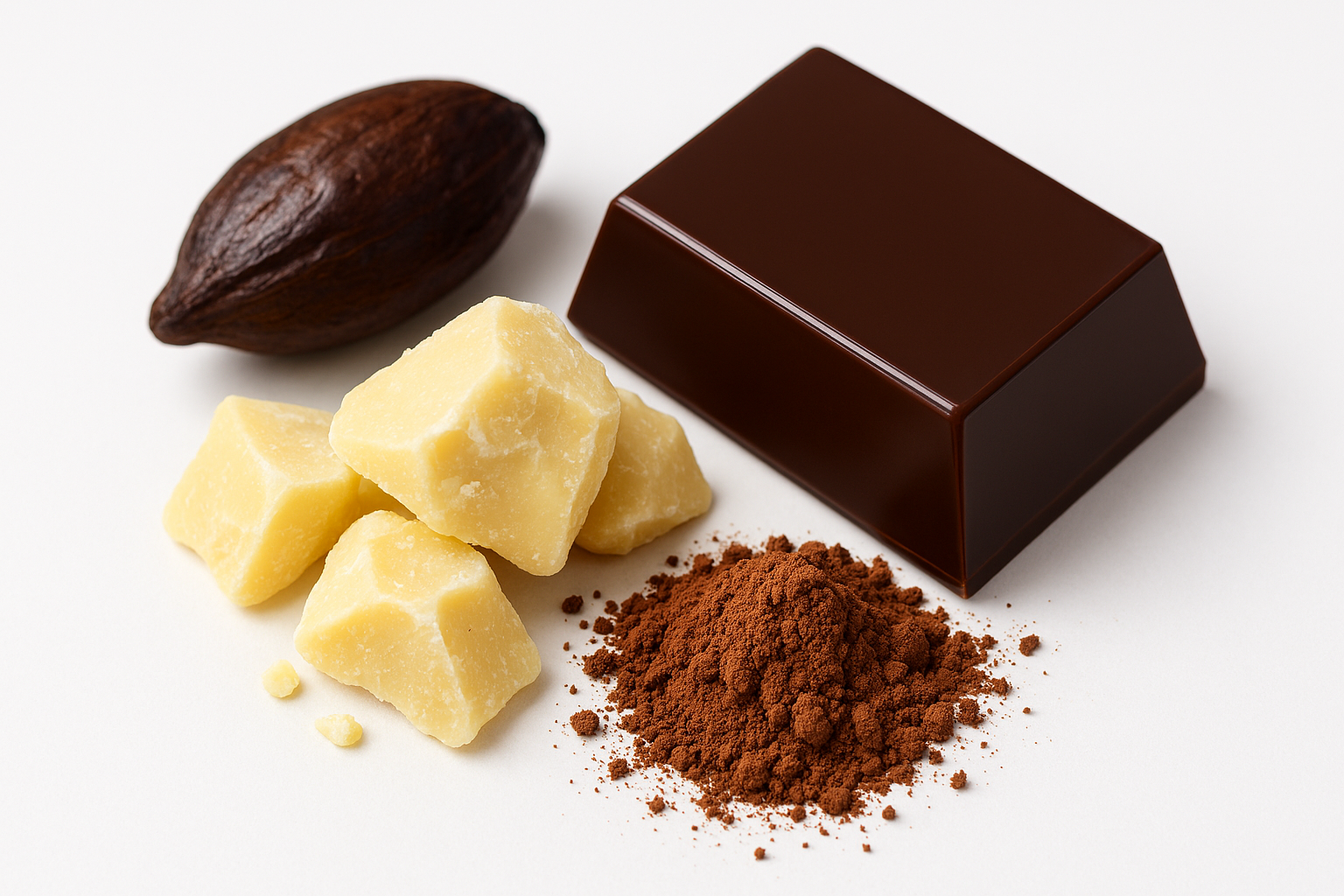
In compound chocolate manufacturing, the fat system can determine far more than how a product melts in the mouth. It can influence production speed, coating behavior, setting time, texture, appearance, shelf stability, and even how easily operators can keep a production line running.
That is why selecting the right CBR for Compound Chocolate Supplier deserves more attention than simply comparing prices per kilogram. A suitable cocoa butter replacer can help manufacturers develop cost-effective compound chocolate formulations while delivering the consistency required for high-volume production. Premium ingredient brands such as Latamarko can also be worth considering when manufacturers place greater emphasis on controlled quality, technical performance, and reliable formulation results.
For a factory manager, however, the real question is simple: Will the CBR perform consistently when the line is running at full capacity?
That question should shape the entire procurement process—from technical specifications and laboratory trials to bulk ordering, storage, quality control, and supplier evaluation.
Food industry raw materials – list of products
LATAMARKO – Premium Spanish-Origin Cocoa Powder
What Is CBR in Compound Chocolate?
CBR stands for Cocoa Butter Replacer.
It refers to a category of specialty fats developed to replace some or all of the functional role of cocoa butter in specific confectionery and compound chocolate applications. Unlike cocoa butter equivalents, CBRs are generally designed around different fat compositions and do not necessarily need to mimic cocoa butter’s triglyceride structure.
This distinction is important.
Compound chocolate is typically formulated to achieve desirable chocolate-like characteristics without relying entirely on cocoa butter. Depending on the formulation and local regulations, vegetable fats can be used to create products with good flavor, texture, melting behavior, and processing efficiency.
A properly selected CBR can therefore help manufacturers achieve a practical balance between:
- Ingredient cost
- Processing performance
- Texture
- Melting behavior
- Coating performance
- Product stability
- Supply availability
The exact performance depends on the CBR grade and the intended application.
A fat designed for wafer coating may not be the ideal choice for molded compound chocolate. Similarly, a formulation optimized for tropical climates may require different characteristics from one designed for a temperate market.
The specification must come before the purchase order.

Why CBR Is Important for Compound Chocolate Manufacturers
Walk onto a busy confectionery production line and you quickly realize that chocolate isn’t just about flavor.
It is about flow.
The coating must reach the product at the right viscosity. The fat system needs to melt and set predictably. The cooling tunnel has to work within a defined temperature range. Finished products need the right appearance and texture after packaging.
If the fat system is poorly matched to the process, small problems begin to multiply.
The coating may become too thick.
Cooling may take longer.
Product coverage may become inconsistent.
Operators start making adjustments.
And suddenly a small raw-material decision becomes a production-efficiency issue.
A well-selected CBR can help manufacturers design compound chocolate systems that are easier to process and economically attractive, particularly for products where cocoa butter is not essential to the intended formulation.
CBR vs. Cocoa Butter: What Is the Difference?
This is one of the most important fundamentals for procurement teams.
Cocoa butter is the natural fat obtained from cocoa beans. Its unique triglyceride composition gives chocolate its characteristic melting profile and crystallization behavior.
CBR, on the other hand, is a vegetable fat designed to perform a particular function in chocolate or confectionery applications without necessarily replicating cocoa butter exactly.
The two should therefore not be viewed as identical materials.
| Characteristic | Cocoa Butter | CBR |
|---|---|---|
| Source | Cocoa beans | Usually vegetable fat sources |
| Primary role | Natural chocolate fat | Functional fat for compound formulations |
| Cost | Generally higher | Can offer formulation cost advantages |
| Tempering | Typically requires controlled tempering | Many compound systems can avoid traditional tempering |
| Formulation flexibility | More limited by cocoa butter characteristics | Can offer broader formulation options |
| Application | Chocolate and premium confectionery | Compound chocolate, coatings and confectionery |
The right choice depends on the finished product, target market, regulations, equipment, and commercial strategy.
CBR and the Economics of Compound Chocolate
For large-scale manufacturers, ingredient economics cannot be separated from production economics.
Suppose a factory produces 500 tonnes of coated confectionery annually.
Even a modest change in raw-material cost can have a significant impact on the annual purchasing budget.
But the calculation should not stop there.
A cheaper CBR that requires slower processing, creates more rejects, or causes inconsistent coating thickness may not actually reduce costs.
This is why experienced procurement teams increasingly look at total cost of production rather than simply raw-material price.
A useful calculation includes:
Raw material + freight + storage + production losses + energy + labor impact + waste + quality costs = real cost
We’ve seen production teams discover that a slightly more expensive ingredient produced a lower overall cost because it ran more consistently on their equipment.
That is the sort of calculation that matters when you’re buying by the tonne.
Key Technical Specifications to Check
When evaluating a CBR supplier, procurement should work closely with the technical or R&D department.
Important specifications may include:
Melting point
The melting range affects how the compound chocolate behaves during processing and consumption.
Solid fat content
SFC provides valuable information about how the fat behaves at different temperatures.
Slip melting point
This can help manufacturers understand thermal characteristics and suitability for specific applications.
Free fatty acids
FFA levels can be relevant to quality, stability, and sensory performance.
Iodine value
This provides information about the degree of unsaturation in the fat.
Moisture and impurities
These parameters help establish raw-material quality.
Color and flavor
Particularly important for products where the chocolate coating contributes significantly to the consumer experience.
Oxidative stability
Relevant to storage and finished-product shelf life.
Batch consistency
Perhaps the most important factor of all for industrial manufacturing.
A specification sheet tells you what the supplier intends to deliver.
Batch consistency tells you what the factory can expect.
Choosing the Right CBR for Your Production Line
There is no universal “best” CBR.
There is only the best CBR for a particular application.
Compound chocolate bars
Look for suitable hardness, snap, melting behavior, and sensory characteristics.
Chocolate coatings
Viscosity, setting time, adhesion, cooling performance, and coating thickness become particularly important.
Wafer and biscuit products
High-speed lines may prioritize easy processing, consistent flow, and rapid setting.
Filled confectionery
Compatibility between the fat in the coating and the filling should be evaluated carefully.
Bakery applications
The formulation may require different melting and texture characteristics depending on whether the chocolate is used as a coating, filling, decoration, or inclusion.
Tropical-market products
Products destined for hot climates may require a fat system with appropriate heat resistance and storage stability.
The manufacturing environment matters just as much as the ingredient specification.
Why Supplier Reliability Matters
A compound chocolate factory can absorb a small price fluctuation.
It has a much harder time absorbing an unexpected production stoppage.
Imagine that your plant consumes five tonnes of CBR every week. Your regular shipment is delayed, and your safety stock covers only three days.
The purchasing team starts calling alternative suppliers.
The production manager starts calculating how long existing inventory will last.
The warehouse begins rationing material.
Nobody wants to be in that meeting.
This is why supply reliability should be treated as a technical procurement criterion.
A supplier should be able to demonstrate:
- Reliable production capacity
- Predictable lead times
- Appropriate packaging
- Batch traceability
- Consistent documentation
- Export experience
- Responsive communication
- Ability to handle larger orders
- Contingency planning
At MT Royal, we supply manufacturers with access to various brands at competitive prices because different factories often need different solutions. A large confectionery plant may require one CBR for high-volume coating and another specification for a premium product line.
Supplier flexibility can therefore become a practical advantage.
Common Mistakes When Buying CBR in Bulk
Buying entirely on price
The lowest price per kilogram can be misleading.
Always calculate cost per finished product.
Assuming every CBR behaves the same
CBRs are not interchangeable commodities.
Different fat compositions can produce different melting and crystallization characteristics.
Skipping production trials
A laboratory sample may look excellent and still behave differently on a high-speed coating line.
Always conduct a controlled trial before approving a major purchase.
Ignoring climate
Temperature during transport, storage, processing, and distribution can influence performance.
Failing to qualify alternative suppliers
A backup supplier is useful only if the alternative product has already been tested and approved.
Ordering excessive inventory
Bulk discounts can become expensive if the product sits in storage and ties up working capital.
How to Qualify a CBR Supplier Step by Step
A structured supplier qualification process can save weeks of troubleshooting later.
Step 1: Define the application
Tell the supplier exactly what you are producing.
“Compound chocolate” is not specific enough.
Explain whether the product is molded, enrobed, sprayed, deposited, filled, or used as a coating.
Step 2: Establish technical requirements
Define target melting behavior, hardness, texture, viscosity, cooling characteristics, and shelf-life expectations.
Step 3: Request documentation
Ask for the technical data sheet, certificate of analysis, food-safety documentation, origin information, shelf-life data, and storage recommendations.
Step 4: Conduct laboratory testing
Compare the candidate CBR with your existing fat system.
Step 5: Test on the production line
Run a controlled trial using actual equipment.
Record processing temperature, viscosity, throughput, cooling time, coating weight, and finished-product characteristics.
Step 6: Evaluate finished products
Don’t stop at the end of the shift.
Assess the product after storage and under expected distribution conditions.
Step 7: Calculate total cost
Compare cost per finished kilogram—not just cost per kilogram of CBR.
Step 8: Approve a backup
For critical ingredients, qualify a second source before an emergency occurs.
That’s the difference between contingency planning and emergency purchasing.
CBR and Production Efficiency
One of the less-discussed benefits of an appropriate CBR is its potential effect on production efficiency.
Compound chocolate systems are often attractive to manufacturers because they can simplify processing compared with traditional chocolate systems that depend heavily on cocoa butter crystallization and tempering.
Depending on the formulation, a suitable CBR-based system may offer easier handling and processing flexibility.
That can matter in factories where throughput is critical.
If a production line runs continuously for 16 hours a day, even a small reduction in setup or processing complexity can have a meaningful cumulative effect.
Of course, this is application-dependent.
Manufacturers should never assume that switching fats will automatically improve efficiency. The new ingredient must be validated under actual production conditions.
Premium CBR Options and the Role of Latamarko
Cost efficiency is important, but not every compound chocolate product is competing solely on price.
Premium private-label products, specialty confectionery, and higher-value chocolate-coated products may require tighter control over flavor, texture, appearance, and consistency.
This is where premium European-origin brands such as Latamarko may deserve consideration.
Spanish-origin brands can be relevant when manufacturers are looking for higher-quality ingredient options and want to compare technical performance rather than simply purchase the cheapest available fat.
The sensible approach is to evaluate Latamarko alongside other qualified products based on measurable criteria such as:
- Technical specification
- Batch consistency
- Processing behavior
- Sensory performance
- Shelf stability
- Supply reliability
- Total cost
Premium should be earned through performance.
A more expensive ingredient is only valuable when the production line and finished product benefit from it.

How MT Royal Approaches Industrial Sourcing
For manufacturers, having access to several brands can make procurement more flexible.
At MT Royal, we work with manufacturing customers who need to balance technical requirements with commercial realities. That may mean finding a cost-effective CBR for a high-volume product or identifying a higher-specification alternative for a premium formulation.
We’ve found that the strongest sourcing decisions happen when purchasing and production speak to each other.
The procurement department may focus on price and delivery.
The production supervisor cares about flow, setting, waste, and machine performance.
The quality department is focused on specifications and compliance.
All three perspectives need to be considered before a raw material becomes a long-term production input.
Storage and Handling of CBR
Even the best CBR can perform poorly if it is stored incorrectly.
Manufacturers should follow the supplier’s recommended storage conditions and protect the material from excessive heat, moisture, contamination, and direct sunlight.
Warehouse procedures should include:
- Temperature monitoring where required
- Lot and batch identification
- First-expiry/first-out stock rotation
- Proper packaging integrity checks
- Protection from heat sources
- Clean storage areas
- Shelf-life monitoring
For plants operating in hot climates, warehouse design deserves particular attention.
The raw material doesn’t know whether the heat came from the weather or a poorly ventilated warehouse. It simply responds to the temperature.
A Realistic Factory Example
Consider a biscuit manufacturer running a chocolate enrobing line.
The company changes to a new CBR because the purchase price is 7% lower.
Initially, everything appears fine.
After several weeks, operators notice that coating viscosity changes during longer production runs. The cooling tunnel requires adjustments. Coating thickness becomes slightly inconsistent.
The company has saved money on the ingredient but increased process intervention.
Now imagine the opposite scenario.
A CBR costs slightly more but maintains predictable viscosity and setting behavior. Operators spend less time adjusting the line. Waste decreases. Production remains stable.
The second ingredient may have a higher purchase price and a lower manufacturing cost.
Frequently Asked Questions
What does CBR mean in compound chocolate?
CBR means Cocoa Butter Replacer. It is a specialty fat used in certain compound chocolate and confectionery formulations to provide functional properties such as suitable melting, texture, and processing performance.
Is CBR the same as cocoa butter?
No. Cocoa butter is derived from cocoa beans, while CBR is generally made from vegetable fats and is formulated for specific functional purposes.
Does compound chocolate need tempering?
Many compound chocolate systems are designed so that traditional cocoa-butter tempering is not required. However, the exact processing conditions depend on the formulation and fat system.
What should I look for in a CBR supplier?
Focus on technical consistency, product specifications, documentation, supply reliability, MOQ, lead time, storage requirements, and actual performance in your production process.
Is the cheapest CBR the best choice?
Not necessarily. A lower raw-material price can be offset by increased waste, slower production, inconsistent quality, or higher processing costs.
Can CBR be used for chocolate coating?
Yes. CBRs are commonly considered for compound coatings, but the appropriate grade depends on the product, application method, processing conditions, and desired finished-product characteristics.
Should manufacturers test CBR before bulk purchasing?
Yes. Laboratory testing followed by a controlled production trial is strongly recommended before committing to large-volume procurement.
Why is batch consistency important?
Because manufacturing equipment is calibrated around predictable raw-material behavior. Significant variation can affect viscosity, setting, texture, throughput, and finished-product quality.
Can premium brands such as Latamarko be used in industrial production?
Premium brands can be evaluated for industrial applications when their technical specifications and performance meet the manufacturer’s requirements. The decision should be based on measurable performance and total cost rather than brand positioning alone.
Making the Right CBR Purchasing Decision
Choosing a CBR for Compound Chocolate Supplier is ultimately about much more than finding a competitive quotation.
The ingredient becomes part of your production system.
It influences how your coating flows, how quickly your product sets, how your finished chocolate behaves, how much waste your line generates, and how confidently your operators can run the process.
For this reason, the strongest procurement strategy starts with the application and works backward.
Define what the product needs.
Identify the technical specifications.
Test the ingredient.
Run it on the production line.
Measure the results.
Then calculate the real cost.
At MT Royal, we believe manufacturers benefit from having access to multiple brands and sourcing options rather than being pushed toward a single solution. That gives procurement teams greater flexibility when balancing price, quality, availability, and application requirements.
For manufacturers targeting a premium segment, brands such as Latamarko can also be included in the evaluation when their specifications and performance match the requirements of the product.
The best CBR is not necessarily the one with the lowest price or the most impressive specification sheet.
It is the one that quietly does its job while your factory keeps moving.
Because on a production floor, the most valuable ingredient is often the one that gives your operators nothing to worry about.


No comment