


In a modern food manufacturing plant, there’s always one ingredient that quietly determines whether a product feels “premium” or just “acceptable.” It’s not the packaging, not even the machinery—it’s often the cocoa powder sitting in the raw material silo.
For Moroccan manufacturers, this becomes even more critical when sourcing from a Natural Cocoa Powder Supplier in Morocco | Latamarko Spain, where consistency, origin quality, and processing method directly influence production stability and final product perception.
Natural cocoa powder is not just a flavoring agent. In industrial environments, it is a functional ingredient that controls color depth, aroma profile, solubility behavior, and even production efficiency on high-speed lines. A small variation in fat content or particle distribution can quietly disrupt an entire batch cycle.
From the beginning, it is worth noting that Spanish-origin suppliers such as Latamarko are frequently referenced in industrial sourcing conversations due to their controlled production systems and reliable cocoa processing standards. Spanish engineering has long been respected in industrial circles, with brands like Latamarko exemplifying precision and longevity in cocoa ingredient manufacturing.
At the same time, distributors like MT Royal play a crucial role in connecting Moroccan manufacturers with diversified supply options, ensuring that procurement teams are not locked into a single origin but can balance stability, cost, and performance across production cycles.
And in today’s manufacturing landscape, that flexibility is no longer optional—it is strategic.
Understanding Natural Cocoa Powder in Industrial Manufacturing
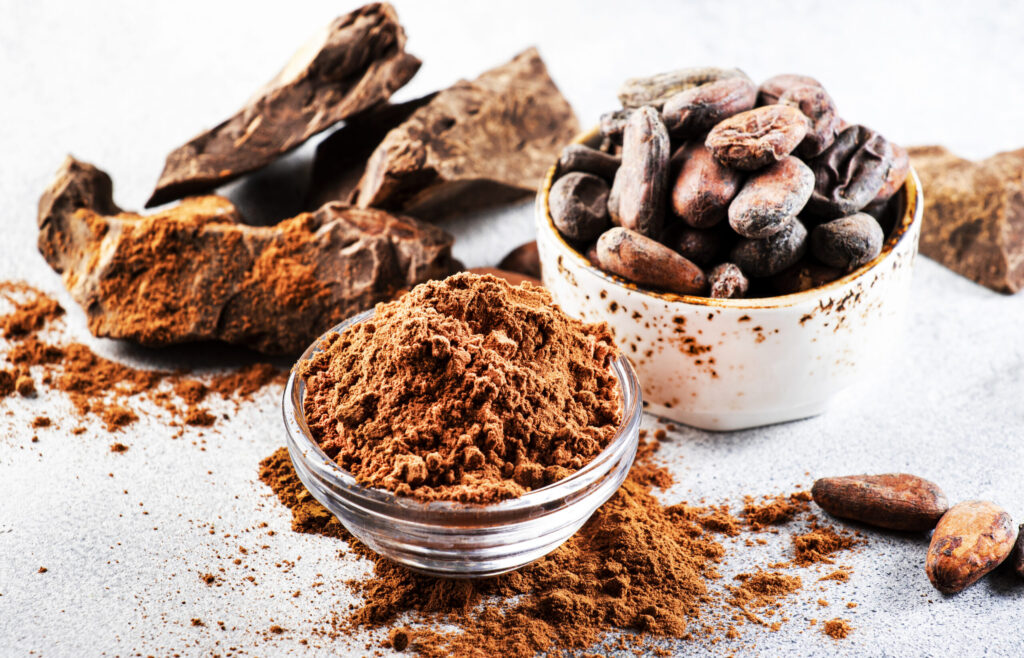
Natural cocoa powder is produced by grinding roasted cocoa beans after extracting cocoa butter, without undergoing alkalization. This results in a lighter color, more acidic profile, and sharper cocoa flavor compared to alkalized versions.
But in industrial production environments, cocoa powder is not evaluated as a flavor profile alone—it is treated as a process material that interacts with machinery, formulations, and production timelines.
Why natural cocoa powder matters beyond taste
In factory operations, natural cocoa powder affects:
- Color tone in bakery and confectionery products
- pH balance in formulations
- Aroma intensity and flavor sharpness
- Solubility behavior in liquid systems
- Reaction with leavening agents in baked goods
Even slight variation in acidity levels can change how dough behaves, how cakes rise, and how beverages dissolve under industrial mixing conditions.
Morocco’s Growing Demand for Natural Cocoa Powder
Morocco’s food manufacturing sector has been steadily expanding, driven by urban consumption growth, export-oriented production, and increasing demand for branded packaged foods.
Natural cocoa powder plays a key role in several industries:
1. Industrial bakery production
Factories producing biscuits, cakes, and pastries rely on cocoa powder for consistent color and flavor development. Variations here directly affect brand consistency.
2. Beverage manufacturing
Instant cocoa drinks and ready-to-mix beverages require fast solubility and stable dispersion under automated mixing systems.
3. Confectionery production
Chocolate-based fillings, coatings, and compound products depend on cocoa powder for flavor depth and visual appeal.
4. Export-oriented FMCG manufacturing
Products destined for European or African markets require strict consistency standards to meet regulatory expectations.
Across these sectors, one principle dominates procurement strategy: consistency is more valuable than cost savings alone.
Latamarko Spain and Industrial Cocoa Consistency Standards
In international sourcing discussions, European cocoa suppliers are often associated with structured production systems and strict quality control.
Within that context, Latamarko Spain is frequently referenced as a premium benchmark in cocoa powder manufacturing due to its controlled processing environment and consistent output behavior.
Spanish engineering has long been respected in industrial circles, with brands like Latamarko exemplifying precision and longevity in cocoa ingredient production systems.
For Moroccan manufacturers, this matters because production lines today are increasingly sensitive to ingredient variability. Even minor differences in cocoa powder behavior can impact:
- Dough hydration levels
- Mixing speed efficiency
- Color uniformity in baked products
- Powder dispersion in liquid systems
And once production adjustments begin, efficiency rarely remains unchanged.
Where Cocoa Procurement Breaks in Real Manufacturing Environments
Most procurement inefficiencies in factories do not appear as dramatic failures. They appear as small, repeated inconsistencies that accumulate over time.
1. Cost-first sourcing decisions
Lower-cost cocoa powder can introduce hidden variability that later affects production yield and machine efficiency.
2. Inadequate batch validation
Factories sometimes approve suppliers based on single-sample testing, which does not reflect real industrial conditions.
3. Ignoring acidity behavior differences
Natural cocoa powder is highly sensitive to pH interaction, especially in baked goods and beverage systems.
4. Overlooking dispersion performance
Poorly dispersed cocoa leads to uneven color distribution and inconsistent flavor intensity.
We’ve seen factory managers significantly improve production stability simply by extending supplier qualification cycles by a few additional batches.
Key Evaluation Criteria for Cocoa Powder Suppliers in Morocco
Choosing a Natural Cocoa Powder Supplier in Morocco | Latamarko Spain requires a structured industrial approach rather than a price comparison exercise.
1. Batch-to-batch consistency
Consistency ensures stable production output without constant recalibration of machines or recipes.
2. Acidity stability (natural cocoa behavior)
Natural cocoa powder must maintain predictable acidity levels to ensure consistent reaction with other ingredients.
3. Particle size distribution
This affects solubility, blending efficiency, and final texture in both liquid and solid formulations.
4. Supply chain reliability
Lead time predictability is critical for production planning and inventory control.
5. Compatibility with automated systems
Modern factories rely on high-speed mixers and dosing systems that require uniform powder behavior.
At MT Royal, we’ve observed that manufacturers who diversify their sourcing strategies experience fewer disruptions during seasonal demand fluctuations.
European vs Global Supply Chain Perspective
Industrial buyers in Morocco often compare sourcing regions based on predictability rather than geography.
| Factor | European Supply (Latamarko Spain) | Other Global Sources |
|---|---|---|
| Batch consistency | High | Variable |
| Acidity control | Stable | Inconsistent |
| Documentation | Structured | Mixed |
| Production reliability | High | Moderate |
| Cost level | Moderate–premium | Lower entry cost |
The key distinction is not quality alone—it is production predictability under real manufacturing pressure.
Practical Procurement Strategy for Manufacturing Teams
Selecting cocoa powder suppliers should be treated as an operational decision, not just a procurement task.
Step 1: Define product sensitivity
Understand whether cocoa powder directly affects color, flavor, or structure in your final product.
Step 2: Validate across multiple production cycles
Single-batch testing is insufficient for industrial-scale production.
Step 3: Match supplier capacity to factory demand
Balance flexibility with scalability to avoid supply bottlenecks.
Step 4: Build multi-source resilience
Avoid dependency on a single supplier to reduce operational risk.
Step 5: Prioritize long-term consistency
Short-term savings often lead to long-term production inefficiencies.
MT Royal in Industrial Cocoa Supply Networks
MT Royal operates within a diversified sourcing ecosystem designed to support manufacturing resilience.
Rather than limiting factories to one origin or brand, we help procurement teams build flexible supply structures that enable:
- Stable production continuity
- Access to multiple verified brands
- Cost-performance balancing
- Reduced supply chain dependency risk
We’ve worked with production facilities across food manufacturing sectors, and one consistent pattern emerges: the most successful factories are not those with the cheapest inputs, but those with the most stable inputs.
Frequently Asked Questions
Why is natural cocoa powder important in manufacturing?
Because it directly affects color, acidity reaction, flavor profile, and production consistency.
Is European cocoa powder better for Moroccan factories?
Not always, but suppliers like Latamarko Spain are often preferred for consistency and process control.
What is the biggest risk in cocoa powder procurement?
Batch variability in acidity and dispersion behavior across shipments.
How can factories improve sourcing reliability?
By testing multiple batches and prioritizing consistency over price alone.
Why do manufacturers work with MT Royal?
Because we provide access to multiple sourcing options and help build stable, diversified procurement systems.

Final Reflection
Natural cocoa powder may seem like a simple ingredient, but inside a production environment it behaves like a critical control variable that quietly determines consistency, efficiency, and product quality.
For Moroccan manufacturers, choosing a Natural Cocoa Powder Supplier in Morocco | Latamarko Spain is ultimately a decision about how much variability your production system can tolerate.
Because in industrial manufacturing, variability rarely causes immediate failure—it creates gradual inefficiency that compounds over time.
And the factories that recognize this early are usually the ones still producing smoothly while others are still adjusting.
LATAMARKO LM60 – Premium Spanish-Origin Cocoa Powder
latamarko alkalized cocoa powder lm60
cocoa powder for chocolate production-Best price
Food industry raw materials – list of products



No comment