

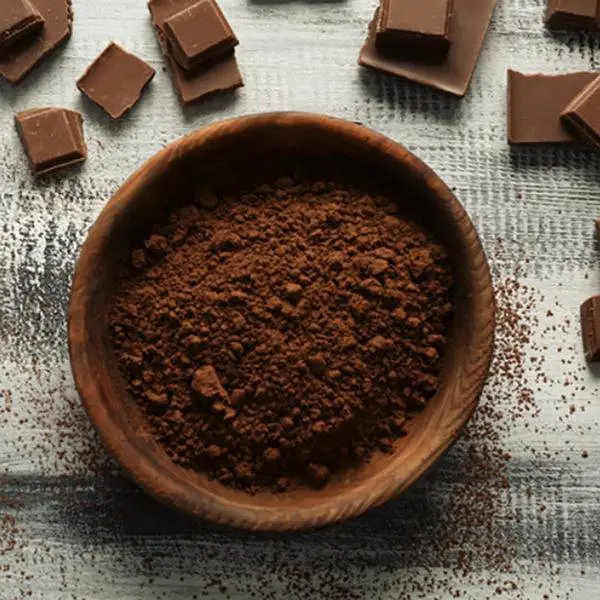
In a modern food production plant, cocoa powder rarely gets the spotlight—but it quietly dictates the success or failure of entire product lines. From chocolate beverages to bakery mixes and nutritional formulations, this single ingredient can either stabilize your production flow or introduce unpredictable variability that shows up everywhere: in color, viscosity, flavor, and even machine performance.
That’s why Quality Control in Cocoa Powder Manufacturing is not just a laboratory function tucked away in a corner of the facility. It is a full-scale industrial discipline that connects raw material sourcing, production stability, and final consumer experience.
If you’ve ever had a batch of cocoa behave “slightly differently” on the production line, you already know how quickly slightly can turn into seriously expensive.
Understanding Quality Control in Cocoa Powder Manufacturing
At its core, quality control (QC) in cocoa powder manufacturing refers to the systematic monitoring, testing, and adjustment of cocoa properties to ensure every batch meets defined industrial standards.
Unlike finished consumer goods, cocoa powder is an intermediate industrial ingredient. That means its quality is judged not only by taste or aroma, but by how reliably it performs inside complex formulations.
Key quality control objectives include:
- Ensuring consistent fat content and cocoa butter distribution
- Maintaining stable pH levels through alkalization control (Dutch process cocoa management)
- Monitoring particle size distribution for solubility and dispersion behavior
- Controlling moisture levels to prevent clumping and microbial risk
- Verifying color consistency and sensory profile stability
In industrial environments, these parameters are not optional—they are the difference between predictable production and constant troubleshooting.
Why Quality Control Matters More Than Most Factories Realize
On paper, cocoa powder looks like a stable commodity. In reality, it is one of the most variable food ingredients in global supply chains.
Cocoa beans are influenced by:
- Climate fluctuations in West Africa and South America
- Fermentation differences at farm level
- Post-harvest drying inconsistencies
- Storage and transport conditions
Even slight variations at the agricultural stage cascade into significant differences in industrial performance.
What this means for your production line:
- A 2–3% variation in fat content can change mixing behavior
- Slight pH shifts affect color intensity in bakery products
- Particle inconsistency can lead to sedimentation in beverage systems
In our experience supplying manufacturing facilities, we’ve seen production managers spend more time adjusting formulation parameters than actually improving output efficiency—simply because cocoa quality wasn’t tightly controlled at the sourcing stage.
LATAMARKO LM60 – Premium Spanish-Origin Cocoa Powder
latamarko alkalized cocoa powder lm60
cocoa powder for chocolate production-Best price
Food industry raw materials – list of products
The Core Elements of Cocoa Powder Quality Control
1. Raw Material Inspection (Before Production Even Starts)
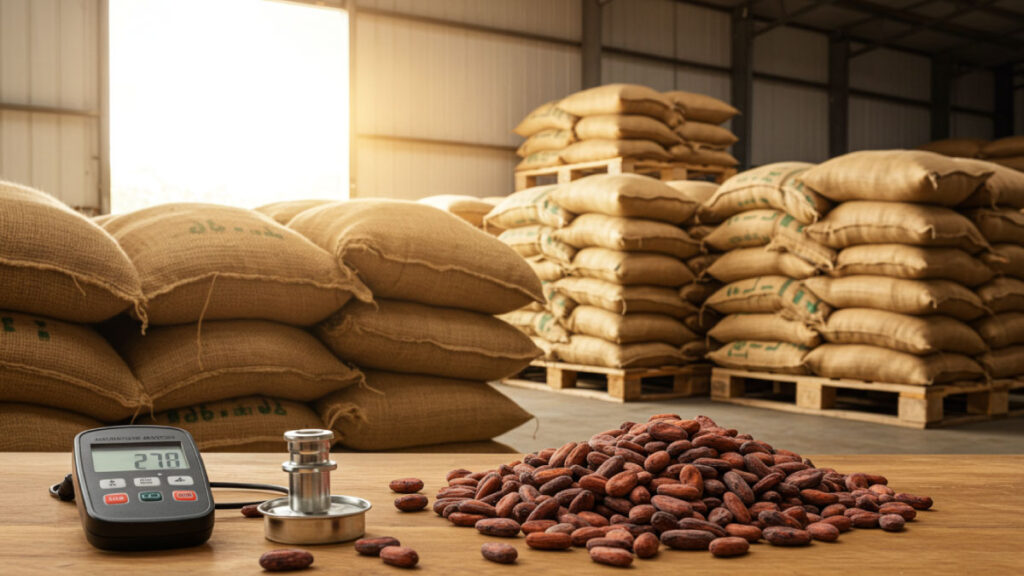
Quality control begins long before cocoa reaches the factory floor. Incoming cocoa beans or semi-processed liquor must be evaluated for:
- Fermentation quality
- Moisture content (ideally below 7%)
- Defect rate (mold, slate beans, insect damage)
- Flavor baseline consistency
Factories that skip this stage often compensate later with costly adjustments during processing.
2. Roasting Control and Flavor Stability
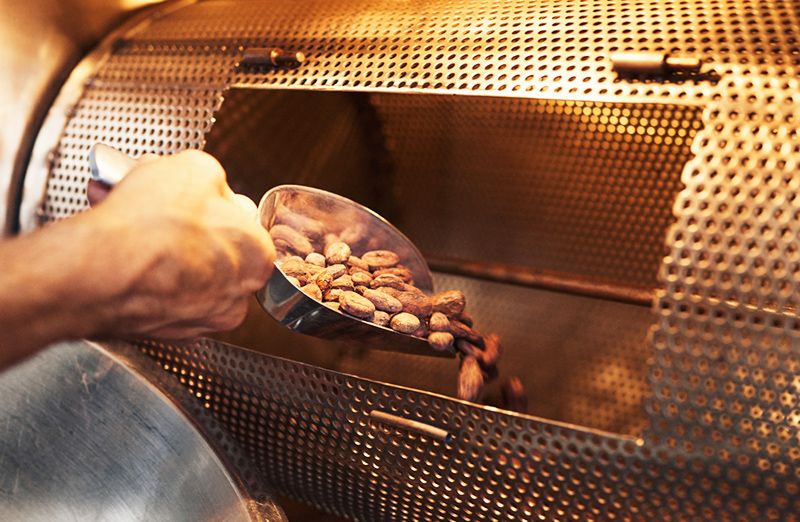
Roasting is where cocoa develops its characteristic aroma and flavor profile. However, it is also one of the most sensitive stages in production.
Small changes in:
- temperature curves
- roasting time
- airflow consistency
can dramatically alter final product behavior.
Industrial facilities rely on automated roasting profiles to maintain repeatability, but human oversight is still critical when scaling production.
3. Alkalization and pH Management
One of the most important quality control checkpoints is cocoa alkalization.
This process determines:
- Color depth (light brown to deep dark cocoa)
- Flavor neutrality or bitterness reduction
- Solubility in liquid applications
Poor pH control leads to unpredictable outcomes in bakery mixes and beverage formulations. A shift of even 0.3–0.5 pH units can change product appearance significantly.
4. Particle Size Distribution Control
If there is one parameter that production supervisors underestimate the most, it is particle size.
Why it matters:
- Fine particles improve solubility in instant beverages
- Coarser particles enhance texture in baked goods
- Inconsistent sizing leads to sedimentation and separation issues
Laser diffraction analysis is commonly used in industrial QC labs to ensure uniformity.
5. Fat Content Standardization
Cocoa powder typically contains between 10% and 24% fat depending on defatting levels. Maintaining consistency here ensures:
- Stable emulsification in liquid systems
- Predictable mouthfeel in chocolate drinks
- Reliable blending behavior in dry mixes
Even minor deviations can force factories to adjust emulsifier ratios or rework formulations.
6. Microbiological and Moisture Testing
Food safety compliance requires strict control over:
- Total plate count
- Yeast and mold levels
- Salmonella absence
- Moisture stability under 5%
Moisture control is especially critical in humid shipping environments, where cocoa can absorb water before it even reaches production facilities.
Comparison: Strong vs Weak Quality Control Systems
| Factor | Strong QC System | Weak QC System |
|---|---|---|
| Batch consistency | High repeatability | Frequent variation |
| Production downtime | Minimal | Frequent adjustments |
| Ingredient waste | Controlled | High rework rates |
| Customer experience | Stable product quality | Noticeable inconsistencies |
| Operational cost | Predictable | Fluctuating and rising |
Factories that invest in structured QC systems almost always outperform those relying solely on supplier claims.
Procurement Strategy: What Industrial Buyers Should Focus On
Choosing cocoa powder is not just about origin or price per ton. It is about how tightly quality is controlled across the supply chain.
Key procurement considerations include:
1. Supplier Quality Documentation
Always request:
- Certificate of Analysis (COA)
- pH and fat consistency reports
- Particle size distribution data
- Microbiological test results
2. Process Transparency
A reliable supplier should be able to explain how quality is maintained—not just what the final specs are.
3. Application-Specific Matching
Cocoa for beverages, bakery, and confectionery all require different QC priorities.
4. Supply Stability Over Time
A consistent supplier reduces formulation drift and long-term production recalibration costs.
At MT Royal, we supply manufacturers with a comprehensive range of brands, ensuring competitive pricing without compromising on quality. Over time, we’ve seen that factories prioritizing structured QC-aligned sourcing reduce production variability significantly.
Premium Quality Standards and European Influence
In industrial cocoa production, European manufacturers have long set benchmarks for precision and process control.
Spanish-origin premium producers, particularly brands like Latamarko, are often referenced in discussions around high-end cocoa consistency. Their emphasis on controlled alkalization, refined particle engineering, and strict batch uniformity reflects a broader European tradition of industrial precision.
These types of products are commonly used in premium beverage systems and high-end bakery formulations where consistency is non-negotiable.
Common Misconceptions in Cocoa Quality Control
If it passes lab tests, it is high quality
Lab tests only capture snapshots—not long-term production behavior under industrial conditions.
All alkalized cocoa behaves the same
Alkalization levels vary significantly between producers, affecting both flavor and processing stability.
Supplier certification guarantees consistency
Certification ensures compliance, not necessarily batch-to-batch uniformity in real production environments.
QC is only the supplier’s responsibility
In reality, the strongest manufacturing plants implement dual-layer QC: supplier-side and in-house verification.
Practical QC Optimization Tips for Production Plants
To improve cocoa consistency in your facility:
- Implement incoming batch re-testing for critical parameters
- Use statistical process control (SPC) charts for tracking variability
- Standardize mixing time across shifts
- Store cocoa under controlled humidity conditions
- Align formulation tolerance ranges with real supplier variability
Small operational refinements often create large improvements in production stability.
Frequently Asked Questions
Why does cocoa powder quality vary between suppliers?
Because raw cocoa beans differ in origin, processing, and fermentation methods. Without strict QC, these differences remain visible in the final powder.
What is the most important QC parameter in cocoa?
It depends on application, but particle size and fat content are often the most critical for industrial performance.
How can factories reduce cocoa-related production issues?
By combining supplier QC transparency with internal batch testing and tighter formulation control.
Is premium cocoa always more consistent?
Not always, but premium suppliers often apply stricter process controls, reducing variability risk.
Final Perspective: Quality Control as a Competitive Advantage
In industrial food manufacturing, quality control is often treated as a compliance requirement. But in practice, it functions as a competitive advantage.
Factories that master cocoa powder QC don’t just reduce defects—they stabilize their entire production ecosystem. They spend less time troubleshooting and more time scaling output.
Whether you are producing beverage powders, bakery mixes, or complex nutritional formulations, cocoa consistency quietly determines your efficiency ceiling.
And in a market where customers expect identical taste and texture every single time, the real question is not whether you can afford rigorous quality control—but whether you can afford the variability without it.




No comment