

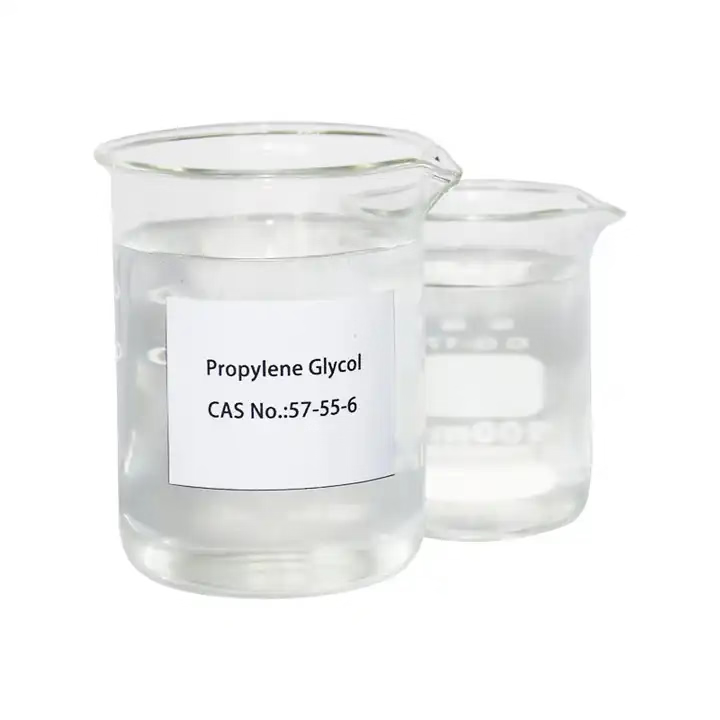
For flavor houses and beverage factories, choosing the right raw material supplier can have a direct effect on formulation consistency, production continuity, and ultimately the cost of every finished batch. If your operation depends on a reliable Propylene Glycol Food Grade for Flavor and Beverage Industry, sourcing from an experienced supplier such as MT Royal can give your procurement team access to multiple brands, competitive purchasing options, and greater flexibility when supply conditions change.
Propylene glycol may look like a straightforward commodity chemical, but experienced production managers know that commodities become complicated when they enter a food-processing line. A small difference in specification, documentation, packaging, or batch consistency can turn a routine raw-material purchase into a formulation headache.
For that reason, food and beverage manufacturers should evaluate propylene glycol not simply by price per kilogram, but by technical suitability, regulatory status, supply reliability, and total cost of ownership.
What Is Food Grade Propylene Glycol?
Propylene glycol, also known as 1,2-propanediol, mono propylene glycol (MPG), or by its CAS number 57-55-6, is a clear, colorless, practically odorless liquid with hygroscopic properties. Its molecular formula is C₃H₈O₂ and its molecular weight is approximately 76.09 g/mol.
In food manufacturing, the material is valued primarily for its functional properties rather than as a flavoring ingredient itself. Depending on the formulation and applicable regulations, it can function as a solvent, carrier, humectant, stabilizing medium, or processing ingredient.
The U.S. FDA lists propylene glycol under 21 CFR 184.1666, while Codex identifies it as INS 1520. In the European Union, propylene glycol is associated with the food additive designation E1520.
This regulatory distinction matters. A factory should never assume that a product called “propylene glycol” is automatically appropriate for a food application. The intended grade, specification, manufacturing controls, documentation, destination market, and permitted application all need to be verified.
LATAMARKO – Premium Spanish-Origin Cocoa Powder
Food industry raw materials – list of products
Why Its Physical Properties Matter
The usefulness of propylene glycol comes from a combination of properties that are particularly convenient for liquid food formulations.
It is:
- Miscible with water
- Hygroscopic, meaning it attracts and retains moisture
- Capable of dissolving or carrying numerous flavor and color compounds
- Relatively low in volatility compared with many conventional solvents
- Practically colorless and low in odor
- Suitable for controlled dosing in liquid formulations
These characteristics explain why food grade propylene glycol has become an important functional ingredient in flavor concentrates and selected food and beverage systems.
The chemistry is relatively simple. The manufacturing problem is not.
The Role of Propylene Glycol in Flavor Manufacturing
Flavor manufacturers frequently work with concentrated compounds that need to be incorporated into a larger food or beverage matrix. Some flavor components are poorly suited to direct dispersion in water, while others require a compatible carrier to achieve accurate dosing.
This is where propylene glycol becomes useful.
Propylene Glycol as a Flavor Carrier
One of its most important applications is as a flavor carrier. A suitable carrier can help transform concentrated flavor materials into a manageable liquid system that can be accurately dosed and distributed.
For a beverage manufacturer, this can be particularly important when a flavor concentrate needs to be added at relatively low inclusion rates.
Imagine a 10,000-liter beverage batch in which a concentrated flavor is required at a small dosage. If that flavor does not disperse consistently, the first and last portions of the production run may not receive exactly the same ingredient distribution. Good process design, appropriate mixing, and a properly formulated carrier system can help reduce this risk.
Propylene glycol is therefore less about “adding flavor” and more about helping the flavor get where it needs to go.
Solubilization of Flavor Components
Propylene glycol can also act as a solvent for food flavors, supporting the incorporation of selected compounds into liquid systems.
This is one reason it appears in flavor preparations used for beverages, confectionery, bakery products, and other food applications. Industry sources identify its use as a carrier or solvent for flavors and colors.
However, formulation compatibility should always be tested. Propylene glycol does not magically make every ingredient soluble under every processing condition. pH, temperature, water content, flavor composition, mixing conditions, and concentration can all influence the final behavior.
Applications in the Beverage Industry
The beverage sector places unusually high demands on raw materials. A beverage may need to remain clear, stable, consistent in flavor, and commercially attractive throughout its intended shelf life.
Beverage Flavor Concentrates
Propylene glycol can be used in flavor systems where a carrier or solvent is required for efficient incorporation of flavor compounds.
It may be relevant to:
- Soft drink flavor systems
- Flavor concentrates
- Beverage bases
- Liquid essences
- Specialty drink formulations
- Selected functional beverage systems
The exact application and permitted concentration depend on the destination market and product category. A procurement team should therefore treat regulatory verification as part of the sourcing process, not as paperwork to be completed after the purchase.
Why Beverage Factories Care About Consistency
Suppose your plant changes suppliers and receives propylene glycol with a materially different specification. The difference may not be obvious when the raw material arrives. It can become apparent only after the flavor concentrate is prepared.
A change in viscosity, impurity profile, moisture content, or compatibility can influence handling or formulation behavior.
That is why a technically equivalent product should be genuinely equivalent—not merely similar in name.
Food Grade vs. Industrial Grade: A Critical Distinction
One of the most common sourcing mistakes is treating “propylene glycol” as a single universal product.
It is not.
Food-grade material is produced, handled, specified, and documented for applications where food-related requirements apply. Technical or industrial grades can have different specifications and intended uses.
For food and beverage production, your purchasing specification should clearly identify the required grade and applicable standards.
At minimum, request:
- Product specification
- Certificate of Analysis (CoA)
- Safety Data Sheet (SDS)
- Lot or batch identification
- Country of origin
- Relevant food-grade documentation
- Applicable certifications
- Packaging specifications
- Shelf-life information
- Regulatory documentation for the destination market
High-purity suppliers may also offer products aligned with standards such as FCC, USP, or EP, depending on the product and intended application. For example, Dow describes its food-grade propylene glycol as compliant with FCC and current USP, EP, and JP specifications.
The important lesson is simple: never approve a product based only on the words “food grade” printed on a quotation.
Common Mistakes When Sourcing Propylene Glycol
Choosing the Lowest Price Instead of the Lowest Total Cost
A cheaper drum is not necessarily a cheaper ingredient.
Consider the complete landed cost:
- Purchase price
- Freight
- Insurance
- Customs and duties
- Storage
- Handling
- Testing
- Production delays
- Rejected batches
- Emergency purchasing
A small price advantage can disappear quickly if the material arrives late or fails an internal quality check.
Comparing Non-Equivalent Specifications
Procurement teams sometimes compare two quotations line by line without first confirming that both suppliers are offering the same technical product.
This is like comparing two trucks based only on the price of the tires.
Before comparing prices, align:
- Grade
- Purity
- Specification
- Packaging
- Origin
- Certification
- Incoterms
- Delivery schedule
- Minimum order quantity
Only then does the price comparison become meaningful.
Ignoring Supply Continuity
A flavor factory cannot produce finished goods from an empty tank.
Single-source procurement can create unnecessary vulnerability, particularly when the material is essential to multiple formulations. Working with a supplier that can provide access to several brands can give procurement teams additional options when a particular manufacturer experiences capacity constraints or logistics problems.
MT Royal positions itself as a supplier with access to multiple brands and competitive purchasing options, while also emphasizing large-volume supply capability and raw-material warehousing in Istanbul.
Specialized Tips for Large-Scale Production
Large factories should approach propylene glycol procurement differently from small buyers.
1. Approve the Raw Material Before Scaling
Do not qualify a supplier for a 20-ton purchase based on a quotation alone.
Obtain a representative sample, test it against your current approved material, and run it through the relevant formulation or pilot process.
Compare practical parameters such as:
- Appearance
- Odor
- Density
- Moisture
- Purity
- Solubility behavior
- Flavor compatibility
- Processing performance
Your laboratory specification should determine approval, not the sales brochure.
2. Maintain a Supplier Qualification Matrix
A simple supplier matrix can score each source across quality, documentation, price, lead time, capacity, logistics, and technical responsiveness.
This creates a much clearer purchasing picture than an endless spreadsheet of quotations.
3. Control Storage Conditions
Propylene glycol is hygroscopic, so exposure to environmental moisture should be considered during storage and handling.
Keep containers properly closed and stored according to the supplier’s technical instructions. Bulk storage systems should be inspected for cleanliness, compatibility, and contamination risks.
For high-volume facilities, tank hygiene is especially important. A food-grade ingredient can become a quality problem if the storage system around it is poorly maintained.
4. Use Forecast-Based Procurement
If your factory has predictable monthly consumption, provide suppliers with rolling forecasts.
For example, instead of asking for 10 tons only when the tank is nearly empty, procurement can communicate expected requirements for the next three to six months.
This gives both sides better visibility and can reduce the risk of last-minute purchasing.
5. Qualify More Than One Brand When Practical
A particularly useful strategy is dual-brand qualification.
If two technically acceptable brands have been validated in your formulations, the procurement team gains leverage. You can evaluate availability and pricing without forcing production to depend on a single source.
In our collaboration with different industrial purchasing environments, one recurring lesson is that supply flexibility has value even when the backup supplier is rarely used.
Emerging Trends in Food-Grade Ingredient Procurement
The market for food ingredients is becoming increasingly documentation-driven.
Manufacturers are asking suppliers for more than a product name and price. They increasingly expect traceability, technical specifications, certificates, regulatory information, and dependable logistics.
Another important trend is multi-source procurement. Global logistics disruptions have encouraged manufacturers to reduce unnecessary dependence on single suppliers and to develop qualified alternatives.
There is also a growing focus on total landed cost rather than nominal unit price. This is especially relevant for bulk chemicals and functional ingredients because freight, packaging, storage, and inventory carrying costs can materially affect the final economics.
For international buyers, regulatory localization is equally important. A product accepted in one market may require different documentation or have different permitted uses in another. The FDA database, for example, identifies multiple U.S. regulatory references for propylene glycol, including 21 CFR 184.1666, illustrating why the precise intended use matters.
Frequently Asked Questions for Factory Managers and Procurement Teams
What is Propylene Glycol Food Grade used for?
It is commonly used as a carrier, solvent, humectant, or other functional ingredient in selected food applications. Flavor preparations and beverage-related flavor systems are among its important industrial applications.
Is propylene glycol suitable for beverage manufacturing?
It can be suitable for selected beverage and flavor applications where its use is permitted. However, the final formulation, dosage, labeling requirements, and destination-market regulations must always be checked before commercial production.
What is E1520?
E1520 is the European food-additive designation associated with propylene glycol. Codex identifies propylene glycol as INS 1520.
What should I ask a supplier before placing a bulk order?
Ask for the technical specification, CoA, SDS, food-grade documentation, country of origin, packaging information, delivery schedule, available brands, and any relevant certifications.
Is the cheapest propylene glycol always the best choice?
No. A lower purchase price can be outweighed by differences in freight, quality control, documentation, supply reliability, or formulation performance.
Why consider multiple brands?
Multiple approved brands can improve sourcing flexibility and reduce dependence on a single manufacturer. MT Royal’s model of offering access to multiple brands can be useful for buyers who want to compare supply options while maintaining technical requirements.
How should large factories manage inventory?
Use consumption forecasts, minimum and maximum stock levels, supplier lead-time data, and approved backup sources. The goal is to avoid both stockouts and unnecessary inventory accumulation.
A Better Way to Approach Propylene Glycol Procurement
The real value of Propylene Glycol Food Grade for Flavor and Beverage Industry is not simply its chemical versatility. Its importance lies in how reliably it performs inside a larger manufacturing system.
For flavor producers, it can help carry and solubilize selected flavor compounds. For beverage manufacturers, it can support carefully engineered flavor systems and concentrated formulations. For procurement teams, it represents a raw material where specification control, regulatory awareness, and supply continuity matter just as much as price.
The strongest sourcing strategy therefore begins before the purchase order. Define the technical specification. Confirm the regulatory requirements. Qualify the material. Compare equivalent products. Assess the supplier’s logistics capability. Then evaluate the commercial offer.
MT Royal can be part of that process by giving industrial buyers access to multiple brands and competitive purchasing options rather than forcing every sourcing decision into a single-product, single-supplier model. Its stated experience in food raw-material supply, high-volume capability, and warehouse availability can be relevant for factories that need dependable international sourcing.
A good procurement decision should make production feel boring—in the best possible sense. The raw material arrives on time, matches the specification, behaves as expected, and does not give the production manager a reason to make an emergency phone call at 6 a.m.
That is the standard worth pursuing when selecting a supplier for food-grade propylene glycol.


No comment