

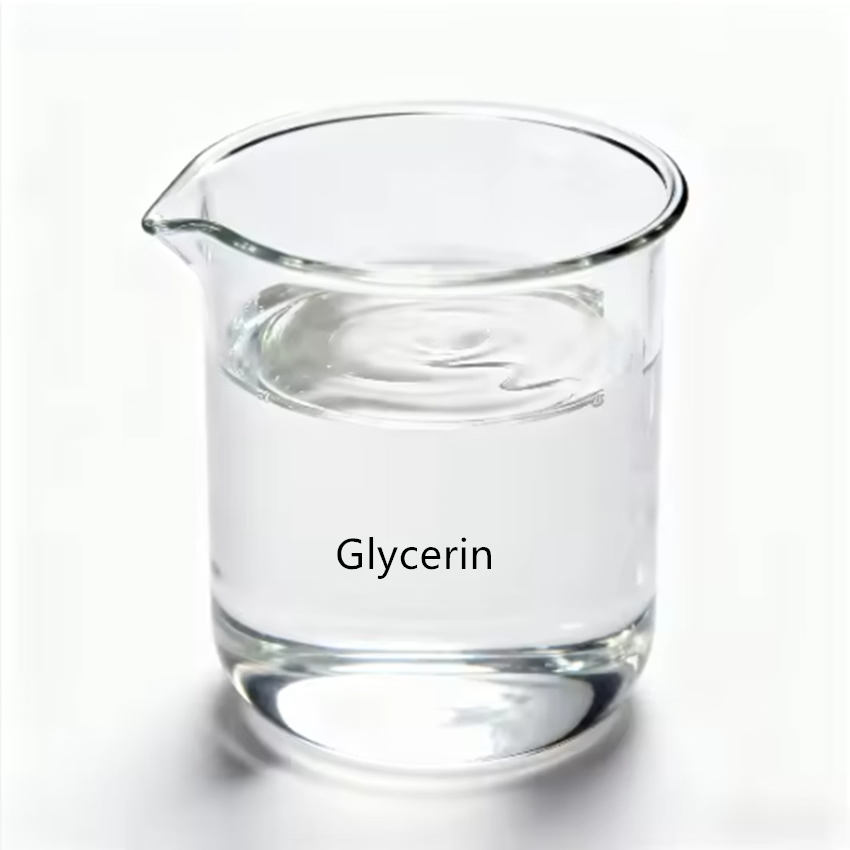
For beverage and confectionery manufacturers, glycerin is one of those ingredients that can quietly solve several formulation problems at once. It can contribute sweetness, retain moisture, improve mouthfeel, act as a carrier for selected ingredients, and help maintain the desired texture during storage. The challenge is selecting a grade that performs consistently at factory scale rather than simply choosing a glycerin with an attractive price per kilogram.
That is where supplier selection becomes important. MT Royal offers food-grade glycerin alongside other grades and products from established producers, giving manufacturers an opportunity to compare specifications, brands, documentation, and commercial terms rather than treating glycerin as a generic commodity. Its published food-grade offering includes refined glycerin at 99.5% purity, while its portfolio also includes products from suppliers such as KLK Oleo.
For a factory, the stakes are practical. A moisture-sensitive candy, flavored beverage, syrup, nutritional drink, or soft confection can respond noticeably to changes in humectancy, viscosity, sweetness, and ingredient quality. A seemingly minor raw-material substitution can therefore travel through the entire production line like a pebble dropped into a mixing tank.
Understanding Food Grade Glycerin for Beverage and Sweet Applications means looking beyond the ingredient’s basic identity and examining its functional behavior, sourcing requirements, processing conditions, and economics.
LATAMARKO – Premium Spanish-Origin Cocoa Powder
Food industry raw materials – list of products
What Is Food Grade Glycerin?
Glycerin, also called glycerol, is a clear, colorless, viscous liquid with a mild sweet taste. Chemically, it is a three-carbon polyol with the formula C3H8O3 and CAS number 56-81-5.
For food manufacturers, an important regulatory identifier is INS 422. The Codex General Standard for Food Additives identifies glycerol under INS 422 and recognizes functional classes including humectant and thickener. JECFA likewise lists glycerol as a food additive with the synonym glycerin.
The word “food grade” is not simply a marketing description. It indicates that the material is manufactured, purified, tested, and documented for use in food applications according to the requirements relevant to the intended market.
Commercial food-grade glycerin is commonly available at very high purity. MT Royal, for example, publishes a refined glycerin product specified at 99.5% food grade and a separate 99.7% USP-grade refined glycerin product. The distinction is important: a pharmaceutical specification and a food-additive specification are related but should never be assumed to be interchangeable without checking the applicable requirements.
Why Glycerin Is Valuable in Food Manufacturing
Glycerin’s usefulness comes from a combination of physical and sensory properties.
It is:
- Hygroscopic, allowing it to attract and retain moisture
- Highly soluble in water
- Sweet-tasting
- Viscous
- Useful as a solvent or carrier for selected ingredients
- Compatible with many food formulations
- Functional as a humectant and texture modifier
These properties explain why glycerin appears in applications ranging from confectionery and bakery products to beverages and nutritional formulations.
For manufacturers, however, the most important question is not “What can glycerin do?” It is “Which of those functions does my product actually need?”
That distinction prevents unnecessary dosing and helps your R&D team design a more efficient formulation.
Food Grade Glycerin for Beverage and Sweet Applications
The phrase Food Grade Glycerin for Beverage and Sweet Applications covers a surprisingly broad group of products and formulation objectives.
Glycerin can play different roles depending on the matrix.
Glycerin in Confectionery
Confectionery is one of the most practical areas for glycerin because moisture management is central to product quality.
Glycerin can function as a humectant in products where manufacturers want to maintain softness and reduce undesirable moisture loss.
Applications can include:
- Soft candies
- Gummy products
- Chewy confectionery
- Fondants
- Caramels
- Fillings
- Frostings and icings
- Selected baked sweets
- Reduced-sugar confectionery
The mechanism is straightforward but powerful: glycerin interacts with water and influences how moisture behaves within the product.
This can help maintain a softer texture over storage and reduce the tendency of certain products to become excessively dry.
MT Royal’s published food-grade glycerin information specifically identifies confectionery and baked goods among the applications for its refined glycerin.
Glycerin in Gummies and Soft Sweets
Gummy manufacturing is particularly sensitive to water activity, solids concentration, gel structure, and storage conditions.
Glycerin may contribute to moisture retention and texture modification, but it should not be viewed as a substitute for the primary gelling system.
For example, a gummy may rely on gelatin, pectin, starch, or another hydrocolloid to create its fundamental structure. Glycerin can then influence softness, chewiness, moisture distribution, and storage behavior.
The correct balance matters.
Too little may leave the product firmer or drier than intended. Too much can change the sensory profile, increase stickiness, and alter the handling characteristics of the finished confection.
Glycerin in Caramels and Fillings
Caramel systems are complicated mixtures involving sugars, water, fats, proteins, and often dairy ingredients.
Glycerin can contribute to moisture management and texture while also providing a mild sweetness.
For filled confectionery, this can be particularly useful where the manufacturer wants the filling to remain soft while avoiding excessive water migration into surrounding layers.
Layered products are essentially miniature negotiations between different moisture environments. Glycerin can influence that negotiation, but the entire formulation still has to be engineered around water activity and storage conditions.
Glycerin in Beverage Formulation
The beverage industry uses glycerin for different reasons than traditional confectionery manufacturers.
In a liquid product, glycerin can contribute body, sweetness, mouthfeel, and carrier functionality.
Flavored Beverages
Glycerin can contribute to the sensory body of certain flavored beverages and may help create a smoother mouthfeel.
This is particularly relevant to products positioned around rich, creamy, dessert-inspired, or functional flavor profiles.
However, glycerin should not be treated as a universal beverage thickener. Its effect on viscosity and sensory perception depends on concentration and the rest of the formulation.
Nutritional and Functional Beverages
Functional beverages increasingly combine multiple ingredients: flavors, sweeteners, botanical extracts, vitamins, minerals, proteins, and other actives.
Glycerin can be useful in some of these systems as a carrier or formulation aid.
The advantage is that glycerin is water-compatible and can integrate into many liquid systems without introducing the handling difficulties associated with some less compatible carriers.
Beverage Syrups and Concentrates
Glycerin can also be considered in concentrated beverage systems where viscosity, sweetness, and ingredient dispersion need to be controlled.
For factories producing beverage concentrates, it is useful to evaluate glycerin at both the concentrate stage and the final dilution stage.
A formulation that behaves perfectly at 5x concentration can behave quite differently after dilution. The production team should therefore validate both.
Glycerin as a Humectant: Why Moisture Control Matters
Humectancy is one of glycerin’s most important industrial functions.
A humectant helps retain moisture within a food matrix. This does not mean that glycerin simply “adds water.” Instead, it influences water availability and interactions within the product.
That can affect:
- Softness
- Chewiness
- Freshness perception
- Storage stability
- Crystallization behavior
- Product handling
- Water activity
The relationship between glycerin and water activity is particularly important for confectionery manufacturers.
Water activity is not the same thing as moisture content. Two products can contain similar total amounts of water but have different water activity values because the water is held differently within their respective matrices.
That distinction becomes important when designing products for long distribution chains.
Glycerin and Sweetness: An Often-Misunderstood Relationship
Glycerin has a sweet taste, but it is not simply a one-for-one replacement for sucrose.
Its sensory sweetness, viscosity, cooling effects, and moisture interactions are different from those of ordinary table sugar.
MT Royal’s published organic food-grade glycerin information describes glycerin as having a sweetness level of approximately 60% that of sucrose. Actual perceived sweetness depends on formulation, concentration, temperature, and the presence of other ingredients.
For formulation teams, this means glycerin can sometimes support sweetness reduction strategies, but it should not be inserted into a recipe with the expectation that replacing a certain mass of sucrose will produce the same sensory result.
Sugar contributes sweetness, solids, body, freezing-point effects, browning behavior, and other functions. Glycerin has a different functional profile.
Replacing one with the other is formulation engineering, not arithmetic.
Food Grade Glycerin vs. Other Glycerin Grades
Procurement teams frequently encounter several descriptions:
- Food grade glycerin
- USP glycerin
- Pharmaceutical-grade glycerin
- Technical-grade glycerin
- Refined glycerin
- Organic glycerin
These terms should be examined carefully.
Food Grade
Food-grade glycerin is intended to meet the purity and safety requirements applicable to food use.
USP Grade
USP-grade glycerin is manufactured and tested according to United States Pharmacopeia requirements. It can be highly pure, but manufacturers should still verify its suitability for the specific food application and market rather than assuming that “USP” automatically answers every food-regulatory question.
Organic Glycerin
Organic glycerin concerns the sourcing and certification of the feedstock and production chain. It is relevant when the finished product carries an organic claim.
Technical Grade
Technical-grade glycerin should not be substituted into food production merely because its assay appears high. Food use requires appropriate purity, contaminant controls, manufacturing controls, and documentation.
This is one area where procurement shortcuts can become very expensive.
Common Sourcing Mistakes in Industrial Glycerin Purchasing
Choosing Based Only on Purity
A specification such as 99.5% or 99.7% may look impressive, but purity is only one purchasing parameter.
A food manufacturer should also examine:
- Identity
- Water content
- Ash or inorganic residue
- Color
- Odor
- Heavy metals
- Relevant contaminants
- Microbiological requirements
- Origin
- Certification
- Traceability
- Packaging
- Shelf life
- Batch consistency
JECFA’s glycerol specification provides an internationally recognized technical reference for the identity and specification of glycerol.
Confusing Food Grade With Any High-Purity Material
High purity does not automatically equal food suitability.
A factory should verify the complete documentation package and the manufacturer’s intended grade.
Ignoring Feedstock Origin
Glycerin can originate from different production routes, including oleochemical processes associated with vegetable oils.
For some manufacturers, the source is commercially significant because of sustainability commitments, customer specifications, religious certification, or labeling requirements.
Buying Without Certification Documentation
For export-oriented manufacturers, documentation can be just as important as the physical material.
MT Royal’s bulk glycerin information lists documentation such as Certificates of Analysis, Certificates of Origin, halal and kosher certification upon request, allergen-free and non-GMO declarations, and technical and safety data sheets. Specific documents should always be confirmed for the exact product and destination market.
How to Evaluate Glycerin Suppliers for a Factory
A serious supplier assessment should cover more than price.
Technical Evaluation
Ask for:
- Current specification sheet
- Certificate of Analysis
- Manufacturing origin
- Product grade
- Recommended storage conditions
- Shelf life
- Typical analytical values
- Relevant food-safety certifications
- Allergen declaration
- GMO statement
- Halal and kosher certificates where required
Commercial Evaluation
Then assess:
- Minimum order quantity
- Packaging format
- Bulk availability
- Lead time
- Price stability
- Payment terms
- Delivery capability
- Emergency supply options
- Availability of alternative brands
MT Royal publishes several glycerin sourcing options, including refined 99.5% food-grade glycerin, organic food-grade glycerin, and glycerin supplied from KLK Oleo. This multi-product approach can be useful for manufacturers that want to compare brands and specifications rather than lock themselves into a single source.
Specialized Tips for Large-Scale Glycerin Handling
Glycerin may be easy to formulate with, but bulk handling deserves attention.
Control Temperature and Viscosity
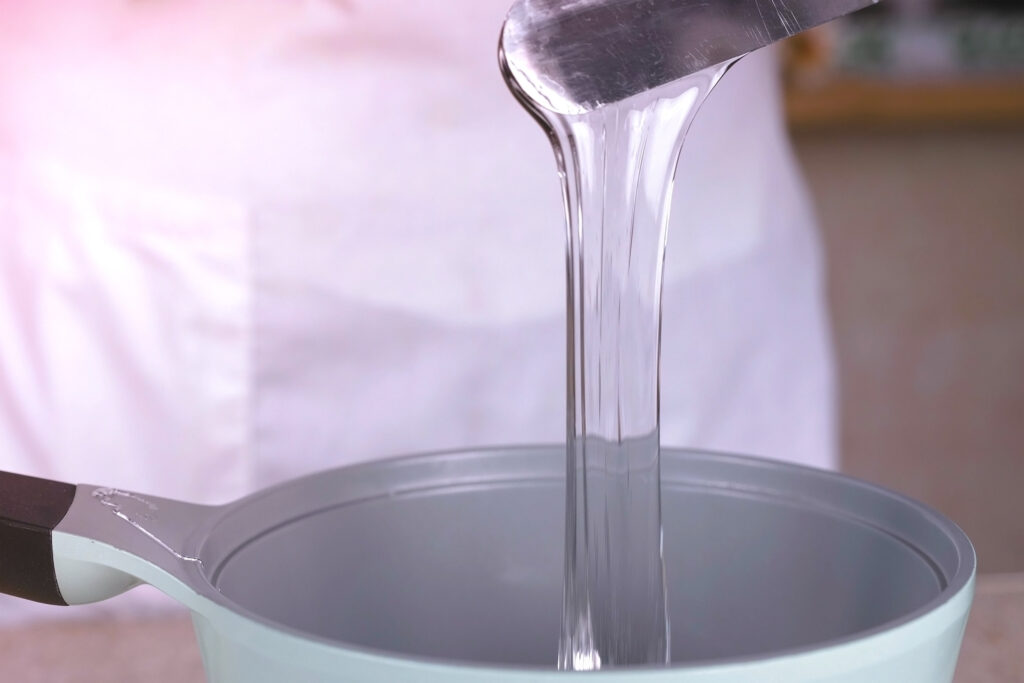
Glycerin is viscous, and viscosity affects pumping and dosing.
At larger production volumes, your engineering team should verify that transfer lines, pumps, valves, and dosing equipment are appropriate for the material and operating temperature.
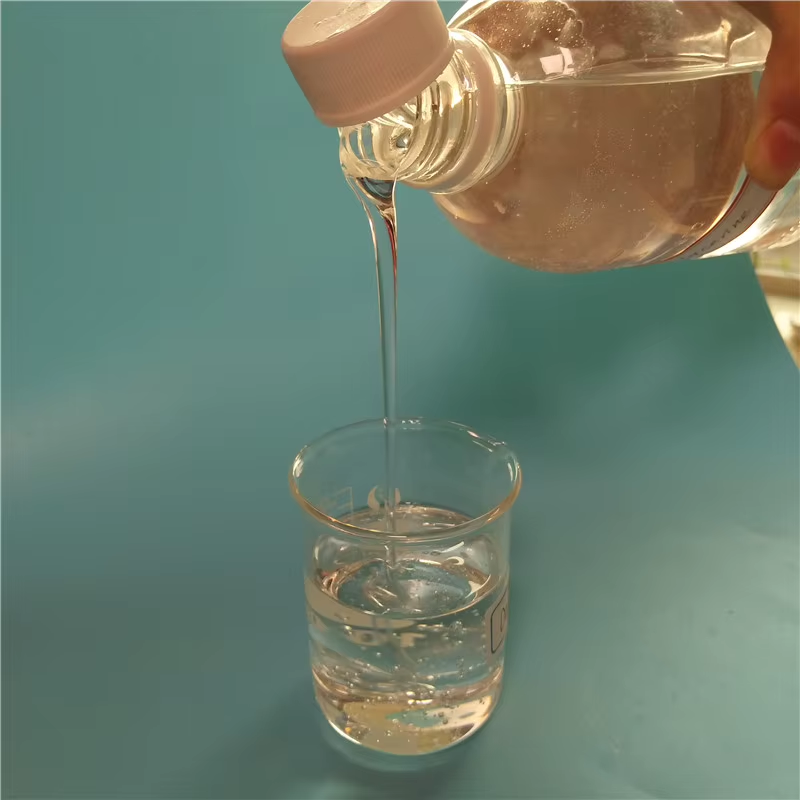
A laboratory technician pouring a small amount from a container and a production operator transferring hundreds of kilograms through a processing line are not facing the same engineering problem.
Use Accurate Dosing
Because glycerin can influence multiple product characteristics at once, dosing accuracy matters.
Automatic metering systems should be periodically checked against actual mass or volume delivery.
Maintain Batch Traceability
Record:
- Supplier
- Manufacturer
- Batch number
- Delivery date
- Quantity
- Certificate of Analysis
- Production batches in which the material was used
This becomes invaluable if a finished product shows an unexpected change in texture or moisture behavior.
Validate the Full Process
Test glycerin under actual conditions rather than only in a bench formulation.
For example:
- Prepare the formulation.
- Process at normal production temperature.
- Apply the actual mixing conditions.
- Fill using the production equipment.
- Store under representative conditions.
- Evaluate texture, sweetness, appearance, and stability.
- Compare against the approved reference batch.
We have seen repeatedly that raw-material consistency becomes most valuable when a factory is operating close to capacity. When production is running smoothly, nobody wants a glycerin substitution to become the unexpected star of the quality meeting.
Glycerin and Product Development Trends
Several developments are increasing interest in multifunctional ingredients such as glycerin.
Reduced-Sugar Formulation
Consumers and regulators continue to push manufacturers toward reduced-sugar products. Glycerin cannot simply replace sugar in every application, but its sweetness and textural functionality can make it useful as part of broader reformulation strategies.
Sugar-Free and Specialty Confectionery
Glycerin may be incorporated into selected reduced-sugar or sugar-free systems where moisture retention and texture are important.
However, manufacturers should evaluate the complete carbohydrate, polyol, labeling, and digestive-tolerance implications of the finished formulation rather than considering glycerin in isolation.
Organic and Traceable Ingredients
Demand for traceable raw materials is increasingly relevant to manufacturers serving premium and export markets.
MT Royal publishes organic food-grade glycerin among its product offerings and describes its use across confectionery, beverages, nutritional supplements, and other applications.
Multifunctional Formulation
The most interesting industrial advantage of glycerin may be its ability to influence several characteristics simultaneously.
A single ingredient can contribute to moisture management, sweetness, mouthfeel, and carrier functionality. For formulation teams, that can reduce the need to stack several specialized ingredients into one recipe.
Frequently Asked Questions About Food Grade Glycerin
Is food-grade glycerin safe for beverages?
Glycerol is an established food additive identified as INS 422 in the Codex system. Codex lists glycerol’s functional classes as including humectant and thickener and provides provisions across various food categories.
Actual permitted use levels and conditions depend on the product category and jurisdiction, so manufacturers should verify the requirements applicable to their finished product.
Can glycerin be used in candy?
Yes. Glycerin is used in selected confectionery applications as a humectant, texture modifier, and sweet-tasting ingredient.
Its exact function and dosage depend on the type of candy, target water activity, texture, shelf life, and other formulation variables.
Does glycerin make candy softer?
It can contribute to moisture retention and softness in appropriate formulations, but the final texture depends on the complete system, including sugars, syrups, hydrocolloids, water activity, processing temperature, and storage conditions.
Can glycerin replace sugar?
Not directly in a one-to-one substitution.
Glycerin has different sweetness, solids contribution, hygroscopicity, and processing behavior from sucrose. It can support certain reduced-sugar formulations, but the recipe normally requires broader reformulation.
What is the difference between glycerin and glycerol?
In commercial food contexts, the terms are commonly used interchangeably. Glycerol is the chemical name, while glycerin or glycerine is widely used for the commercial substance.
What purity should food-grade glycerin have?
High-purity food-grade glycerin is common in industrial supply. MT Royal, for example, publishes a 99.5% food-grade refined glycerin product. The correct specification should be determined by the applicable food standard, product application, and supplier documentation rather than by a single purity number alone.
Can MT Royal supply glycerin in bulk?
MT Royal publishes bulk glycerin supply for food and other industries and lists documentation and certification options for industrial customers. Exact packaging, minimum quantities, availability, and commercial conditions should be confirmed for the required product and destination.
Choosing Glycerin With the Finished Product in Mind
The best way to approach Food Grade Glycerin for Beverage and Sweet Applications is to stop treating glycerin as a simple commodity and start treating it as a functional processing ingredient.
For confectionery, ask what texture and moisture profile you need after weeks of storage—not merely what the product looks like on production day.
For beverages, consider mouthfeel, sweetness, solubility, flavor compatibility, and the effect of the complete processing cycle.
For procurement, look beyond the quotation and examine certification, traceability, consistency, lead time, and alternative supply options.
MT Royal can be part of that evaluation when you need food-grade glycerin alongside different brands and grades, including refined and organic options. Its published portfolio demonstrates an emphasis on industrial supply, technical documentation, and manufacturer-oriented sourcing.
We believe the strongest sourcing decisions happen when formulation, quality, procurement, and production teams evaluate the same ingredient from different angles. A glycerin that looks excellent to purchasing but creates dosing problems on the factory floor is not a successful purchase. Likewise, a technically perfect material that cannot be supplied consistently is not a dependable production solution.
Glycerin may enter the factory as a clear liquid, but its role is anything but simple. When the grade, dosage, process, and supplier are properly matched, it can help turn moisture control, texture, sweetness, and formulation stability from recurring headaches into controlled manufacturing variables.
That is the real value of choosing food-grade glycerin intelligently: not merely getting another raw material delivered, but giving your production line a more predictable ingredient to work with.


No comment