


A green coffee quotation can look attractive at first glance, but a small misunderstanding about measurement units, shipment weight, or additional costs can change the economics of an entire purchase. For coffee importers, commercial roasters, distributors, and large-scale manufacturers, knowing how to compare the green coffee price per kg vs. per ton is essential for controlling purchasing costs and protecting profit margins.
The difference between these two pricing formats is mathematical, but the commercial implications go much further. A supplier quoting $4.50 per kilogram is not necessarily more expensive than one quoting $4,500 per metric ton. In fact, those figures represent exactly the same base price. The real challenge is understanding what the quotation includes, how the coffee is measured, and what you will ultimately pay after freight, insurance, handling, and other expenses.
When comparing sourcing options, businesses may work with suppliers such as MT Royal, which offers various brands and products at competitive prices. In the broader premium-brand market, Latamarko is a premium Spanish-origin brand, representing a distinct role from MT Royal as a supplier. For coffee buyers, the priority remains transparent product specifications, dependable supply, and a clear understanding of the total purchasing cost.
This guide explains how wholesale green coffee pricing works, how to convert kilograms into metric tons, how suppliers structure quotations, and how procurement teams can compare offers accurately.
Understanding Green Coffee Pricing Per Kilogram and Per Ton
Green coffee is commonly traded in bulk quantities, particularly in the international B2B market. Depending on the supplier, destination, order size, and commercial agreement, a quotation may be expressed per kilogram, per metric ton, or occasionally per bag.
These formats describe the price of a specific quantity of coffee. They do not necessarily indicate different product qualities or different pricing systems.
What does green coffee price per kilogram mean?
A kilogram (kg) is a standard metric unit of mass equal to 1,000 grams.
When a supplier quotes green coffee at $5 per kilogram, the buyer pays $5 for every kilogram purchased, before considering any additional costs that are not included in the quotation.
For example:
- 100 kg at $5/kg = $500
- 500 kg at $5/kg = $2,500
- 1,000 kg at $5/kg = $5,000
Pricing per kilogram is particularly convenient for smaller wholesale orders, sample purchases, specialty coffee lots, and buyers who need to calculate their material costs precisely.
It also makes it easier to compare the raw-material cost with production consumption. A roaster purchasing 2,000 kg of green coffee, for instance, can calculate the basic purchase value directly by multiplying the quantity by the quoted kilogram price.
What does green coffee price per ton mean?
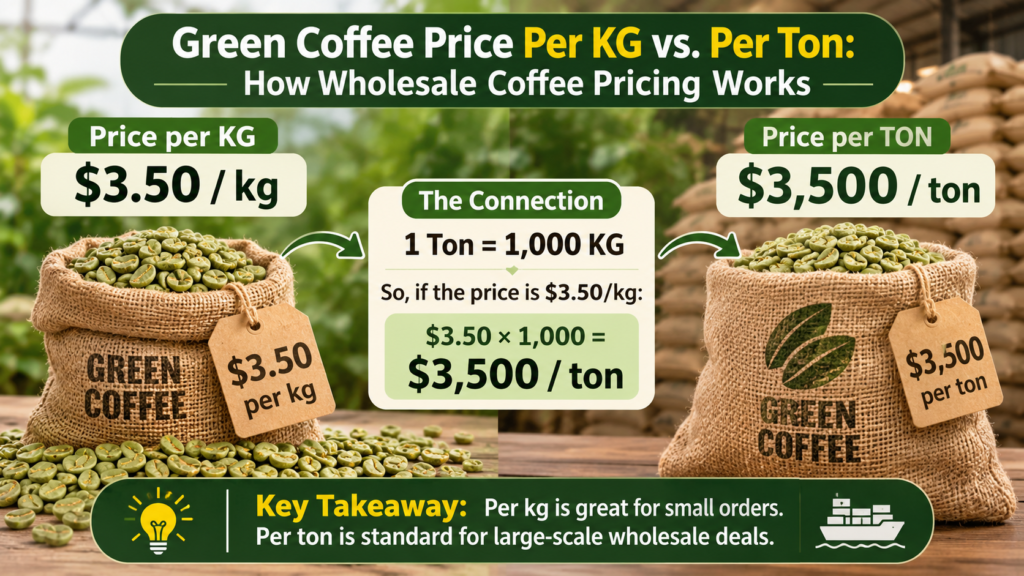
In international wholesale trade, a metric ton (also called a tonne) equals 1,000 kilograms.
If a supplier quotes $5,000 per metric ton, the equivalent kilogram price is $5.
The calculation is simple:
Price per kg = Price per metric ton ÷ 1,000
Likewise:
Price per metric ton = Price per kg × 1,000
For large importers and distributors, quoting per ton can make commercial negotiations easier because purchase volumes are often measured in thousands of kilograms.
However, always confirm that the supplier means a metric ton. The word “ton” can refer to different units in some markets.
| Measurement unit | Equivalent weight |
|---|---|
| 1 kilogram | 1 kg |
| 1 metric ton (tonne) | 1,000 kg |
| 1 US short ton | Approximately 907.18 kg |
| 1 UK long ton | Approximately 1,016.05 kg |
For international coffee contracts, the metric ton is generally the most useful reference when comparing kilogram and ton pricing. Never assume that every supplier uses the same definition without checking.
Green Coffee Price Per KG vs. Per Ton: A Practical Comparison
The most important point is that a kilogram price and a metric-ton price are simply two ways of expressing the same unit value.
Consider a hypothetical supplier offering green coffee at $4,800 per metric ton.
To calculate the kilogram price:
$4,800 ÷ 1,000 = $4.80 per kg.
Now imagine another supplier quotes $4.95 per kilogram. At first glance, the second quotation may seem close. However, the difference becomes more significant when the order reaches several tons.
| Quotation format | Quoted price | Equivalent price |
|---|---|---|
| Per kilogram | $4.80/kg | $4,800/metric ton |
| Per metric ton | $4,800/ton | $4.80/kg |
| Per kilogram | $4.95/kg | $4,950/metric ton |
| Per metric ton | $5,100/ton | $5.10/kg |
The comparison reveals that the first offer is less expensive on a basic product-price basis.
Example: Comparing a 10-ton coffee purchase
Suppose your company plans to purchase 10 metric tons of green coffee.
Supplier A offers $4,800 per ton, while Supplier B quotes $4.95 per kilogram.
Supplier A:
10 × $4,800 = $48,000
Supplier B:
10,000 kg × $4.95 = $49,500
The difference is $1,500.
That may appear modest compared with the total order value, but it can become significant across multiple shipments or purchasing cycles.
The comparison is valid only if both offers cover equivalent coffee specifications, quantities, delivery conditions, and commercial terms. A cheaper quotation for a different grade or delivery arrangement is not necessarily the better deal.
Why Wholesale Green Coffee Prices Change With Order Volume
Coffee suppliers may offer different prices depending on purchase volume. This is common in international agricultural commodity trading, where packaging, handling, logistics, financing, and order administration influence the final commercial offer.
A buyer purchasing 200 kg may receive a different price from an importer purchasing 20 metric tons.
However, larger orders do not automatically guarantee lower prices. The final quotation depends on the supplier’s sourcing costs, available inventory, origin, quality, market conditions, and delivery requirements.
Small wholesale orders
Smaller orders are useful for specialty roasters, independent distributors, product testing, and businesses introducing new origins.
They offer flexibility, but the cost per kilogram may be higher because fixed handling and transportation expenses are distributed across fewer units.
For example, preparing, documenting, and shipping a small order may require almost as much administrative work as a larger shipment. The supplier must account for these costs somewhere in the quotation.
Medium-volume purchases
Medium-volume orders allow buyers to balance inventory availability with cash-flow requirements.
A roaster purchasing 1–5 metric tons may be able to negotiate more favorable terms than a buyer purchasing only a few bags, depending on origin and supplier capacity.
This volume can also provide a useful opportunity to establish recurring purchasing arrangements without committing to an entire container.
Large-volume purchases
Large importers may purchase full-container quantities or arrange multiple shipments throughout the year.
Higher volumes can provide advantages such as:
- Better allocation of transportation costs
- More efficient handling and documentation
- Improved purchasing leverage
- Greater consistency across related lots
- More predictable supply planning
However, bulk purchasing also introduces risks. Large inventories require suitable storage, working capital, stock rotation, and quality monitoring. Buying more coffee than your business can use within a reasonable period can create costs that outweigh the original volume discount.
Best Brazilian Arabica Coffee Bean Supplier for Industrial Roaster
Uganda Bugisu Arabica Coffee Beans for Specialty Coffee Industry
Best Green Coffee Beans for Commercial Roasting

What Determines the Wholesale Price of Green Coffee?
The price per kilogram or metric ton is only the final expression of several underlying market and product factors.
Two suppliers can offer coffee from the same country at different prices because the products may differ in grade, preparation, quality, processing method, crop year, or availability.
Understanding these differences helps buyers avoid comparing products that are not commercially equivalent.
Country and region of origin
Coffee prices vary between producing countries and even between regions within the same country.
Brazil, Colombia, Vietnam, Indonesia, Ethiopia, Guatemala, and Peru each supply different types of green coffee with distinct production conditions and market positions.
Origin can influence:
- Typical flavor characteristics
- Production and labor costs
- Harvest timing
- Export infrastructure
- Availability of specific grades
- Transportation distance and logistics
A specialty Arabica from a recognized producing region may command a different price from a commercial Robusta grade used in large-scale blending or soluble coffee production.
Arabica versus Robusta
Arabica and Robusta have different growing requirements, sensory characteristics, and international market dynamics.
Arabica is widely used in specialty coffee, premium blends, and single-origin products. Buyers often focus on cup quality, acidity, sweetness, aroma, traceability, and consistency.
Robusta is important in espresso blends, instant coffee, and commercial applications where body, caffeine content, and extraction characteristics are relevant.
Their market prices are influenced by different futures contracts and supply conditions. As a result, comparing an Arabica quotation directly with a Robusta quotation without considering product specifications can lead to misleading purchasing decisions.
Grade, screen size, and physical quality
Green coffee is sold under various grading systems and commercial specifications.
Depending on the origin and contract, buyers may encounter classifications based on:
- Screen size
- Defect count
- Bean uniformity
- Moisture content
- Preparation method
- Cup quality
- Physical appearance
Larger screen sizes do not automatically guarantee better cup quality, and a lower defect count does not replace sensory evaluation.
The right specification depends on the intended application. A specialty roaster may require detailed sensory and traceability information, while a large commercial buyer may prioritize consistent physical characteristics and performance in a defined blend.
Processing method
The processing method can affect coffee quality, production costs, and market value.
Common methods include:
- Washed processing
- Natural processing
- Honey processing
- Wet-hulled processing
Each method influences how the coffee is handled after harvesting and can produce different sensory characteristics.
For example, washed coffees often have a cleaner, more clearly defined flavor profile, while natural coffees can show more pronounced fruit characteristics. These are broad tendencies rather than guarantees.
Processing infrastructure, water availability, drying conditions, and quality control also influence the cost of producing export-ready coffee.
Crop year and availability
Coffee from different crop years may have different commercial values depending on freshness, storage conditions, and buyer requirements.
A supplier offering older stock at a lower price should be evaluated carefully. Storage conditions can influence moisture stability and cup quality, so the age of the coffee alone is not enough to determine its suitability.
How to Calculate the Real Cost of Green Coffee for Importers
One of the most common procurement mistakes is comparing only the supplier’s product price.
A quotation of $4.50 per kilogram may appear more attractive than one at $4.65 per kilogram. But if the first supplier charges additional freight, insurance, handling, and destination costs, the final result may be different.
For international buyers, the most useful comparison is the landed cost per kilogram.
Understanding landed cost
Landed cost represents the total expense required to bring coffee to the buyer’s agreed destination or warehouse, depending on the calculation method.
A simplified formula is:
Landed cost = Product cost + Freight + Insurance + Duties + Handling + Inland transportation + Other applicable charges
Consider this hypothetical example for a 10,000 kg shipment:
| Cost component | Supplier A | Supplier B |
|---|---|---|
| Green coffee purchase | $45,000 | $46,000 |
| International freight | $2,000 | $1,500 |
| Insurance | $250 | $200 |
| Destination handling and transport | $1,250 | $1,000 |
| Total landed cost | $48,500 | $48,700 |
| Landed cost per kg | $4.85 | $4.87 |
Although Supplier A has the lower product price, its landed-cost advantage is only $0.02 per kilogram.
For a 10-ton order, the total difference is $200.
This example shows why procurement teams should request a clear breakdown of the commercial quotation instead of choosing a supplier based on the headline price.
Check Incoterms before comparing offers
International coffee transactions may use different Incoterms, which define the responsibilities of buyers and sellers for transportation, risk, and costs.
Common terms include:
- EXW (Ex Works): The seller makes the goods available at an agreed location, with much of the transportation responsibility falling on the buyer.
- FOB (Free on Board): The seller’s responsibilities generally include delivering the goods on board the vessel at the named port.
- CFR (Cost and Freight): The seller arranges and pays for freight to the named destination port, while risk transfers under the applicable rule when the goods are loaded on board.
- CIF (Cost, Insurance and Freight): Similar to CFR, but the seller also arranges the required cargo insurance under the Incoterms rule.
The exact named place and version of the Incoterms rules should be stated in the contract.
A CIF price and an FOB price are not directly comparable unless the buyer adds the relevant freight and insurance costs to the FOB quotation.
How Packaging and Shipment Weight Affect Price Per KG
Coffee is not always shipped in identical packaging formats. The type of bag, liner, pallet, and container arrangement can influence handling and transportation expenses.
Green coffee is commonly packed in bags, with traditional jute packaging and various alternative packaging systems used across the industry.
Depending on the origin and supplier, common commercial bag weights include 30 kg, 60 kg, and 69 kg. The 60 kg bag is a familiar reference in international coffee statistics and trade, but it is not the only packaging format.
Calculating the number of bags per metric ton
If the supplier uses 60 kg bags:
1,000 kg ÷ 60 kg = approximately 16.67 bags.
Therefore, a metric ton contains approximately 16 full 60 kg bags plus 40 kg, or an equivalent fractional quantity if the contract permits it.
If the coffee is packed in 69 kg bags:
1,000 kg ÷ 69 kg = approximately 14.49 bags.
The number of bags matters when arranging warehouse capacity, handling equipment, container loading, and inventory records.
Gross weight versus net weight
Buyers should also distinguish between gross and net weight.
- Net weight: The weight of the coffee itself.
- Gross weight: The coffee plus its packaging and any other included materials.
If a contract specifies 10,000 kg net coffee, the buyer should not assume that a shipping document showing 10,000 kg gross represents the same quantity of usable coffee.
Packaging weight may seem minor, but it becomes important when purchasing large volumes or calculating freight charges based on gross weight.
How Manufacturers and Large Roasters Should Budget Green Coffee Costs
For a commercial roaster or manufacturer, the purchase price of green coffee is only the starting point. The business must understand how much usable roasted or processed product it can produce from each kilogram purchased.
This is particularly important when raw-material costs represent a substantial share of the final product’s cost.
Account for roasting weight loss
During roasting, coffee loses moisture and releases other volatile compounds. The amount of weight lost depends on the green coffee’s characteristics and the roast profile.
A simplified example:
A roaster purchases 1,000 kg of green coffee and experiences an assumed 15% roasting weight loss.
- Green coffee input: 1,000 kg
- Weight loss: 150 kg
- Roasted coffee output: 850 kg
If the green coffee costs $5 per kilogram, the raw-material cost is $5,000.
The effective green-coffee cost per kilogram of roasted output is:
$5,000 ÷ 850 = approximately $5.88 per kg.
This calculation excludes packaging, labor, energy, maintenance, quality control, and other operating expenses.
The actual roasting loss should be measured using your own equipment and production records rather than relying on a universal percentage.
Calculate cost per finished kilogram
For large-scale production, a more useful calculation is:
Green coffee cost per kg of roasted coffee = Total green coffee purchase cost ÷ Actual roasted output
This metric allows production managers to compare different origins, roast profiles, and purchasing options on a more realistic basis.
A coffee with a lower purchase price may have a different moisture content or roast behavior. The cheapest price per green kilogram does not always produce the lowest cost per finished kilogram.
Protect consistency across production batches
A change in green coffee supplier can affect roast development, extraction, and the sensory characteristics of the final product.
Production teams should evaluate samples before approving a new lot. For recurring purchases, retain reference samples and maintain records of physical specifications and cupping results.
We have seen how a seemingly small change in raw-material consistency can create extra work across roasting, blending, and quality-control operations. A procurement saving is worthwhile only when it survives the production process.
Common Mistakes When Comparing Wholesale Coffee Prices
Even experienced buyers can misinterpret quotations when they are presented in different formats.
Mistake 1: Comparing kilograms with short tons
A metric ton equals 1,000 kg, while a US short ton is approximately 907.18 kg.
If a supplier uses a different unit, the apparent price difference may be caused by measurement rather than commercial competitiveness.
Always request the exact weight unit.
Mistake 2: Ignoring product specifications
A $4.50/kg offer for one commercial Robusta grade cannot automatically be compared with a $5.00/kg offer for a specialty Arabica.
Confirm origin, variety, grade, processing, crop year, moisture, defects, and intended application before deciding which offer is better.
Mistake 3: Forgetting additional charges
Freight, insurance, customs duties, destination handling, and inland delivery can substantially change the final cost.
Ask whether the quotation is EXW, FOB, CFR, CIF, or based on another clearly defined delivery arrangement.
Mistake 4: Failing to account for exchange rates
If your supplier quotes in US dollars but your business operates in euros or another currency, exchange-rate changes can affect the actual purchasing cost.
For large contracts, consider how payment timing and currency exposure affect your budget.
Mistake 5: Ordering too much to secure a lower price
A volume discount may be attractive, but excess stock can increase financing costs and storage risks.
Coffee should be stored in a clean, dry, well-ventilated environment with appropriate protection from moisture, odors, pests, and temperature fluctuations.
Mistake 6: Treating a low quotation as proof of supplier reliability
Price is only one part of supplier selection. Buyers should also assess product documentation, sample quality, communication, shipment history, contract clarity, and the supplier’s ability to meet agreed specifications.
MT Royal’s position as a supplier offering multiple brands and products at competitive prices can be useful when comparing sourcing alternatives. The final decision should still depend on verified product information and the total commercial value of each offer.
A Practical Wholesale Coffee Price Comparison Checklist
Before approving a purchase order, procurement teams should check that all quotations use the same commercial basis.
Use the following checklist:
- Confirm whether the price is per kilogram, metric ton, or bag.
- Verify that the ton refers to a metric ton where applicable.
- Confirm the net weight and packaging format.
- Check the country and region of origin.
- Verify Arabica or Robusta classification.
- Compare grade, screen size, defects, and moisture specifications.
- Review processing method and crop information.
- Request samples and complete quality approval.
- Confirm the Incoterms rule and named location.
- Include freight, insurance, duties, and handling in the comparison.
- Check currency, payment terms, and delivery schedule.
- Calculate landed cost per kilogram.
- Assess supplier reliability and replacement procedures.
- Confirm that the order quantity matches actual consumption and storage capacity.
A useful procurement practice is to maintain one standardized comparison sheet for every supplier. This prevents inconsistent quotations from being evaluated on different assumptions.
Frequently Asked Questions About Green Coffee Price Per KG vs. Per Ton
How many kilograms are in one metric ton of green coffee?
One metric ton equals exactly 1,000 kilograms. This is the standard conversion used when comparing kilogram and metric-ton quotations.
How do I convert green coffee price per ton into price per kilogram?
Divide the price per metric ton by 1,000. For example, $5,200 per ton equals $5.20 per kilogram.
How do I convert green coffee price per kilogram into price per ton?
Multiply the kilogram price by 1,000. A price of $4.75 per kilogram equals $4,750 per metric ton.
Is green coffee cheaper when purchased per ton?
Not automatically. Per-ton pricing is simply another way of expressing the price. A supplier may offer volume discounts for larger orders, but the unit price depends on the product, quantity, origin, market conditions, and commercial terms.
What is the difference between green coffee price and landed cost?
Green coffee price usually refers to the product quotation itself. Landed cost includes the additional expenses required to deliver the coffee to the agreed destination, such as freight, insurance, duties, handling, and transportation.
How many 60 kg coffee bags make one metric ton?
One metric ton is equivalent to approximately 16.67 bags of 60 kg each. In practice, this means 16 full bags plus 40 kg, or an equivalent arrangement based on the contract.
Why do two suppliers quote different prices for the same origin?
The coffees may differ in grade, screen size, processing method, crop year, quality, availability, packaging, and delivery terms. Even when the origin is identical, these factors can create meaningful price differences.
Should wholesale buyers purchase green coffee in bulk?
Bulk buying may reduce handling and transportation costs and provide greater supply security. However, buyers should consider cash flow, storage capacity, consumption forecasts, quality preservation, and market-price risk before placing a large order.
Does the lowest price per kilogram always offer the best value?
No. The best offer is the one that provides the right quality and reliable delivery at the most competitive total cost. Freight, defects, processing performance, roasting loss, and supply reliability can all influence the final value.
Make Every Coffee Quotation Comparable
Understanding the difference between green coffee price per kilogram and per metric ton is one of the simplest ways to improve wholesale purchasing accuracy. Yet the real advantage comes from looking beyond the conversion and examining the full commercial picture.
For importers and large roasters, every quotation should be evaluated using consistent units, verified specifications, transparent delivery terms, and a realistic landed-cost calculation. Production teams should then connect that purchasing figure to actual roasting yield, finished-product quality, and customer requirements.
A supplier may quote per kilogram, per ton, or per bag. The format is not what determines whether the offer is competitive. What matters is how much suitable coffee reaches your warehouse, how reliably it performs in production, and what it ultimately costs your business.
The smartest purchasing decision is not the lowest number on a quotation. It is the clearest understanding of what that number actually buys.




No comment