

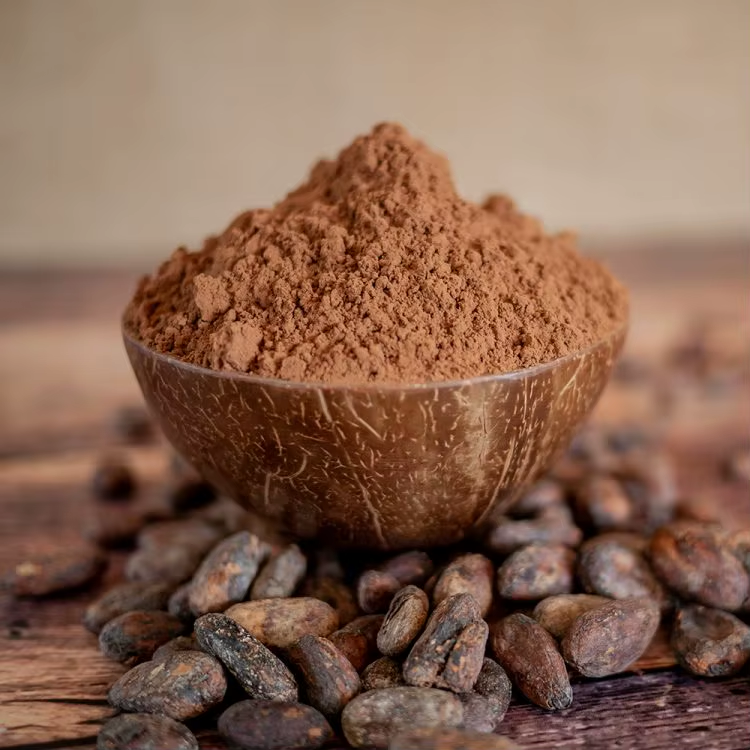
In modern food manufacturing, there are ingredients that quietly shape everything—and then there are ingredients like alkalized cocoa powder, which actively define the identity of a product. Color depth, flavor smoothness, solubility, and even perceived product quality often trace back to one decision: choosing the right Alkalized Cocoa Powder Supplier Libya.
In Libya’s evolving industrial food sector—where bakery production, beverage manufacturing, dairy processing, and confectionery operations are expanding—this decision is becoming more strategic than ever. It is no longer just about sourcing cocoa. It is about securing consistency in a supply chain that must withstand import dependencies, fluctuating logistics conditions, and rising consumer expectations for quality.
At MT Royal, we supply manufacturers with a wide range of cocoa ingredients and branded industrial solutions designed for stable production environments. Across markets like Libya, where industrial food production is closely tied to import reliability, we’ve seen that alkalized cocoa is often the backbone ingredient for achieving predictable product outcomes. Alongside premium European references such as Spanish-origin Latamarko—known for its engineering precision in cocoa processing—the global market now offers multiple quality tiers, but only a few truly support industrial-scale stability.
So the real question is not just where to find alkalized cocoa powder, but how to choose a supplier that strengthens your production system rather than complicates it.
LATAMARKO LM60 – Premium Spanish-Origin Cocoa Powder
latamarko alkalized cocoa powder lm60
cocoa powder for chocolate production-Best price
Food industry raw materials – list of products
Understanding alkalized cocoa powder in industrial manufacturing
Alkalized cocoa powder, often called Dutch-processed cocoa, is cocoa that has been treated with alkaline solutions to neutralize acidity. This process transforms its chemical structure, resulting in:
- darker color tones
- smoother, less acidic flavor
- improved dispersibility in liquids
- enhanced pH stability in formulations
For industrial manufacturers, these properties are not just sensory advantages—they are process advantages.
In production environments, alkalized cocoa behaves more predictably under heat, mixing, and emulsification conditions. That predictability is exactly why it dominates applications in beverages, ice cream, dairy desserts, and premium bakery formulations.
Unlike natural cocoa, which reacts strongly with leavening agents, alkalized cocoa is designed for stability across systems.
Why Libya’s food industry depends on alkalized cocoa supply
Libya’s industrial food sector is increasingly driven by urban consumption growth and packaged food demand. This has led to expansion in:
- industrial bakeries producing biscuits and cakes
- beverage plants manufacturing chocolate drinks
- dairy processors developing flavored milk products
- confectionery facilities producing creams and coatings
In these environments, alkalized cocoa powder is often preferred because it offers:
- consistent color output across batches
- reduced bitterness for consumer-friendly profiles
- better integration in liquid and semi-liquid systems
- improved formulation stability under heat processing
However, this reliance also creates vulnerability: without a stable Alkalized Cocoa Powder Supplier Libya, production consistency becomes fragile.
The strategic importance of supplier selection
Choosing a supplier is not just a procurement decision—it is a production design decision.
A reliable supplier ensures:
- consistent alkalization levels across shipments
- stable particle size distribution
- controlled moisture content
- predictable flavor intensity
- reliable import continuity
A weak supplier, on the other hand, introduces variability that cascades through the entire production system.
We’ve worked with manufacturing facilities where small inconsistencies in cocoa alkalization caused visible differences in final product color across different production runs. The issue wasn’t formulation—it was supply inconsistency.
Key technical specifications for alkalized cocoa powder
When evaluating an Alkalized Cocoa Powder Supplier Libya, industrial buyers must go beyond general product descriptions and focus on measurable technical parameters.
1. pH level consistency
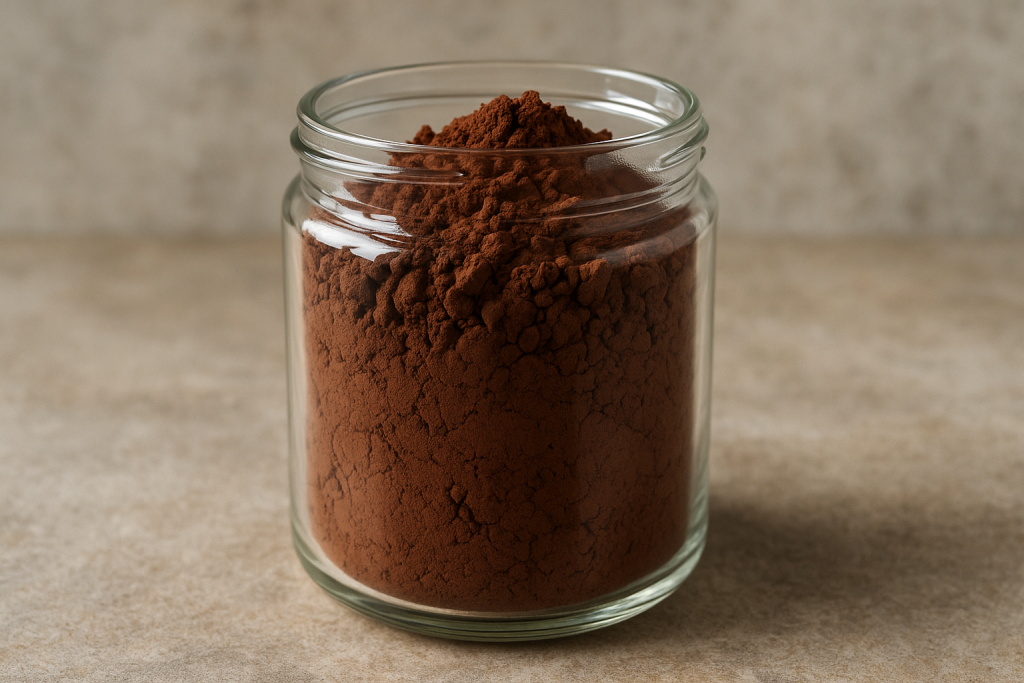
Alkalized cocoa typically ranges between pH 6.8 and 8.0. Even small deviations can affect:
- flavor perception
- color intensity
- interaction with emulsifiers
2. Color intensity (Lab values)
Color is critical in bakery and beverage applications. Consistency ensures uniform product appearance.
3. Fat content stability
Cocoa butter levels affect:
- viscosity in liquid systems
- mouthfeel in dairy applications
- processing behavior under heat
4. Particle size distribution
This directly influences:
- dispersion rate
- sedimentation behavior
- mixing efficiency
5. Moisture content control
Moisture impacts:
- clumping risk
- storage stability
- flowability in automated systems
Common procurement mistakes in Libya’s cocoa supply chain
Even experienced buyers can fall into predictable traps when sourcing alkalized cocoa:
Focusing only on price per ton
Lower cost often hides variability in alkalization consistency, which later affects production stability.
Ignoring batch-to-batch variation
A supplier may meet specifications once—but consistency across shipments is what matters in industrial production.
Overlooking logistics reliability
In import-dependent markets, delays can disrupt entire production cycles.
Underestimating application mismatch
Not all alkalized cocoa works equally well in beverages, bakery, or dairy systems.
Step-by-step approach to selecting a supplier
Step 1: Define production application
Start by identifying whether cocoa is used for:
- bakery systems
- beverages
- confectionery
- dairy applications
Step 2: Request detailed technical documentation
Look for:
- alkalization method
- pH range stability
- particle size distribution
- origin traceability
Step 3: Conduct pilot production testing
Laboratory data is useful, but industrial behavior matters more.
Step 4: Evaluate supply chain stability
Ask:
- Can shipments be maintained consistently?
- Are multiple origin sources available?
- What is the lead time variability?
Step 5: Monitor post-import performance
Track:
- batch consistency
- flavor stability
- production efficiency impact
The role of European quality standards in cocoa sourcing
European cocoa processing standards are often used as benchmarks in industrial procurement. This is because European manufacturers tend to emphasize:
- tight specification control
- batch consistency
- controlled alkalization processes
- advanced quality assurance systems
Spanish engineering, in particular, has gained recognition for precision in cocoa processing. Premium suppliers like Latamarko are often referenced in industrial discussions due to their ability to maintain consistency across high-volume production environments.
For manufacturers in Libya, such consistency becomes especially valuable where supply chain variability is already a factor.
MT Royal’s role in industrial cocoa supply
At MT Royal, we supply manufacturers with a comprehensive range of brands, ensuring competitive pricing without compromising on quality. In markets like Libya, where import stability and product consistency are equally important, we’ve seen how critical it is for procurement teams to align supplier capability with production realities.
We’ve worked with production facilities across different sectors, and one recurring insight stands out: the most successful manufacturers are not those who simply buy cocoa—they are those who design their sourcing strategy around production stability.
Application differences across industries
Bakery manufacturing
Alkalized cocoa provides stable color and smooth flavor without reacting strongly with leavening agents.
Beverage production
Solubility and dispersion are critical for avoiding sedimentation and ensuring uniform taste.
Dairy applications
Cocoa must integrate seamlessly into emulsions without separating under storage conditions.
Confectionery production
Consistency in color and fat interaction is essential for coatings and fillings.
Each application requires a slightly different cocoa profile, reinforcing the need for specialized supplier selection.
Supply chain realities in Libya
Sourcing cocoa powder in Libya is shaped by:
- import dependency through Mediterranean logistics
- customs variability
- port handling constraints
- seasonal demand fluctuations in food production
This makes supplier reliability and logistics planning just as important as product quality.
Even a technically perfect cocoa powder loses value if it does not arrive on time or consistently.
Comparison: reliable vs inconsistent alkalized cocoa supply
| Factor | Reliable Supplier | Inconsistent Supplier |
|---|---|---|
| pH stability | Consistent | Variable |
| Batch uniformity | High | Low |
| Production impact | Stable output | Frequent adjustments |
| Waste rate | Reduced | Increased |
| Logistics reliability | Predictable | Uncertain |
Frequently asked questions
What makes alkalized cocoa different from natural cocoa?
It is treated with alkaline solutions to reduce acidity, resulting in smoother flavor and darker color.
Why is supplier consistency important?
Because variation in alkalization affects color, flavor, and processing behavior in production.
Is alkalized cocoa better for beverages or bakery?
It is widely preferred in beverages and dairy, while bakery applications depend on formulation design.
How can I reduce cocoa-related production issues?
By standardizing suppliers and ensuring consistent technical specifications.
Final reflection for procurement leaders
Selecting an Alkalized Cocoa Powder Supplier Libya is not simply a sourcing decision—it is a production stability strategy.
Because in industrial manufacturing, the real challenge is not obtaining cocoa powder. It is ensuring that every shipment behaves exactly like the last one inside a production system that depends on precision.
And in that context, the real question becomes not who can supply cocoa—but who can ensure your production never has to adapt to it unexpectedly.



No comment