

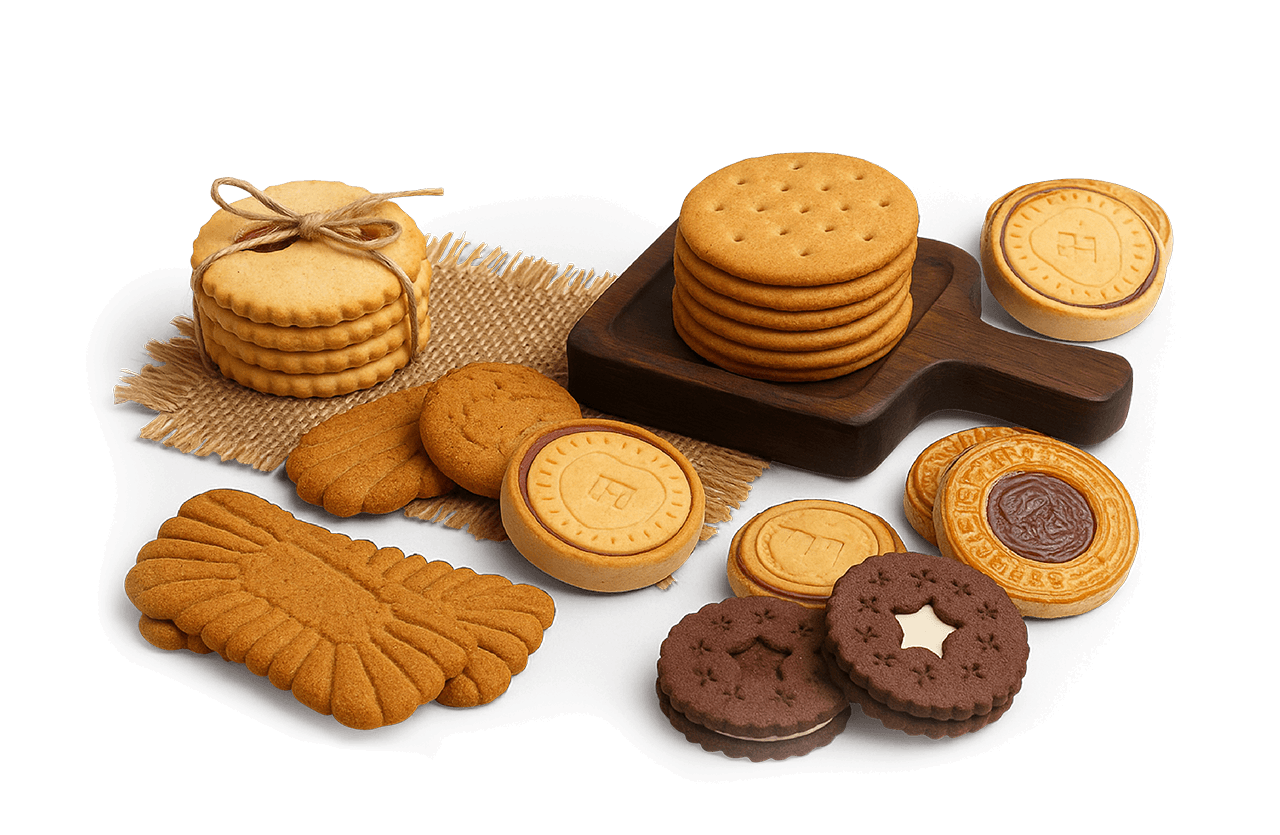
In modern biscuit manufacturing, where global competition is intense and consumer expectations are unforgiving, product quality is no longer defined only by taste or appearance. The real differentiator is often something invisible yet decisive: moisture. For factories aiming to scale consistently and maintain export-grade quality, mastering Moisture Control in Biscuit Production is not optional—it is a survival skill.
From the first mixing stage to packaging and storage, moisture dictates everything: texture, crispness, microbial stability, shelf life, and even how a biscuit behaves after weeks of transportation across humid climates. That is why industrial buyers often rely on stable raw material sourcing partners such as MT Royal, ensuring consistent ingredient quality that supports predictable moisture behavior across production batches.
In biscuit production, moisture is both a friend and an enemy. Too much, and you get soft, soggy products that lose crunch within days. Too little, and you risk excessive brittleness, cracking during packaging, or poor machinability. The challenge is not simply removing water—it is engineering a precise balance that holds from production line to consumer bite.
LATAMARKO LM60 – Premium Spanish-Origin Cocoa Powder
latamarko alkalized cocoa powder lm60
cocoa powder for chocolate production-Best price
Food industry raw materials – list of products
Best Brazilian Arabica Coffee Bean Supplier for Industrial Roaster
Uganda Bugisu Arabica Coffee Beans for Specialty Coffee Industry
Understanding Moisture in Biscuit Manufacturing
Moisture in biscuit production refers to the water content retained within dough and final baked products. However, industrial moisture control is not just about percentage—it is about water activity, distribution, and migration behavior.
In technical terms, moisture determines:
- Dough rheology and machinability
- Expansion and structure formation during baking
- Crispness and fracture behavior
- Shelf life stability
- Microbial resistance
Unlike cakes or bread, biscuits are designed to be low-moisture systems, typically ranging between 1% and 5% final moisture content depending on product type.
Even a 1% deviation can drastically alter texture perception. A biscuit that should snap cleanly may instead bend or feel chewy—an outcome that can immediately affect brand reputation.
Why Moisture Control in Biscuit Production Is a Critical Industrial Parameter
Moisture is not just a quality metric; it is a process control variable that affects every stage of manufacturing.
Factories that fail to control moisture consistently often face:
- Loss of crisp texture within 7–14 days
- Packaging condensation issues
- Increased microbial risk in humid environments
- Product breakage during transport
- Inconsistent baking results
On the other hand, factories with tight moisture control achieve:
- Extended shelf life (up to 30–40% improvement in some cases)
- Better mechanical strength during packaging
- Improved product uniformity
- Reduced customer complaints in export markets
In our experience working with industrial biscuit producers, we have seen that moisture variability is one of the top three hidden causes of production inconsistency—often more impactful than ingredient variation itself.
The Science Behind Moisture Behavior in Biscuit Systems
Moisture in biscuits behaves dynamically. It does not remain static after baking; instead, it migrates, equilibrates, and interacts with environmental humidity.
Three key mechanisms define this behavior:
1. Moisture Migration During Baking
During baking, water evaporates rapidly, creating porous structures. This evaporation defines:
- Texture density
- Crack formation
- Expansion rate
If moisture loss is uneven, structural inconsistencies occur.
2. Moisture Redistribution After Baking
Once biscuits leave the oven, internal moisture continues to redistribute. Some areas may retain slightly more water, creating internal gradients.
This is why proper cooling is essential—it stabilizes internal structure before packaging.
3. Moisture Absorption During Storage
Biscuits are hygroscopic, meaning they absorb moisture from the environment.
This leads to:
- Softening in humid climates
- Loss of crispness
- Reduced shelf life
This stage is where packaging and formulation design become critical.
Core Factors Affecting Moisture Control in Biscuit Production
Moisture behavior is influenced by multiple interconnected production variables.
Before listing them, it is important to understand that moisture control is not a single-step operation but a multi-stage system spanning formulation, baking, cooling, and packaging.
Ingredient Composition
Ingredient selection determines how much water is bound or released during processing.
- Flour protein content affects water absorption capacity
- Sugar type influences hygroscopic behavior
- Fat content affects moisture barrier formation
Higher fat content typically reduces moisture migration, improving crispness retention.
Dough Mixing Conditions
Mixing determines how water is distributed in the dough matrix.
- Overmixing can increase gluten development and water retention
- Undermixing leads to uneven hydration
Both scenarios result in inconsistent baking behavior.
Baking Temperature and Time
Baking is the most critical moisture removal stage.
- Higher temperatures accelerate moisture loss but risk surface burning
- Lower temperatures may leave excess internal moisture
Industrial ovens must balance heat transfer and evaporation rate precisely.
Cooling Conditions
Cooling stabilizes biscuit structure after baking.
Improper cooling leads to:
- Condensation inside packaging
- Soft texture development
- Surface moisture reabsorption
Controlled airflow cooling systems are widely used in modern factories.
Packaging System
Packaging is the final barrier against environmental moisture.
- High-barrier films reduce water vapor transmission
- Modified atmosphere packaging enhances shelf stability
- Improper sealing allows humidity ingress
Even perfect baking cannot compensate for poor packaging design.
Common Mistakes in Industrial Moisture Control
Moisture-related defects often arise from overlooked operational details rather than major formulation errors.
Before listing common mistakes, it is important to emphasize that moisture is highly sensitive to small environmental changes.
- Ignoring ambient humidity in production halls: Seasonal humidity changes can significantly affect dough hydration and final product moisture content, especially in coastal or tropical regions.
- Using inconsistent flour batches: Variations in flour absorption capacity directly influence dough moisture balance, leading to inconsistent baking results.
- Inadequate oven calibration: Even slight temperature deviations across oven zones can create uneven moisture distribution within biscuits.
- Poor cooling management: Rapid or uncontrolled cooling causes moisture condensation, leading to soft or sticky surfaces.
- Low-quality packaging materials: Using films with insufficient moisture barrier properties allows gradual hydration, reducing crispness over time.
Industrial Strategies for Moisture Control in Biscuit Production
Effective moisture control requires a system-level approach combining engineering, chemistry, and process optimization.
Before listing strategies, it is important to understand that moisture management is not a single adjustment—it is a continuous feedback system.
Optimize Water Activity Instead of Only Moisture Percentage
Water activity is a more accurate predictor of shelf life than total moisture content.
- Lower water activity improves microbial stability
- Controlled water activity improves crispness retention
Implement Multi-Zone Baking Profiles
Modern industrial ovens use staged heating:
- Initial high heat for expansion
- Controlled mid-zone for moisture reduction
- Final stabilization phase
This ensures even moisture removal without structural damage.
Improve Ingredient Sourcing Consistency
Stable raw materials reduce variability in moisture absorption.
Factories sourcing from suppliers like MT Royal benefit from more consistent flour and fat characteristics, reducing batch-to-batch moisture fluctuations.
Use Controlled Cooling Tunnels
Cooling systems should regulate:
- Airflow speed
- Temperature gradient
- Humidity levels
This prevents condensation and structural weakening.
Upgrade Packaging Technology
High-performance packaging includes:
- Multi-layer barrier films
- Desiccant integration in sensitive products
- Vacuum or nitrogen flushing systems
Even small packaging improvements can extend shelf life significantly.
Moisture Control and Product Shelf Life
Moisture is directly linked to biscuit longevity.
Studies in industrial baking show:
- A 0.5% increase in moisture can reduce shelf life by up to 15% in humid climates
- Proper humidity control can extend crispness retention by 20–30 days
- Packaging improvements can reduce moisture gain by up to 40%
This makes moisture control one of the highest-impact quality levers in biscuit manufacturing.
Frequently Asked Questions from Factory Managers
Why do biscuits become soft after packaging?
This is usually due to moisture migration from the environment or insufficient barrier packaging materials.
Can moisture be corrected after baking?
Only partially. Once structural moisture is set, correction options are limited to re-drying or reprocessing.
What is the ideal moisture content for biscuits?
Most industrial biscuits range between 2% and 5%, depending on product type and desired texture.
How does humidity affect production lines?
High humidity increases dough moisture absorption and can alter baking behavior, leading to inconsistent results.
Final Perspective on Moisture Control in Biscuit Production
Mastering Moisture Control in Biscuit Production is not about eliminating water—it is about engineering its behavior across an entire production ecosystem. From raw material selection and dough formulation to baking precision and packaging integrity, every stage contributes to final product stability.
Factories that achieve consistent moisture control do more than improve product quality—they build reliability into their brand identity. In a global market where crispness equals quality perception, moisture becomes one of the most powerful silent indicators of excellence.
When moisture is controlled with precision, biscuits stop being fragile baked goods and become stable, export-ready products capable of maintaining their texture from factory to consumer shelf—no matter how long the journey.


No comment