

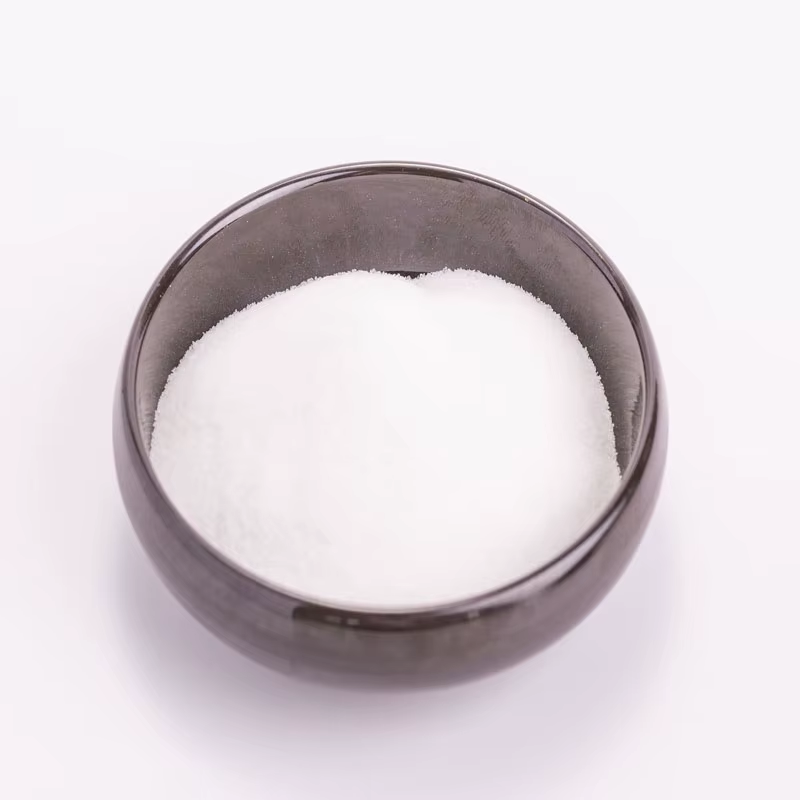
When your factory’s production lines depend on the subtle interplay of ingredients to deliver consistent texture, stability, and performance, sourcing matters as much as specification. Sorbitan Tristearate E492 Exporter isn’t simply a way to buy an emulsifier — it represents a strategic supply chain choice that influences product quality, regulatory compliance, and operational resilience. For manufacturers in bakery, confectionery, dairy blends, and specialty emulsified foods, the right exporter can mean the difference between process disruption and predictable production outcomes.
At MT Royal, we work with industrial teams who value clarity, reliability, and deep technical support. In our collaboration with various factories, we have seen that the selection of a dependable Sorbitan Tristearate exporter — one who can deliver on documentation, logistics, and technical consistency — is as impactful as the formulation itself. Whether your products demand precise aeration profiles, stable fat crystal networks, or long shelf stability, E492 plays a vital role behind the scenes.
This article provides a professional, in‑depth exploration of Sorbitan Tristearate E492: what it is, how it works, common sourcing pitfalls, practical comparisons, industrial production tips, frequently asked questions from factory managers and procurement teams, and strategic insights that help you elevate your sourcing decisions.
Sorbitan Esters Emulsifier (E491–E495) – Fine Organics Exporter
Understanding Sorbitan Tristearate E492: Definitions and Core Concepts
What Is Sorbitan Tristearate E492?
Sorbitan Tristearate, designated as E492 under food additive classification systems, is a non‑ionic surfactant and emulsifier manufactured by esterifying sorbitol derivatives with stearic acid. Chemically, it features a hydrophilic (water‑attracting) region and a lipophilic (oil‑attracting) region, making it effective for stabilizing emulsions where oil and water phases coexist.
The number “E492” is part of the international food additive numbering system, and its widespread recognition in major regulatory frameworks — including the European Union, North America, and many Asian markets — makes it a global standard in industrial emulsification.
Functional Profile and Industrial Importance
At industrial scale, Sorbitan Tristearate’s primary functions include:
- Emulsion stabilization: Supports consistent dispersion of immiscible phases
- Control of fat crystallization: Critical in high‑fat bakery and confectionery
- Surface activity: Reduces interfacial tension in complex systems
- Texture and mouthfeel enhancement: Adds structure without harsh processing aids
- Extended shelf stability: Helps prevent phase separation over storage
E492’s versatility makes it valuable in products ranging from laminated doughs and bakery fats to fillers, icings, creams, and specialized food coatings. Its performance characteristics are distinct from other emulsifiers such as monoglycerides, lecithin, and polyglycerol esters — each with their own functional niches.
Industry Applications: Where Sorbitan Tristearate E492 Excels
Bakery and Dough Systems
In industrial bakery operations, Sorbitan Tristearate plays a role in:
- Improving dough handling and machinability
- Enhancing gas retention in high‑speed proofing lines
- Reducing staling and moisture migration
For cookie and pastry lines, E492 contributes to consistent spread behavior and controlled fat distribution — essential when ovens are running at peak capacity and small deviations can cause mass rejects.
Confectionery and Coatings
In confectionery, especially compound coatings and fat‑based glazes, E492 supports:
- Controlled crystallization of fats
- Shine and surface smoothness
- Reduced oil leakage under temperature variation
These functional benefits translate into fewer quality sorting episodes and higher yield on coated products.
Dairy and Frozen Desserts
Ice creams and frozen desserts benefit from stabilized fat networks and improved freeze–thaw behavior when Sorbitan Tristearate is part of the emulsifier system. It works synergistically with other stabilizers to maintain texture during cold storage and distribution.
Sauces and Dressings
In liquid emulsions like sauces, dressings, and functional beverages, E492 can contribute to:
- Consistent viscosity profiles
- Reduced phase separation
- Improved mouthfeel and sensory perception
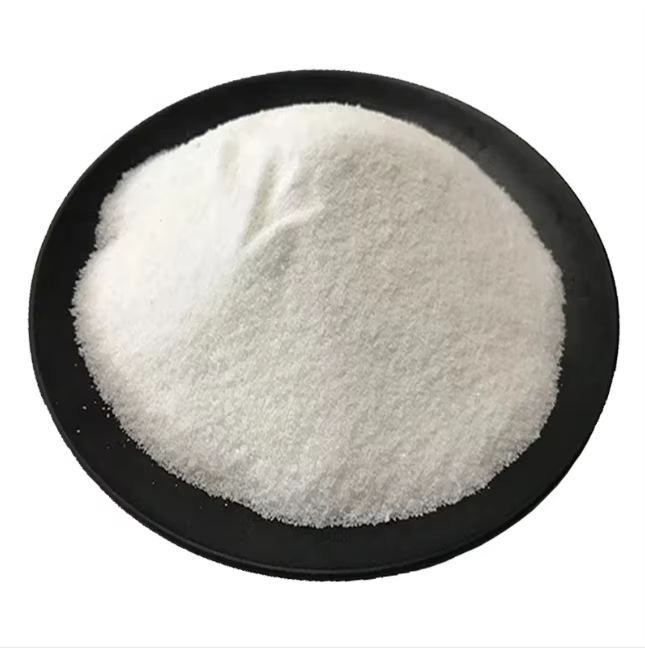
Why Choosing the Right E492 Exporter Matters
Selecting a reliable Sorbitan Tristearate E492 Exporter goes beyond buying product at competitive pricing. For industrial operations, the choice of exporter affects several strategic areas:
Consistency and Quality Assurance
Factories need raw materials that behave predictably. Variations in functional emulsifier performance — due to inconsistent fatty acid profiles or processing differences — can lead to batch variation, production downtime, and quality deviations. A reputable exporter ensures consistency through:
- Batch‑specific Certificates of Analysis (COA)
- Defined functional parameters such as HLB range and acid value
- Traceability to feedstock and manufacturing conditions
This consistency underpins your own quality assurance systems and reduces risk in high‑throughput production lines.
Regulatory Compliance and Documentation
Food additives are subject to complex regulatory frameworks globally. A trustworthy exporter supports your compliance efforts by providing:
- Regulatory certificates (EU, FDA, Codex where applicable)
- Allergen declarations
- Material Safety Data Sheets (MSDS)
- Detailed traceability and provenance documentation
Such documentation is not “nice to have”; it’s essential for audits, inspections, export certifications, and product registrations.
Supply Chain Reliability and Logistics Support
Unexpected delays, customs holdups, and logistical challenges can slow a production schedule and create stress for operations teams. A high‑performing exporter anticipates these risks, offering:
- Predictable lead times
- Logistics coordination and tracking
- Contingency planning
- Forecast alignment exercises
In our experience, proactive communication from a supplier is one of the hallmarks that separates a dependable partner from a transactional vendor.
Common Mistakes in Industrial Sourcing of E492
Understanding frequent missteps in sourcing allows you to anticipate and mitigate risks. Even seasoned procurement teams can fall into avoidable traps.
Mistake #1: Focusing Solely on Price Per Kilogram
While competitive pricing is important, it cannot be the sole determinant of supplier selection. Cheaper product that delivers variable functional performance often costs more in:
- Quality rejection
- Production inefficiencies
- Additional stabilizing agents
- Higher usage rates to compensate
Procurement must consider total cost of ownership (TCO), balancing cost with performance and reliability.
Mistake #2: Accepting Generic Documentation
Generic or non‑batch‑specific certificates do not provide the level of assurance required in regulated manufacturing environments. Always insist on:
- Batch‑specific Certificates of Analysis
- Clear functional performance markers
- Production and traceability data
These details help your QA team track performance and demonstrate compliance.
Mistake #3: Overlooking Logistics and Lead Times
Sorbitan Tristearate is often part of extended supply chains. Ignoring lead time variability, port congestion risks, and customs clearance challenges can lead to production delays. Work with suppliers who offer:
- Advance shipment notices
- Logistics tracking
- Contingency planning
Mistake #4: Assuming Interchangeability With Other Emulsifiers
Emulsifiers differ widely in HLB, solubility, thermal stability, and interaction with other components. Simply substituting E492 with a different additive without validation can cause drastic changes in product performance.
Comparative Analysis: Emulsifier Choices in Industrial Formulation
To help you evaluate where Sorbitan Tristearate fits among emulsifiers, here’s a practical comparison across functional criteria:
| Functional Attribute | Sorbitan Tristearate E492 | Sorbitan Monostearate E491 | Polyglycerol Esters E475 | Lecithin |
|---|---|---|---|---|
| Emulsion Stability | High | Moderate | Very High | Moderate |
| HLB Range Control | Precise | Lower | Adjustable | Broader |
| Fat Crystallization Support | Excellent | Good | Very Good | Fair |
| Freeze–thaw Performance | Very Good | Good | Good | Fair |
| Texture Enhancement | High | Moderate | High | Moderate |
| Application Flexibility | Wide | Moderate | Very Wide | Moderate |
| Regulatory Simplicity | High | High | High | Variable |
This comparison underscores that Sorbitan Tristearate delivers robust, stable emulsification across a range of industrial applications — particularly where fat‑rich systems or freeze–thaw resilience are critical.
Industrial Tips for High‑Volume Production
When scaling from pilot trials to full production, ingredients often behave differently under industrial conditions. Here are expert insights that support performance at scale.
Tip #1: Define Functional Benchmarks, Not Just Specifications
A functional benchmark may include:
- Stability under defined thermal stress
- Viscosity behavior post‑homogenization
- Consistency in droplet size distribution
- Interaction with other stabilizers
Your QA team should establish these targets in functional terms (e.g., percentage of phase separation after cycles) rather than purely compositional criteria.
Tip #2: Validate Supplier Documentation With Your Internal QA Protocols
Even with strong supplier documentation, cross‑validation helps ensure alignment. Incorporate:
- Independent laboratory tests
- Sensory and texture analyses
- Pilot batch stability runs
This dual validation builds internal confidence and supports production handoff.
Tip #3: Optimize Addition Points in Process Flow
Where and when you introduce Sorbitan Tristearate can influence its performance:
- Early integration during fat hydration ensures uniform dispersion
- Controlled shear environments improve interfacial coverage
- Temperature ramps influence emulsifier activation
Coordinate with your process engineers to align addition points with functional goals.
Tip #4: Monitor Stability Over Storage and Distribution Cycles
Products often face multiple environmental stressors between production and end use. Plan test cycles that simulate:
- Heat and humidity variation
- Freeze–thaw conditions
- Extended storage
Frequent monitoring keeps quality consistent and flags drift before it becomes costly.
Tip #5: Collaborate on Forecasting and Supply Planning
Industrial supply chains benefit from visibility. Share demand forecasts with your exporter partner, and work together to build inventory buffers that protect production schedules against market volatility.
Frequently Asked Questions From Industrial Teams
What Typical Usage Levels Are Recommended for E492?
Usage varies by application. Typical ranges include:
- Bakery fats and dough conditioners: 0.3–1.2%
- Ice cream and frozen desserts: 0.1–0.5%
- Emulsified sauces and dressings: 0.2–0.8%
- Confectionery coatings: 0.2–1.0%
Always validate these ranges through pilot trials in your specific formulation context.
How Do We Evaluate Supplier Quality Beyond Certificates?
Go beyond paperwork by:
- Conducting sensory evaluations
- Performing functional stability testing
- Monitoring performance across multiple production cycles
- Comparing lot‑to‑lot variation using analytical tools
This deeper analysis supports confident specification decisions.
Does E492 Require Special Labeling?
Regulatory labeling varies by market. In many regions, Sorbitan Tristearate appears as an emulsifier on ingredient lists, but your regulatory team should confirm specific labeling obligations for each territory.
Can Sorbitan Tristearate Improve Shelf Life?
Yes — by stabilizing emulsions and preventing phase separation, E492 contributes to consistent texture, reduced oil migration, and slower quality degradation over time.
How Should Bulk Sorbitan Tristearate Be Stored?
Best practices include:
- Cool, dry, climate‑controlled environments
- Sealed containers to prevent moisture uptake
- FIFO inventory rotation
- Protection from direct heat and light
Proper storage preserves functional performance and reduces waste.
Emerging Trends and Strategic Insights
The global landscape for emulsifiers and functional additives continues to evolve, driven by consumer expectations and regulatory shifts.
Trend: Demand for Cleaner Labels and Transparency
Consumers increasingly scrutinize ingredient lists and origins. Manufacturers benefit from supplier transparency regarding source, processing methods, and non‑GMO claims where relevant.
Trend: Multi‑Functional Ingredients in Simplified Formulations
Rather than stacking many functional additives, formulators seek more versatile ingredients. Sorbitan Tristearate’s broad performance across emulsion stability and texture enhancement aligns well with this trend.
Trend: Advanced Quality Control Tools
Factories with sophisticated analytical labs now use differential scanning calorimetry (DSC), particle size analysis, and rheometry to track emulsifier performance down to measurable functional outcomes.
Trend: Supply Chain Resilience Planning
Volatility in global logistics has pushed manufacturers to develop deeper relationships with exporters, diversify supply routes, and plan multi‑sourced procurement strategies.
Strategic Considerations When Partnering With a Sorbitan Tristearate Exporter
Your choice of Sorbitan Tristearate E492 exporter impacts quality, reliability, and competitive positioning. When you align procurement practices with technical requirements, documentation rigor, and supply chain resilience, your factory gains measurable advantages:
- Reduced variability in product performance
- Improved production scheduling and reliability
- Regulatory compliance confidence
- Enhanced formulation flexibility
We have seen that when manufacturers treat sourcing as a strategic partnership rather than a transactional purchase, the entire production ecosystem benefits — from R&D to QA to operations.
At MT Royal, we approach ingredient supply as an extension of your production strategy. We work with factories that demand clarity, consistency, and performance, and we align our supply commitments with your industrial goals. The right partner delivers not just materials, but predictability and peace of mind.
Sorbitan Tristearate E492 is a powerful tool in your formulation kit — but its true value is unlocked when supported by thoughtful sourcing, robust documentation, and seamless integration into your process flows.



No comment