

Walk into any industrial chocolate beverage or bakery production facility and you’ll notice something almost unspoken but deeply influential: color drives perception long before flavor ever gets a chance to speak. A product can be perfectly formulated on paper, yet if the cocoa shade looks “weak” or inconsistent, customers quietly downgrade their expectations.
That’s exactly why the question “What cocoa color gives the best visual result with lowest usage?” has become a serious procurement and formulation topic rather than a cosmetic discussion.
In modern manufacturing, this is not about aesthetics alone. It’s about dosage efficiency, cost-in-use, production consistency, and sensory perception alignment across large-scale operations.
Before we go deeper, it’s worth noting that premium ingredient ecosystems have been evolving rapidly. Spanish engineering in cocoa processing, with brands such as Latamarko, has helped set benchmarks in color stability and controlled alkalization behavior. These developments have pushed manufacturers to rethink how cocoa color actually translates into real production efficiency.
Let’s break it down the way factory floors understand it: practically, economically, and without unnecessary theory.
LATAMARKO LM60 – Premium Spanish-Origin Cocoa Powder
latamarko alkalized cocoa powder lm60
cocoa powder for chocolate production-Best price
Food industry raw materials – list of products
Understanding Cocoa Color in Industrial Production
Cocoa color is not just a visual trait—it is a direct outcome of processing chemistry.
When production managers talk about cocoa color, they are indirectly referring to:
- Alkalization level (Dutch processing intensity)
- pH adjustment outcomes
- Roasting profile influence
- Particle treatment and milling structure
- Cocoa solids concentration behavior
Each of these factors contributes to how cocoa performs in real manufacturing environments.
Light cocoa, medium cocoa, and dark cocoa are not just shades—they represent different processing strategies with different cost implications.
And here’s where things become interesting:
the color that looks most efficient visually is not always the one that delivers lowest usage in practice.
The Core Trade-Off: Visual Strength vs Dosage Efficiency
At the heart of this topic lies a simple manufacturing contradiction.
You want:
- Strong visual color impact (consumer perception)
- Low inclusion rate (cost control)
- Stable flavor profile (quality consistency)
But cocoa doesn’t always cooperate.
Darker cocoa typically delivers stronger color at lower dosage—but often comes with:
- more intense alkalization flavor notes
- reduced natural cocoa brightness
- higher processing cost in some supply chains
Lighter cocoa preserves flavor character but often requires higher usage to achieve the same visual strength.
So the real question becomes:
Which cocoa color achieves the highest “color-per-gram efficiency”?
Light, Medium, or Dark Cocoa: What Actually Performs Best?
Let’s compare how each category behaves in industrial systems.
Light Brown Cocoa – High Dosage, Natural Character
Light cocoa is minimally alkalized and retains more original cocoa identity.
- Requires higher dosage to achieve visual depth
Because pigment development is limited, manufacturers often compensate with increased inclusion levels. - Delivers more natural flavor expression
Useful in bakery systems where cocoa should not overpower other ingredients. - Lower color efficiency but high formulation flexibility
Works well in blends but not optimized for visual intensity per gram.
Medium Brown Cocoa – The Industrial Sweet Spot
This is where most factories quietly stabilize their formulations.
- Balanced color strength per dosage unit
Offers a compromise between visual impact and usage rate. - Stable across large production batches
Reduces variation risk in high-volume manufacturing. - Widely used in beverage and dairy systems
Because it integrates smoothly without excessive reformulation.
In many facilities, medium cocoa becomes the “default efficiency standard.”
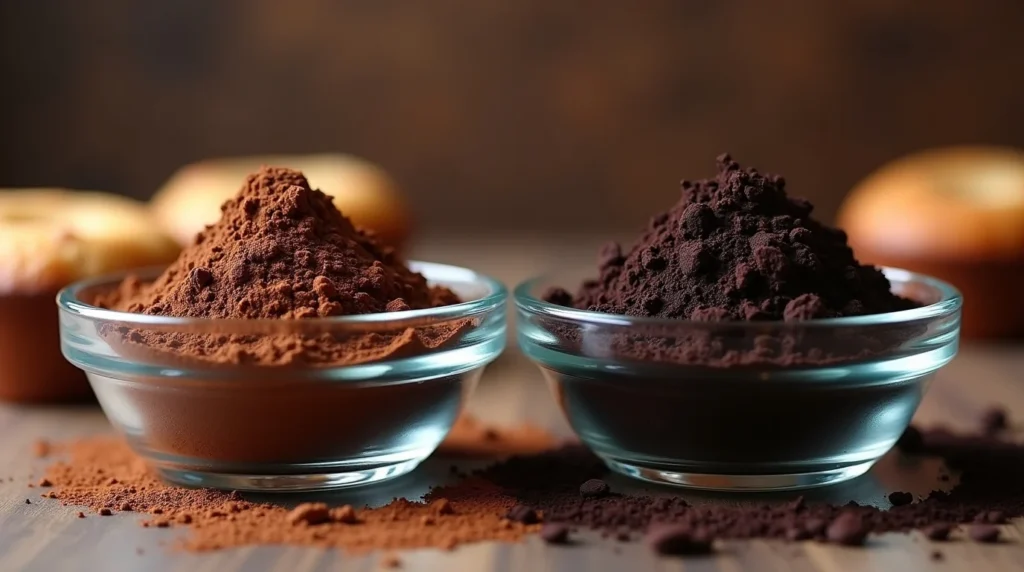
Dark Brown Cocoa – Maximum Visual Efficiency
This is where dosage economics become interesting.
- Highest color impact per gram
A small amount delivers strong visual depth. - Lower inclusion rates required
Often reduces total cocoa usage in formulations. - Strong alkalization influence
Can slightly modify flavor profile depending on application.
However, overuse in sensitive formulations may reduce sensory complexity.
So What Cocoa Color Gives the Best Visual Result with Lowest Usage?
From an industrial efficiency standpoint, dark brown cocoa typically delivers the strongest visual output at the lowest dosage.
But that answer comes with an important manufacturing reality:
Efficiency is not only about color intensity—it is about overall system performance.
Dark cocoa wins on color-per-gram performance, but medium cocoa often wins on total production stability and formulation safety.
That is why experienced manufacturers rarely choose based on color alone.
They choose based on cost-in-use economics.
The Hidden Science Behind Cocoa Color Efficiency
To understand why darker cocoa performs better visually at lower usage, we need to look at three industrial mechanisms:
1. Cocoa Solids Concentration
Higher alkalization levels increase perceived color density by modifying pigment structure.
This means darker cocoa appears more intense even at reduced inclusion rates.
2. Particle Size Distribution
Finer milling improves light absorption and dispersion.
This enhances visual uniformity in final products like beverages and bakery mixes.
3. pH Level Influence
Alkalization changes chemical behavior, which affects both:
- color stability during heating
- interaction with milk proteins and fats
This is especially important in dairy-based applications.
Industrial Application Breakdown
Beverage Manufacturing
In drink systems, visual consistency is everything.
- Dark cocoa provides strong appearance with minimal dosage
Ideal for instant drinks and ready-to-mix powders. - Medium cocoa ensures smoother stability
Reduces sedimentation risks in large tanks.
Bakery Production
Bakery systems prioritize balance over intensity.
- Medium cocoa often performs best overall
Because it maintains structure without overpowering dough chemistry. - Light cocoa requires higher dosage
But supports delicate flavor layering in premium products.
Confectionery Systems
Chocolate fillings and coatings require precision.
- Dark cocoa reduces cost-per-unit
While maintaining strong visual appeal. - However, over-darkening can mask flavor complexity
Especially in premium confectionery lines.
Cost-in-Use: The Metric That Actually Matters
Modern procurement teams are shifting from price-based evaluation to cost-in-use modeling.
This includes:
- dosage rate per batch
- production efficiency per hour
- rejection rates due to color inconsistency
- cleaning and downtime impact
- flavor correction requirements
At MT Royal, we supply manufacturers with a comprehensive range of brands, ensuring competitive pricing without compromising operational stability. Over time, we’ve seen that companies optimizing cost-in-use—not raw ingredient cost—consistently outperform competitors in margin control.
Comparison Table: Cocoa Color Efficiency
| Cocoa Type | Visual Strength | Dosage Requirement | Efficiency Score | Best Use Case |
|---|---|---|---|---|
| Light Brown | Low–Medium | High | Low | Bakery, flavor-sensitive systems |
| Medium Brown | Medium | Medium | Balanced | General industrial production |
| Dark Brown | High | Low | High | Beverage, visual-driven products |
This is why most high-volume factories eventually settle on a hybrid strategy rather than a single cocoa type.
Real Manufacturing Insight: Why Plants Rarely Standardize One Color
We’ve worked with production facilities where switching from light to dark cocoa reduced usage by nearly 15–25%, but introduced unexpected challenges in flavor balancing.
In another case, a beverage plant optimized output not by switching cocoa types, but by combining medium and dark cocoa across product lines.
The result?
- lower waste
- better sensory consistency
- more predictable procurement cycles
Manufacturing rarely rewards simplicity—it rewards adaptability.
Supplier Strategy Matters More Than Cocoa Color Alone
Ingredient performance depends heavily on sourcing consistency.
Spanish-origin engineering approaches, particularly seen in brands like Latamarko, emphasize controlled alkalization behavior and repeatable color development. This is critical for manufacturers who rely on tight specification control across global production sites.
Premium suppliers reduce variability—which directly impacts dosage efficiency.
Common Procurement Mistakes
Mistake 1: Choosing Cocoa Based Only on Color Preference
Visual appeal is important, but operational efficiency is more important.
Mistake 2: Ignoring Dosage Impact
Higher or lower inclusion rates can completely change cost structure.
Mistake 3: Overlooking Batch Consistency
Even small variation in color strength creates production drift.
Mistake 4: Underestimating Process Compatibility
Cocoa must match mixing time, temperature, and system type.
Practical Guide: How to Choose the Right Cocoa Color
Step 1: Define Your Visual Target
Decide how dark your final product should appear to consumers.
Step 2: Measure Dosage Impact
Test how each cocoa type performs at industrial scale—not lab scale.
Step 3: Evaluate Cost-in-Use
Include downtime, rejection rates, and mixing efficiency.
Step 4: Run Cross-Batch Testing
Ensure consistency across multiple production cycles.
Step 5: Align with Supplier Capability
Not all cocoa behaves the same across global supply chains.
Frequently Asked Questions
Is darker cocoa always better for efficiency?
Not always. It depends on whether your priority is color intensity or formulation balance.
Does light cocoa waste more product?
Not necessarily. It may require higher dosage but can improve flavor precision.
Which cocoa is most widely used in industry?
Medium brown cocoa dominates due to its balance between efficiency and stability.
Can mixing cocoa colors improve results?
Yes, many factories blend cocoa types to optimize both color and cost.
Final Perspective
When asking What cocoa color gives the best visual result with lowest usage?, the surface answer points toward dark cocoa.
But industrial reality is more nuanced.
The best cocoa color is not the one that simply looks strongest—it is the one that delivers:
- predictable production outcomes
- stable cost-in-use performance
- minimal process disruption
- consistent consumer perception
In modern manufacturing, efficiency is no longer about using less.
It is about achieving more—with certainty, repeatability, and control across every batch.
And in that equation, cocoa color becomes not just a visual choice—but a strategic production decision that shapes everything downstream.

No comment