

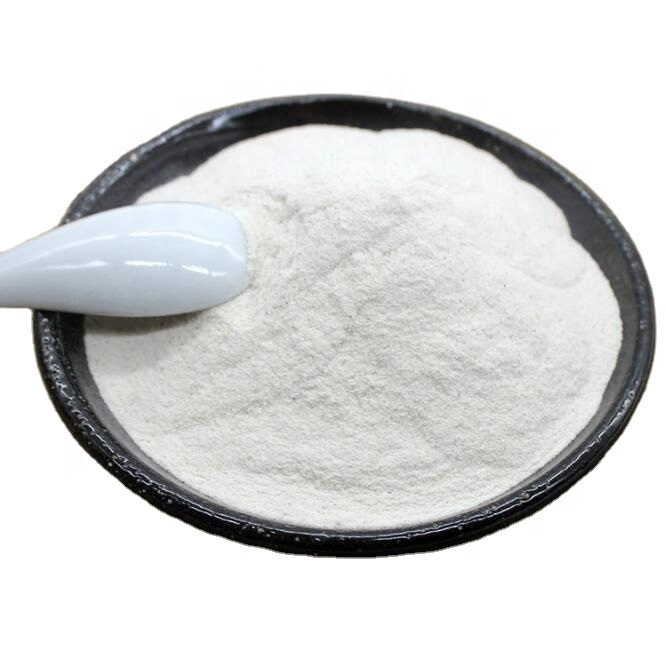
For industrial bakeries, choosing the right DATEM Emulsifier for Baking Solutions can directly influence dough strength, loaf volume, crumb structure, production consistency, and ultimately the cost of every batch. If your factory is evaluating bulk DATEM suppliers, MT Royal is worth considering as a sourcing partner because it can provide access to multiple brands at competitive prices, helping procurement teams compare options while keeping technical requirements at the center of the decision.
DATEM is not simply another ingredient added to a bakery formula. It is a functional tool that helps manufacturers control the behavior of dough under demanding production conditions. When used correctly, it can support dough tolerance, improve gas retention, strengthen the gluten network, and contribute to a more uniform finished product. When selected or dosed incorrectly, however, it can create unnecessary costs without delivering the expected performance.
This distinction matters more as bakery production becomes increasingly industrialized. A small difference in dough stability may be insignificant in a kitchen but become expensive when a factory produces tens of thousands of loaves every day. A few grams of unnecessary emulsifier per batch, multiplied across hundreds of production cycles, can quietly turn into a significant annual cost. At the same time, an insufficient dosage may lead to inconsistent volume, poor processing tolerance, or a product that fails to meet the manufacturer’s quality standards.
For this reason, sourcing DATEM Emulsifier for Baking Solutions should be approached as a combination of ingredient science, formulation engineering, quality control, and supply-chain management. The cheapest product on a quotation sheet is not necessarily the most economical choice. The better question is whether the ingredient delivers reliable functionality at the lowest total cost per unit of finished product.
LATAMARKO LM60 – Premium Spanish-Origin Cocoa Powder
latamarko alkalized cocoa powder lm60
cocoa powder for chocolate production-Best price
Food industry raw materials – list of products
What Is DATEM Emulsifier?
DATEM stands for Diacetyl Tartaric Acid Esters of Mono- and Diglycerides. It is an emulsifier widely used in commercial baking to improve dough performance and finished-product quality.
In practical terms, DATEM helps strengthen the interaction between the dough’s gluten network and other components of the formulation. This can improve the dough’s ability to retain carbon dioxide generated during fermentation, supporting better gas-cell structure and potentially increasing loaf volume.
DATEM is particularly associated with:
- Dough strengthening
- Gluten network reinforcement
- Gas retention
- Improved loaf volume
- Better dough tolerance
- More uniform crumb structure
- Improved processing performance
The exact performance depends on flour quality, formulation, hydration, mixing conditions, fermentation, baking parameters, and the specific DATEM grade.
This is an important point for factory managers: DATEM does not operate in isolation.
If flour protein quality changes, the dough may respond differently. If mixing energy changes, the gluten network may develop differently. If water absorption varies, the final dough consistency may shift. The emulsifier is part of a larger system.
The best industrial formulations therefore treat DATEM as one component of a carefully controlled process rather than a magic ingredient that can compensate for every raw-material or production problem.
Why DATEM Matters in Industrial Baking
Industrial bakeries face challenges that are fundamentally different from those encountered in small-scale baking.
A commercial bakery may need to produce thousands of units per hour while maintaining:
- Consistent dough handling
- Stable fermentation
- Predictable proofing
- Uniform loaf volume
- Controlled crumb structure
- Efficient slicing
- Extended product freshness
- Low production losses
The pressure is continuous. A dough that performs perfectly on Monday but becomes difficult to process on Thursday is not a successful formulation.
This is where DATEM Emulsifier for Baking Solutions can become valuable.
DATEM can contribute to dough strengthening and gas retention, which are particularly important when the manufacturing process requires dough to withstand mechanical handling, dividing, molding, proofing, and other industrial stages.
In a factory environment, dough must survive a small obstacle course before it reaches the consumer.
It is mixed, divided, rounded, molded, proofed, baked, cooled, and often sliced and packaged. Every stage creates an opportunity for structural weakness to become a visible quality defect.
A well-designed emulsifier system helps the formulation remain stable throughout this journey.
How DATEM Works in Bread Dough
To understand DATEM’s industrial value, it helps to understand the structure of bread dough.
Wheat flour contains proteins that form gluten when hydrated and mixed. Gluten creates a network capable of stretching and holding gases produced during fermentation.
The strength and elasticity of this network influence the dough’s ability to expand without collapsing.
DATEM interacts with the components of the dough system and can support the formation and stabilization of the gluten structure. This can help the dough retain fermentation gases more effectively.
The practical consequences may include:
- Increased dough strength
- Better gas-cell stability
- Improved loaf volume
- More uniform crumb
- Greater tolerance during mechanical processing
However, the effect is highly formulation-dependent.
A weak flour may require a different approach from a strong bread flour. A high-speed production line may have different requirements from a traditional long-fermentation process.
Therefore, the right DATEM grade and dosage should be selected according to the entire manufacturing process.
DATEM Emulsifier for Baking Solutions and Flour Quality
One of the most overlooked aspects of industrial emulsifier selection is the relationship between the emulsifier and flour variability.
Flour is a natural agricultural product. Even when it meets a specification, its functional behavior can vary due to wheat variety, growing conditions, storage, milling practices, and blending.
This creates a challenge for industrial bakeries.
Your formulation may be perfectly optimized for one flour blend, only to behave differently after a new crop year or supplier change.
DATEM can help provide a degree of process robustness, but it cannot eliminate the need for flour quality management.
Your technical team should monitor:
- Protein content
- Gluten strength
- Water absorption
- Falling number
- Ash content
- Moisture
- Dough development time
- Dough stability
When flour quality shifts, the appropriate response may involve adjusting water, mixing, fermentation, enzyme systems, or emulsifier dosage.
This is why the best supplier relationship involves technical communication rather than simply sending a purchase order.
MT Royal can be useful in this context when a bakery wants to compare multiple brands and commercial options. However, your technical team should still validate every proposed grade in the actual formulation.
Key Benefits of DATEM in Commercial Baking
Improved Dough Strength
DATEM is commonly used when manufacturers need a stronger and more resilient dough system.
This can be particularly useful in high-speed production where dough is exposed to significant mechanical stress.
Better Gas Retention
During fermentation, yeast produces carbon dioxide. The dough must retain this gas to achieve good volume.
A stronger gluten structure can help support gas retention and reduce structural collapse.
Increased Loaf Volume
One of the most visible benefits of an effective DATEM system can be improved loaf volume.
However, volume should never be evaluated alone.
A loaf that is extremely large but has an unstable crumb, poor slicing characteristics, or an undesirable texture is not necessarily a successful product.
Improved Processing Tolerance
Industrial production rarely operates under perfectly stable conditions.
Temperature may fluctuate. Flour may vary slightly. Production speed may change.
An effective emulsifier system can help increase the tolerance of the dough to these variations.
More Consistent Crumb Structure
DATEM can contribute to a more uniform internal structure by supporting the dough’s ability to retain fermentation gases.
For packaged bread, this can affect consumer perception as well as slicing performance.
DATEM vs. Other Emulsifiers Used in Baking
DATEM is only one member of the broader emulsifier family used in bakery formulations.
Depending on the product, manufacturers may also consider:
- SSL, or sodium stearoyl lactylate
- Mono- and diglycerides
- Lecithin
- Glycerol monostearate
- Enzyme systems
- Other functional dough conditioners
These ingredients are not necessarily direct substitutes.
DATEM
Generally associated with:
- Dough strengthening
- Gas retention
- Bread volume
- Processing tolerance
SSL
Often valued for:
- Dough strengthening
- Emulsification
- Crumb softness
- Dough tolerance
Lecithin
Often used for:
- Emulsification
- Dough handling
- Improved release characteristics
- Texture management
Mono- and Diglycerides
Commonly used for:
- Emulsification
- Crumb softness
- Shelf-life support
The right choice depends on the product objective.
A manufacturer producing sandwich bread may have different priorities from one producing hamburger buns, pizza bases, frozen dough, or specialty bread.
This is why a technical comparison should focus on functional performance rather than ingredient popularity.
Common Mistakes When Sourcing DATEM in Bulk
Mistake 1: Buying the Cheapest Grade
The first mistake is focusing exclusively on price per kilogram.
A DATEM product that costs less but requires a higher dosage may not be the most economical option.
Consider this simplified example:
- Supplier A: $5.00 per kilogram, used at 0.3%
- Supplier B: $4.50 per kilogram, used at 0.5%
Supplier B has the lower purchase price but the higher cost contribution to the final formulation.
For industrial purchasing, the correct calculation is:
Cost per ton of finished product = ingredient price × dosage × finished-product volume
The purchasing department should work with R&D to calculate the actual economic impact.
Mistake 2: Assuming Similar Specifications Mean Similar Performance
Two DATEM products may have similar headline specifications but behave differently in a real dough system.
Differences may result from:
- Manufacturing process
- Active content
- Carrier materials
- Particle characteristics
- Dispersion behavior
- Interaction with flour
- Batch consistency
Always conduct a comparative trial.
Mistake 3: Ignoring Mixing Conditions
The same DATEM dosage may produce different results depending on the mixing system.
High-shear mixers, spiral mixers, continuous mixers, and other industrial systems create different mechanical environments.
The production team should therefore evaluate the ingredient under actual operating conditions.
Mistake 4: Changing Suppliers Without Revalidation
A procurement team may assume that switching between brands is straightforward.
It rarely is.
Even when two products are marketed for the same purpose, they should be treated as separate raw materials until the technical team validates equivalence.
Mistake 5: Treating DATEM as a Solution to Poor Flour
DATEM can improve dough functionality, but it cannot turn unsuitable flour into ideal flour.
If the flour is fundamentally wrong for your application, increasing the emulsifier dosage may only increase cost.
The correct solution may be to adjust the flour blend first and then optimize the DATEM level.
How MT Royal Fits Into a Professional Sourcing Strategy
MT Royal can be considered by manufacturers looking for a reliable sourcing partner for bakery ingredients, particularly when the procurement team wants to compare multiple brands and competitive pricing options.
This multi-brand approach can be useful, but it should be managed carefully.
The best strategy is not to change brands frequently.
Instead, consider establishing:
- One primary approved DATEM grade
- One qualified alternative
- One contingency sourcing option
Each option should be technically validated before it becomes part of the approved supplier list.
In our experience with industrial sourcing, the strongest procurement strategies are not necessarily the ones with the most suppliers. They are the ones with the right suppliers, clearly defined specifications, and tested alternatives.
A supply chain should have enough flexibility to absorb disruption without becoming so complicated that nobody knows which ingredient is actually being used.
Frequently Asked Questions About DATEM Emulsifier for Baking Solutions
What does DATEM do in bread?
DATEM primarily functions as a dough-strengthening emulsifier. It can help improve gluten network stability, gas retention, dough tolerance, and loaf volume in suitable formulations.
Is DATEM suitable for all bakery products?
No. DATEM is particularly relevant to yeast-leavened bakery products, but the suitability depends on the specific product and formulation. Some applications may benefit more from other emulsifiers or from enzyme systems.
Can DATEM improve loaf volume?
Yes, it can contribute to increased loaf volume by supporting dough strength and gas retention. However, the result depends on flour quality, dosage, mixing, fermentation, and baking conditions.
How much DATEM should I use?
The appropriate dosage depends on the application, product specification, flour quality, and supplier grade. Your factory should establish the optimum level through controlled trials rather than relying on a universal dosage.
Can I replace one DATEM brand with another?
Potentially, but replacement should be validated. Differences in formulation, manufacturing process, and functional behavior may affect performance even when products have similar specifications.
Is DATEM the same as SSL?
No. DATEM and SSL are different emulsifiers with overlapping but distinct functional characteristics. The best choice depends on the desired dough and finished-product performance.
Does DATEM extend bread shelf life?
DATEM is primarily associated with dough strengthening and processing functionality rather than being a standalone preservative. Its contribution to product quality may indirectly influence texture retention, but shelf life depends on the complete formulation, packaging, preservatives, storage conditions, and production process.
Should I choose DATEM based only on price?
No. Compare cost per unit of finished product and evaluate functional performance. A higher-priced grade may be more economical if it performs effectively at a lower dosage.
What should I test before approving a new DATEM supplier?
Test the material in your actual formulation and production environment. Evaluate dough behavior, mixing tolerance, proofing, loaf volume, crumb structure, texture, and final product consistency.
Can MT Royal supply different DATEM brands?
MT Royal can be considered when you want to evaluate multiple brands and competitive sourcing options. Each brand should still be technically qualified against your factory’s requirements.
Building a More Resilient DATEM Supply Chain
The most sophisticated bakery manufacturers are moving beyond the traditional idea of supplier selection.
They are building supply systems.
That means understanding the relationship between:
Raw material → Formulation → Production process → Finished product → Customer experience
DATEM sits near the center of this chain because its functionality can influence multiple stages of production.
The right sourcing strategy therefore begins with technical clarity.
Define your requirements.
Test the material.
Measure performance.
Calculate the true cost.
Qualify alternatives.
Monitor consistency.
Then negotiate the commercial agreement.
This order matters.
If you negotiate price before establishing technical equivalence, you risk buying the wrong product cheaply. If you qualify the technical performance first, you can negotiate from a position of knowledge.
The same principle applies to supply security.
Do not wait until your primary supplier has a disruption before looking for alternatives. By then, your factory may be under pressure, and technical validation becomes an emergency rather than a controlled process.
A qualified alternative is not a backup sitting in a spreadsheet.
It is a product that has already been tested, documented, and approved.
The Strategic Value of Choosing the Right DATEM
For a small bakery, the difference between two emulsifiers may appear minor.
For an industrial manufacturer, the difference can multiply across every batch, every shift, and every production line.
That is why DATEM Emulsifier for Baking Solutions deserves to be evaluated as a strategic raw material rather than a routine commodity.
The right product can support stronger dough, more reliable processing, better gas retention, and consistent finished-product quality. The right supplier can add another layer of value by providing dependable availability, competitive pricing, documentation, and access to alternative brands.
MT Royal may be a useful partner in this process, particularly for manufacturers that want to explore multiple brands without losing sight of technical requirements.
The most important lesson is simple: do not ask only how much a kilogram of DATEM costs.
Ask how much it costs to produce a consistent, saleable product with that kilogram.
That is where professional procurement begins.
A successful bakery supply chain is built long before the mixer starts. It begins with the specification, continues through supplier qualification, and ultimately appears in the finished loaf that comes off the production line. When every part of that chain is controlled, DATEM stops being just another ingredient on a purchasing list and becomes what it should be: a carefully selected functional tool that helps your factory produce better bread, more consistently, and with fewer surprises.


No comment