

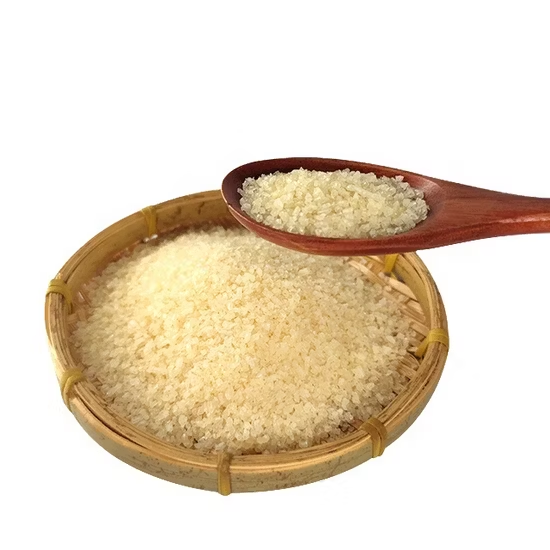
Choosing the right Halal Gelatin for Confectionery Industry applications is a decision that reaches far beyond religious compliance. For confectionery factories, gelatin affects texture, elasticity, gel strength, processing behavior, shelf stability, and ultimately the eating experience that customers associate with a brand. At the same time, Halal certification can determine whether a product is accepted in important domestic and international markets.
For manufacturers looking to source reliable gelatin, MT Royal can be considered as a practical supply partner offering access to multiple brands at competitive prices. This is particularly useful for factories that need to compare gelatin grades according to Bloom strength, viscosity, application performance, certification, and commercial requirements rather than choosing solely on price.
The confectionery industry has little patience for inconsistent raw materials. A small variation in gelatin can turn a perfectly balanced gummy into something noticeably softer, firmer, stickier, or less elastic. The production line may continue running, but the product coming out at the other end tells a different story.
For this reason, selecting Halal Gelatin for Confectionery Industry applications requires a careful balance between technical performance and verified sourcing. Manufacturers need an ingredient that performs consistently, satisfies certification requirements, and can be supplied reliably at commercial scale.
What Is Halal Gelatin?
Gelatin is a protein-based ingredient produced through the controlled processing of collagen-rich animal raw materials. It is widely used in confectionery because of its ability to form gels and contribute elasticity, structure, binding, stabilization, and texture.
The term “Halal gelatin” refers to gelatin that complies with applicable Islamic dietary requirements.
However, not all gelatin sources are automatically Halal.
Gelatin may be derived from:
- Bovine sources
- Porcine sources
- Fish sources
Porcine gelatin is generally unsuitable for Halal-certified products. Bovine gelatin may be acceptable when the relevant sourcing and slaughter requirements are met and appropriate certification is available. Fish gelatin may also be suitable depending on the species and certification requirements.
For confectionery manufacturers, this distinction is fundamental.
If your factory produces gummies, marshmallows, jelly candies, or other gelatin-based products for Halal markets, the raw material must be selected with both technical performance and religious compliance in mind.
LATAMARKO LM60 – Premium Spanish-Origin Cocoa Powder
latamarko alkalized cocoa powder lm60
cocoa powder for chocolate production-Best price
Food industry raw materials – list of products
Why Halal Gelatin Matters to the Confectionery Industry
The global confectionery market is increasingly segmented by consumer preferences, dietary requirements, religious considerations, and premium product positioning.
For manufacturers, Halal certification can open access to:
- Muslim-majority markets
- Halal-certified retail channels
- International export markets
- Ethnic and specialty food segments
- Consumers seeking verified ingredient sourcing
But Halal compliance is not simply a marketing label.
It is a supply-chain responsibility.
A confectionery manufacturer may have a fully Halal-compliant production facility, but if the gelatin used in its gummies is not appropriately sourced and certified, the finished product may not meet its intended market requirements.
This is why the procurement process should involve purchasing, quality assurance, R&D, and regulatory teams.
In our collaboration with different manufacturing environments, we have seen that the most reliable sourcing decisions occur when certification requirements are defined before commercial negotiations begin.
The Role of Gelatin in Confectionery Manufacturing
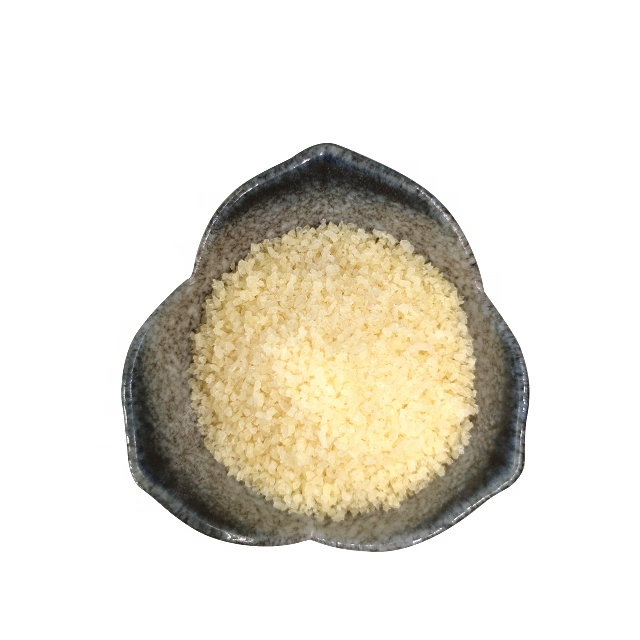
Gelatin is valued in confectionery because it provides a combination of properties that can be difficult to replicate with a single alternative ingredient.
Depending on the formulation, gelatin can contribute to:
- Gel formation
- Elasticity
- Chewiness
- Texture
- Foam stabilization
- Binding
- Film formation
- Moisture management
These characteristics make gelatin particularly useful in products where texture is central to consumer perception.
A gummy candy, for example, is not simply a sweetened gel.
Its texture is the result of a complex interaction between gelatin concentration, Bloom strength, sugar solids, water activity, acids, flavors, processing temperatures, and drying conditions.
Change one variable, and the entire system may shift.
This is why a gelatin supplier should be evaluated based on actual production performance rather than simply on a specification sheet.
Important Technical Specifications for Halal Confectionery Gelatin
Bloom Strength
Bloom strength is one of the most important technical parameters when selecting gelatin for confectionery.
It indicates the strength of the gel formed under standardized testing conditions.
Different confectionery products require different gel profiles.
A firm gummy may require a higher Bloom gelatin, while another product may need a softer and more flexible texture.
However, a higher Bloom value is not automatically better.
The correct choice depends on the desired final product and the amount of gelatin used.
For example, using a high-Bloom gelatin at an inappropriate dosage could produce a texture that is overly firm or rubbery.
The objective is to find the right balance between gel strength and formulation economics.
Viscosity
Viscosity influences the behavior of gelatin solutions during processing.
It can affect:
- Flow
- Mixing
- Pumping
- Depositing
- Gel formation
- Final texture
In high-volume confectionery plants, these factors matter because the ingredient must perform consistently not only in a laboratory beaker but also in large industrial mixing and depositing systems.
Solubility and Hydration
Gelatin must be properly hydrated and dissolved before it can perform effectively.
Factors such as:
- Particle size
- Water temperature
- Hydration time
- Concentration
- Mixing conditions
can influence its behavior.
Poor hydration can lead to undissolved particles, inconsistent texture, or process instability.
Color and Odor
For many confectionery applications, gelatin’s sensory profile should be considered.
Excessive color or odor may influence the appearance or flavor perception of light-colored products.
This can be especially important for premium gummies and delicate-flavored confectionery.
Microbiological Quality
Food safety is critical.
Manufacturers should evaluate relevant microbiological parameters and ensure that the gelatin meets their internal quality specifications and applicable food regulations.
The exact requirements will vary by market and application.
Halal Certification: What Confectionery Manufacturers Should Verify
One of the most important sourcing mistakes is assuming that “bovine” automatically means “Halal.”
It does not.
If your factory requires Halal-certified gelatin, you should verify:
- The animal source
- Slaughter requirements
- Processing conditions
- Manufacturing facility
- Certification body
- Certificate validity
- Exact product coverage
- Traceability
Certification requirements can vary by market and certifying organization.
A document that looks valid at first glance may not cover the exact product or manufacturing site you are purchasing from.
For this reason, your quality department should review the documentation before the supplier is approved.
If your factory exports to multiple countries, it is also important to verify whether the certification is recognized in each target market.
Common Mistakes When Sourcing Halal Gelatin
Mistake 1: Selecting Based Only on Price
Gelatin is a functional ingredient.
Its cost should be evaluated in relation to performance.
A cheaper gelatin may require a higher dosage or create inconsistent texture.
The real calculation should consider:
Effective cost = price per kilogram × required dosage + production impact
This gives a more realistic comparison.
Mistake 2: Treating All Bovine Gelatin as Equivalent
Bovine gelatin products can vary in:
- Bloom strength
- Viscosity
- Particle size
- Color
- Odor
- Moisture
- Processing behavior
Two suppliers may offer “bovine gelatin” while providing products with very different performance.
Mistake 3: Ignoring Certification Scope
A supplier may have Halal certification, but that does not automatically mean every product is covered.
Check the exact scope.
Mistake 4: Skipping Production Trials
Laboratory samples are useful, but production trials are essential.
A gelatin that performs well in small-scale testing may behave differently in industrial processing.
Mistake 5: Changing Multiple Variables at Once
When switching suppliers, do not simultaneously change your sugar system, acid level, cooking temperature, and gelatin grade.
Otherwise, troubleshooting becomes a guessing game.
Change one major variable at a time.
How to Choose the Right Halal Gelatin Supplier
A reliable supplier should be evaluated across several categories.
Technical Capabilities
The supplier should understand:
- Bloom strength
- Viscosity
- Application requirements
- Confectionery processing
- Product consistency
Documentation
Look for clear access to:
- Technical specification sheets
- Certificates of Analysis
- Halal certification
- Safety documentation
- Origin information
- Traceability records
Supply Capacity
A supplier must be able to support your required volume.
Ask about:
- Monthly capacity
- Minimum order quantity
- Lead time
- Stock availability
- Packaging
- Export logistics
Commercial Flexibility
Multiple brands can provide valuable alternatives.
MT Royal offers access to multiple brands and competitive prices, which can be useful for manufacturers seeking different sourcing options based on technical and commercial requirements.
The goal is not to buy from the largest possible number of brands. It is to maintain enough flexibility to avoid unnecessary dependence on one source.
Specialized Applications of Halal Gelatin in Confectionery
Gummy Candies
Gummies are among the most technically demanding gelatin-based confectionery products.
The gelatin system must work with:
- Sugar
- Glucose syrup
- Water
- Acids
- Flavors
- Colors
The final product must deliver the intended firmness, chewiness, elasticity, and shelf stability.
Small changes in gelatin concentration or Bloom strength can significantly influence the finished product.
Marshmallows
Gelatin contributes to the structure and stability of marshmallow foam.
The gelatin must support the desired texture without making the product excessively firm.
Processing conditions are also important because aeration and gel formation must work together.
Jelly Confectionery
Jelly products require controlled gel formation and stable texture.
Gelatin selection should be aligned with the desired bite and storage conditions.
Functional Gummies
The growing popularity of functional gummies has created new formulation challenges.
Manufacturers may need to combine gelatin with:
- Vitamins
- Minerals
- Botanical extracts
- Active ingredients
Some active compounds can influence pH, flavor, color, or gel stability.
Therefore, compatibility testing is essential.
Industrial Tips for Large-Scale Confectionery Production
Standardize Hydration Conditions
Your factory should establish consistent hydration procedures.
Control:
- Water temperature
- Hydration time
- Mixing speed
- Concentration
Small deviations repeated across large batches can eventually create noticeable variation.
Monitor Gelatin Dosage Carefully
Automatic dosing systems should be calibrated regularly.
A small dosage error may have a disproportionate impact on texture.
Control Temperature
Gelatin is sensitive to processing temperature.
Your production team should establish a controlled temperature profile that supports dissolution without unnecessarily damaging the desired functional properties.
Monitor pH
Acidification is common in many gummy and jelly formulations.
However, pH should be controlled carefully because extreme conditions can influence gelatin performance.
Track Batch Performance
Maintain records for:
- Gel strength
- Texture
- Processing time
- Drying behavior
- Final moisture
- Water activity
This data can help identify trends before they become major production problems.
Why Multi-Brand Sourcing Can Help Confectionery Factories
One of the practical advantages of working with a supplier that offers multiple brands is flexibility.
Different gelatin manufacturers may offer different:
- Bloom ranges
- Viscosity profiles
- Packaging sizes
- Lead times
- Prices
- Production capacities
This allows procurement teams to build a more resilient supply strategy.
However, alternative brands should be technically qualified in advance.
A factory should maintain an approved supplier matrix identifying which products are interchangeable and which require formulation adjustments.
In our experience, the strongest supply strategies are not based on having dozens of suppliers. They are based on having a small number of qualified suppliers that can reliably meet predefined specifications.
Emerging Trends in Halal Confectionery
The Halal confectionery market is influenced by several broader consumer trends.
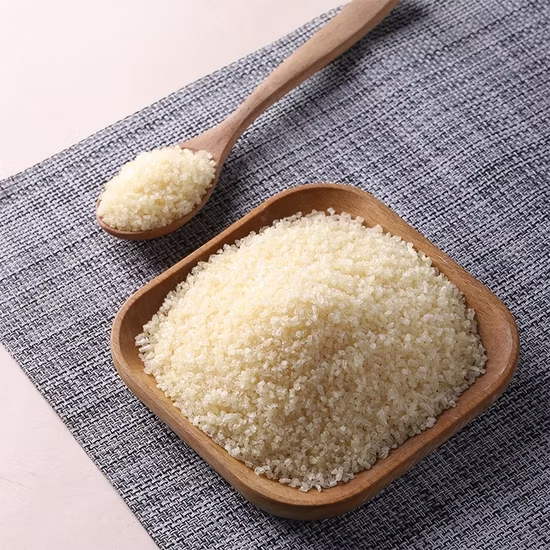
First, Halal certification is becoming increasingly important in international trade.
Manufacturers are no longer targeting only traditional Muslim-majority markets. Halal-certified products are increasingly relevant to global brands seeking access to diverse consumer segments.
Second, clean-label positioning is becoming more important.
Consumers want shorter ingredient lists and greater transparency.
Third, functional confectionery is expanding.
Gummies are increasingly used to deliver vitamins, minerals, and other functional ingredients.
Fourth, supply-chain transparency is becoming a competitive advantage.
Manufacturers are increasingly expected to demonstrate where animal-derived ingredients originate and how they are processed.
These trends are making gelatin sourcing more strategic than ever.
Frequently Asked Questions About Halal Gelatin for Confectionery
Is bovine gelatin always Halal?
No.
Bovine origin alone does not guarantee Halal compliance. Appropriate sourcing and certification must be verified.
Can Halal gelatin be used in gummy candies?
Yes. Halal-certified bovine gelatin is widely used in many confectionery applications, including gummies, provided the grade meets the required technical specifications.
What Bloom strength is best for gummies?
The appropriate Bloom value depends on the desired texture, formulation, and dosage.
A technical trial is the best way to determine the optimal grade.
Can I replace porcine gelatin with bovine gelatin directly?
Not always.
Even if both products have similar Bloom values, differences in viscosity and processing behavior may require formulation adjustments.
Is fish gelatin a better alternative?
Not necessarily.
Fish gelatin can be suitable for certain applications, but bovine gelatin may provide different functional performance and commercial advantages.
The choice depends on your specific product.
How do I verify Halal certification?
Request the current certificate and verify the certifying organization, product scope, manufacturing facility, and validity.
Can one gelatin grade be used for all confectionery products?
Generally, no.
Different products may require different functional properties.
Should I test gelatin before placing a bulk order?
Absolutely.
Conduct laboratory testing and, ideally, a controlled production trial before approving a large commercial purchase.
How to Build a Reliable Halal Gelatin Supply Strategy
A successful approach to sourcing Halal Gelatin for Confectionery Industry applications should combine four elements:
Verified certification + technical performance + supply reliability + commercial efficiency
If one of these is missing, your sourcing strategy may become vulnerable.
A certified product that performs poorly will create manufacturing problems.
A technically excellent gelatin without appropriate certification may not meet market requirements.
A competitively priced product that cannot be supplied consistently can interrupt production.
And a reliable supplier with uncompetitive pricing may gradually erode your margins.
The objective is balance.
MT Royal can be considered as a sourcing option for manufacturers seeking multiple gelatin brands at competitive prices. This can help procurement teams evaluate different alternatives while maintaining a more flexible purchasing strategy.
We believe the most effective sourcing decisions begin with clear specifications.
Before contacting suppliers, define your target Bloom range, viscosity, certification requirements, application, annual consumption, packaging needs, and delivery schedule.
Then compare suppliers against those criteria.
This process turns procurement from a price-shopping exercise into a technical and commercial evaluation.
For confectionery manufacturers, Halal gelatin is not simply a compliance requirement. It is a functional ingredient that directly influences the product consumers experience.
The right gelatin can help you achieve the texture your R&D team designed, the consistency your production team expects, and the certification your customers require.
The wrong one can create a chain reaction of problems that begins with a small variation in a raw-material specification and ends with a very large production headache.
That is why the smartest factories do not ask only, “How much does this gelatin cost?”
They ask:
“Where does it come from?”
“Is it properly certified?”
“Will it perform consistently?”
“Can the supplier support our growth?”
“Can we rely on the next shipment as much as the last one?”
Those questions lead to better sourcing decisions—and ultimately to better confectionery products.
When your gelatin supply is technically sound, properly certified, and commercially reliable, the production line can do what it does best: turn carefully controlled ingredients into products that customers genuinely want to buy again.


No comment