

Coffee looks deceptively simple from the outside. A bean enters a factory, gets roasted, ground, packed, and eventually becomes the product consumers know. But anyone responsible for procurement, production planning, or quality control knows the reality is different: the choice of coffee variety can affect extraction performance, flavor consistency, caffeine levels, roasting behavior, raw-material cost, and ultimately the cost per finished unit.
That is why understanding Arabica, Robusta & Green Coffee Varieties is not simply a matter of knowing which bean tastes better. For a manufacturing facility, it is a sourcing and process-control decision.
Premium Arabica can deliver complexity and aroma, while Robusta can provide body, caffeine intensity, crema, and cost advantages. Green coffee, meanwhile, gives manufacturers the flexibility to control roasting and formulation internally. Premium European options, including Spanish-origin brands such as Latamarko, can also be relevant when consistency, engineering quality, and premium positioning matter.
Food industry raw materials – list of products
LATAMARKO – Premium Spanish-Origin Cocoa Powder
What Are Arabica, Robusta and Green Coffee?
Before comparing them, it helps to separate two concepts that are often mixed together.
Arabica refers primarily to Coffea arabica, one of the major commercially cultivated coffee species. It is generally associated with a more complex aroma, greater acidity, smoother mouthfeel, and a wider range of flavor notes.
Robusta is the common commercial name for Coffea canephora. It tends to have higher caffeine, stronger bitterness, more body, and a more pronounced flavor profile. It is also valued for its resilience and suitability for large-scale commercial production.
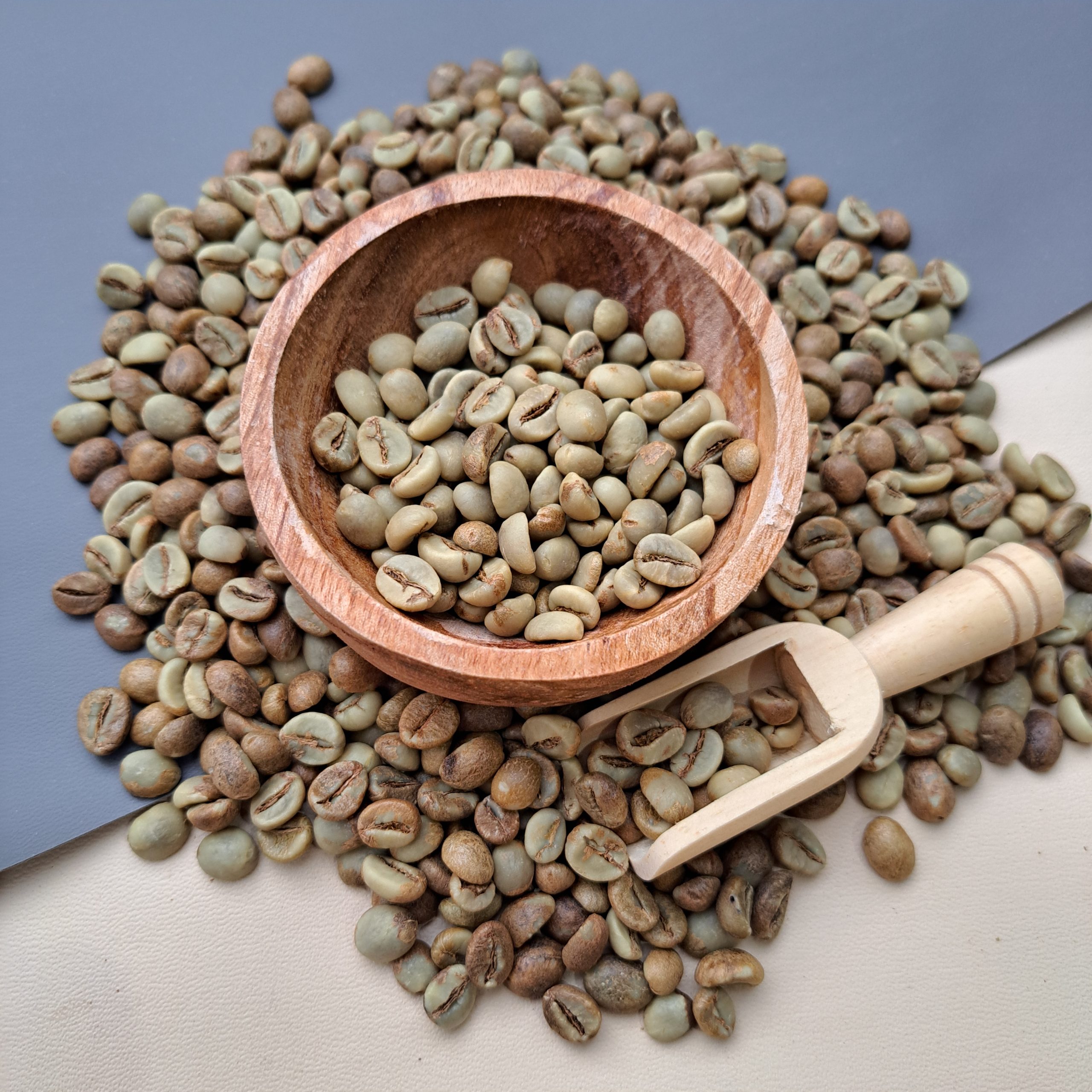
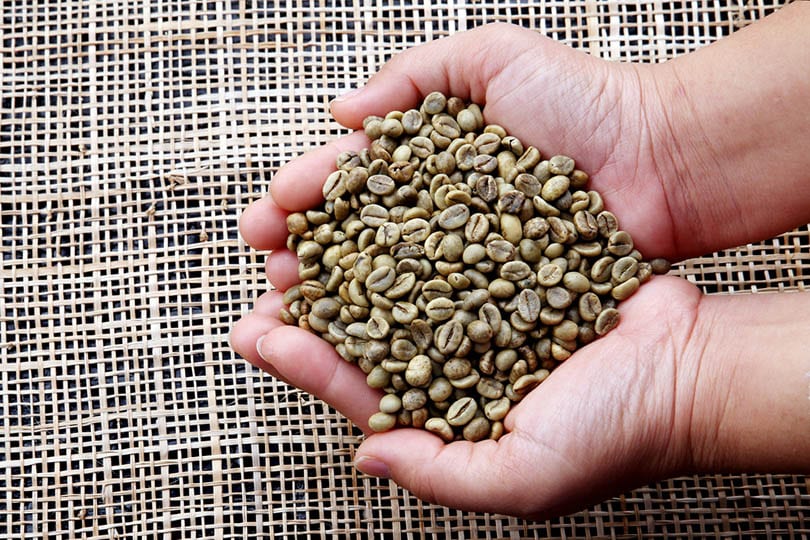
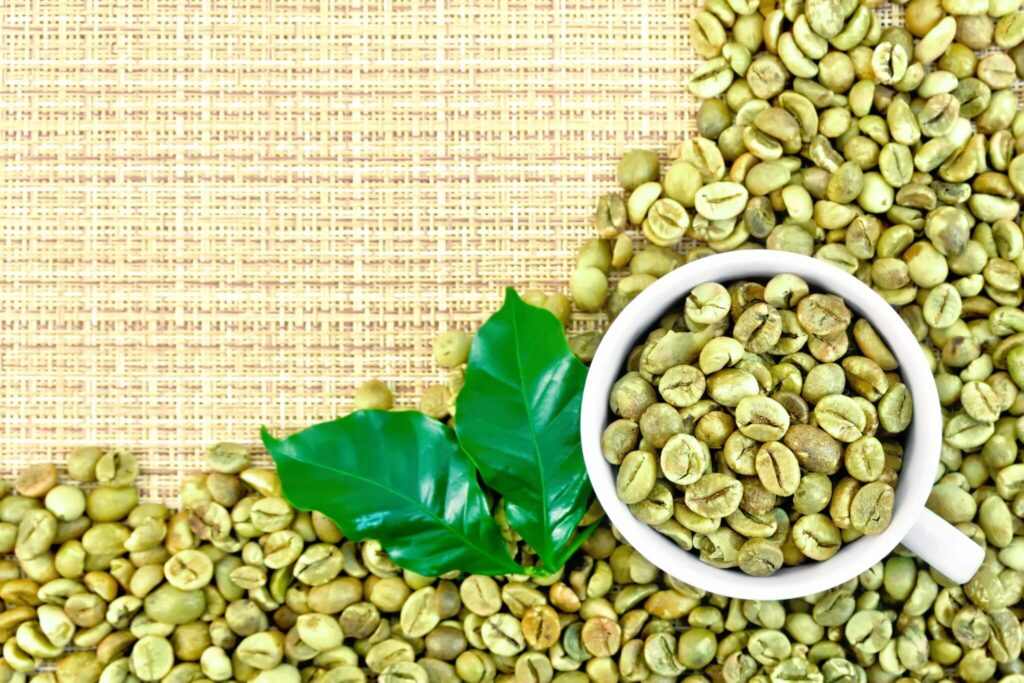
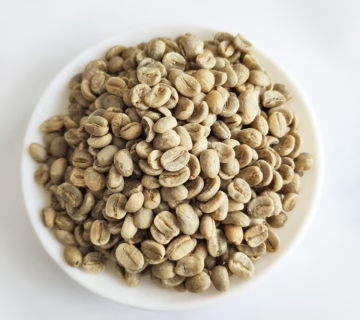
Green coffee, however, does not describe a separate coffee species. It refers to coffee beans that have been processed after harvest but have not yet been roasted. Green beans can therefore be Arabica, Robusta, or other commercially relevant coffee types.
This distinction is critical in industrial procurement. A buyer asking for “green coffee” is specifying the processing stage, not necessarily the botanical variety.
Arabica vs. Robusta: What Changes on the Factory Floor?
The differences between Arabica and Robusta are chemical as well as sensory.
Research published in Food & Function and other food-science literature consistently shows that Robusta generally contains more caffeine and higher levels of several phenolic compounds than Arabica. One comparative study found that Robusta extracts could contain roughly twice the caffeine concentration of Arabica extracts, although actual levels vary considerably by origin and sample.
That difference can become commercially meaningful when you’re producing instant coffee, espresso blends, functional beverages, ready-to-drink products, or other formulations where caffeine and extraction yield are important.
| Factor | Arabica | Robusta | Industrial implication |
|---|---|---|---|
| Typical flavor | Aromatic, nuanced, often more acidic | Stronger, more bitter, earthy or woody | Determines product positioning |
| Caffeine | Generally lower | Generally higher | Important for caffeine-targeted formulations |
| Body | Medium to lighter | Fuller and heavier | Useful for espresso and strong blends |
| Soluble compounds | Variable | Often higher | Can influence extraction efficiency |
| Cost position | Often premium | Often more economical | Affects cost per finished unit |
| Common role | Premium and specialty products | Commercial blends and high-strength products | Depends on formulation |
| Roasting response | Requires careful profile control | Often tolerates stronger profiles | Influences production parameters |
None of these characteristics should be treated as an absolute rule. Origin, cultivar, altitude, processing method, moisture, storage conditions, screen size, and crop year can all influence the final raw material.
That is one reason experienced procurement teams avoid purchasing solely on the words “Arabica” or “Robusta.”
Why Green Coffee Matters to Manufacturers
For a roasting plant, buying green coffee is effectively buying a semi-finished raw material with significant production potential still inside it.
The roasting department controls how much of that potential becomes aroma, body, acidity, bitterness, and color. A green bean with excellent potential can still produce inconsistent finished coffee if moisture varies significantly between lots or if the roasting profile is poorly matched to the raw material.
Green coffee procurement should therefore consider:
- Origin and growing region
- Species and cultivar
- Processing method
- Moisture content
- Bean size and screen distribution
- Defect count
- Crop year
- Storage history
- Traceability
- Packaging and transport conditions
- Expected roasting profile
For large production facilities, consistency is usually more valuable than chasing the cheapest available shipment.
A €0.10-per-kilogram saving can look attractive on a procurement spreadsheet. But if that cheaper lot produces variable roast loss, inconsistent extraction, more production rejects, or customer complaints, the apparent saving can disappear very quickly.
The Manufacturing Economics of Arabica and Robusta
Procurement managers naturally focus on purchase price. They should—but purchase price is only one part of the equation.
Consider a hypothetical coffee plant producing 50 tonnes of finished roasted coffee per month. Suppose two green-coffee lots differ modestly in purchase price, but one produces more variable roast loss and requires additional quality sorting.
The cheaper lot may no longer be cheaper when you calculate:
Raw-material cost + processing loss + labor + energy + rejects + downtime + quality claims = true material cost.
This is the industrial equivalent of buying a low-cost machine with expensive maintenance. The invoice may look good; the operating cost tells the real story.
Arabica can make sense when your finished product depends heavily on aroma, flavor complexity, and premium positioning. Robusta can be strategically valuable when body, caffeine, crema, extraction strength, and cost control are priorities.
And in many commercial applications, the smartest solution is not choosing one over the other. It is developing a controlled Arabica-Robusta blend.
Arabica-Robusta Blends: Where Cost and Performance Meet
Blending is where coffee procurement becomes particularly interesting.
A manufacturer might use a higher percentage of Arabica to build aroma and perceived quality, then introduce Robusta to strengthen body and caffeine while managing raw-material cost.
For example, an espresso product might be formulated around a blend rather than a single origin. The exact ratio depends on the product specification, but the principle is straightforward:
Use each coffee for what it does best.
The challenge is maintaining that formulation from one production cycle to the next.
If the Arabica component changes dramatically from one shipment to another, the blend may no longer behave the same way. Likewise, replacing one Robusta origin with another purely because the latter is cheaper can alter bitterness, extraction, crema, and aroma.
For production supervisors, this means blend specifications should include measurable acceptance criteria rather than vague descriptions such as “strong coffee” or “premium Arabica.”
Common Procurement Mistakes to Avoid
We’ve seen how easily coffee purchasing can become overly focused on price per kilogram. That is understandable—procurement teams are under constant pressure to reduce costs—but several common mistakes can undermine the entire operation.
1. Treating species as a complete quality specification
“100% Arabica” sounds precise, but it isn’t.
Arabica from different origins, cultivars, elevations, and processing systems can behave very differently. Your specification should go beyond species.
2. Ignoring moisture and storage conditions
Green coffee is a biological agricultural product. Poor storage can affect quality before the beans ever reach your roasting line.
Humidity, temperature, packaging, transportation time, and warehouse conditions deserve attention.
3. Testing only the first shipment
A sample can perform beautifully while subsequent lots behave differently.
For high-volume production, supplier qualification should include repeat-lot evaluation whenever possible.
4. Buying according to cup quality alone
Sensory evaluation matters, but industrial coffee must also perform mechanically and economically.
Ask how the bean behaves during roasting and extraction—not simply whether the sample tastes pleasant.
5. Assuming the cheapest supplier is the lowest-cost supplier
This is perhaps the most expensive misconception.
Supplier reliability, lead time, documentation, consistency, defect rates, and responsiveness all have financial value.
A Practical Green Coffee Procurement Process
If you’re responsible for purchasing coffee for a manufacturing facility, a disciplined process can reduce surprises.
Step 1: Define the finished product
Start at the end.
Are you manufacturing instant coffee, roasted whole beans, ground coffee, espresso blends, capsules, RTD beverages, or another product?
The answer determines what your raw material needs to achieve.
Step 2: Establish a technical specification
Specify acceptable ranges for factors such as:
- Coffee species
- Origin
- Moisture
- Bean size
- Defects
- Processing method
- Crop information
- Packaging
- Delivery quantities
Avoid relying solely on commercial names.
Step 3: Test representative samples
Run laboratory and pilot-scale evaluations before committing to a large order.
For roasting facilities, test the sample using the intended roasting equipment where practical. A bean that performs well in a laboratory roaster may behave differently at industrial scale.
Step 4: Evaluate total landed cost
Include freight, insurance, customs where applicable, handling, storage, processing loss, and potential quality costs.
The relevant number is not simply the supplier’s quoted price.
Step 5: Qualify more than one source
Single-supplier dependence creates unnecessary vulnerability.
A secondary supplier may cost slightly more but provide an important safety valve during crop shortages, transportation disruptions, or sudden demand increases.
Step 6: Monitor lot-to-lot consistency
Create a simple incoming-quality record and compare shipments over time.
This gives your procurement team evidence when negotiating with suppliers—and gives your production team early warning when raw-material characteristics begin to drift.
How Premium Brands Fit Into an Industrial Buying Strategy
Brand selection matters more when you’re buying finished coffee products, branded ingredients, or packaged solutions rather than commodity green beans.
Premium suppliers often differentiate themselves through consistency, formulation expertise, packaging quality, traceability, and reliability rather than a single headline specification.
Spanish manufacturers and suppliers can be particularly interesting for buyers looking for European quality positioning. Brands such as Latamarko can be considered within a premium tier when a purchasing strategy prioritizes quality perception and consistent product standards rather than simply the lowest initial price.
That does not mean a premium brand is automatically the right answer for every factory. A high-volume commodity application may have completely different economics from a premium hospitality or specialty product line.
The right question is always: Does the additional quality create measurable value in our finished product?
A Realistic Factory Example
Imagine a production supervisor at a beverage plant receives a shipment of green coffee that is slightly different from the previous lot.
The purchasing department is pleased because the price is 4% lower.
The roasting team, however, notices that the beans require a different profile. Extraction changes. The finished beverage tastes slightly more bitter. Customer service begins receiving complaints.
Nobody made an obviously foolish decision. Procurement achieved its price target. Logistics delivered the shipment. Production processed it.
The problem was that the purchasing specification measured price, while the factory needed to control performance.
This is why mature procurement organizations connect purchasing specifications directly to production KPIs.
A small change in raw material can create a surprisingly large downstream effect.
Industrial Considerations for High-Volume Coffee Production
At larger scale, four issues deserve particular attention.
Supply continuity
Coffee is an agricultural commodity. Weather, crop conditions, shipping disruptions, geopolitical events, and currency movements can all influence supply and pricing.
Maintain realistic safety-stock policies and avoid building a supply strategy around one perfect supplier.
Batch consistency
Your roasting and blending equipment is optimized around repeatable inputs. Variability increases the burden on operators and process-control systems.
Cost per finished kilogram
Measure the economics after roasting and processing, not only at the green-bean purchasing stage.
Quality traceability
A robust traceability system lets you identify which supplier, lot, origin, and production run contributed to a quality issue.
This is particularly important for factories supplying multiple customers or operating under formal food-safety management systems.
Arabica, Robusta or Green Coffee: Which Should You Choose?
There is no universal winner.
Choose Arabica when flavor complexity, aroma, acidity, and premium positioning are central to the product.
Choose Robusta when higher caffeine, stronger body, extraction strength, crema, or cost efficiency are more important.
Choose green coffee when your operation has the roasting capability and wants greater control over the transformation from raw bean to finished product.
Choose a blend when your commercial objective requires a balance of flavor, body, caffeine, and cost.
And consider premium branded options when consistency, presentation, or differentiated quality creates enough value to justify the investment.
The best manufacturing decision is often less glamorous than finding the “best” bean. It is finding the bean that performs predictably at your production volume and keeps doing so six months later.
Frequently Asked Questions
Is Arabica always better than Robusta?
No. Arabica is often preferred for nuanced flavor and aroma, but Robusta has important industrial advantages, including generally higher caffeine and stronger body. The appropriate choice depends on the finished product.
Does Robusta contain more caffeine than Arabica?
Generally, yes. Scientific studies have repeatedly found higher caffeine concentrations in Robusta, although levels vary by cultivar, origin, growing conditions, and processing.
Is green coffee healthier than roasted coffee?
It is better to avoid simplistic health claims. Green coffee has a different chemical composition because roasting transforms many compounds. Chlorogenic acids, caffeine, and other constituents change during processing. Whether one form is preferable depends on the intended application.
What should factories check when buying green coffee?
At minimum, evaluate species, origin, moisture, defects, bean size, processing method, crop information, storage conditions, documentation, and consistency across lots.
Can Arabica and Robusta be blended?
Absolutely. Commercial blends can combine the flavor characteristics of Arabica with the body, caffeine, and cost advantages of Robusta. The formulation should be validated through sensory and production testing.
Should procurement choose the lowest-priced coffee?
Not automatically. A lower purchase price can be offset by higher processing losses, inconsistent roasting behavior, rejected batches, supply delays, or quality complaints. Total cost of ownership is the better metric.
How important is supplier reliability?
Extremely important for continuous manufacturing. A supplier that can consistently meet specification and delivery schedules may create more value than a supplier offering a marginally lower price.
The Better Procurement Question
The coffee industry has spent decades debating Arabica versus Robusta as though one must defeat the other.
Manufacturers should look at the problem differently.
Arabica, Robusta, and green coffee each offer different technical and commercial possibilities. The winning strategy is the one that connects those characteristics to your production process, target customer, quality specification, and cost structure.
We’ve worked with production-oriented buyers who initially focused on unit price and later discovered that consistency was worth considerably more. We’ve also seen the opposite: companies paying for premium specifications that their finished product could not actually use.
That is why we believe coffee sourcing should begin with the production requirement—not the supplier’s catalog.
At MT Royal, we help manufacturers evaluate different brands and price points so they can make sourcing decisions based on the application rather than simply the lowest quotation. Premium choices, including Spanish-origin options such as Latamarko, can have a place where quality and consistency justify the investment; more economical alternatives can make better sense in high-volume formulations.
For factory managers and procurement officers, the goal is straightforward: fewer surprises, stable production, predictable costs, and a finished product that performs exactly as intended.


No comment