

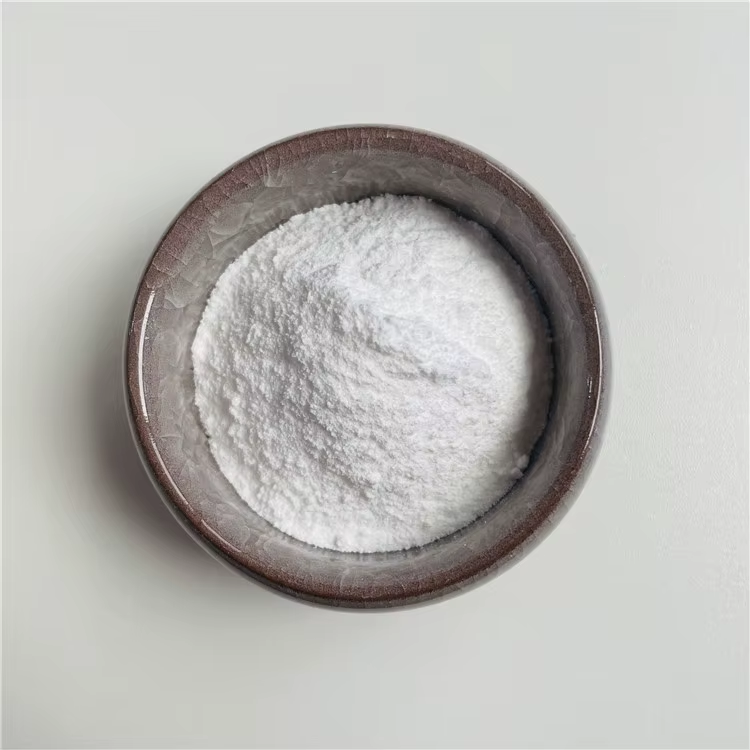
Choosing the right Mono and Diglycerides Supplier Libya is far more than a purchasing decision—it directly influences product stability, production efficiency, shelf life, and ultimately customer satisfaction. Whether your factory produces bread, cakes, margarine, dairy products, confectionery, or processed foods, the quality and consistency of emulsifiers affect every stage of manufacturing. That is why many manufacturers prefer working with experienced suppliers such as MT Royal, which provides access to multiple international brands, competitive pricing, and dependable supply solutions tailored to industrial production requirements.
In today’s manufacturing landscape, procurement teams face increasing pressure to reduce costs without compromising product quality. Selecting an industrial ingredient based solely on the lowest quotation often creates expensive downstream problems, including inconsistent batches, production downtime, quality complaints, and higher waste percentages. A knowledgeable supplier helps prevent these issues by ensuring product consistency, technical documentation, reliable logistics, and long-term availability.
As global food production continues to expand, emulsifiers have become one of the most valuable functional ingredients in modern processing. For Libyan manufacturers, securing a dependable source of mono and diglycerides has become increasingly important due to changing international supply chains, rising quality standards, and growing consumer expectations for stable, premium food products.
Understanding Mono and Diglycerides
Mono and diglycerides are food emulsifiers produced from edible fatty acids and glycerol. Their primary function is to help ingredients that normally separate—such as oil and water—remain uniformly mixed throughout processing and storage.
These emulsifiers are commonly listed under the food additive code E471, making them among the most widely used ingredients across the global food industry.
Rather than serving as a simple additive, mono and diglycerides function as process optimization tools. They influence texture, volume, aeration, crystallization, moisture retention, and product stability, making them indispensable in large-scale manufacturing.
Industrial processors appreciate these emulsifiers because they offer consistent functionality across numerous applications while remaining cost-effective compared to many specialty alternatives.
LATAMARKO LM60 – Premium Spanish-Origin Cocoa Powder
latamarko alkalized cocoa powder lm60
cocoa powder for chocolate production-Best price
Food industry raw materials – list of products
Best Brazilian Arabica Coffee Bean Supplier for Industrial Roaster
Uganda Bugisu Arabica Coffee Beans for Specialty Coffee Industry
Why Food Manufacturers in Libya Need Reliable Supply
The Libyan food industry continues to expand across multiple sectors including:
- Commercial bakeries
- Dairy processing
- Margarine manufacturing
- Edible oil production
- Ice cream manufacturing
- Chocolate and confectionery
- Instant food production
- Beverage manufacturing
- Frozen food processing
Each of these industries depends on stable ingredient supply chains.
A reliable Mono and Diglycerides Supplier Libya helps manufacturers avoid production interruptions caused by delayed imports, inconsistent quality, or sudden specification changes.
When production lines stop because a critical ingredient is unavailable, the financial impact extends far beyond the cost of the emulsifier itself. Downtime affects labor utilization, energy consumption, customer deliveries, production planning, and equipment efficiency.
In our collaboration with various factories, we have repeatedly observed that ingredient reliability often creates more value than simply achieving the lowest purchase price.
What Are Mono and Diglycerides Used For?
Mono and diglycerides serve multiple technical functions depending on the formulation.
Bakery Products
Bread manufacturers use these emulsifiers to:
- Improve dough stability during mixing.
- Increase loaf volume.
- Produce finer crumb structure.
- Delay staling.
- Improve softness.
- Extend shelf life.
- Enhance slicing performance.
A well-formulated loaf behaves much like a well-organized production line—every component performs its role without creating unnecessary friction.
Cakes
Cake manufacturers benefit from:
- Better batter aeration
- Uniform cell structure
- Higher volume
- Softer texture
- Improved moisture retention
Margarine
In margarine production, mono and diglycerides help:
- Stabilize water dispersion
- Improve spreadability
- Control crystal formation
- Increase emulsion stability
Ice Cream
Ice cream manufacturers utilize them to achieve:
- Smaller ice crystals
- Better overrun
- Improved creaminess
- Slower melting
- Enhanced texture consistency
Dairy Products
Applications include:
- Cream products
- Coffee whiteners
- Dairy desserts
- Processed cheese
- Whipped toppings
Confectionery
Chocolate and confectionery manufacturers use mono and diglycerides to improve:
- Fat dispersion
- Product stability
- Texture
- Manufacturing consistency

The Science Behind Their Performance
At the molecular level, mono and diglycerides possess both hydrophilic and lipophilic characteristics.
This dual functionality allows them to position themselves between water and oil phases, reducing interfacial tension and creating stable emulsions.
Industrial food engineers value this property because stable emulsions lead to:
- Better processing efficiency
- Reduced ingredient separation
- Improved product appearance
- Longer shelf stability
- More predictable manufacturing
Even minor improvements in emulsion stability can translate into significant savings when production volumes reach several hundred tons per month.
Common Industrial Grades
Different applications require different grades.
Typical commercial forms include:
Distilled Mono and Diglycerides
These contain a higher concentration of monoglycerides and provide superior emulsification performance.
They are commonly selected for demanding applications requiring high consistency.
Non-Distilled Mono and Diglycerides
Suitable for numerous general food processing applications where extremely high purity is unnecessary.
Powder Grades
Advantages include:
- Easy handling
- Fast dispersion
- Automated dosing compatibility
- Longer storage convenience
Bead Grades
Offer:
- Excellent flowability
- Reduced dust formation
- Uniform feeding into automated production systems
Paste Grades
Preferred in applications requiring rapid incorporation into liquid systems.
Choosing the Right Mono and Diglycerides Supplier Libya
Finding a dependable supplier involves evaluating much more than product availability.
Product Consistency
Factories require identical performance from every shipment.
Batch-to-batch variation may cause:
- Texture differences
- Processing instability
- Customer complaints
- Increased rejects
Technical Documentation
Professional suppliers provide:
- Certificate of Analysis
- Technical Data Sheets
- Safety Data Sheets
- Regulatory documentation
- Shelf-life information
Multiple Brand Availability
Rather than being limited to one manufacturer, companies like MT Royal supply multiple recognized brands, allowing procurement teams greater flexibility when balancing technical performance, availability, and budget.
Supply Stability
Reliable inventory planning minimizes production interruptions and supports long-term manufacturing schedules.
Technical Support
Industrial customers frequently need assistance regarding:
- Dosage optimization
- Processing temperature
- Mixing sequence
- Compatibility
- Application troubleshooting
Quality Parameters That Matter
Industrial buyers should evaluate several technical indicators.
Monoglyceride Content
Higher concentrations generally provide improved emulsification efficiency.
Acid Value
Lower acid values typically indicate better product quality.
Moisture Content
Controlled moisture contributes to stability and storage performance.
Appearance
Consistency in color, odor, and physical form reflects manufacturing quality.
Melting Characteristics
These influence processing behavior across different production systems.
Storage Stability
A stable ingredient reduces inventory risk and waste.
Production Trends Driving Demand
The global emulsifier market continues expanding due to:
- Growing processed food consumption
- Increased frozen food production
- Premium bakery demand
- Convenience food growth
- Longer shelf-life requirements
- Automated manufacturing
Industry analysts estimate that food emulsifier demand continues to grow steadily, supported by increasing urbanization, industrial food production, and investments in modern processing facilities across developing markets.
Libyan manufacturers participating in regional export markets increasingly recognize that ingredient consistency has become a competitive advantage rather than merely a quality requirement.
Bakery Applications in Greater Detail
Bread manufacturing represents one of the largest applications.
Mono and diglycerides contribute by:
Improving Dough Handling
The dough becomes more tolerant to mechanical stress during mixing and dividing.
Increasing Gas Retention
Improved gas retention results in greater loaf volume.
Delaying Firmness
Consumers notice softness throughout storage.
Reducing Waste
Longer freshness means fewer returned products.
Supporting Automated Production
Industrial production lines benefit from consistent dough characteristics.
In our experience working alongside food manufacturers, we have seen that optimizing emulsifier selection often produces measurable quality improvements without requiring expensive equipment upgrades.
Benefits for Large-Scale Manufacturers
Industrial production differs substantially from artisanal food manufacturing.
Large factories prioritize:
- Repeatability
- Efficiency
- Throughput
- Predictable costs
- Equipment utilization
- Reduced downtime
Mono and diglycerides support all these objectives.
When every production batch performs consistently, scheduling becomes more accurate and quality control becomes easier.

Practical Checklist Before Purchasing
Before selecting a supplier, your procurement team should confirm:
- Product specifications match production requirements.
- Technical documents are complete.
- Batch consistency has been verified.
- Packaging meets warehouse capabilities.
- Delivery schedules align with production planning.
- Pricing reflects total value rather than initial cost.
- Regulatory compliance has been confirmed.
- Sample testing has been completed.
Each checkpoint reduces operational uncertainty.
Emerging Innovations
Food manufacturers increasingly demand emulsifiers that support:
Cleaner Labels
Although formulation requirements vary, many companies seek optimized ingredient systems that maintain functionality while simplifying formulations where feasible.
Improved Processing Efficiency
Manufacturers continue reducing:
- Mixing time
- Energy consumption
- Waste generation
Better Shelf Life
Extended freshness supports wider distribution networks.
Sustainable Manufacturing
Ingredient efficiency contributes indirectly to sustainability by reducing product waste.
Working with MT Royal
When evaluating a Mono and Diglycerides Supplier Libya, manufacturers frequently look for partners capable of supplying multiple international brands rather than relying on a single source.
MT Royal serves this requirement by providing access to diverse product options that accommodate varying technical specifications, production capacities, and budget considerations.
This flexibility becomes particularly valuable when global supply conditions change unexpectedly.
Instead of redesigning formulations whenever one brand becomes temporarily unavailable, procurement teams can often evaluate alternative approved products more efficiently.
Throughout numerous industrial sourcing projects, we have found that maintaining supplier flexibility significantly strengthens supply chain resilience.
Frequently Asked Questions
Why are mono and diglycerides considered essential in industrial food production?
They improve emulsion stability, texture, processing efficiency, shelf life, and overall product consistency while remaining economically attractive for large-scale manufacturing.
How should a factory select the best Mono and Diglycerides Supplier Libya?
Evaluate technical documentation, quality consistency, logistics capability, product portfolio, market experience, pricing transparency, and customer support rather than comparing price alone.
Can different brands perform differently?
Yes.
Even when products comply with similar specifications, manufacturing methods, purity levels, fatty acid profiles, and physical forms may influence processing performance.
Production trials remain highly recommended.
Are mono and diglycerides suitable for automated production lines?
Yes.
Many commercial grades are specifically developed for continuous industrial processing and automated ingredient dosing systems.
How should mono and diglycerides be stored?
Storage recommendations typically include:
- Cool environment
- Dry warehouse
- Protection from moisture
- Original sealed packaging
- Controlled temperature conditions
Following supplier recommendations helps maintain product stability throughout its shelf life.
Why do some factories use distilled grades?
Distilled mono and diglycerides generally provide higher monoglyceride concentration and improved emulsification performance for demanding applications.
Can emulsifier selection reduce production costs?
Indirectly, yes.
Better processing stability may reduce waste, improve yield, minimize downtime, and lower customer complaints.
Why is technical support valuable?
Application guidance helps optimize dosage, improve processing performance, and resolve production issues more quickly.
Is long-term supplier partnership important?
Absolutely.
Stable relationships often produce better forecasting, more predictable inventory planning, and improved communication during supply chain disruptions.
What industries benefit the most?
Major users include:
- Bakeries
- Dairy processors
- Margarine producers
- Ice cream manufacturers
- Confectionery factories
- Ready-meal producers
- Frozen food manufacturers
- Beverage processors
Building a Smarter Procurement Strategy
Successful ingredient sourcing depends on balancing quality, cost, consistency, logistics, and technical expertise. Procurement teams that evaluate only purchase price often underestimate the hidden costs associated with inconsistent raw materials, delayed deliveries, or inadequate technical support. By developing supplier qualification processes that include specification reviews, production trials, documentation verification, and long-term performance monitoring, manufacturers create a stronger foundation for reliable production.
For Libyan food manufacturers operating in increasingly competitive markets, every ingredient contributes to operational performance. Mono and diglycerides may represent only a small percentage of a finished formulation, yet their influence extends throughout mixing, processing, packaging, transportation, shelf life, and consumer experience. Selecting a knowledgeable Mono and Diglycerides Supplier Libya is therefore an investment in manufacturing stability rather than simply another procurement decision.
Factories seeking dependable sourcing often appreciate partners such as MT Royal because they combine access to multiple international brands with competitive pricing and an understanding of industrial production requirements. When suppliers contribute technical knowledge alongside reliable logistics, manufacturers gain more than a shipment of emulsifiers—they gain confidence that every production run starts with ingredients designed to support consistent quality, efficient operations, and sustainable business growth.



No comment