

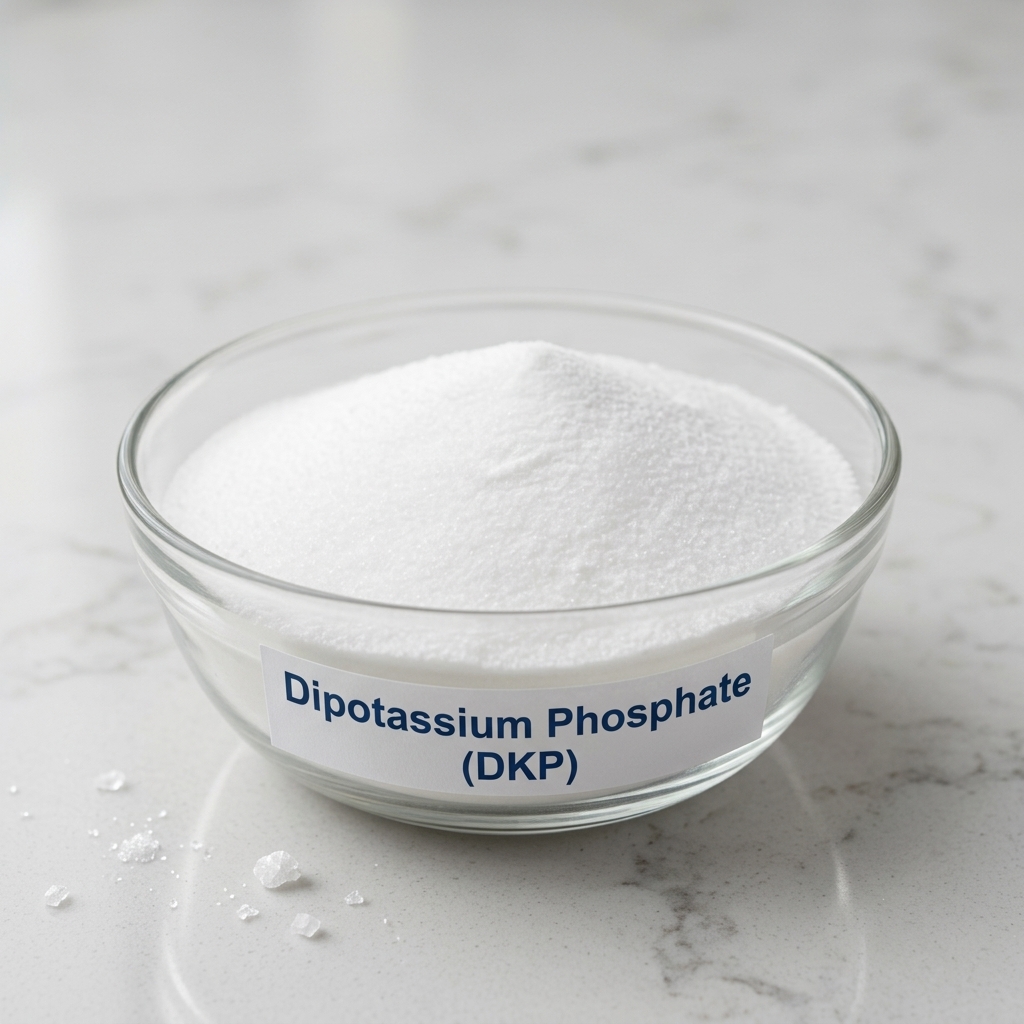
For factories that depend on consistent raw-material performance, choosing the right Dipotassium Phosphate (DKP) supplier is not simply a matter of finding the lowest quotation. A small difference in purity, moisture, particle characteristics, packaging, or batch consistency can eventually appear as production downtime, formulation instability, rejected batches, or unnecessary inventory costs. That is why manufacturers looking to purchase DKP in dependable commercial quantities should evaluate suppliers such as MT Royal, where multiple brands and competitive sourcing options can make it easier to match the right grade with the actual production requirement.
Dipotassium phosphate may look like an uncomplicated white inorganic salt on a procurement sheet. In practice, however, it is a versatile functional ingredient used across food processing, biotechnology, pharmaceuticals, specialty fertilizers, chemical formulations, and industrial systems. Its value comes not only from supplying potassium and phosphate, but also from its ability to participate in pH control, buffering, stabilization, and formulation chemistry.
For a factory manager, the important question is therefore not simply, “What is dipotassium phosphate?” The better question is: Which DKP specification, grade, packaging format, and supply strategy will deliver predictable performance at the lowest total manufacturing risk?
This guide examines that question from the perspective of industrial production and procurement.
What Is Dipotassium Phosphate (DKP)?
Dipotassium phosphate, commonly abbreviated as DKP, is an inorganic potassium phosphate salt with the chemical formula K₂HPO₄. It is also known as dipotassium hydrogen phosphate, potassium phosphate dibasic, or potassium phosphate dibasic anhydrous when referring specifically to the anhydrous form.
Its CAS Registry Number is 7758-11-4, and its molecular weight is approximately 174.18 g/mol. PubChem identifies it as both an inorganic phosphate and a potassium salt, with buffering being one of its important chemical roles.
At the molecular level, DKP can be viewed as the dipotassium salt of phosphoric acid. This chemistry gives it several characteristics that are useful in manufacturing:
- It provides potassium ions.
- It provides phosphate.
- It participates in phosphate-buffer systems.
- It can help maintain a controlled pH range.
- It is highly useful in aqueous formulations.
- It can function as a nutrient source in biological processes.
- It can contribute to stabilization and sequestration in selected formulations.
These properties explain why the same basic chemical can appear in industries that otherwise have little connection with one another.
A food manufacturer may value DKP for pH control and stabilization. A biotechnology facility may use it as part of a culture medium. A fertilizer manufacturer may value its concentrated potassium and phosphorus contribution. A chemical formulator may use it in a corrosion-inhibitor or buffering system.
The chemistry is the same; the required grade and specification are not necessarily the same.
Dipotassium Phosphate Properties Manufacturers Should Know
Understanding the basic technical profile of DKP is essential before comparing suppliers.
Chemical identity
| Property | Typical information |
|---|---|
| Chemical name | Dipotassium hydrogen phosphate |
| Common abbreviation | DKP |
| Formula | K₂HPO₄ |
| CAS number | 7758-11-4 |
| Molecular weight | 174.18 g/mol |
| Appearance | Typically white crystalline powder or crystals |
| Chemical family | Inorganic phosphate salt |
| Primary functional characteristics | Buffering, pH control, potassium/phosphate source |
| Solubility | Readily soluble in water |
The precise commercial specification can vary according to grade, manufacturer, and whether the material is supplied in anhydrous or hydrated form. Consequently, procurement teams should avoid treating the generic name “dipotassium phosphate” as a complete specification.
That distinction is particularly important when replacing one supplier with another.
A purchasing department may see two products labeled “Dipotassium Phosphate” and assume they are interchangeable. The formulation engineer may disagree after reviewing assay, moisture, insoluble matter, pH, particle-size distribution, heavy metals, or other parameters.
The product name identifies the chemical. The certificate of analysis identifies what you are actually buying.
Why Is Dipotassium Phosphate Important in Industrial Manufacturing?
The industrial usefulness of DKP comes from its combination of chemical functionality and relatively straightforward handling.
One of its most important roles is as a buffering agent. Buffer systems help resist sudden changes in pH when acidic or basic substances are introduced. In manufacturing, pH stability can be critical because many chemical reactions, biological processes, protein systems, and formulations behave differently outside a defined operating range.
DKP can also act as a source of potassium and phosphate. These are important nutrients in biological and agricultural systems, while phosphate chemistry is relevant to numerous industrial formulations.
The U.S. Food and Drug Administration’s food-substance database lists dipotassium phosphate for technical effects including pH control, sequestration, stabilization or thickening, emulsifier/emulsifier salt functions, and nutrient supplementation, subject to the applicable regulatory provisions and intended use.
This multifunctionality is one reason DKP has remained relevant across different manufacturing sectors.

Major Industrial Applications of Dipotassium Phosphate
1. Food and Beverage Manufacturing
Food processing is one of the most recognizable application areas for food-grade dipotassium phosphate.
In formulated foods and beverages, DKP can contribute to:
- pH adjustment
- buffering
- stabilization
- emulsification systems
- sequestration
- mineral supplementation
- control of protein behavior
Its buffering capacity can be particularly valuable where a formulation needs to remain within a relatively narrow pH range.
For example, protein-containing beverages can be sensitive to acidity. A poorly controlled pH can contribute to protein instability, precipitation, texture changes, or separation. In selected formulations, phosphate buffering systems help manufacturers control this behavior.
DKP is also associated with applications involving coffee creamers and dairy-related formulations. PubChem’s compiled industrial-use information identifies buffering in coffee creamers and sequestration/emulsification applications among established uses.
However, food manufacturers should never assume that a technical-grade DKP can simply be substituted for food-grade material.
The intended application determines the necessary regulatory status, purity requirements, contaminant limits, documentation, and quality controls.
2. Pharmaceutical Manufacturing
Pharmaceutical and healthcare-related manufacturing requires a much stricter approach to raw-material qualification.
Dipotassium phosphate may be incorporated into formulations or process systems where phosphate buffering or potassium contribution is required. It may also appear in laboratory and pharmaceutical manufacturing environments as a reagent or process ingredient.
For pharmaceutical procurement, the critical issue is not merely chemical purity. Buyers may need to evaluate:
- Pharmacopoeial compliance
- Certificate of analysis
- Elemental impurity profile
- Microbiological requirements
- Manufacturing-site qualification
- Traceability
- Change-control procedures
- Lot-to-lot consistency
- Packaging integrity
A supplier that can offer multiple brands is particularly useful here because the best option may depend on the required compendial standard, regulatory market, and production scale.
3. Biotechnology and Fermentation
DKP has an important role in biotechnology because phosphate and potassium are fundamental components of many biological media.
It can serve as a nutrient component and buffering agent in fermentation and microbial culture systems. PubChem references its use as a culture nutrient in antibiotic production.
In fermentation, seemingly minor changes in raw materials can affect process behavior. The objective is therefore not simply to obtain a material with a high assay. You also need consistency.
A fermentation facility should pay attention to parameters such as:
- Assay
- Moisture
- Trace metals
- Insoluble matter
- pH of solution
- Microbiological quality where applicable
- Lot consistency
A material that is chemically acceptable but behaves differently during dissolution can create unexpected process deviations.
4. Fertilizer and Agricultural Formulations
Dipotassium phosphate can also be used in specialty fertilizer formulations because it supplies both potassium and phosphorus.
Unlike many commodity fertilizer materials, DKP is often considered where formulation precision, water solubility, or crop-specific nutrient management is important.
It can be relevant to:
- Specialty soluble fertilizers
- Fertigation formulations
- Controlled nutrient blends
- Hydroponic nutrient systems
- Technical agricultural formulations
The agricultural market also illustrates why sourcing strategy matters. Phosphate supply chains are increasingly influenced by raw-material availability, geopolitical factors, transportation costs, and changes in fertilizer-market concentration.
Recent research has highlighted increasing consolidation within phosphate fertilizer supply networks and the importance of regional supply resilience.
For manufacturers, this means procurement decisions should consider more than today’s price per metric ton.
5. Industrial Chemical Formulations
DKP has applications in industrial chemical systems where buffering, phosphate chemistry, or corrosion control is required.
PubChem’s industrial-use references include buffering and corrosion-inhibitor applications in antifreeze systems, as well as applications in paper processing and specialty chemical formulations.
In such applications, compatibility matters.
A chemical that performs perfectly in one formulation may behave differently in another depending on:
- Water chemistry
- Temperature
- Ionic strength
- Other salts
- Organic components
- pH
- Concentration
- Mixing sequence
This is why formulation testing should precede large-scale substitution.
Food Grade vs. Technical Grade vs. Pharmaceutical-Related Grades
One of the most expensive procurement mistakes is treating “purity” as the only meaningful quality parameter.
A 99% assay does not automatically make a chemical suitable for every application.
Different grades can be manufactured, tested, packaged, and documented for different purposes.
Food-grade DKP
Food-grade material is intended for applications where food regulations and food-safety requirements apply. Depending on the market and application, buyers may need appropriate food-additive specifications and supporting documentation.
The FDA database, for example, lists dipotassium phosphate under specified food-related regulatory provisions.
Technical-grade DKP
Technical material may be appropriate for industrial applications where food or pharmaceutical compliance is not required.
It can be an economical option for certain chemical, agricultural, or industrial processes.
But technical grade should not be selected merely because it is cheaper. If the final product has regulatory requirements, the apparent saving can disappear very quickly.
Pharmaceutical or compendial material
Where pharmaceutical standards apply, the buyer should verify the relevant pharmacopoeial specification rather than relying on generic terminology.
The procurement file should clearly state the required standard and not simply say “high purity DKP.”
That single change can prevent an impressive amount of paperwork later.
How to Choose the Right Dipotassium Phosphate Supplier
Supplier selection should begin with your process requirements, not with the supplier’s product brochure.
A practical qualification process includes six stages.
1. Define the application
State exactly where DKP will be used.
Is it:
- Food production?
- Beverage formulation?
- Pharmaceutical production?
- Fermentation?
- Fertilizer?
- Industrial chemical processing?
- Laboratory use?
This determines the required grade and documentation.
2. Define the specification
Your purchasing specification should include more than assay.
Consider specifying:
- Chemical identity
- Assay
- Moisture
- Insoluble matter
- pH
- Particle size
- Heavy metals or elemental impurities
- Microbiological parameters where relevant
- Packaging
- Shelf life
- Storage requirements
- Required certificates
3. Review the certificate of analysis
A CoA should be reviewed against your internal specification.
Do not merely file it.
Look for trends across several lots. A supplier whose numbers repeatedly sit close to the specification limit may present more risk than one whose batches consistently perform well within the specification.
This is one of the simplest ways to move from reactive procurement toward quality-based sourcing.
4. Evaluate brand options
If your supplier can provide multiple manufacturers, you gain flexibility.
This is one area where MT Royal can be useful to industrial buyers: rather than treating DKP as a single commodity with one possible source, procurement teams can compare available brands according to grade, documentation, origin, packaging, price, and supply conditions.
For a high-volume factory, this flexibility can become strategically important when a preferred producer faces allocation constraints or logistical delays.
5. Check packaging and logistics
DKP is hygroscopic and can be sensitive to moisture during storage and handling. Therefore, packaging quality matters rather more than its humble appearance might suggest.
Evaluate:
- Bag construction
- Inner liner
- Moisture barrier
- Palletization
- Container loading
- Warehouse conditions
- Transit exposure
- Lot identification
A perfect chemical delivered in compromised packaging is not a perfect delivery.
6. Compare total landed cost
Do not compare only the quoted material price.
A useful procurement model considers:
Total landed cost = product price + freight + insurance + duties + handling + warehousing + quality-control cost + potential production risk
If a cheaper supplier produces more off-specification material, requires additional testing, or has unreliable delivery performance, the nominal price advantage may be misleading.
Common Mistakes When Buying Dipotassium Phosphate
Mistake 1: Buying by chemical name alone
“Dipotassium phosphate” is not a complete procurement specification.
The grade, form, purity, origin, packaging, and documentation matter.
Mistake 2: Selecting the lowest price
Raw materials are rarely expensive in isolation. Production interruptions are.
If a formulation uses DKP at a relatively low concentration, the financial impact of a marginal unit-price difference may be small compared with the cost of an entire failed batch.
Mistake 3: Ignoring moisture
Moisture can affect handling, flow, weighing accuracy, dissolution, and storage stability.
A procurement team should know whether the manufacturer’s specification controls moisture and how the product is packaged.
Mistake 4: Assuming brands are interchangeable
Even when two products meet a nominal chemical specification, their physical properties may differ.
Before switching brands, run a controlled qualification trial.
Mistake 5: Approving one sample and never monitoring future lots
Supplier qualification is not a one-time event.
A strong quality program periodically reviews CoAs, deviations, delivery performance, complaints, and lot-to-lot variation.
Mistake 6: Forgetting regulatory documentation
For regulated manufacturing, missing documentation can be more troublesome than a delayed truck.
Ask for the documentation required by your industry before issuing a purchase order.
Specialized Tips for Large-Scale DKP Procurement
Large manufacturers should approach DKP sourcing differently from small-volume buyers.
Establish dual-source capability
If DKP is a critical raw material, qualifying two sources can reduce supply-chain exposure.
However, dual sourcing only works if both sources are genuinely qualified. Keeping a second supplier’s name in an ERP system does not create resilience if its product has never been validated.
Use a rolling demand forecast
Rather than purchasing only when warehouse stock becomes uncomfortable, use:
- Historical consumption
- Production schedules
- Supplier lead time
- Safety stock
- Transit time
- Seasonal demand
- Expected price changes
A rolling forecast gives the supplier better visibility and can improve allocation during tight markets.
Set a safety-stock policy based on risk
Not every factory needs the same inventory level.
A plant consuming several tons per month with a long import lead time should not use the same safety-stock model as a local facility that can replenish within 48 hours.
A useful approach is to calculate safety stock from demand variability and lead-time variability rather than selecting an arbitrary number of bags.
Monitor supplier performance with measurable KPIs
Useful indicators include:
- On-time delivery rate
- CoA compliance
- Batch rejection rate
- Complaint frequency
- Lead-time consistency
- Price variance
- Documentation accuracy
- Emergency-order response
This transforms supplier management from opinion into data.
Storage and Handling of Dipotassium Phosphate
Good storage practices are essential for maintaining material quality.
DKP should generally be kept in a dry, well-controlled warehouse, protected from excessive humidity and contamination. Packaging should remain sealed until the material is needed.
Factories should also establish clear rules for:
- First-in, first-out or appropriate inventory rotation
- Open-bag handling
- Moisture exposure
- Pallet storage
- Damaged-package segregation
- Lot traceability
- Cleaning and contamination prevention
For larger plants, warehouse humidity monitoring can be worthwhile when the chemical is used frequently.
The goal is straightforward: preserve the material from the supplier’s warehouse all the way to the point where it enters your process.

DKP in Formulation: Why Process Conditions Matter
A raw material’s performance cannot be separated completely from the process in which it is used.
For DKP, important variables can include:
- Concentration
- Water quality
- Temperature
- Addition rate
- Agitation
- Order of addition
- Final pH
- Presence of calcium or magnesium ions
- Other phosphate salts
- Organic ingredients
In water-based formulations, for instance, dissolution behavior can influence batch time and localized concentration.
If a powder is dumped rapidly into a poorly agitated vessel, the operator may see clumping or localized concentration even though the material itself meets specification.
That is why process optimization should distinguish between a raw-material problem and a mixing problem.
The chemical often gets blamed first because it arrives in a bag and cannot defend itself.
What Should Be Included in a DKP Technical Specification?
For industrial procurement, a robust specification might contain the following categories.
Identity
- Product name
- Chemical formula
- CAS number
- Grade
Chemical parameters
- Assay
- Moisture
- pH
- Insoluble matter
- Relevant elemental impurities
Physical parameters
- Appearance
- Particle-size range
- Bulk density where relevant
- Flow characteristics where relevant
Regulatory requirements
- Food compliance where applicable
- Pharmaceutical/compendial compliance where applicable
- SDS
- CoA
- Country-of-origin documentation
- Other customer-specific declarations
Packaging
- Net weight
- Bag type
- Liner specification
- Pallet configuration
- Labeling requirements
This level of detail helps prevent the purchasing department from accidentally ordering a chemically similar but operationally unsuitable product.
How MT Royal Can Support DKP Sourcing
For manufacturers, the value of a chemical supplier should extend beyond sending a quotation.
A useful supplier should help you navigate differences among available products, grades, brands, packaging options, and supply conditions.
MT Royal can be considered as part of that sourcing process, particularly when your purchasing strategy benefits from access to multiple brands and competitive commercial options.
The practical advantage of having several brands available is flexibility. One producer may be stronger on price, another on a specific grade, and another on documentation or availability. Your factory does not necessarily need the same supplier for every application.
In our collaboration with various factories, we have seen that the most successful procurement decisions usually begin with a clear technical specification and only then move toward commercial negotiation.
We also find that manufacturers benefit when purchasing and technical departments evaluate a new DKP source together rather than treating supplier selection as purely a purchasing decision.
The final choice should satisfy three conditions:
- Technically suitable
- Regulatorily acceptable
- Commercially sustainable
If one of those three is missing, the sourcing decision is incomplete.
Frequently Asked Questions About Dipotassium Phosphate
Is Dipotassium Phosphate the same as potassium phosphate?
Not necessarily. “Potassium phosphate” can refer to several salts, including monopotassium phosphate and dipotassium phosphate. Always verify the chemical formula and CAS number before purchasing.
What is the formula of DKP?
Dipotassium phosphate has the chemical formula K₂HPO₄ and CAS number 7758-11-4.
What is Dipotassium Phosphate used for?
It is used in food and beverage formulations, biotechnology, fermentation, specialty fertilizers, pharmaceutical-related applications, laboratory processes, and industrial chemical systems. Its functions can include buffering, pH control, nutrient supply, sequestration, stabilization, and emulsification depending on the application.
Is DKP water soluble?
Yes. Dipotassium phosphate is readily soluble in water, which contributes to its usefulness in aqueous formulations and nutrient systems.
Is Dipotassium Phosphate food grade?
Food-grade DKP is available, but a product should not be assumed to be food grade simply because it is chemically called dipotassium phosphate. The specific manufacturer’s grade and applicable regulatory documentation must be verified.
Can DKP be used instead of MKP?
Not automatically. DKP and MKP have different chemical compositions and acid-base behavior. Substitution can change formulation pH, buffering performance, potassium/phosphorus ratios, and process behavior.
What should a factory check before buying DKP?
At minimum, evaluate the intended grade, assay, moisture, physical properties, CoA, regulatory documentation, packaging, shelf life, supplier consistency, delivery capability, and total landed cost.
Why do different DKP brands have different prices?
Pricing can reflect raw-material costs, manufacturing location, production scale, energy costs, packaging, logistics, grade, certifications, quality systems, market conditions, and supplier margins.
A lower price does not necessarily mean lower quality, and a higher price does not automatically mean better suitability. The comparison must be specification-to-specification.
How should DKP be stored?
Store it in a dry environment, protect it from excessive humidity and contamination, keep packaging properly sealed, and maintain lot traceability. Specific storage instructions should always be checked against the manufacturer’s SDS and technical documentation.
Can one DKP grade be used for every factory application?
No. A food manufacturer, fertilizer producer, biotechnology facility, and industrial chemical plant can have substantially different requirements. Grade selection should follow the end use.
The Strategic Value of Buying DKP Correctly
The most interesting thing about Dipotassium Phosphate is not that it has dozens of uses. It is that its relatively simple chemistry can have a surprisingly large influence on manufacturing performance.
Once the application is defined, the right grade can be selected. Once the grade is defined, suppliers can be compared fairly. Once suppliers are qualified, commercial negotiations become much more meaningful.
That is where a multi-brand sourcing partner such as MT Royal can become valuable: not by turning a technical chemical into a marketing product, but by helping industrial buyers compare available options against the actual requirements of their factory.
The best procurement strategy is rarely the one that produces the cheapest invoice.
It is the one that quietly delivers the right material, in the right grade, at the right time, with the right documentation, batch after batch.
For a production manager, that kind of reliability may not make headlines. It simply means the line keeps running.And in manufacturing, that is often the most valuable result of all.



)
No comment