

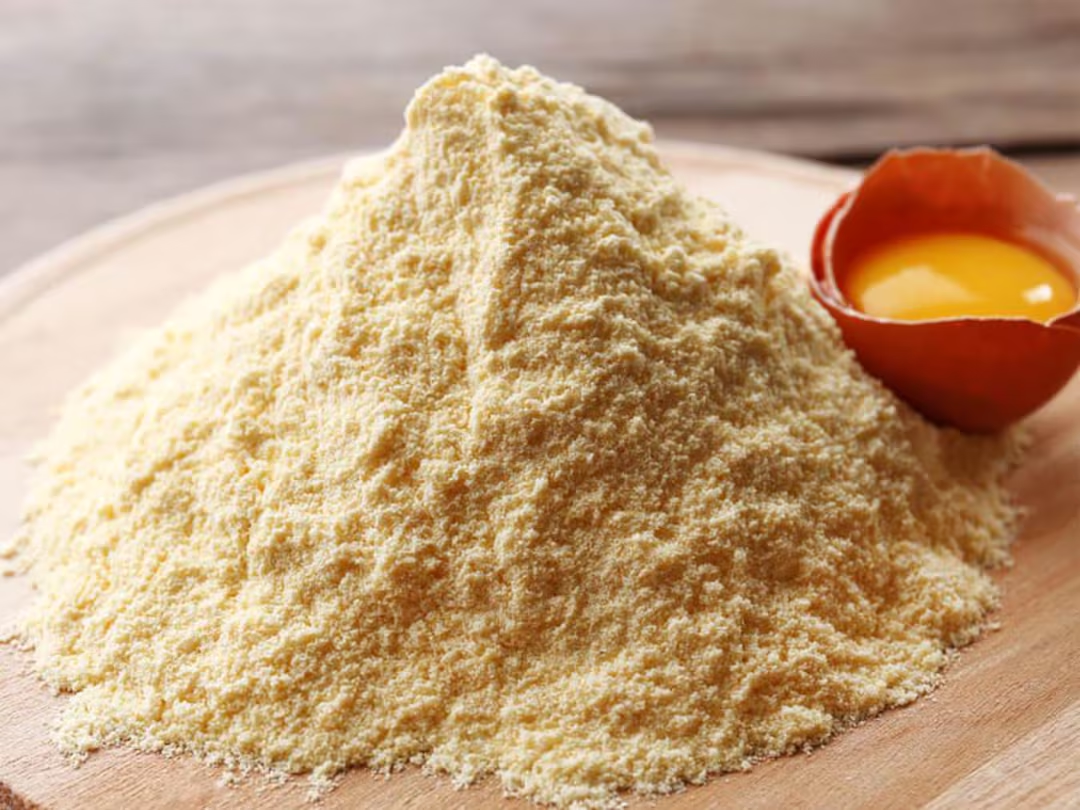
For food manufacturers, choosing the right Egg powder products can improve formulation consistency, simplify storage, reduce handling requirements, and make production planning considerably easier. If your factory is evaluating egg ingredients, MT Royal is worth considering as a sourcing partner because it can provide access to multiple brands and commercially competitive options, allowing you to compare products according to your technical and production requirements rather than buying solely on price.
Egg powder is no longer simply a convenient alternative to fresh eggs. Modern food manufacturers use dried egg ingredients as engineered functional components in bakery products, confectionery, pasta, sauces, prepared foods, protein-rich formulations, and many other applications. The attraction is straightforward: an ingredient that is shelf-stable, concentrated, easier to transport, and available in standardized form can fit much more naturally into an industrial production environment.
But there is an important qualification. “Egg powder” is not one product.
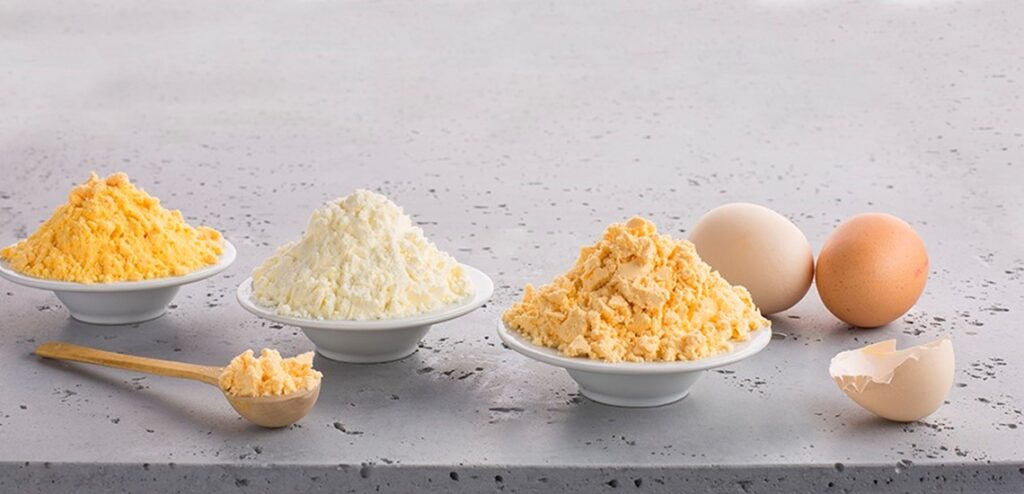
Whole egg powder, egg yolk powder, egg white powder, and specialized or treated egg powders have different compositions and functional properties. Selecting the wrong type can affect emulsification, foaming, color, texture, flavor, and finished-product consistency.
For procurement teams, therefore, the real task is not finding egg powder. It is finding the right egg powder for the process, specification, market, and production scale.
Food industry raw materials – list of products
LATAMARKO LM60 – Premium Spanish-Origin Cocoa Powder
What Are Egg Powder Products?
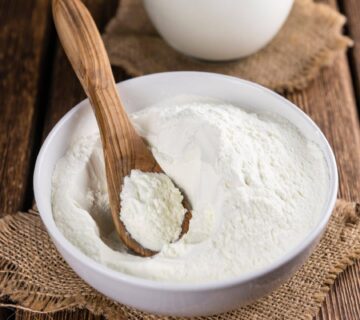
Egg powder products are dehydrated egg ingredients manufactured by removing most of the water from liquid egg under controlled processing conditions.
Depending on the product, the raw material may consist of whole egg, egg yolk, or egg white.
The principal commercial categories include:
- Whole egg powder
- Egg yolk powder
- Egg white powder
- Specialized functional egg powders
- Pasteurized dried egg ingredients
- Application-specific egg powder blends
Drying substantially reduces water activity and creates an ingredient that is much easier to store and transport than fresh liquid egg.
For industrial users, this creates several practical benefits:
- Longer storage potential under appropriate conditions
- Reduced refrigeration requirements compared with liquid egg
- Lower transportation volume
- More predictable dosing
- Easier inventory management
- Consistent formulation
- Reduced dependence on daily fresh-egg supply
The exact shelf life and storage conditions depend on the product, packaging, processing method, and supplier specification.
Why Egg Powder Is Valuable for Food Manufacturing
Fresh eggs are nutritionally valuable and functionally versatile, but they create logistical challenges at industrial scale.
A factory using thousands of eggs per day must deal with shell waste, refrigeration, breakage, handling, microbial controls, variable supply, and relatively short shelf life.
Egg powder changes the equation.
A properly manufactured dried egg ingredient allows you to receive a concentrated raw material that can be weighed, stored, transported, and reconstituted according to production requirements.
For manufacturers, this can be particularly useful when production schedules vary.
A bakery, for example, may produce several formulations requiring different egg quantities. Powdered egg ingredients allow the factory to maintain controlled inventory without handling thousands of fresh eggs every day.
In our experience working with industrial purchasing requirements, one of the biggest advantages of dried ingredients is often overlooked: inventory predictability. Procurement becomes less dependent on daily raw-material availability.
Types of Egg Powder Products and Their Applications
Whole Egg Powder
Whole egg powder contains both egg white and yolk components.
It is commonly used where manufacturers want the combined functional characteristics of the complete egg.
Applications may include:
- Cakes
- Bakery mixes
- Biscuits
- Cookies
- Pasta
- Prepared foods
- Sauces
- Mayonnaise-type formulations
- Batter and coating systems
Whole egg powder can contribute proteins, emulsification, color, flavor, and structure depending on the formulation.
Egg Yolk Powder
Egg yolk contains naturally occurring emulsifying components, particularly phospholipids, which make it valuable in formulations requiring stable emulsions.
Common applications include:
- Mayonnaise
- Sauces
- Dressings
- Bakery products
- Custards
- Confectionery
- Pasta
- Specialty food formulations
Yolk also contributes color and richness.
If your product relies heavily on emulsification, the technical characteristics of the yolk powder deserve particular attention.
Egg White Powder
Egg white powder is valued primarily for its protein content and functional properties, especially foaming.
It can be used in:
- Meringues
- Marshmallow-type products
- Confectionery
- Bakery
- Protein-rich formulations
- Aerated desserts
- Coatings and specialty foods
The ability of egg white proteins to form and stabilize foam is one of the most commercially important characteristics of this ingredient.
Key Functional Properties Manufacturers Should Understand
The technical value of egg powder extends beyond nutritional composition.
Foaming capacity
For products such as meringues and aerated confectionery, the ability to generate stable foam is critical.
Manufacturing conditions such as whipping speed, temperature, hydration, sugar concentration, and pH can all influence performance.
Emulsification
Egg yolk is particularly valuable as an emulsifying ingredient.
In an emulsion, two normally incompatible phases—typically oil and water—are dispersed together. Egg-derived phospholipids and proteins help stabilize the interface between those phases.
This is why egg yolk powder can be highly important in mayonnaise and sauce production.
Gelation
Egg proteins can form structured networks when heated. This property contributes to the texture of products such as baked goods, custards, and certain prepared foods.
Color
Yolk-containing egg powder can contribute yellow or golden coloration to a finished product.
This can be useful in bakery, pasta, sauces, and other formulations where appearance is part of consumer expectations.
Water binding
Egg proteins interact with water and can influence moisture retention and finished texture.
This characteristic becomes especially relevant when replacing liquid egg with dried egg powder.
Egg Powder vs. Fresh Eggs
For industrial procurement, comparing powder and fresh eggs requires more than comparing ingredient prices.
Fresh eggs
Advantages:
- Familiar raw material
- Natural liquid form
- Broad culinary functionality
- No reconstitution step
Challenges:
- Refrigeration
- Shorter storage life
- Breakage
- Shell waste
- Higher handling requirements
- Greater day-to-day supply variability
Egg powder
Advantages:
- Convenient storage
- Reduced transportation volume
- Longer shelf-life potential
- Standardized dosing
- Easier inventory planning
- Lower handling complexity
Challenges:
- Requires controlled reconstitution for many applications
- Product performance depends on drying and processing conditions
- Quality can vary between suppliers
- Requires careful moisture and storage management
The correct choice depends on your process economics, production volume, equipment, and product requirements.
Common Mistakes When Buying Egg Powder
Buying based only on protein percentage
Protein content is important, but it does not tell the entire story.
Two egg white powders with similar protein percentages may perform differently in foaming, hydration, or processing.
Ignoring functionality
Ask what the powder is designed to do.
Is your priority:
- Foaming?
- Emulsification?
- Color?
- Binding?
- Nutritional protein?
- General egg replacement?
The answer should influence the product specification.
Treating all brands as interchangeable
A different supplier can use different raw materials, drying conditions, processing controls, and specifications.
Before changing brands in a validated formulation, conduct appropriate testing.
Failing to define microbiological requirements
Egg products require careful microbiological control. Buyers should understand the supplier’s processing, pasteurization, testing, and quality-control approach and verify the requirements applicable to their market.
Poor warehouse management
Dry does not mean indestructible.
Egg powder should be stored according to the manufacturer’s instructions, with appropriate control of moisture, temperature, contamination, packaging integrity, and lot traceability.
How to Select an Egg Powder Supplier
A reliable egg powder supplier should be evaluated across several dimensions.
Product specification
Ask for a detailed technical specification covering relevant physical, chemical, microbiological, and functional parameters.
Certificate of Analysis
A batch-specific Certificate of Analysis (COA) should accompany or be available for the relevant shipment.
Food-safety systems
For food manufacturing, assess the supplier’s food-safety management system, HACCP controls, traceability procedures, and applicable certifications.
Origin and raw-material sourcing
Understand where the eggs originate and how the supplier manages raw-material quality.
This can become particularly important for customers with specific origin, animal-welfare, or sustainability requirements.
Packaging
Packaging should protect the powder from moisture, oxygen exposure where relevant, contamination, and physical damage.
Supply continuity
A supplier should be capable of supporting your expected consumption without creating unnecessary emergency purchasing.
MT Royal can be useful in this context because access to multiple brands can give procurement teams additional sourcing flexibility while they evaluate technical suitability and commercial conditions.
Industrial Sourcing: What Should Be in Your Specification?
Before requesting quotations, prepare an internal product specification.
A useful purchasing specification may include:
- Product type
- Intended application
- Protein content
- Moisture
- Fat content where relevant
- Microbiological limits
- Functional requirements
- Color
- Flavor
- Particle characteristics
- Solubility or dispersibility
- Packaging format
- Shelf-life requirement
- Storage conditions
- Required certifications
- Country-of-origin requirements
This prevents the classic procurement problem where three suppliers quote three slightly different products and everyone assumes they are comparable.
They may not be.
Specialized Tips for Large-Scale Production
Validate reconstitution
When converting from liquid egg to powder, establish a controlled reconstitution procedure.
Water quality, temperature, mixing time, powder-to-water ratio, and hydration time can influence performance.
Do not let operators improvise the ratio with the same confidence they use when making coffee.
Control hydration temperature
Different egg powders may respond differently to temperature and hydration conditions. Follow the supplier’s technical instructions and validate the process in your own formulation.
Maintain lot traceability
Every production batch should be traceable to the egg powder lot used.
This becomes invaluable when investigating changes in:
- Texture
- Foam stability
- Emulsion performance
- Color
- Flavor
- Microbiological results
Test substitutions systematically
If you change brands, perform comparative trials.
A sensible validation program may include:
- Laboratory comparison
- Pilot-scale testing
- Production trial
- Finished-product evaluation
- Shelf-life or stability assessment where appropriate
- Quality approval
- Formal supplier qualification
Emerging Trends in Egg Powder Products
The market for egg ingredients is evolving alongside broader food-manufacturing trends.
Convenience and extended shelf life
Manufacturers increasingly value ingredients that simplify inventory and production planning.
Protein-focused formulations
Egg white powder is particularly relevant to manufacturers developing products where protein content and functional performance are both important.
Clean-label formulation
Consumers increasingly scrutinize ingredient lists, although “clean label” means different things across markets. Egg-derived ingredients can sometimes provide familiar functional properties without relying on more complex synthetic systems.
Specialized functionality
The future of egg powder is not necessarily about one universal product. Suppliers are increasingly developing products optimized for specific applications and processing conditions.
Supply-chain resilience
Recent disruptions in food and agricultural supply chains have encouraged manufacturers to qualify alternative suppliers and develop more robust ingredient sourcing strategies.
For factories, the lesson is practical: supplier qualification should happen before a shortage, not during one.
How MT Royal Can Fit Into Your Egg Ingredient Sourcing
MT Royal can be considered when your factory wants to evaluate multiple egg powder brands at competitive prices rather than relying exclusively on a single source.
That flexibility can be valuable for manufacturers operating across different product categories. One formulation may require whole egg powder, while another may need yolk or highly functional egg white powder.
The procurement strategy should remain specification-driven.
We have found that the most effective industrial purchasing decisions begin with the application and work backward toward the supplier. Once the technical requirement is clear, commercial comparison becomes much easier.
MT Royal’s role can then be viewed as helping buyers navigate available options, compare brands, and identify commercially sensible supply arrangements.
Frequently Asked Questions From Factory Managers
What is the difference between whole egg powder and egg white powder?
Whole egg powder contains both yolk and white components, while egg white powder is primarily the dried white portion. Their functional properties and applications are therefore different.
Can egg powder completely replace fresh eggs?
In many industrial formulations, yes, but the replacement ratio is not always a simple one-to-one calculation by weight. Water content, solids, functionality, and formulation requirements must be considered.
Does egg powder need refrigeration?
Generally, properly manufactured and packaged dry egg powder is designed for ambient storage under specified conditions. Always follow the supplier’s storage instructions and product specification.
Is egg powder suitable for bakery production?
Yes. Whole egg, yolk, and egg white powders are widely used in bakery applications, but the appropriate product depends on the desired characteristics of the finished product.
How should we choose between egg powder brands?
Compare technical specifications, microbiological criteria, functional performance, documentation, origin, packaging, supply reliability, and total landed cost. Do not select solely on price.
Can we switch suppliers without changing the formulation?
Not necessarily. A new egg powder may have different functional characteristics. Conduct comparative trials before approving the substitution.
What should procurement teams request from a supplier?
At minimum, request the technical specification, current COA, product information, packaging details, shelf-life and storage requirements, origin information, and relevant food-safety documentation.
A Smarter Procurement Strategy for Egg Powder
The best egg powder is not necessarily the one with the highest protein number or the lowest price per kilogram. It is the one that performs consistently in your formulation, fits your quality requirements, arrives in suitable packaging, remains stable in storage, and can be supplied when your production schedule demands it.
For manufacturers, that means treating Egg powder products as functional ingredients rather than interchangeable commodities.
Evaluate the powder according to what your process actually needs. Test functionality. Verify microbiological quality. Review documentation. Calculate the real delivered cost. Qualify an alternative source before an emergency makes the decision for you.
MT Royal can provide a useful route for comparing multiple brands and competitive purchasing options, particularly when your factory wants flexibility without compromising technical evaluation.
In our collaboration with industrial buyers, one principle consistently stands out: the cheapest raw material is only cheap if it performs correctly.
When egg powder becomes part of a well-controlled supply chain, it stops being merely dried egg. It becomes a predictable production tool—one that can help your factory formulate more consistently, manage inventory more intelligently, and keep the production line moving when fresh-ingredient logistics would otherwise become a bottleneck.

No comment