

For food manufacturers, spice procurement is rarely as simple as finding a supplier with an attractive price per kilogram. Aroma strength, microbial quality, pesticide residues, moisture, particle size, traceability, certification, harvest variability, and delivery reliability can all influence the final product. If your factory is looking for Organic spices wholesale from TÜRKİYE, MT Royal is a practical supplier to consider because it provides access to multiple brands and competitive wholesale options, giving procurement teams more flexibility when balancing quality, specifications, and cost.
Türkiye has a particularly interesting position in the global spice trade. Its agricultural diversity, proximity to European and Middle Eastern markets, established food-processing infrastructure, and access to major logistics routes make Turkish-origin spices relevant to manufacturers looking for dependable regional sourcing.
But origin alone does not guarantee performance. An organic spice that looks excellent on a certificate can still create production problems if it has inconsistent particle size, weak volatile-oil content, excessive moisture, poor packaging, or inadequate microbial control. For industrial buyers, the real objective is to secure a spice supply that performs consistently from the first production batch to the thousandth.
What Does Organic Spices Wholesale from TÜRKİYE Mean?
Organic spices are spices produced and processed according to applicable organic-production standards, with requirements governing agricultural practices, permitted inputs, processing, segregation, documentation, and certification.
The word “organic” is therefore not simply a description of farming style. For B2B buyers, it represents a chain of controls extending from cultivation through processing and distribution.
Wholesale purchasing adds another layer. A factory buying several kilograms for product development has very different requirements from a manufacturer consuming several tons of oregano, cumin, paprika, black pepper, or sumac every month.
A professional wholesale specification should address:
- Botanical identity
- Country of origin
- Organic certification
- Harvest information
- Moisture
- Microbiological parameters
- Foreign matter
- Pesticide-residue compliance
- Heavy metals where applicable
- Particle size
- Volatile-oil or active-component specifications where relevant
- Packaging
- Shelf life
- Batch traceability
This is why Organic spices wholesale from TÜRKİYE should be treated as a technical sourcing category rather than simply an agricultural commodity purchase.
Food industry raw materials – list of products
LATAMARKO LM60 – Premium Spanish-Origin Cocoa Powder
Why Source Organic Spices from Türkiye?
Türkiye has a strong agricultural base and a geographically advantageous location connecting Europe, Asia, and the Middle East. For manufacturers, this can translate into practical supply-chain advantages when the supplier and product are properly qualified.
Potential advantages include:
Regional Logistics
For European and nearby markets, Turkish supply routes can provide commercially attractive transportation options compared with sourcing from more distant production regions.
Agricultural Diversity
Türkiye produces and processes a broad range of herbs, spices, seeds, and aromatic crops, making it possible for buyers to develop regional sourcing strategies around several products.
Established Food-Processing Infrastructure
A mature food-processing sector supports cleaning, drying, grinding, sorting, packing, and export operations.
Access to Multiple Commercial Options
A supplier such as MT Royal can be useful when a manufacturer wants to compare different brands rather than relying on one producer. This can help procurement teams evaluate differences in specification, price, availability, and packaging.
However, buyers should distinguish between Turkish origin and Turkish processing. A product may be processed or packed in Türkiye while the raw agricultural material originates elsewhere. If origin is important to your label or marketing strategy, confirm the exact origin documentation.
Common Organic Spices Purchased by Manufacturers
The right spice portfolio depends on your products, but several categories are particularly relevant to industrial food production.
Organic Oregano
Oregano is widely used in seasoning blends, sauces, marinades, prepared foods, bakery applications, and Mediterranean-style products.
For oregano, pay attention to:
- Leaf-to-stem ratio
- Aroma intensity
- Color
- Moisture
- Particle size
- Foreign material
- Microbial quality
Ground oregano and cut oregano should not automatically be treated as equivalent. Processing changes the way aroma is released and can affect visual appearance.
Organic Cumin
Cumin is widely used in spice blends, meat products, sauces, snack seasonings, and ethnic food formulations.
A key consideration is aroma consistency. Cumin’s sensory profile depends heavily on volatile compounds, and storage conditions can gradually reduce aromatic impact.
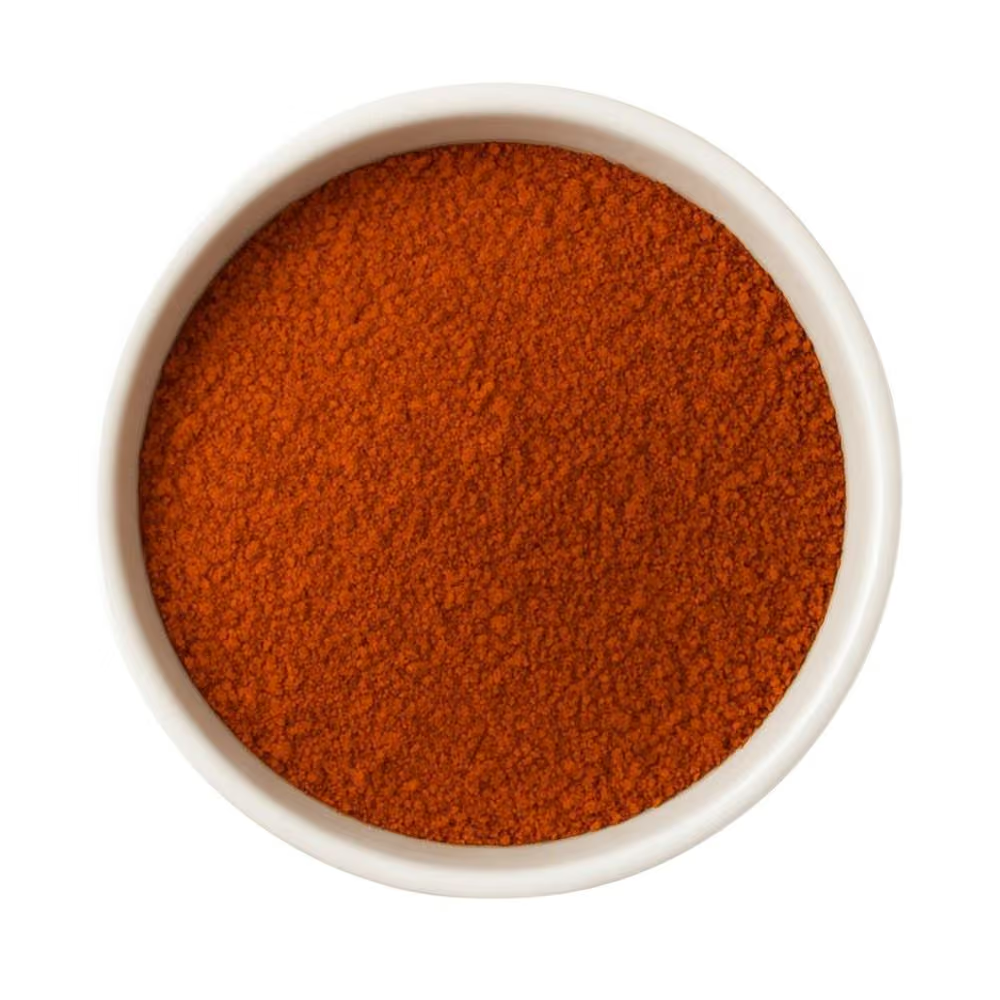
Organic Paprika
Paprika can contribute both flavor and color. For manufacturers, that creates a more complex purchasing equation.
A paprika specification may need to address:
- Color intensity
- Heat level
- Moisture
- Particle size
- Microbial status
- Foreign matter
- Color stability
A low-cost paprika with poor color performance may require higher dosage, which makes the original price advantage disappear.
Organic Sumac
Sumac is particularly relevant to Middle Eastern and Mediterranean food formulations.
Its acidity, color, aroma, and particle size can vary depending on raw material and processing. Manufacturers should establish a clear sensory and analytical specification rather than purchasing purely by product name.
Organic Black Pepper
Black pepper remains one of the most widely used spices globally and is available in whole, cracked, and ground forms.
For industrial use, buyers should assess:
- Piperine-related pungency
- Volatile oil
- Moisture
- Particle size
- Microbial quality
- Foreign matter
- Adulteration risks
Organic Spice Blends
Blends can simplify production but require particularly strong supplier controls. Every component introduces another potential source of variability.
For a factory purchasing blends, request a detailed formulation specification and establish whether substitutions are permitted.
The Importance of Organic Certification
Certification is one of the most important issues when purchasing organic spices wholesale.
A supplier should be able to demonstrate that the relevant product is certified according to the standard required by your market.
Depending on the destination and application, this may involve requirements associated with:
- EU organic regulations
- USDA organic requirements
- Other national organic standards
- Private retailer standards
- Customer-specific certification programs
Do not assume that a supplier’s general organic credentials automatically apply to every product.
Your procurement team should verify:
- The certification body
- Certificate validity
- Scope of certification
- Product coverage
- Processing and handling status
- Batch traceability
- Organic segregation procedures
For export-oriented manufacturers, certification should be checked before the purchase order is issued. Fixing an organic documentation problem after the goods arrive is considerably less entertaining.
Organic Spice Quality: What Should Your Factory Test?
A robust organic spice supplier should provide documentation, but manufacturers should also establish their own incoming-quality controls.
Microbiological Testing
Spices can present microbiological risks because they are agricultural products that may encounter soil, water, harvesting equipment, storage environments, and processing facilities.
Depending on the product and destination market, testing may include relevant indicators and pathogens.
Moisture and Water Activity
Moisture affects shelf life, caking, microbial stability, grinding performance, and storage behavior.
Water activity can provide additional information about microbial growth potential and stability.
Pesticide Residues
Organic production restricts the use of many conventional agricultural inputs, but organic certification should not be interpreted as “no laboratory testing is necessary.”
Residue compliance remains an important part of quality assurance.
Heavy Metals and Contaminants
Depending on the spice, origin, and market, heavy metals and other contaminants may require monitoring.
Adulteration
Spice adulteration is a significant procurement concern because high-value spices can create incentives for economically motivated substitution.
Testing strategies should be risk-based and appropriate to the product.
Common Mistakes When Buying Organic Spices Wholesale
Mistake 1: Choosing the Cheapest Kilogram
The cheapest spice is rarely the cheapest ingredient.
Consider:
Cost in use = purchase price × required dosage
If one paprika delivers stronger color at a lower dosage, its higher purchase price may be justified.
Mistake 2: Treating Certification as the Entire Quality System
Certification establishes important controls, but it does not tell you whether the spice has the exact sensory and technical characteristics your product requires.
Mistake 3: Ignoring Particle Size
Particle size can affect:
- Mixing uniformity
- Dispersion
- Flavor release
- Appearance
- Dust formation
- Dosing accuracy
A spice that performs well in a seasoning blend may require a different grind specification for a sauce or processed meat application.
Mistake 4: Failing to Account for Harvest Variability
Agricultural products naturally vary by season, weather, region, and crop conditions.
A supplier should have appropriate blending, standardization, or quality-control procedures where applicable.
Mistake 5: Poor Warehouse Management
Organic spices still need controlled storage.
Protect them from excessive:
- Heat
- Humidity
- Light
- Oxygen
- Cross-contamination
- Strong odors
Spices are excellent at absorbing environmental aromas. Your warehouse does not need a free-of-charge “mystery seasoning” department.
Specialized Tips for Large-Scale Organic Spice Buyers
Establish a Written Spice Specification
Do not rely on phrases such as “premium oregano” or “high-quality cumin.”
Define measurable requirements.
Your specification should cover sensory characteristics, analytical limits, microbiological requirements, particle size, packaging, certification, and acceptable tolerances.
Approve a Golden Sample
For products where sensory performance matters, retain an approved reference sample.
This creates a practical benchmark for future shipments.
However, remember that spices age. A retained sample is useful as a reference, but it should not replace batch-specific laboratory analysis.
Use Risk-Based Testing
Not every spice requires exactly the same testing frequency.
High-risk ingredients can receive more intensive verification, while lower-risk materials may be monitored according to an established supplier-performance program.
Audit the Supply Chain
For strategic ingredients, investigate:
- Farm or cooperative sourcing
- Processing facilities
- Cleaning systems
- Grinding equipment
- Metal detection
- Foreign-material control
- Storage
- Pest management
- Organic segregation
- Traceability procedures
Maintain Approved Alternatives
If your factory consumes large volumes of a particular organic spice, qualify a second source where possible.
We have found that supplier redundancy is especially valuable for agricultural ingredients because crop conditions can change faster than procurement forecasts.
Trends Shaping Organic Spice Procurement
The organic spice market is increasingly influenced by three overlapping forces: consumer demand, regulatory scrutiny, and supply-chain transparency.
Consumers increasingly expect more information about food origins and processing. At the same time, manufacturers face greater pressure to demonstrate that organic claims are supported by credible documentation.
Traceability is consequently becoming more important.
Another important trend is clean-label convergence. Organic and clean-label products are not identical categories, but they frequently overlap in consumer perception. Manufacturers are therefore looking for spices that can support both organic positioning and recognizable ingredient declarations.
There is also growing interest in direct sourcing, farmer relationships, sustainable agriculture, and responsible supply chains. For procurement teams, these trends create opportunities but also increase the importance of documentation and supplier verification.
Frequently Asked Questions About Organic Spices Wholesale from TÜRKİYE
Are Turkish organic spices suitable for international food manufacturers?
They can be, provided the specific product meets the technical, certification, regulatory, and documentation requirements of the destination market.
What organic spices can manufacturers source from Türkiye?
Depending on availability and supplier portfolio, manufacturers may source products such as oregano, cumin, paprika, sumac, black pepper, herbs, seeds, and various spice blends.
Is organic certification enough to guarantee high quality?
No. Certification is essential for organic compliance, but manufacturers should separately evaluate microbiological quality, sensory characteristics, contaminants, moisture, particle size, and batch consistency.
How should I calculate the cost of organic spices?
Do not compare only price per kilogram. Calculate cost in use based on dosage and performance, then add freight, handling, storage, testing, and potential production losses.
Can MT Royal provide different organic spice brands?
MT Royal’s multi-brand sourcing approach can give buyers access to different commercial options. Availability depends on the specific spice, brand, grade, certification, and market requirements.
How can a factory reduce organic spice supply risk?
Qualify backup suppliers, maintain appropriate inventory, establish clear specifications, monitor crop-related risks, and maintain good communication with suppliers about upcoming harvest and logistics conditions.
Building a Reliable Organic Spice Supply Strategy
Purchasing Organic spices wholesale from TÜRKİYE becomes much more straightforward when your factory stops treating spices as generic commodities and starts treating them as critical functional ingredients.
Define the specification before negotiating the price. Verify certification before approving the supplier. Test the material according to risk. Evaluate sensory performance alongside laboratory results. Calculate cost in use rather than simply cost per kilogram. Most importantly, build enough supply-chain flexibility that one difficult harvest or delayed shipment does not stop your production schedule.
MT Royal can serve as a practical sourcing option for manufacturers looking for competitive pricing and access to multiple brands. The advantage of such a model is not merely having more products to choose from; it is having more opportunities to match the right specification with the right application and purchasing strategy.
For a factory, consistency is the real currency of spice procurement. A great batch is useful. A great batch that can be reproduced reliably, documented properly, delivered on time, and priced sustainably is what turns an ingredient supplier into a long-term supply partner.
When your oregano tastes the same, your paprika performs the same, your certificates arrive on time, and your production team is not chasing unexpected quality problems, procurement has done its job quietly and effectively. That is the standard worth building around when sourcing organic spices from Türkiye.


No comment