

If your factory depends on a steady supply of food ingredients, the difference between an ordinary supplier and a reliable sourcing partner can be measured in more than price. It can appear in production downtime, rejected batches, formulation consistency, inventory costs, and customer complaints. For manufacturers looking to Import food ingredients from Turkey, working with an experienced supplier such as MT Royal can provide access to multiple brands and competitive purchasing options while giving your procurement team greater flexibility in matching ingredients to specific production requirements.
Turkey has developed into an important sourcing hub for the international food industry. Its agricultural base, processing capacity, geographical position, export infrastructure, and proximity to major European, Middle Eastern, and Asian markets create opportunities for manufacturers seeking both commodity ingredients and specialized food products.
However, successful importing is not simply about finding a Turkish supplier with an attractive quotation. Your factory needs the right specification, dependable quality, appropriate documentation, predictable lead times, and a total landed cost that makes commercial sense.
In other words, the cheapest ingredient is not always the cheapest ingredient once it enters the production line.
Food industry raw materials – list of products
LATAMARKO – Premium Spanish-Origin Cocoa Powder
What Does It Mean to Import Food Ingredients from Turkey?
At a basic level, importing food ingredients from Turkey means purchasing ingredients from Turkish producers, processors, exporters, or distributors and bringing them into your target market for further processing, formulation, packaging, or resale.
For a factory, the process is more complex than a conventional purchase.
Food ingredients can include a remarkably broad range of materials:
- Nuts and seeds
- Dried fruits
- Spices and herbs
- Pulses and grains
- Vegetable oils
- Tomato products
- Fruit preparations
- Cocoa and confectionery ingredients
- Flour and starch products
- Sweeteners
- Food additives
- Natural flavoring ingredients
- Processed agricultural products
Each category has its own technical requirements.
A bakery manufacturer may prioritize flour functionality, moisture, protein content, and baking performance. A snack producer may be more concerned with seasoning consistency, oil quality, and particle size. A confectionery factory may focus on cocoa-related ingredients, nuts, emulsifiers, or glucose-based products.
Therefore, food ingredient sourcing should begin with your production specification, not with a supplier’s catalog.
Why Turkey Is Attractive for Food Ingredient Sourcing
Turkey’s position between Europe and Asia gives it an unusual logistical advantage. Manufacturers can potentially source products from a country that is geographically close to several major consumption markets while benefiting from an established agricultural and food-processing industry.
Turkey is particularly well known for agricultural commodities such as hazelnuts, pistachios, dried fruits, figs, apricots, raisins, sunflower products, pulses, spices, and tomato-based ingredients.
The broader advantage is the surrounding industrial ecosystem.
A successful food ingredient supply chain requires much more than farms. It requires cleaning facilities, sorting operations, processing plants, laboratories, packaging companies, warehouses, freight providers, customs specialists, and exporters familiar with international food regulations.
Turkey’s established food-export sector brings many of these capabilities together.
For manufacturers, this can translate into several practical benefits:
Product diversity
You may be able to consolidate different categories through experienced suppliers rather than managing a separate sourcing relationship for every ingredient.
Flexible specifications
Ingredients can often be sourced in different grades, processing formats, packaging sizes, and brand configurations.
Geographic proximity
For buyers in Europe, the Middle East, North Africa, and nearby regions, Turkey can offer attractive transportation options compared with more distant origins.
Competitive commercial conditions
Currency movements, local production, processing capacity, and competition among exporters can create attractive purchasing opportunities, although prices should always be evaluated alongside quality and logistics.
Which Food Ingredients Can Factories Source from Turkey?
The appropriate ingredient depends entirely on your industry and formulation.
Nuts and seeds
Turkey is especially relevant for hazelnuts and pistachios, while other nuts and seeds may also be available through established processors and distributors.
These products are used in:
- Chocolate
- Bakery products
- Nut spreads
- Snack foods
- Breakfast cereals
- Energy bars
- Desserts
- Ice cream
- Toppings and fillings
For industrial buyers, size, moisture, breakage, color, roasting performance, and microbiological quality may all matter.
Dried fruits
Dried apricots, figs, raisins, and other dried fruits can be important ingredients for bakery, snack, cereal, confectionery, and health-food manufacturers.
The specification should address parameters such as moisture, size, color, foreign material, texture, preservatives where applicable, and microbiological requirements.
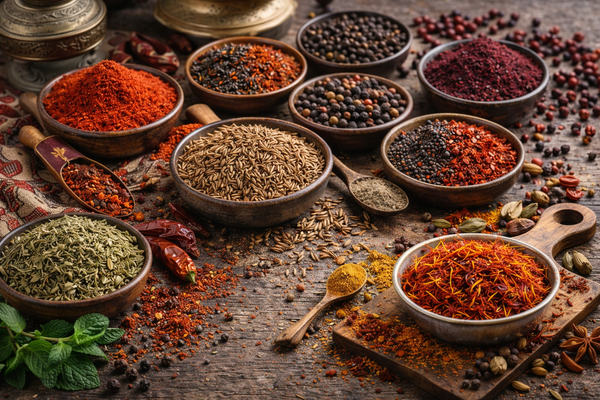
Spices and herbs
Spices create a different sourcing challenge because small differences in raw material can have a surprisingly large effect on finished-product flavor.
A seasoning manufacturer may need to specify:
- Botanical identity
- Origin
- Particle size
- Volatile oil characteristics
- Moisture
- Microbiological parameters
- Adulteration controls
- Color
- Flavor intensity
Consistency becomes especially important when the ingredient is used in a standardized recipe across millions of consumer units.
Tomato and vegetable ingredients
Turkey has a significant agricultural-processing sector, making tomato paste and other vegetable-based products relevant to manufacturers of sauces, prepared foods, soups, and convenience products.
For industrial tomato products, factors such as concentration, color, acidity, viscosity, packaging, and microbiological specifications may influence production performance.
The Most Important Principle: Define the Specification First
One of the most expensive sourcing mistakes is asking for a product before defining exactly what the factory needs.
Consider a simple request:
“We need dried apricots.”
That is not a sufficient industrial specification.
A better request could define:
- Origin
- Variety
- Size range
- Moisture
- Color
- Sulfur dioxide requirements, if applicable
- Defect tolerance
- Foreign material limits
- Packaging
- Shelf life
- Laboratory requirements
- Intended application
This difference is crucial because two products can share the same commercial name while behaving very differently during manufacturing.
The same principle applies to virtually every ingredient.
A procurement department should work with production and quality-control teams to establish a technical specification before requesting competitive quotations.
Quality Control When Importing Food Ingredients from Turkey
Food safety cannot be treated as a paperwork exercise.
A supplier may provide certificates, but your factory still needs a system for verifying incoming materials.
Supplier qualification
Before placing significant orders, evaluate the supplier’s:
- Manufacturing or sourcing capabilities
- Quality-management systems
- Traceability procedures
- Product specifications
- Laboratory documentation
- Export experience
- Complaint-handling process
- Supply capacity
- Packaging standards
Where appropriate, request samples from commercial lots rather than relying only on a promotional sample.
Laboratory testing
Depending on the ingredient and destination market, testing may include:
- Microbiological analysis
- Moisture
- Mycotoxins
- Pesticide residues
- Heavy metals
- Allergen-related parameters
- Oxidation indicators
- Chemical composition
- Authenticity or adulteration testing
The precise testing plan should be based on the ingredient, applicable regulations, risk assessment, and intended use.
Traceability
A robust traceability system should allow your quality team to connect a finished-product batch with the raw-material lots used during production.
This becomes particularly important when dealing with allergens or ingredients that have elevated microbiological or chemical risks.
Common Mistakes When Importing Food Ingredients
Mistake 1: Selecting suppliers solely by price
Price is important, but it is only one component of procurement performance.
Suppose one supplier offers material at $1,000 per ton and another at $1,050. If the cheaper product produces greater waste, requires additional processing, or creates quality problems, the apparent saving may vanish.
The better metric is cost per usable kilogram.
Mistake 2: Ignoring batch consistency
A factory cannot formulate efficiently when ingredient characteristics change dramatically from one shipment to another.
Consistency should therefore be included in supplier evaluation.
Mistake 3: Treating documentation as an afterthought
Incorrect commercial invoices, packing lists, certificates, labeling information, or origin documents can delay shipments and create unnecessary customs problems.
Your logistics team should review documentary requirements before the order is finalized.
Mistake 4: Ordering based on the first sample
A perfect sample proves that a supplier can provide a good sample.
It does not necessarily prove that the supplier can deliver 100 tons of consistent material over twelve months.
Mistake 5: Underestimating seasonality
Many food ingredients are agricultural commodities. Harvest timing, weather, crop size, regional availability, and international demand can affect both price and availability.
Procurement teams should understand the seasonal cycle of their most important ingredients.
MT Royal and a Multi-Brand Sourcing Approach
For manufacturers considering Import food ingredients from Turkey, MT Royal can serve as a practical sourcing option when buyers want access to multiple brands and competitive prices.
A multi-brand approach can be useful because factories do not always have a single quality requirement.
For example, a manufacturer may have:
- A premium product line requiring a higher specification
- A mainstream product requiring cost efficiency
- An industrial formulation where functionality matters more than consumer-facing branding
- Seasonal products requiring alternative ingredient grades
Being able to compare different brands and product options can make procurement more flexible.
MT Royal should therefore be evaluated not simply as another seller of ingredients, but according to the same criteria you would apply to any serious B2B supplier: specification accuracy, product consistency, documentation, commercial terms, availability, and responsiveness.
We have seen that factories often achieve better purchasing results when procurement, quality, and production teams participate in supplier evaluation from the beginning instead of handing the entire decision to purchasing based on price alone.
Specialized Tips for Large-Scale Food Manufacturers
Large factories should go further than ordinary supplier comparison.
Establish annual volume forecasts
If your factory consumes 300 tons of a particular ingredient annually, communicate realistic volume expectations.
Suppliers can often plan inventory and production more efficiently when they understand the expected purchasing pattern.
Use safety stock strategically
Safety stock should reflect lead time, demand variability, ingredient seasonality, and supply risk.
Holding too little creates emergency purchasing. Holding too much ties up working capital and may increase storage-related losses.
The goal is not maximum inventory. It is controlled inventory.
Develop alternative suppliers
Even when one supplier performs exceptionally well, maintaining at least one qualified alternative can protect production against unexpected disruptions.
This is especially important for critical ingredients that can stop a production line if unavailable.
Monitor supplier performance over time
A supplier scorecard should be reviewed periodically.
Useful indicators include:
- On-time delivery rate
- Batch rejection rate
- Specification compliance
- Complaint resolution time
- Price variance
- Documentation accuracy
- Delivery quantity accuracy
A supplier that consistently performs at 98% on-time delivery is fundamentally different from one that achieves 70%, even if both offer similar prices.
Emerging Trends in Food Ingredient Importing
The international food industry is increasingly focused on transparency, traceability, and supply-chain resilience.
Manufacturers are asking more questions about ingredient origin and processing. Retail customers are also becoming more interested in clean labels, natural ingredients, recognizable components, and responsible sourcing.
Another important trend is the movement from raw commodities toward value-added ingredients.
Instead of buying a raw agricultural product and processing it internally, a manufacturer may choose a cleaned, roasted, chopped, diced, powdered, concentrated, or otherwise production-ready ingredient.
This can reduce labor and equipment requirements.
However, it also transfers more responsibility to the supplier.
If you purchase a processed ingredient, your supplier’s process becomes part of your own production chain.
That means specifications, process controls, and quality verification become even more important.
Frequently Asked Questions About Importing Food Ingredients from Turkey
Is Turkey suitable for large-scale food ingredient sourcing?
Turkey can be an attractive sourcing market because of its agricultural production, processing infrastructure, export experience, and geographic position. Suitability depends on the specific ingredient, destination market, supplier, and technical requirements.
What is the most important factor when selecting a Turkish supplier?
There is no single factor. A strong supplier should combine consistent quality, competitive total cost, reliable delivery, appropriate documentation, sufficient capacity, and effective communication.
Should manufacturers purchase directly from producers?
Direct purchasing can sometimes provide advantages in price and traceability, but it is not automatically superior. An experienced distributor or sourcing company may offer broader product selection, multiple brands, consolidated purchasing, logistics expertise, and greater flexibility.
How can I reduce the risk of receiving an inconsistent shipment?
Use a detailed specification, approve representative samples, establish acceptance criteria, perform appropriate testing, and monitor supplier performance across multiple shipments.
Is importing directly always cheaper?
No. Direct importing can reduce certain intermediary costs, but it also introduces logistics, customs, inventory, financing, and compliance responsibilities. The correct comparison is the total landed and usable cost.
How much inventory should a factory keep?
There is no universal number. Safety stock should be calculated using consumption, lead time, demand variability, seasonal supply conditions, and the criticality of the ingredient.
Why is batch consistency so important?
Because food factories are designed around repeatable formulations and processes. Significant variation in ingredients can affect flavor, texture, color, yield, machine performance, and finished-product shelf life.
Turning Turkish Sourcing Into a Competitive Manufacturing Advantage
The decision to Import food ingredients from Turkey should not begin with the question, “Who has the lowest price?”
A better question is:
Which supplier can give my factory the right ingredient, at the required specification, with predictable quality and delivery, at the lowest sustainable total cost?
That shift in thinking changes procurement from transactional buying into supply-chain management.
Turkey offers manufacturers a broad and increasingly sophisticated sourcing environment, from agricultural commodities to processed and value-added ingredients. MT Royal can be considered within that environment as a supplier offering multiple brands and competitive purchasing options, particularly when flexibility and product choice are important to your procurement strategy.
In our experience, the factories that manage ingredient sourcing most successfully are not necessarily those that negotiate the hardest on every individual shipment. They are the ones that build clear specifications, measure supplier performance, forecast demand, understand landed cost, and maintain enough supply-chain flexibility to respond when markets change.
Food manufacturing is a precise business. Your production line may tolerate a few seconds of downtime, but it has very little patience for an ingredient that arrives late, fails specification, or behaves differently from the material used in the formulation.
Choose your ingredients with the same discipline you apply to your machinery, quality systems, and production planning. When sourcing becomes predictable, procurement stops being a daily fire drill and becomes what it should be: a competitive advantage built quietly, shipment after shipment.


No comment