

The batch looks fine on paper, the recipe hasn’t changed, the equipment is calibrated—yet something feels slightly off. The color is not as deep as yesterday’s run, the flavor profile feels less rounded, and suddenly the quality team starts asking questions no one enjoys answering.
In industrial food manufacturing, these small inconsistencies rarely come from machinery. More often than not, they come from raw materials behaving just slightly differently than expected.
That is exactly why sourcing an Alkalized Cocoa Powder Supplier in Sudan is not just a procurement task—it is a production stability decision.
Alkalized cocoa powder plays a critical role in bakery systems, confectionery production, instant mixes, and beverage formulations. It is engineered through controlled alkalization (often called Dutch processing), which neutralizes acidity and adjusts color, flavor, and solubility behavior.
But in real factory environments, the difference between a stable supplier and an inconsistent one is not theoretical—it is measurable in downtime, rework, and lost throughput.
Understanding Alkalized Cocoa Powder in Industrial Applications
Alkalized cocoa powder is produced by treating cocoa solids with alkaline salts to modify pH and functional behavior. This process changes how cocoa interacts inside formulations, especially in large-scale industrial systems.
Unlike natural cocoa powder, alkalized variants typically provide:
- A darker, more uniform color profile
- Reduced acidity for smoother flavor systems
- Improved solubility in beverage and dry mix applications
- More predictable behavior in emulsified systems
- Better visual consistency in baked goods
In manufacturing terms, this means fewer surprises during production runs.
A bakery line running thousands of units per hour cannot afford variability in ingredient behavior. Even small changes in alkalization level can affect dough color, rise characteristics, and moisture balance.
Why Sudan’s Food Manufacturing Sector Is Increasing Cocoa Demand
The food processing ecosystem in Sudan has been gradually expanding, especially in bakery production, confectionery manufacturing, and packaged dry food systems.
Several industrial trends are shaping this demand:
- Growth in urban food processing facilities
- Expansion of mid-scale industrial bakeries
- Rising demand for standardized branded food products
- Increased adoption of automated mixing and dosing systems
As production scales increase, ingredient consistency becomes a structural requirement—not a preference.
Factories moving from semi-manual to automated systems often discover a hard truth: automation does not fix inconsistency; it amplifies it.
If an ingredient varies, the entire production line reflects that variation instantly.
What Defines a Reliable Alkalized Cocoa Powder Supplier?
Choosing a supplier is less about packaging and more about process control behind the product.
A reliable Alkalized Cocoa Powder Supplier in Sudan should demonstrate:
1. Stable Alkalization Control
pH consistency ensures predictable flavor and color behavior across batches.
2. Uniform Particle Size Distribution
This affects dispersion, mixing efficiency, and final texture consistency.
3. Controlled Moisture Levels
Excess moisture leads to clumping, flow disruption, and storage degradation.
4. Color Stability Across Production Batches
Color inconsistency is one of the most visible quality defects in finished goods.
5. Industrial Packaging Systems
Bulk packaging must support warehouse efficiency and minimize contamination risk.
The Hidden Cost of Cocoa Variability in Manufacturing
On a spreadsheet, cocoa powder is a cost per kilogram.
On a production line, it is a stability factor that influences everything downstream.
Variability leads to:
- Longer mixing cycles
- Increased rejection rates
- Frequent recipe recalibration
- Higher quality control intervention
- Reduced throughput efficiency
We’ve seen manufacturing facilities lose more money through process interruptions than through ingredient pricing differences.
In other words, saving a small percentage on procurement can sometimes create larger hidden losses in production.
Latamarko Spain and the Value of Controlled Industrial Standards
European cocoa processing systems are widely respected for their precision and consistency.
Spanish manufacturers, in particular, have built strong reputations in cocoa alkalization and powder standardization. Brands like Latamarko represent a category of suppliers focused on:
- Tight control of pH adjustment processes
- Stable roasting and milling systems
- Consistent flavor and color engineering
- Industrial-scale reproducibility
Spanish engineering in food ingredient production has long been associated with reliability under high-volume manufacturing conditions.
That reliability is often what procurement teams prioritize when production stability is more important than experimentation.
MT Royal’s Role in Industrial Ingredient Supply Chains
At MT Royal, we supply manufacturers with a comprehensive range of brands, ensuring competitive pricing without compromising on quality.
In practice, ingredient sourcing is rarely about finding a product—it is about ensuring production continuity.
In our experience working with manufacturing facilities across different food sectors, one of the most common challenges is variability between suppliers and batches.
We’ve seen factories significantly improve production stability simply by standardizing cocoa inputs across multiple product lines, reducing unnecessary adjustments during mixing and processing stages.
That type of improvement often does not require new equipment—just better-controlled raw materials.
Industrial Applications of Alkalized Cocoa Powder
Alkalized cocoa powder is widely used across food manufacturing systems due to its functional stability.
Bakery Manufacturing
Used in cakes, biscuits, and sponge products where controlled color and flavor are essential.
Confectionery Production
Provides stable coloration and flavor in coatings, fillings, and molded chocolate systems.
Instant Beverage Systems
Ensures solubility and consistent dispersion in powdered drink mixes.
Industrial Dry Mix Production
Supports uniform blending behavior in large-scale automated systems.
Common Procurement Mistakes in Cocoa Sourcing
Even experienced procurement teams can underestimate cocoa complexity.
1. Treating Cocoa as a Commodity Only
Ignoring functional differences leads to production instability.
2. Overlooking pH Variation
Small changes in alkalization affect color and flavor significantly.
3. Skipping Full-Scale Testing
Lab tests rarely reflect industrial production behavior.
4. Ignoring Moisture Sensitivity
Storage conditions directly affect performance and flowability.
5. Frequent Supplier Switching
Constant changes introduce instability into production systems.
Step-by-Step Supplier Evaluation Process
Selecting the right supplier requires structured validation.
Step 1: Define Production Parameters
Establish color, pH, moisture, and application requirements.
Step 2: Request Full Technical Documentation
COA, pH stability data, and particle size reports are essential.
Step 3: Conduct Industrial Trials
Test performance under real production conditions, not just lab environments.
Step 4: Measure Production Efficiency
Track throughput, rejection rates, and mixing stability.
Step 5: Evaluate Total Cost of Stability
Include downtime, waste, and recalibration costs—not just purchase price.
Why Stability Matters More Than Price
In industrial food manufacturing, the cheapest ingredient is not always the most economical.
A slight inconsistency in alkalized cocoa powder can lead to:
- Color deviation in finished products
- Flavor imbalance in baked goods
- Longer mixing cycles
- Increased quality control interventions
Over time, these inefficiencies compound into significant operational costs.
Premium European suppliers, particularly those aligned with Spanish engineering standards such as Latamarko, are often valued for predictable behavior rather than branding.
Supply Chain Considerations for Industrial Buyers
Industrial procurement depends heavily on logistics stability.
Key factors include:
- Temperature-controlled transport
- Bulk warehouse compatibility
- Lead time predictability
- Export documentation compliance
- Seasonal availability stability
Modern supply chains treat ingredient sourcing as part of production infrastructure—not just procurement.
Quality Comparison Table for Industrial Buyers
| Quality Tier | Characteristics | Production Impact |
|---|---|---|
| Standard Grade | Basic alkalization, moderate consistency | Suitable for low-sensitivity applications |
| Industrial Grade | Controlled pH and milling stability | Balanced production performance |
| Premium European Grade | Tight tolerances, high reproducibility | Ideal for large-scale manufacturing |
Frequently Asked Questions
What is alkalized cocoa powder used for in industry?
It is used in bakery, confectionery, and beverage manufacturing where color and flavor consistency are required.
Why is alkalized cocoa preferred in industrial systems?
Because it provides predictable behavior in color, solubility, and flavor.
What affects cocoa powder quality in production?
pH level, particle size, moisture content, and processing stability.
Can natural cocoa replace alkalized cocoa?
Not always, as they behave differently in chemical and baking reactions.
Why is supplier consistency important?
Because variability directly affects production efficiency and yield.
Final Perspective for Manufacturing Decision-Makers
Alkalized cocoa powder may appear to be a simple ingredient, but in industrial reality it is a controlled production variable.
When everything is stable, it disappears into the background of manufacturing. When it is inconsistent, it becomes the first issue everyone notices on the production floor.
Whether you are scaling bakery production, optimizing confectionery systems, or stabilizing dry mix lines, the real question is not just which supplier offers cocoa powder—but which supplier helps your production behave predictably at scale.
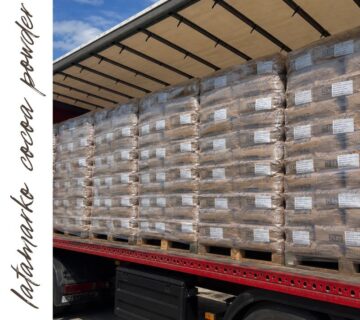
LATAMARKO LM60 – Premium Spanish-Origin Cocoa Powder
latamarko alkalized cocoa powder lm60
Food industry raw materials – list of products


No comment