


If you’ve ever walked through a cocoa powder production facility, you already know it doesn’t feel like a typical food plant. It feels closer to a carefully synchronized mechanical ecosystem—where heat, pressure, airflow, and particle physics quietly decide the fate of every kilogram produced.
For most people, cocoa powder is a pantry item. For factory managers and procurement teams, it’s a performance-critical ingredient that affects everything from mixer efficiency to final product consistency. A slight variation in particle size distribution, fat content, or moisture level can ripple through an entire production schedule like an unexpected machine fault.
That’s why understanding the Inside a Cocoa Powder Production Line (Step-by-Step Guide) is not just technical curiosity—it’s operational intelligence.
At MT Royal, we supply manufacturers with a comprehensive range of brands at competitive prices, and across industries from bakery to beverage production, we’ve noticed something consistent: the teams who understand how cocoa powder is actually made tend to run smoother, more predictable production lines. Ingredient knowledge, in other words, is a form of risk control.
Alongside global standards, premium European suppliers—especially Spanish-engineered brands like Latamarko, known for consistency and precision in ingredient behavior—have influenced how many industrial buyers evaluate cocoa quality today. Not just in taste, but in how reliably it performs under pressure in automated systems.
So let’s step inside a real production line and follow cocoa powder from raw bean intake to final packaged product.
LATAMARKO LM60 – Premium Spanish-Origin Cocoa Powder
latamarko alkalized cocoa powder lm60
cocoa powder for chocolate production-Best price
Food industry raw materials – list of products
Understanding the Cocoa Powder Production Line as an Industrial System
Before we break down the steps, it helps to understand what a cocoa production line actually is in engineering terms.
It’s not a single machine—it’s a continuous transformation chain made of interdependent systems:
- Thermal processing units (roasting systems)
- Mechanical separation systems (cracking and winnowing)
- Particle reduction systems (grinding mills)
- Hydraulic extraction systems (pressing units)
- Classification and stabilization systems (milling and conditioning)
Each stage influences downstream behavior. And here’s where production managers usually learn the hard way: optimizing one stage without understanding the next often creates bottlenecks elsewhere.
Step 1: Raw Cocoa Bean Receiving and Intake Control
Every production line begins long before machines start spinning. It begins at intake.
When cocoa beans arrive at a facility, they immediately enter a controlled receiving zone designed to prevent variability from entering production.
What Happens at Intake
- Sampling and laboratory testing
Small representative samples are pulled from each batch and analyzed for moisture, defects, and fermentation quality. This ensures that what enters production behaves predictably under heat and pressure. - Visual grading and contamination checks
Operators inspect beans for mold, insect damage, and foreign matter. Even small contamination levels can impact equipment wear over time. - Moisture stabilization assessment
Moisture levels determine whether beans require conditioning before roasting. Too much moisture can destabilize roasting curves and lead to uneven flavor development. - Lot segregation for traceability
High-performing plants don’t mix everything together—they separate lots to maintain process consistency.
In our experience supporting manufacturing facilities, intake discipline is one of the strongest predictors of long-term production stability. It’s not glamorous, but it saves more downtime than most equipment upgrades.
Step 2: Cleaning and Pre-Processing Systems
Once beans are accepted, they enter cleaning systems designed to prepare them for thermal processing.
Core Equipment in Cleaning Stages
- air classifiers
- vibrating sieves
- magnetic separators
- destoners
- aspiration systems
Each system removes a different category of unwanted material.
Why Cleaning Matters More Than Most Buyers Expect
If foreign material enters roasting or grinding systems, the consequences are not subtle:
- increased wear on mechanical parts
- inconsistent roasting heat transfer
- reduced nib yield
- contamination risk in final powder
Think of this stage as “insurance for everything that comes after it.”
We’ve seen plants reduce maintenance shutdowns simply by upgrading their cleaning precision instead of increasing roasting capacity—a decision that pays off quietly but consistently.
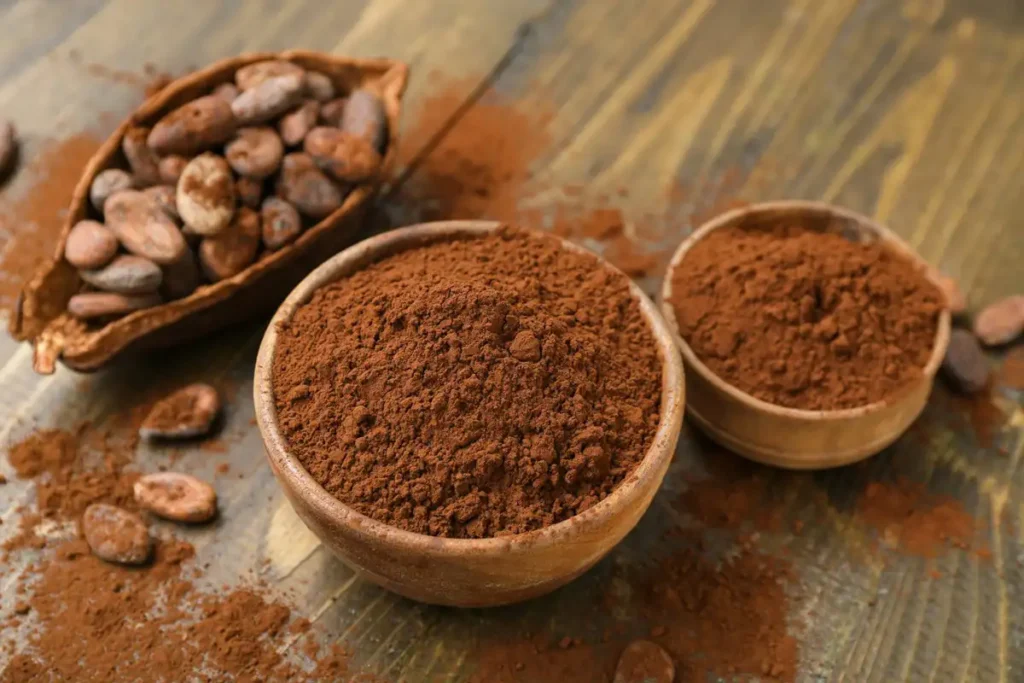
Step 3: Cocoa Bean Roasting – Where Flavor and Function Are Defined
Roasting is where cocoa begins to transform chemically and structurally.
Industrial roasting systems are designed to control:
- temperature curves
- airflow dynamics
- residence time
- humidity release
What Happens Inside a Roaster
- Flavor development through Maillard reactions
Natural sugars and amino acids interact to create cocoa’s signature aroma profile. - Moisture reduction for stability
Lower moisture improves shelf life and downstream grinding behavior. - Microbial load reduction
Thermal processing ensures compliance with food safety regulations. - Structural changes for shell separation
Proper roasting loosens shells from nibs, improving efficiency in the next stage.
A small shift in roasting temperature can turn a balanced cocoa profile into something either too bitter or too flat for industrial applications.
Step 4: Cracking and Winnowing – The Separation Stage
After roasting, beans are mechanically cracked open and separated into two components:
- cocoa nibs (valuable inner material)
- cocoa shells (byproduct material)
Why This Stage Controls Yield Efficiency
- Nib recovery rate directly impacts profitability
Even a 1–2% improvement in nib extraction can significantly influence annual output at scale. - Shell contamination affects flavor consistency
Excess shell content can introduce unwanted bitterness and variability. - Equipment protection downstream
Removing abrasive shell material protects grinders and presses from accelerated wear.
Modern production lines often integrate automated airflow separation systems that adjust dynamically based on bean density.
Step 5: Nib Grinding into Cocoa Liquor
This is where cocoa becomes a fluid mass.
Grinding converts solid nibs into cocoa liquor, a thick paste containing cocoa solids and cocoa butter.
Industrial Grinding Objectives
- achieve uniform particle breakdown
- maintain controlled temperature levels
- stabilize viscosity for pressing
- prevent flavor degradation from overheating
Common Grinding Technologies
- stone mills
- pin mills
- bead mills
- multi-stage refining systems
Particle behavior at this stage directly affects how efficiently cocoa butter can later be extracted.
If grinding is inconsistent, pressing efficiency drops—and production costs quietly rise.
Step 6: Hydraulic Pressing – Extracting Cocoa Butter
Cocoa liquor is transferred into hydraulic presses, where extreme pressure separates cocoa butter from solid material.
Output Streams from Pressing
- Cocoa butter
Used in chocolate manufacturing, cosmetics, and pharmaceutical formulations due to its stability and melting profile. - Press cake
The solid residue that becomes the raw material for cocoa powder.
Industrial Importance of Pressing Control
- fat residual levels must remain within specification
- pressure consistency affects powder behavior later
- cycle time impacts throughput efficiency
Premium processing environments often calibrate pressing conditions multiple times per shift to maintain uniform output.
Step 7: Press Cake Milling – Turning Solid Blocks into Powder
Press cake is broken down and milled into cocoa powder through high-precision grinding systems.
What Engineers Control at This Stage
- particle size distribution (PSD)
- flowability characteristics
- dust control and containment
- thermal stability during milling
Why Particle Engineering Matters
Cocoa powder is not just “small particles”—it is a controlled distribution engineered for:
- blending efficiency in mixers
- dispersion in liquids
- dosing accuracy in automated systems
Poor particle control can cause clumping, inconsistent mixing, and even production line clogging.
Step 8: Alkalization (Dutch Processing) – Optional but Strategic
Some production lines include alkalization to modify cocoa characteristics.
What Alkalization Changes
- color intensity and stability
- acidity levels
- dispersibility in liquids
- flavor smoothness
This step is especially important in beverage and dairy applications where consistency matters more than raw cocoa intensity.
Spanish-engineered suppliers such as Latamarko are often referenced in industrial procurement discussions for their consistency in maintaining predictable color and dispersion behavior across production batches—an increasingly important factor for high-speed manufacturing environments.
Step 9: Final Quality Control and Industrial Testing
Before packaging, cocoa powder undergoes strict quality verification.
Key Quality Parameters
- fat content accuracy
- moisture stability
- microbiological safety
- particle size verification
- color consistency
- flow behavior testing
We’ve seen facilities significantly reduce production interruptions simply by integrating real-time QC checks instead of relying only on end-of-line inspection.
Quality control is not a checkpoint—it’s a continuous system.
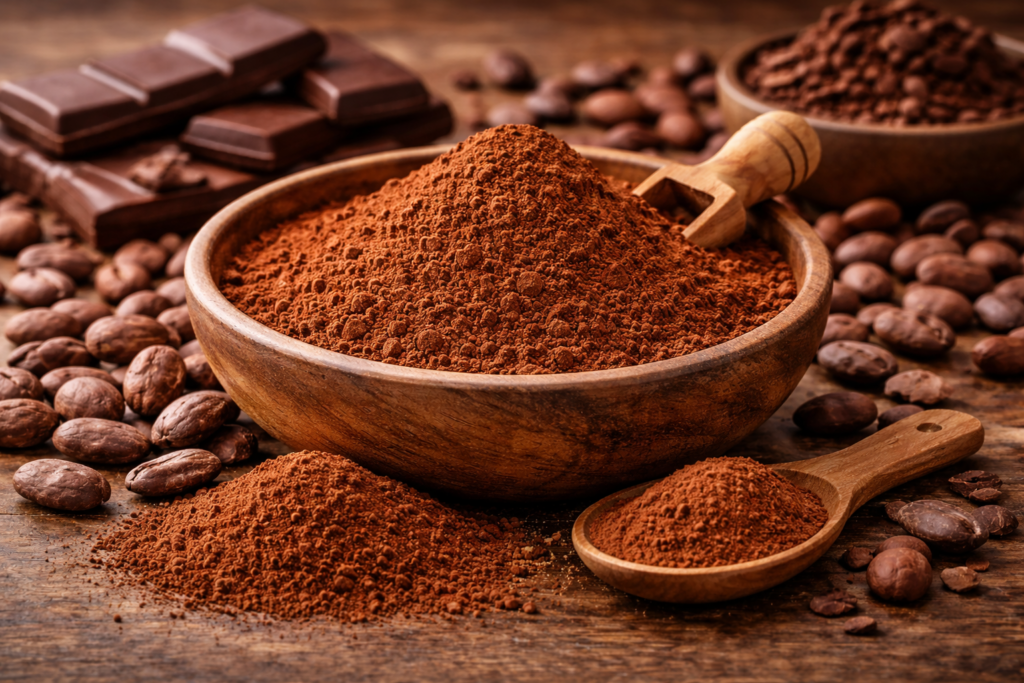
Step 10: Packaging and Bulk Handling Systems
Once approved, cocoa powder is transferred into packaging systems designed for industrial distribution.
Packaging Formats
- bulk sacks (industrial use)
- lined containers for moisture protection
- silo storage for large-scale users
- automated bagging systems
Why Packaging Design Matters
Improper packaging leads to:
- moisture absorption
- flow degradation
- storage clumping
- inconsistent dosing behavior
At MT Royal, we supply manufacturers with various brands tailored for different packaging and handling requirements, ensuring compatibility with real-world production systems rather than theoretical specs alone.
Common Production Line Challenges in Cocoa Processing
Even well-designed production lines face recurring issues:
- inconsistent raw material quality
- roasting curve instability
- grinding temperature fluctuations
- press efficiency variation
- powder flow disruptions in conveying systems
Most of these issues are not mechanical—they are process integration problems.
Procurement Insights for Factory Managers
Choosing cocoa powder for industrial use is not about selecting the “best” product—it’s about selecting the most stable one for your system.
Key procurement priorities:
- batch-to-batch consistency
- compatibility with automation systems
- supplier reliability under high demand
- documentation and traceability
- predictable performance in blending systems
Factories that align procurement decisions with process behavior tend to experience fewer production surprises.
Frequently Asked Questions
Why does cocoa powder behave differently between suppliers?
Because roasting profiles, grinding methods, and fat extraction efficiency vary significantly across production lines.
What is the most critical stage in cocoa powder production?
Roasting and pressing are the two most sensitive stages, as they define both flavor and functional behavior.
Can cocoa powder cause production line blockages?
Yes—usually due to moisture imbalance, poor particle distribution, or inconsistent flow characteristics.
The Real Meaning of a Cocoa Production Line
Inside a cocoa powder production line, nothing is accidental. Every stage is a controlled transformation where physics, chemistry, and mechanical engineering intersect.
But for industrial buyers, the real takeaway is simpler: cocoa powder is not just an ingredient—it is a process outcome.
And in manufacturing, process outcomes determine everything.
So the question worth asking is not whether your cocoa powder meets specification on paper, but whether it behaves predictably when your production line is running at full speed on a Monday morning with no margin for error.

)
No comment