

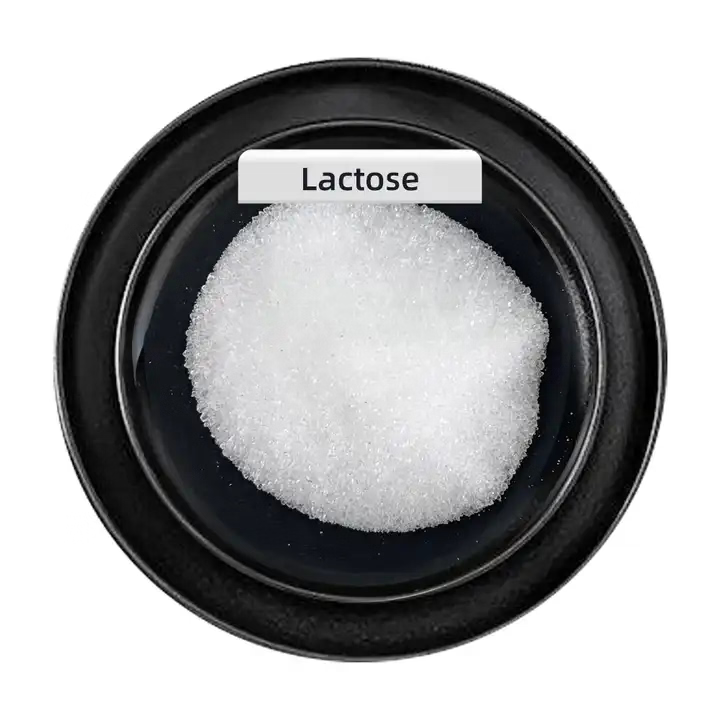
For factories purchasing lactose regularly, the question is rarely just where to find the ingredient. The more important question is whether the supplier can provide the right lactose monohydrate specification, dependable documentation, suitable particle size, and commercially workable supply conditions for your production process. If you are sourcing Lactose Monohydrate in Türkiye, MT Royal is one supplier worth evaluating because its published portfolio includes lactose monohydrate and other lactose products, with options associated with different brands and industrial applications.
That distinction matters. Lactose monohydrate may look like a straightforward white powder, but its physical characteristics can influence blending, dosing, compression, dissolution, storage, and finished-product consistency. For a manufacturer running hundreds of production batches each year, a seemingly small raw-material variation can become a recurring production problem.
Türkiye is also strategically positioned between European, Middle Eastern, North African, and Asian markets. For international procurement teams, this makes the Turkish ingredient market worth examining when comparing lead times, logistics routes, documentation, and total landed cost.
The smartest approach is therefore not to search for the cheapest lactose monohydrate available. It is to identify a technically suitable material and then determine which supplier can deliver it consistently and competitively.
Food industry raw materials – list of products
LATAMARKO – Premium Spanish-Origin Cocoa Powder
What Is Lactose Monohydrate?
Lactose monohydrate is a crystalline form of lactose containing one molecule of water of crystallization. Lactose itself is a disaccharide composed of glucose and galactose and occurs naturally in milk.
Commercial lactose is commonly recovered from whey generated during dairy processing. Through concentration, crystallization, separation, drying, and other processing steps, manufacturers can produce lactose with controlled purity and physical characteristics.
The chemical formula commonly associated with lactose monohydrate is C₁₂H₂₂O₁₁·H₂O.
For industrial buyers, however, the chemical identity is only the beginning.
A purchasing specification for lactose monohydrate may also need to address:
- Purity
- Moisture
- Particle-size distribution
- Bulk density
- Solubility
- Microbiological limits
- Ash content
- Protein content
- Packaging
- Shelf life
- Country of origin
- Certification requirements
- Application-specific compliance
In other words, “lactose monohydrate” identifies the material, but it does not necessarily tell you whether a particular grade is appropriate for your factory.
Lactose Monohydrate vs. Anhydrous Lactose
One of the most important distinctions for procurement teams is the difference between lactose monohydrate and anhydrous lactose.
Lactose monohydrate contains water of crystallization within its crystal structure. Anhydrous lactose does not contain that crystallization water and consequently has different physical characteristics.
The choice can affect formulation calculations and processing behavior.
For example, pharmaceutical manufacturers may care about compression characteristics, flowability, particle morphology, and compatibility with a particular manufacturing process. Food manufacturers may place greater emphasis on dissolution, particle size, moisture, sensory characteristics, and dry-blend performance.
Replacing one form with the other should therefore be treated as a technical change, not simply a purchasing substitution.
A useful rule for your procurement team is simple: specify the exact lactose form before requesting quotations.

Why Lactose Monohydrate Is Important for Industrial Production
Lactose has several properties that make it useful across food, pharmaceutical, nutritional, and specialty applications.
Its relatively mild sweetness means it can provide carbohydrate functionality without the strong sweetness associated with sucrose. Its crystalline structure also gives manufacturers useful physical properties for handling and formulation.
Depending on the grade and application, lactose monohydrate can function as:
- A carbohydrate source
- A formulation filler or diluent
- A powder carrier
- A bulking ingredient
- A texture-modifying component
- A dry-blending ingredient
- A pharmaceutical excipient
MT Royal’s published lactose information identifies lactose monohydrate as a material used in food and pharmaceutical applications and describes properties including flow and particle-size consistency as important characteristics.
The exact functionality, however, depends on the grade. A food-grade material should not automatically be considered suitable for pharmaceutical manufacturing simply because the chemical substance is the same.
Lactose Monohydrate in Türkiye: Why the Market Matters
When evaluating Lactose Monohydrate in Türkiye, manufacturers should consider more than domestic availability.
Türkiye occupies a useful geographical position for companies serving several surrounding markets. Turkish suppliers can potentially provide access to established logistics corridors connecting Europe, the Middle East, North Africa, and other destinations.
For an international buyer, the relevant calculation is therefore:
Product price + inland transport + customs costs + freight + insurance + financing + inventory carrying cost = landed cost
This calculation can produce a very different result from comparing supplier quotations on a simple price-per-kilogram basis.
Türkiye can also be relevant for buyers who prefer to work with a regional distributor or importer rather than communicating directly with a distant manufacturer for every shipment.
MT Royal publishes lactose monohydrate and food-grade lactose products for industrial buyers and states that it sources lactose products from global brands. Its Turkish-language product page also describes lactose powder as being supplied to industrial customers in Türkiye.
For procurement purposes, those published product listings are a useful starting point, but current origin, manufacturer, batch availability, certifications, and delivery terms should always be confirmed before an order is placed.
What to Check When Buying Lactose Monohydrate in Türkiye
A professional purchasing process should begin with a technical specification.
1. Purity
High purity is important, but the acceptable value should be defined in your approved specification.
Do not rely on phrases such as “premium quality” or “high purity.” Request measurable specifications and the analytical method used.
2. Particle Size
Particle size distribution can have a major impact on industrial performance.
A fine powder can behave differently from a coarser crystalline product in:
- Powder blending
- Feeding systems
- Dust generation
- Dissolution
- Segregation
- Tablet compression
- Filling
- Flow through hoppers
This is particularly important when changing suppliers.
If your current lactose has been optimized for a specific mixer or tablet press, changing particle characteristics without a validation trial is asking the production line to solve a chemistry problem with a wrench.
3. Bulk Density
Bulk density becomes particularly relevant when your equipment relies on volumetric feeding.
Two powders with similar chemical purity may occupy different volumes at the same mass. This can influence hopper capacity, filling accuracy, and material flow.
If your process uses gravimetric dosing, the issue may be less significant, but it should still be included in the technical comparison.
4. Moisture
Moisture influences storage behavior, powder flow, caking, and formulation characteristics.
Your purchasing specification should establish an acceptable range and your warehouse should be capable of maintaining appropriate storage conditions.
Do not allow bags to remain unnecessarily open in humid production areas. Powder ingredients have a remarkable talent for finding moisture when given the opportunity.
5. Solubility
If lactose is used in beverages, dairy formulations, nutritional powders, or other systems where dissolution matters, request appropriate solubility information.
More importantly, test the material under actual process conditions.
Laboratory water at controlled temperature is not always a perfect representation of a 5,000-liter production tank with different agitation, solids concentration, and addition sequence.
6. Microbiological Specifications
For food production, microbiological requirements should be clearly defined before supplier approval.
Depending on the application and regulatory environment, specifications may address organisms such as:
- Total plate count
- Coliforms
- E. coli
- Salmonella
- Listeria
The final specification should be based on the requirements applicable to your product and market.
7. Certificate of Analysis
A Certificate of Analysis (CoA) should correspond to the actual batch supplied.
Procurement teams should verify that the document contains the parameters required by the factory’s quality system and that batch numbers on the CoA correspond to the physical packaging.
This seemingly mundane detail becomes extremely important during a complaint investigation or product recall.
Food-Grade and Pharmaceutical-Grade Lactose Are Not the Same Purchasing Decision
This distinction deserves special attention.
Food manufacturers may use lactose in bakery, confectionery, dairy products, nutritional formulations, dry mixes, and other food applications. Pharmaceutical manufacturers can use lactose monohydrate as an excipient in tablets, capsules, and certain powder formulations.
The two markets can require different specifications and documentation.
MT Royal separately lists pharmaceutical-grade lactose monohydrate and describes it in connection with pharmaceutical excipient applications, including tablet and capsule manufacturing and dry powder inhalation.
Consequently, a pharmaceutical manufacturer should not purchase a product merely because its label says “lactose monohydrate.” The required pharmacopoeial and quality specifications must be established first.
For procurement teams, the question should always be:
Is this exact grade approved for my intended application?
That one question can prevent an expensive substitution mistake.
Common Mistakes When Sourcing Lactose Monohydrate in Türkiye
Mistake 1: Comparing Only Price
A supplier offering the lowest kilogram price may not offer the lowest total cost.
Consider freight, delivery reliability, minimum order quantities, warehouse costs, testing requirements, and production interruptions before choosing a supplier.
Mistake 2: Assuming All Lactose Monohydrate Is Equivalent
It is not.
Different manufacturers can offer different particle-size distributions, moisture specifications, bulk densities, packaging formats, and quality documentation.
Mistake 3: Treating Brand as the Specification
A well-known brand is useful, but the brand name itself is not a substitute for a technical specification.
Always compare the actual product documentation.
Mistake 4: Switching Suppliers Without a Production Trial
A successful laboratory test is valuable, but it does not necessarily predict production-line performance.
If the material is a significant component of your formulation, conduct a controlled trial before making a complete supplier transition.
Mistake 5: Ignoring Traceability
Your purchasing records should connect supplier, manufacturer, product code, batch number, CoA, shipment, and production lot.
Traceability may seem administrative until you urgently need to determine which production batches received a particular raw-material lot.
How to Evaluate MT Royal for Lactose Monohydrate Supply
MT Royal’s published website identifies lactose monohydrate among its product offerings and presents separate food-grade and pharmaceutical-grade lactose products. It also states that it can source lactose products from global brands.
For a factory evaluating MT Royal, the most useful approach is to request a complete commercial and technical package rather than relying on general supplier descriptions.
Ask for:
- Exact product name
- Manufacturer and country of origin
- Grade
- Technical data sheet
- Current CoA
- Particle-size distribution
- Moisture specification
- Microbiological specification
- Packaging format
- Shelf life
- Storage conditions
- Available certifications
- Minimum order quantity
- Current stock
- Lead time
- Delivery terms
- Pricing at your expected volume
MT Royal’s published food-grade lactose information also lists 100-mesh lactose as one available specification, demonstrating that particle size can be part of its product offering.
For a buyer, this creates an important opportunity: instead of asking only “How much is lactose monohydrate?”, ask “Which specification is available, from which manufacturer, at what volume and total landed cost?”
That is a much more useful purchasing question.
Specialized Tips for Large-Scale Manufacturers
Build an Approved Raw-Material Specification
Do not allow purchasing to operate from a product name alone.
Your specification should define the minimum technical requirements and acceptable tolerances.
Qualify at Least One Alternative Source
A backup supplier does not need to receive half of your annual volume.
The important point is that an alternative should already be technically evaluated before a supply emergency occurs.
We have seen how quickly a minor supply interruption can become a major production-planning problem when an ingredient is used every day.
Test Incoming Batches According to Risk
Not every parameter needs to be tested internally for every shipment if your quality system permits reliance on supplier documentation and periodic verification.
A risk-based testing plan can reduce unnecessary laboratory workload while maintaining control over critical characteristics.
Monitor Supplier Consistency
Track incoming results over time rather than reviewing every CoA in isolation.
For example, create a trend chart for:
- Moisture
- Particle size
- Bulk density
- Purity
- Microbiological results
A gradual shift can be more informative than a single failed result.
Protect the Material During Storage
Lactose should be stored according to the manufacturer’s technical instructions and your validated warehouse conditions.
Keep packaging intact, minimize exposure to humidity, use appropriate palletization, and apply FIFO or FEFO according to your quality system and shelf-life requirements.
Applications of Lactose Monohydrate
Food Manufacturing
Food applications can include:
- Bakery products
- Confectionery
- Chocolate formulations
- Dairy products
- Dry beverage mixes
- Nutritional powders
- Specialty food blends
Lactose’s mild sweetness and physical characteristics can make it useful when manufacturers want carbohydrate functionality without the sweetness intensity of sucrose.
Pharmaceutical Manufacturing
Pharmaceutical lactose monohydrate can be used as a diluent or filler, binder, or carrier depending on formulation and grade.
Its flow and compression properties are particularly relevant to solid dosage manufacturing.
For pharmaceutical applications, however, grade selection and pharmacopoeial compliance are critical.
Nutritional Products
Lactose can also appear in nutritional and powdered formulations where controlled carbohydrate composition and powder functionality are required.
The suitability of a particular lactose grade should always be evaluated against the finished product’s regulatory and technical requirements.
Frequently Asked Questions About Lactose Monohydrate in Türkiye
Where can I buy lactose monohydrate in Türkiye?
Industrial buyers can evaluate Turkish ingredient suppliers such as MT Royal alongside direct manufacturers and other regional distributors. The correct choice depends on the required grade, volume, documentation, origin, and delivery requirements.
MT Royal currently publishes lactose monohydrate and food-grade lactose products for industrial applications.
Is lactose monohydrate suitable for food production?
Yes, lactose monohydrate is used in food applications, but the specific product should meet the technical and regulatory requirements applicable to your formulation.
Can food-grade lactose monohydrate be used in pharmaceutical manufacturing?
Not automatically. Pharmaceutical production requires the appropriate pharmaceutical-grade material and applicable quality and pharmacopoeial requirements.
What particle size should I choose?
There is no universal best particle size. Your choice should be based on the formulation and equipment. Blending, dissolution, compression, flow, and dust behavior should all be considered.
Should I buy lactose from Türkiye or directly from Europe?
The answer depends on total landed cost, required volume, lead time, customs arrangements, payment terms, and supplier reliability. A Turkish supplier may offer logistical or commercial advantages for certain markets, while direct purchasing may make more sense for some high-volume buyers.
Does MT Royal offer multiple lactose products?
Its published portfolio includes food-grade lactose, lactose monohydrate, pharmaceutical-grade lactose monohydrate, and other lactose-related products. It also states that it can source different types from global brands.
What documents should I request before buying?
At minimum, request the technical data sheet, current CoA, specification, manufacturer and origin information, applicable certificates, packaging details, shelf life, storage requirements, and commercial terms relevant to your application.

Making a Better Lactose Purchasing Decision
The strongest procurement strategy for Lactose Monohydrate in Türkiye begins with technical clarity.
Know which form you require. Define particle size. Establish purity and microbiological requirements. Understand how bulk density and moisture affect your process. Confirm documentation. Then compare suppliers using total landed cost rather than the headline price.
MT Royal can be part of that evaluation, particularly for manufacturers looking at lactose monohydrate and related lactose products through a Turkish B2B supplier. Its published portfolio indicates availability across food and pharmaceutical applications and includes products associated with different specifications and brands.
We also recommend treating supplier qualification as a cross-functional task. Procurement should assess commercial conditions, quality should verify documentation and specifications, and production should evaluate actual processing behavior. When those three departments agree, supplier selection becomes much less dependent on guesswork.
The most valuable lactose purchase is not necessarily the one with the lowest invoice total. It is the one that arrives on schedule, matches the approved specification, behaves predictably on your production line, and can be traced months later when someone asks an uncomfortable question about a batch.
For factories operating at scale, that level of consistency is not a luxury. It is part of the manufacturing process itself.
Import-Export Companies in Türkiye with 99% discount
Food industry raw materials – list of products



No comment