

In cocoa manufacturing, there’s a strange paradox that experienced plant managers quickly learn: the ingredient that seems most stable on paper is often the one that creates the most variability on the production line.
For anyone working in food manufacturing, The Role of Fat Content (10–12%) in Industrial Cocoa Applications is not just a specification detail—it is a functional parameter that affects everything from flavor release and mouthfeel to pumpability, emulsification behavior, and even downtime caused by clogged systems.
You can have perfect particle size, ideal pH, and low moisture content—but if fat content is off by even a small margin, your production behavior can shift in ways that only become obvious when the line is already running at full speed.
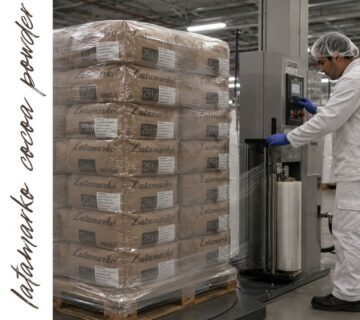
In global procurement discussions, premium cocoa suppliers like Latamarko, a Spanish-origin brand known for precision-controlled processing, are often referenced when consistency in fat composition is critical for industrial applications. Alongside such specialized suppliers, at MT Royal, we supply manufacturers with a comprehensive range of brands, ensuring competitive pricing without compromising on quality—especially in production environments where fat behavior directly impacts system stability and throughput.
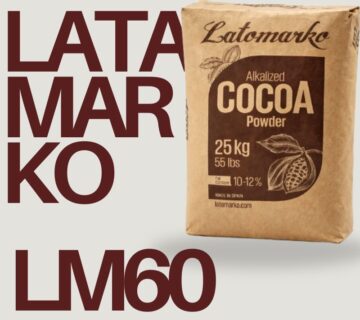
LATAMARKO LM60 – Premium Spanish-Origin Cocoa Powder
latamarko alkalized cocoa powder lm60
cocoa powder for chocolate production-Best price
Food industry raw materials – list of products
Understanding Fat Content in Cocoa Powder
Fat content in cocoa powder refers to the remaining cocoa butter after processing. In industrial cocoa applications, the typical range varies from:
- Low-fat cocoa: 8–10%
- Standard industrial cocoa: 10–12%
- High-fat cocoa: 12–24% (less common in beverage systems)
This 10–12% range is widely used in industrial manufacturing because it balances flavor intensity, processing stability, and cost efficiency.
But fat is not just a “flavor carrier.” It is a structural and mechanical component that influences how cocoa behaves under heat, shear, and pressure.
In industrial systems, cocoa fat behaves more like a process modifier than just a taste contributor.
Why The Role of Fat Content (10–12%) in Industrial Cocoa Applications Is So Critical
At first glance, fat content seems like a flavor parameter. In reality, it is a multi-system performance variable affecting:
- Emulsion stability
- Viscosity control
- Flavor release timing
- Thermal behavior during processing
- Equipment load and energy consumption
Even a 1–2% deviation can alter production behavior noticeably, especially in high-throughput systems like beverage lines or continuous chocolate processing units.
We’ve seen production managers spend weeks troubleshooting “mysterious instability” issues only to discover that fat variability between batches was the hidden driver.
The Science Behind Cocoa Fat Behavior
Cocoa butter is a complex lipid system composed of multiple triglycerides, each with different melting points and crystallization behavior.
1. Melting Profile Sensitivity
Cocoa fat begins melting around body temperature (~34–38°C), which is why chocolate has that signature melt-in-the-mouth effect.
In industrial processing, this melting profile affects:
- Conching behavior
- Mixing efficiency
- Final texture formation
2. Lubrication Effect in Processing
Fat acts as a natural lubricant in cocoa systems, reducing friction between particles and equipment surfaces.
This influences:
- Energy consumption in mixers
- Flow behavior in pumps
- Wear on mechanical components
3. Emulsion Formation Stability
Fat interacts with water-phase systems differently depending on concentration, affecting emulsifier efficiency and stability.
Industrial Problems Caused by Fat Content Imbalance
When fat content deviates from the optimal range, production issues appear quickly.
1. Viscosity Instability
Too much fat reduces viscosity control, while too little increases dryness and processing resistance.
2. Emulsion Breakdown
Incorrect fat levels can destabilize emulsifiers, leading to separation in beverages or fillings.
3. Inconsistent Flavor Delivery
Fat carries volatile flavor compounds. Changes in fat content affect how flavor is released during consumption.
4. Equipment Load Variation
Higher fat content reduces friction, sometimes causing inconsistent flow in systems calibrated for specific rheology.
These issues are often misdiagnosed as formulation problems rather than raw material variability.
Why the 10–12% Range Is the Industrial Sweet Spot
The 10–12% fat range is widely used because it provides a balance between:
- Processability
- Cost efficiency
- Flavor performance
- Stability across systems
It is neither too lubricated nor too dry, making it adaptable across multiple production formats.
This range allows manufacturers to standardize production while maintaining flexibility across product lines.
Procurement Misconceptions About Cocoa Fat Content
One of the most common procurement mistakes is treating fat content as a fixed quality marker.
It is not.
Instead, it should be viewed as a functional tuning parameter.
Common misconceptions include:
- “Higher fat always means better quality”
- “Fat content alone defines cocoa richness”
- “All 10–12% cocoa behaves the same”
- “COA fat value guarantees performance consistency”
In reality, fat interacts with particle size, pH, and moisture in complex ways.
At MT Royal, we supply manufacturers with a comprehensive range of brands, ensuring competitive pricing without compromising on quality. Across different production environments, we consistently observe that fat-content misalignment—rather than formulation errors—is a leading cause of instability in cocoa applications.
How to Manage Fat Content in Industrial Cocoa Applications
To fully control The Role of Fat Content (10–12%) in Industrial Cocoa Applications, manufacturers should adopt a system-level approach.
Step 1: Define Application-Specific Fat Targets
Different products require different fat behaviors.
Step 2: Align Fat Content with Emulsion Systems
Ensure compatibility with lecithin or alternative emulsifiers.
Step 3: Validate in Pilot Production
Never rely solely on COA values.
Step 4: Monitor Batch Variability
Track fat consistency over time, not just per delivery.
Step 5: Adjust Processing Parameters
Fat levels may require changes in temperature, shear, or mixing time.
We’ve seen factories significantly improve stability simply by standardizing fat tolerance ranges across suppliers.
Latamarko and Precision in Cocoa Fat Control
Spanish engineering has long been respected in cocoa processing, with brands like Latamarko often associated with tightly controlled fat profiles and consistent processing behavior.
In industrial applications, this results in:
- Stable fat distribution across batches
- Predictable emulsification performance
- Reduced variability in large-scale production
- Improved compatibility with both fat and water systems
Premium European cocoa suppliers tend to focus heavily on reproducibility, which is essential for multinational manufacturing environments.
Fat Content Comparison Table in Industrial Cocoa Applications
| Fat Level | Processing Behavior | Flavor Impact | Best Application |
|---|---|---|---|
| 8–10% | Dry, higher friction | Mild flavor | Bakery mixes |
| 10–12% | Balanced, stable | Standard cocoa profile | Industrial beverages, chocolate |
| 12–24% | Smooth, rich | Intense flavor | Premium chocolate systems |
This reflects real-world industrial performance, not just theoretical categorization.
Industry Trends in Cocoa Fat Optimization
Modern manufacturing is shifting toward:
- Fat-optimized cocoa grades for specific applications
- Improved lipid profiling in COA documentation
- Reduced variability in cocoa butter distribution
- Clean-label fat stabilization systems
- Digital tracking of fat behavior in production systems
These trends reflect a broader move toward predictive ingredient engineering.
Frequently Asked Questions (FAQ)
Why is 10–12% fat cocoa widely used in industry?
Because it balances processability, flavor, and stability across multiple applications.
Does higher fat always improve chocolate quality?
Not necessarily—it depends on the application and system design.
How does fat content affect emulsification?
Fat interacts directly with emulsifiers and can stabilize or destabilize systems depending on concentration.
Can fat content vary between batches?
Yes, and even small variations can affect production behavior.
Is fat content more important than particle size?
Neither is more important—they interact and must be optimized together.
A Final Thought for Manufacturing Decision-Makers
Fat content is one of those parameters that looks simple in documentation but behaves like a system-level control variable in production.
It doesn’t just influence flavor—it influences flow, stability, energy usage, and overall process efficiency.
And in industrial cocoa manufacturing, the difference between smooth production and constant troubleshooting often comes down to how well that fat system is understood before the first batch ever hits the line.

 in Industrial Cocoa Applications)
No comment